
BuddhistCatholicContemplativeEvangelicalGeneral ChristianHinduJewishLatter-day SaintMuslimNew VisionsProgressive Christian
Beliefs
- Buddhist
- Catholic
- Contemplative
- Evangelical
- General Christian
- Hindu
- Jewish
- Latter-day Saint
- More Voices
- Muslim
- New Visions
- Pagan
- Progressive Christian
Topics
- Religion News
- Food and Religion
- Sports and Religion
- Religious Art
- Religious Music and Entertainment
- Religious Events
- History and Religion
- Style and Religion
- Politics and Religion
- Women in Religion
- Recreation Outdoors and Religion
- Business Finance and Religion
- Careers Workplace and Religion
- Education and Religion
- Family Parenting and Religion
- Health Fitness and Religion
- Home and Religion
- Relationships and Religion
- Technology and Religion
- Travel and Religion
Columnists
- Buddhist Columnists
- Business Finance and Religion Columnists
- Careers Workplace and Religion Columnists
- Catholic Columnists
- Contemplative Columnists
- Education and Religion Columnists
- Evangelists Columnists
- Family Parenting and Religion Columnists
- General Christian Columnists
- Health Fitness and Religion Columnists
- Hindu Columnists
- History and Religion Columnists
- Home and Religion Columnists
- Jewish Columnists
- More Voices Columnists
- Latter Day Columnists
- Muslim Columnists
- New Visions Columnists
- Nonreligious Columnists
- Pagan Columnists
- Politics and Religion Columnists
- Progressive Columnists
- Recreation Outdoors and Religion Columnists
- Relationships and Religion Columnists
- Religion News Columnists
- Religious Art Columnists
- Religious Events Columnists
- Religious Music and Entertainment Columnists
- Sports and Religion Columnists
- Style and Religion Columnists
- Technology and Religion Columnists
- Travel and Religion Columnists
- Women in Religion Columnists
Resource Library
- 2026 Calendar
- Library of World Religions
- The 100 Most Holy Places on Earth
- Patheos Answers
- Podcasts
- Videos
- Faith Leaders Database
- Anglican Episcopalian
- Bahai
- Baptist
- Buddhism
- Christianity
- Confucianism
- Eastern Orthodoxy
- Hinduism
- Holiness and Pentecostal
- ISKCON
- Islam
- Judaism
- Lutheran
- Methodist
- The Church of Jesus Christ of Latter-day Saints
- New Age
- Paganism
- Presbytarian and Reformed
- Protestantism
- Religion Behind the Scenes
- Roman Catholic
- Scientology
- Shia Islam
- Sikhism
- Sufism
- Sunni Islam
- Taoism
- Zen
- See all religions
Research Tools
 Ad-Free & Subscriber Log-In Subscription Support
Ad-Free & Subscriber Log-In Subscription Support
Follow Patheos 

- Trending:
- Forgiveness
- |
- Marriage
- |
- Consciousness
- |
- Death Penalty
- |
- Election
- |
- Halloween
 Biblical Words and World
- Home
- Evangelical
- Thief or Terrorist: What Kind of Criminal Was Crucified With Jesus?
Thief or Terrorist: What Kind of Criminal Was Crucified With Jesus?
Last updated on: March 22, 2018 at 5:30 am by Tom Hobson
Thief or Terrorist: What Kind of Criminal Was Crucified With Jesus? 2018-03-22T05:26:54-05:00 Tom Hobson
Patheos Explore the world's faith through different perspectives on religion and spirituality! Patheos has the views of the prevalent religions and spiritualities of the world.
“Thief” is too mild a word in the verse where we are told that Jesus was “crucified between two thieves” (Matthew 27:38). The same is true in John 18:40, where we are told, “Now Barabbas was a robber.” The language is too mild. Not even “bandit” has enough kick to translate the word lēstēs. Barabbas and his buddies who were crucified with Jesus would be better described as revolutionaries, guerillas, pirates (the landlubber variety), or (to use a modern term) “terrorists.”
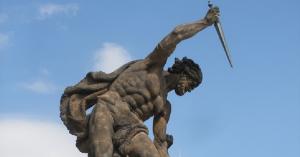
“Die, die, die!” Photo by Anders Sandberg. Creative Commons BY-2.0 via Flickr, cropped.
The difference becomes clear when we look at the alternative Greek terms. Kleptēs is the term for a burglar, someone who steals by being sneaky (Matthew 6:19-20). Jesus compares his coming to being like a kleptēs in the night (Matthew 24:43, Revelation 3:3, 16:15). Likewise, the New Testament compares the day of the Lord to such a thief (1 Thessalonians 5:2-4, 2 Peter 3:10).
Paul’s sin list in 1 Corinthians 6:10 includes not only kleptai, but also harpages. A harpax is a literally a “snatcher,” a mugger, someone who steals openly by force. The verb form is “to snatch,” the same verb Paul uses for the Rapture in 1 Thessalonians 4:17 (harpagēsometha, “we shall be snatched up”).
Our daughter describes the three Greek terms for thief as “sneaky, grabby, and stabby.” “Sneaky” is the kleptēs. “Grabby” is the harpax. Now, it’s time for the “stabby.”
We might call the lēstēs a harpax on steroids. Today’s ISIS fighters would be an excellent example, who combine robbery, pillaging, and murder with political revolution. Josephus uses lēstēs and its related adjectives and substantives 143 times. He pairs the lēstai together with the stasiōdes (insurrectionists, as in for example Jewish War 5.53). He explicitly describes as lēstai the Sicarii, men who circulated in the 50’s AD with short hidden daggers which they used to assassinate anyone who was not part of the anti-Roman resistance (literal “cloak-and-dagger!” See http://www.ancient-origins.net/history-important-events/sicarii-jewish-daggermen-thirst-roman-blood-008179). Josephus also speaks of the rebels who tyrannized Jerusalem through the horrors of 68-70 AD as lēstai. He uses the term lēstrikos polemos for “guerilla warfare” (Jewish War 2.65).
In the parable of the Good Samaritan in Luke 10:30, the traveler to Jericho is attacked by lēstai. The attackers not only strip him (the robbery component), but also beat him and leave him half-dead. There is no political revolution component (of course, Jesus probably intends the story as fiction), but here it is the gratuitous violence that marks the attackers as lēstai and not simply harpages or “snatchers.”
Two lēstai were crucified with Jesus. Barabbas (John 18:40) would have been the third, if he had not been freed by the Good Friday mob. Barabbas was being held for insurrection and murder (Luke 23:19), not stealing. We must note that neither Jewish nor Roman law prescribed the death penalty for mere theft. These men next to Jesus at Calvary were not being crucified for stealing, but for being violent revolutionaries.
It was a death so hideous, that both Gnosticism and Islam tried to wiggle out of the scandal thereof by claiming that God engineered a substitute for the real Jesus. For Gnosticism, they needed a substitute for the physical pain. For Islam, they needed a substitute for God’s prophet to avoid the ultimate injustice.
Nice try, but it flies in the face of honest history. Who was there on the ground who was in a position to take Jesus’ place, or to make it happen? Simon of Cyrene could be commandeered to carry the cross, but none of those who were carrying out the crucifixion would have allowed a substitute for the victim.
The scandal was unavoidable. It was part of the total price Jesus paid for the sins of an entire planet. The physical and emotional pain was bad enough. Cicero calls the cross crudelissimi taeterrimique (the “most cruel and terror-inspiring” penalty), while Origen calls it turpissima “(most obscene”). But the real pain was the penalty of hell placed on him for every one of us that was squeezed into those few hours of earthly time.
How degrading, for Jesus to suffer Rome’s most hideous punishment with such dangerous, violent men! Here we have a vivid picture of the depths to which Jesus humbled himself (Philippians 2:8), from whence God highly exalted him, and gave him the name at which every knee shall bow. Let us ponder the humiliation Jesus suffered by being crucified between two terrorists, as we commemorate Good Friday and celebrate Resurrection Sunday.
Previous Post

March 19, 2018
Puzzles in the Trial of Jesus
Next Post
March 26, 2018 Anti Ain't the Word We Thought It Was
Browse Our Archives
Select a Category Biblical ethic Biblical word studies Biblical world Creation Historical Jesus Uncategorized
Select a Month July 2018 June 2018 May 2018 April 2018 March 2018 February 2018 January 2018 December 2017 November 2017 October 2017 September 2017 August 2017 July 2017
Follow Us!
TAKE THE
Religious Wisdom Quiz
What was the name of the disciple in Damascus who was sent to pray for Saul after his conversion?
Select your answer to see how you score.
Philip Silas Barnabas Ananias
Books by This Author Books by Tom Hobson
Related posts from Biblical Words and World

Words I Never Heard in the Bible

Musonius Rufus, Women's Equality, and the New Testament


TRENDING AT PATHEOS Evangelical

How the author of the world's best hymn...
I've been working with John Newton for a while now. This makes...

Long before this Lectio Divina, Psalm 130 - the song - started...

What About the Trees? Another Living Parable
After I finished writing the last article about falling leaves as a...

Why Classical Education Is a Conversation, Not a...
Come and Read: Joy in Classical Education When I was a little...

Falling Leaves: A Living Parable on Letting Go
I’ve spent the vast majority of my life in the southeast corner...

Cornell University has received a great deal of negative publicity and intense...
view all Evangelical blogs
Ad-Free & Subscriber Log-In Subscription Support
- About Us
- 2026 Calendar
- Videos
- Podcasts
- Library of World Religions
- Faith In Media Tracker
- Advertise With Us
- Write for Us
- Privacy Policy
- Terms of Service
- Do Not Sell My Data
- Contact Us
- Radiant Digital
- Manage Newsletter Subscriptions
- Unsubscribe From Notifications
- Sitemap
Copyright 2008-2026, Patheos. All rights reserved.
Subscription Support Ad-Free & Subscriber Log-In
Follow Patheos