
BuddhistCatholicContemplativeEvangelicalGeneral ChristianHinduJewishLatter-day SaintMuslimNew VisionsProgressive Christian
Beliefs
- Buddhist
- Catholic
- Contemplative
- Evangelical
- General Christian
- Hindu
- Jewish
- Latter-day Saint
- More Voices
- Muslim
- New Visions
- Pagan
- Progressive Christian
Topics
- Religion News
- Food and Religion
- Sports and Religion
- Religious Art
- Religious Music and Entertainment
- Religious Events
- History and Religion
- Style and Religion
- Politics and Religion
- Women in Religion
- Recreation Outdoors and Religion
- Business Finance and Religion
- Careers Workplace and Religion
- Education and Religion
- Family Parenting and Religion
- Health Fitness and Religion
- Home and Religion
- Relationships and Religion
- Technology and Religion
- Travel and Religion
Columnists
- Buddhist Columnists
- Business Finance and Religion Columnists
- Careers Workplace and Religion Columnists
- Catholic Columnists
- Contemplative Columnists
- Education and Religion Columnists
- Evangelists Columnists
- Family Parenting and Religion Columnists
- General Christian Columnists
- Health Fitness and Religion Columnists
- Hindu Columnists
- History and Religion Columnists
- Home and Religion Columnists
- Jewish Columnists
- More Voices Columnists
- Latter Day Columnists
- Muslim Columnists
- New Visions Columnists
- Nonreligious Columnists
- Pagan Columnists
- Politics and Religion Columnists
- Progressive Columnists
- Recreation Outdoors and Religion Columnists
- Relationships and Religion Columnists
- Religion News Columnists
- Religious Art Columnists
- Religious Events Columnists
- Religious Music and Entertainment Columnists
- Sports and Religion Columnists
- Style and Religion Columnists
- Technology and Religion Columnists
- Travel and Religion Columnists
- Women in Religion Columnists
Resource Library
- 2026 Calendar
- Library of World Religions
- The 100 Most Holy Places on Earth
- Patheos Answers
- Podcasts
- Videos
- Faith Leaders Database
- Anglican Episcopalian
- Bahai
- Baptist
- Buddhism
- Christianity
- Confucianism
- Eastern Orthodoxy
- Hinduism
- Holiness and Pentecostal
- ISKCON
- Islam
- Judaism
- Lutheran
- Methodist
- The Church of Jesus Christ of Latter-day Saints
- New Age
- Paganism
- Presbytarian and Reformed
- Protestantism
- Religion Behind the Scenes
- Roman Catholic
- Scientology
- Shia Islam
- Sikhism
- Sufism
- Sunni Islam
- Taoism
- Zen
- See all religions
Research Tools
 Ad-Free & Subscriber Log-In Subscription Support
Ad-Free & Subscriber Log-In Subscription Support
Follow Patheos 

- Trending:
- Forgiveness
- |
- Marriage
- |
- Consciousness
- |
- Death Penalty
- |
- Election
- |
- Halloween
 Biblical Words and World
- Home
- Evangelical
- The Bedrock for What We Believe: Jesus’ Resurrection
The Bedrock for What We Believe: Jesus’ Resurrection
Last updated on: March 30, 2018 at 7:26 am by Tom Hobson
The Bedrock for What We Believe: Jesus’ Resurrection 2018-03-30T07:26:14-05:00 Tom Hobson
Patheos Explore the world's faith through different perspectives on religion and spirituality! Patheos has the views of the prevalent religions and spiritualities of the world.
We find the bedrock for what we believe inside the Church of the Holy Sepulcher in Jerusalem. It is the site of an event so huge that it turned the universe upside down: the resurrection of Jesus of Nazareth in the year 30 AD.
I’ve been there, years ago, but all I saw back then was the tourist level. But in the fall of 2016, archaeologists dug down below the tourist level. They first went thru a level of rubble. Underneath that level, they found a marble slab with a cross on it, laid by the Crusaders. Underneath that slab, they found bedrock, the place where Jesus’ body was laid: the place where the Lord of the universe rose from the dead. (See https://news.nationalgeographic.com/2016/10/jesus-tomb-opened-church-holy-sepulchre/.)
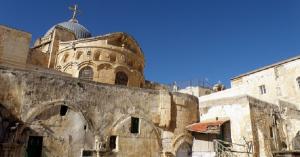
The Church of the Holy Sepulchre in Jerusalem, the bedrock where the crucified Jesus was laid, from which he rose from the dead. Photo by Ron Almog. Attribution 2.0 Generic (CC BY 2.0), via Flickr.
The empty tomb, followed by the appearances of the risen Jesus, becomes the bedrock for what we believe.
Now, how do we know that this is the place? When I first went to Israel, I believed that the so-called Garden Tomb next to Gordon’s Calvary was the site of the Empty Tomb. But then I realized that if the Holy Sepulcher church was not the right place, then the early church forgot where the Empty Tomb was, less than 100 years after it happened.
One hundred years after Easter, the emperor Hadrian built a pagan temple over a Jewish tomb that had become a holy site. What other Jewish tomb would qualify to become such a holy site? In the recent dig, stones from Hadrian’s pagan temple were found. Here in the early 300’s is where believers build the church to mark the spot where Jesus died for us and rose. They cut off the top of the tomb, to make it easy to see that the tomb was empty. The church was bulldozed during the Crusades and rebuilt. A lot has changed, but we cannot forget the place where it all happened.
Jesus’ resurrection is the bedrock for our faith. It is the rock that cannot be shaken, the fact that refuses to go away. Without Jesus’ resurrection, we have no basis on which to claim that our pet fairy tale is truer than anyone else’s pet fairy tale. What really happened on that day in that tomb almost 20 centuries ago makes a world of difference to us today.
Historians tend to be allergic to any claims about supernatural events. But how else is God going to invade history (if that ever happens)? And is it scientific or logical to rule an event out of bounds just because it’s never happened before? It’s better to ask, “What’s the evidence?”
Jesus scholars have developed criteria of authenticity to identify points of historical bedrock in the Gospels. There is some material in the Gospels that we have to take on faith. But whenever we have multiple independent witnesses, whenever we find details that are highly unlikely to have been invented, and whenever the event helps explain other facts that are beyond dispute, there’s where we can be even more confident that here we have the historical Jesus.
All of these criteria kick in to confirm Jesus’ resurrection. We have multiple independent witnesses, including Paul, the earliest (55 AD). We have details that the church would never have invented: the cowardice of the disciples, women as the earliest witnesses, and a Supreme Court justice (Joseph of Arimathea) from a town we’ve never heard of before, who asks for the body of Jesus and buries it in his own unused tomb, which guarantees that there will be no mistake about where he has been placed.
Plus, the resurrection becomes the best explanation for some hard-to-explain facts. How do we explain how men who were so scared they ran away from their Master, turned into men who would take a bullet for him? How do we explain how, the closer we get to the scene of the “crime,” skepticism shrinks and faith grows? That’s not how it works with myths, which arise far away, more than 100 years after the fact. How do we explain the survival of the church? Death of the leader put an end to all other Messianic movements back then. Michael Licona observes that the Church survived with none of the advantages of Buddha, Confucius, or Mohammed.
British scholar N. T. Wright says it’s highly unlikely that the resurrection accounts were invented. He points out that while the Gospels quote prophecy constantly in the crucifixion accounts, they don’t quote the Bible in their resurrection accounts, nor do they cite the resurrection as a reason for personal hope. He says the resurrection narratives read like accounts of an unexpected event that no one knows how to explain.
Wright believes there’s no other way we can explain the quick, radical reshaping of the Jewish hope of resurrection. Never before had anyone predicted that one person would rise from the dead long before everyone else. And for early Christians to say that Jesus was raised from the dead in a non-bodily sense, he says, would have been “historically impossible.”
We’ll look at some of the strongest objections to Jesus’ resurrection in my next post.
Previous Post
March 27, 2018
Showdown in the Garden of Gethsemane
Next Post

April 2, 2018 Cross-Examining the Bedrock for What We Believe
Browse Our Archives
Select a Category Biblical ethic Biblical word studies Biblical world Creation Historical Jesus Uncategorized
Select a Month July 2018 June 2018 May 2018 April 2018 March 2018 February 2018 January 2018 December 2017 November 2017 October 2017 September 2017 August 2017 July 2017
Follow Us!
TAKE THE
Religious Wisdom Quiz
What covered the sky during Jesus’ crucifixion?
Select your answer to see how you score.
Fire Clouds Darkness Rain
Books by This Author Books by Tom Hobson
Related posts from Biblical Words and World
How Much Did Paul Get from Jesus?

Jesus' Ascension: What Difference Does It Make?
Who Do the Polls Say That I Am?
Jesus as World Champion Exorcist, Part Two
TRENDING AT PATHEOS Evangelical

How the author of the world's best hymn...
I've been working with John Newton for a while now. This makes...

Long before this Lectio Divina, Psalm 130 - the song - started...

What About the Trees? Another Living Parable
After I finished writing the last article about falling leaves as a...

Why Classical Education Is a Conversation, Not a...
Come and Read: Joy in Classical Education When I was a little...

Falling Leaves: A Living Parable on Letting Go
I’ve spent the vast majority of my life in the southeast corner...

Cornell University has received a great deal of negative publicity and intense...
view all Evangelical blogs
Ad-Free & Subscriber Log-In Subscription Support
- About Us
- 2026 Calendar
- Videos
- Podcasts
- Library of World Religions
- Faith In Media Tracker
- Advertise With Us
- Write for Us
- Privacy Policy
- Terms of Service
- Do Not Sell My Data
- Contact Us
- Radiant Digital
- Manage Newsletter Subscriptions
- Unsubscribe From Notifications
- Sitemap
Copyright 2008-2026, Patheos. All rights reserved.
Subscription Support Ad-Free & Subscriber Log-In
Follow Patheos