
BuddhistCatholicContemplativeEvangelicalGeneral ChristianHinduJewishLatter-day SaintMuslimNew VisionsProgressive Christian
Beliefs
- Buddhist
- Catholic
- Contemplative
- Evangelical
- General Christian
- Hindu
- Jewish
- Latter-day Saint
- More Voices
- Muslim
- New Visions
- Pagan
- Progressive Christian
Topics
- Religion News
- Food and Religion
- Sports and Religion
- Religious Art
- Religious Music and Entertainment
- Religious Events
- History and Religion
- Style and Religion
- Politics and Religion
- Women in Religion
- Recreation Outdoors and Religion
- Business Finance and Religion
- Careers Workplace and Religion
- Education and Religion
- Family Parenting and Religion
- Health Fitness and Religion
- Home and Religion
- Relationships and Religion
- Technology and Religion
- Travel and Religion
Columnists
- Buddhist Columnists
- Business Finance and Religion Columnists
- Careers Workplace and Religion Columnists
- Catholic Columnists
- Contemplative Columnists
- Education and Religion Columnists
- Evangelists Columnists
- Family Parenting and Religion Columnists
- General Christian Columnists
- Health Fitness and Religion Columnists
- Hindu Columnists
- History and Religion Columnists
- Home and Religion Columnists
- Jewish Columnists
- More Voices Columnists
- Latter Day Columnists
- Muslim Columnists
- New Visions Columnists
- Nonreligious Columnists
- Pagan Columnists
- Politics and Religion Columnists
- Progressive Columnists
- Recreation Outdoors and Religion Columnists
- Relationships and Religion Columnists
- Religion News Columnists
- Religious Art Columnists
- Religious Events Columnists
- Religious Music and Entertainment Columnists
- Sports and Religion Columnists
- Style and Religion Columnists
- Technology and Religion Columnists
- Travel and Religion Columnists
- Women in Religion Columnists
Resource Library
- 2026 Calendar
- Library of World Religions
- The 100 Most Holy Places on Earth
- Patheos Answers
- Podcasts
- Videos
- Faith Leaders Database
- Anglican Episcopalian
- Bahai
- Baptist
- Buddhism
- Christianity
- Confucianism
- Eastern Orthodoxy
- Hinduism
- Holiness and Pentecostal
- ISKCON
- Islam
- Judaism
- Lutheran
- Methodist
- The Church of Jesus Christ of Latter-day Saints
- New Age
- Paganism
- Presbytarian and Reformed
- Protestantism
- Religion Behind the Scenes
- Roman Catholic
- Scientology
- Shia Islam
- Sikhism
- Sufism
- Sunni Islam
- Taoism
- Zen
- See all religions
Research Tools
 Ad-Free & Subscriber Log-In Subscription Support
Ad-Free & Subscriber Log-In Subscription Support
Follow Patheos 

- Trending:
- Forgiveness
- |
- Marriage
- |
- Consciousness
- |
- Death Penalty
- |
- Election
- |
- Halloween
 Biblical Words and World
- Home
- Evangelical
- Puzzles in the Trial of Jesus
Puzzles in the Trial of Jesus
Last updated on: March 19, 2018 at 5:30 am by Tom Hobson
Puzzles in the Trial of Jesus 2018-03-17T11:31:39-05:00 Tom Hobson
Patheos Explore the world's faith through different perspectives on religion and spirituality! Patheos has the views of the prevalent religions and spiritualities of the world.
Two major puzzles about the trial of Jesus deserve answers. First, on which day of the week did it happen? Second, how do we explain how his trial breaks all the rules for a Jewish trial? We will not tackle the puzzle of what year it all happened. There are two well-defended possibilities for a year where Nisan 14 falls on a Friday: 30 AD and 33 AD. Neither date creates any difficulties for the accuracy of the Bible. The other two puzzles do raise difficulties that deserve answers.
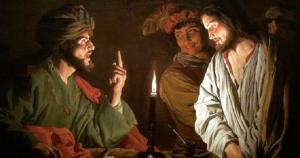
Matthias Stom (1615-1649), “Christ Before Caiaphas.” Public Domain, via Wikimedia Commons.
Mark says it is the date when they “were sacrificing the Passover” (Mark 14:12), which makes it clear that the Last Supper is a Passover meal. John, however, has the Passover lambs being killed the next day while Jesus is dying on the cross. In John, the chief priests won’t enter Pilate’s house because they want to eat the Passover (John 18:28), and John says it’s the Day of Preparation (John 19:14). All four Gospels agree that the crucifixion happens on Friday, because the Sabbath begins as soon as they bury Jesus.
Which of these versions is correct? Is John changing the story to portray Jesus as the Lamb of God who is being sacrificed while the Passover lambs are being slain? Are the Synoptic Gospels altering the facts? Or is there a better solution that accounts for all the data without calling either version into question? (The best solution to a puzzle is the one that uses all the pieces.)
The solution seems to be that not all Jews were reading the calendar the same way. It appears that the Pharisees would start their month a day early if necessary in order to keep Passover from falling on a Sabbath. If this is true, then the Synoptics (and Jesus!) are following the Pharisees’ calendar for celebrating Passover, while John is following the Sadducees. You ask, if the Sadducees ran the Temple, how did the Pharisees get their lambs sacrificed a day early? Answer: The Pharisees called them “peace offerings. “
In his book The Eucharistic Words of Jesus, Joachim Jeremias gives fourteen pieces of evidence why the Last Supper must have been a Passover meal. Several of these are particularly noteworthy. Even though Jesus was staying in Bethany, the meal had to be eaten in Jerusalem (why else would Jesus go to the trouble to book a room there?). Passover was eaten at night. The order of events at the Last Supper fits a Passover meal, although it is hard to be sure exactly how Passover was done before 70 AD. Jesus also interprets elements of the meal, which was only done in Passover meals. Also, the meal was concluded with singing. (Jeremias doesn’t list the dipping of the bread. This would be the bitter herbs.)
If this was not a Passover, it would be easy to mistake it for one. The only detail left up in the air is why there is no lamb mentioned. Ethelbert Stauffer cites evidence that heretics were not allowed to eat the lamb, although they could eat the bread and herbs.
As for the Jewish trial of Jesus: The Mishnah requires a capital trial to be held in the daytime (Sanhedrin 4:1). It cannot be held on a Sabbath or feast day (Sanhedrin 4:1). No guilty verdict can be issued on the same day as a trial (Sanhedrin 4:1). Trials should begin with witnesses for the accused (Sanhedrin 4:1). Blasphemy requires use of the divine name (Sanhedrin 7:5). And a trial should not be held in the high priest’s house (Sanhedrin 11:2).
Every one of these requirements was broken at the trial of Jesus. So were they breaking their own laws? Or is this evidence that Mark was making it up? Or, as Josef Blinzler argues in The Trial of Jesus, perhaps we see the Sadducees running the trial, while the Mishnah reflects Pharisaic practice. Josephus declared that the Sadducees were “heartless” (ōmoi, “savage”) in their legal verdicts (Antiquities 20:199).
Notice that the penalty for blasphemy is stoning, but rather than getting Rome to approve a stoning, Jesus’ enemies can get the Romans to crucify him, both to prolong his misery and to invoke the divine curse on him (Deuteronomy 21:23). It’s not difficult to conclude that the Sadducees were running this trial, and that the Pharisees learned painful lessons from this trial that led them to implement reforms in the legal procedures they published in the Mishnah.
The majority of scholars at the moment lean toward the opinion that the Jews had little or nothing to do with Jesus’ arrest and crucifixion. However, the parable of the Vineyard seems to argue strongly in favor of Jewish involvement (Mark 12:1-2 and parallels). Paul in 1 Thessalonians 2:14-15 also blames the Jews, although we must specify it was only a handful of powerful Sadducees. The Pharisees did not have the power to do it, and there is no memory of them pushing for his death after he won his argument about resurrection against the Sadducees. Josephus says that Pilate condemned him “due to an accusation by the leading men among us” (if this clause in Antiquities 18:63-64 is authentic). Matthew, the Gospel with the strongest pro-Jewish slant, quotes the mob as taking the blame away from Pilate and crying, “May his blood be upon us and upon our children!” (Matthew 27:25)
Tragically, these words of the Good Friday mob have historically been twisted into a hideous excuse to punish all Jews as “Christ-killers” for the sins of a tiny few. Equally hideous was the way some Jews used the Roman sword to kill Christians for refusing to worship Caesar, while they themselves claimed an exemption from doing so that they refused to let Gentile followers of Jesus claim. Both sides are guilty and without excuse.
We must not let our horror for what has been done to the Jewish people lead us to falsify history. There was a Jewish trial of Jesus. Even John, who tells us that Jesus appears before both Annas and Caiaphas but does not describe a Jewish trial per se, states that the Jewish leaders prosecute Jesus in the Roman trial. Both Jews and Romans were involved, although neither truly reflected the will of their people. But ultimately, the Bible blames neither. It says that Jesus was not a victim, but was crucified “according to the deliberate plan and foreknowledge of God” (Acts 2:23).
Here at the cross, God in the flesh engineers the ultimate unfair trade: he takes our sin, and we get his righteousness in exchange. Friends, believe the Good News of the Gospel!
Previous Post

March 15, 2018
No Restroom on the Sabbath at Qumran!
Next Post
March 22, 2018 Thief or Terrorist: What Kind of Criminal Was Crucified With Jesus?
Browse Our Archives
Select a Category Biblical ethic Biblical word studies Biblical world Creation Historical Jesus Uncategorized
Select a Month July 2018 June 2018 May 2018 April 2018 March 2018 February 2018 January 2018 December 2017 November 2017 October 2017 September 2017 August 2017 July 2017
Follow Us!
TAKE THE
Religious Wisdom Quiz
Who was the oldest man recorded in the Bible?
Select your answer to see how you score.
Jared Noah Adam Methuselah
Books by This Author Books by Tom Hobson
Related posts from Biblical Words and World
How Much Did Paul Get from Jesus?

Jesus' Ascension: What Difference Does It Make?
Who Do the Polls Say That I Am?
Jesus as World Champion Exorcist, Part Two
TRENDING AT PATHEOS Evangelical

How the author of the world's best hymn...
I've been working with John Newton for a while now. This makes...

Long before this Lectio Divina, Psalm 130 - the song - started...

What About the Trees? Another Living Parable
After I finished writing the last article about falling leaves as a...

Why Classical Education Is a Conversation, Not a...
Come and Read: Joy in Classical Education When I was a little...

Falling Leaves: A Living Parable on Letting Go
I’ve spent the vast majority of my life in the southeast corner...

Cornell University has received a great deal of negative publicity and intense...
view all Evangelical blogs
Ad-Free & Subscriber Log-In Subscription Support
- About Us
- 2026 Calendar
- Videos
- Podcasts
- Library of World Religions
- Faith In Media Tracker
- Advertise With Us
- Write for Us
- Privacy Policy
- Terms of Service
- Do Not Sell My Data
- Contact Us
- Radiant Digital
- Manage Newsletter Subscriptions
- Unsubscribe From Notifications
- Sitemap
Copyright 2008-2026, Patheos. All rights reserved.
Subscription Support Ad-Free & Subscriber Log-In
Follow Patheos