
BuddhistCatholicContemplativeEvangelicalGeneral ChristianHinduJewishLatter-day SaintMuslimNew VisionsProgressive Christian
Beliefs
- Buddhist
- Catholic
- Contemplative
- Evangelical
- General Christian
- Hindu
- Jewish
- Latter-day Saint
- More Voices
- Muslim
- New Visions
- Pagan
- Progressive Christian
Topics
- Religion News
- Food and Religion
- Sports and Religion
- Religious Art
- Religious Music and Entertainment
- Religious Events
- History and Religion
- Style and Religion
- Politics and Religion
- Women in Religion
- Recreation Outdoors and Religion
- Business Finance and Religion
- Careers Workplace and Religion
- Education and Religion
- Family Parenting and Religion
- Health Fitness and Religion
- Home and Religion
- Relationships and Religion
- Technology and Religion
- Travel and Religion
Columnists
- Buddhist Columnists
- Business Finance and Religion Columnists
- Careers Workplace and Religion Columnists
- Catholic Columnists
- Contemplative Columnists
- Education and Religion Columnists
- Evangelists Columnists
- Family Parenting and Religion Columnists
- General Christian Columnists
- Health Fitness and Religion Columnists
- Hindu Columnists
- History and Religion Columnists
- Home and Religion Columnists
- Jewish Columnists
- More Voices Columnists
- Latter Day Columnists
- Muslim Columnists
- New Visions Columnists
- Nonreligious Columnists
- Pagan Columnists
- Politics and Religion Columnists
- Progressive Columnists
- Recreation Outdoors and Religion Columnists
- Relationships and Religion Columnists
- Religion News Columnists
- Religious Art Columnists
- Religious Events Columnists
- Religious Music and Entertainment Columnists
- Sports and Religion Columnists
- Style and Religion Columnists
- Technology and Religion Columnists
- Travel and Religion Columnists
- Women in Religion Columnists
Resource Library
- 2026 Calendar
- Library of World Religions
- The 100 Most Holy Places on Earth
- Patheos Answers
- Podcasts
- Videos
- Faith Leaders Database
- Anglican Episcopalian
- Bahai
- Baptist
- Buddhism
- Christianity
- Confucianism
- Eastern Orthodoxy
- Hinduism
- Holiness and Pentecostal
- ISKCON
- Islam
- Judaism
- Lutheran
- Methodist
- The Church of Jesus Christ of Latter-day Saints
- New Age
- Paganism
- Presbytarian and Reformed
- Protestantism
- Religion Behind the Scenes
- Roman Catholic
- Scientology
- Shia Islam
- Sikhism
- Sufism
- Sunni Islam
- Taoism
- Zen
- See all religions
Research Tools
 Ad-Free & Subscriber Log-In Subscription Support
Ad-Free & Subscriber Log-In Subscription Support
Follow Patheos 

- Trending:
- Forgiveness
- |
- Marriage
- |
- Consciousness
- |
- Death Penalty
- |
- Election
- |
- Halloween
 Biblical Words and World
- Home
- Evangelical
- Pharisees: Unfairly Trashed
Pharisees: Unfairly Trashed
Last updated on: March 12, 2018 at 7:02 am by Tom Hobson
Pharisees: Unfairly Trashed 2018-03-12T07:02:02-05:00 Tom Hobson
Patheos Explore the world's faith through different perspectives on religion and spirituality! Patheos has the views of the prevalent religions and spiritualities of the world.
The Pharisees have had a lot of undeserved bad press. Like the Puritans, they have unfairly become victims of a merciless historical spin machine. They have become everyone’s whipping boy. They are one of the most misunderstood groups I’ve ever known.
It’s hard for us to conceive that the Pharisees were actually the liberals of Jesus’ day. They were a group of laypeople who took the holiness laws designed for the priests, and tried to dumb them down to make them easier for the average person to obey. In the process, they got accused by other Jewish groups as being too permissive. The guys at Qumran accused the Pharisees of preaching “smooth things” (halaqot), a pun on the Pharisees’ word for code-of-conduct (halakot). Likewise, the same strictness that kept the Sadducees from believing in life after death because they couldn’t find it in the Torah, also led them to condemn the Pharisees for being too lax.
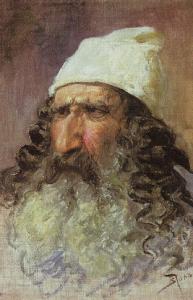
Photo by Polenov. “Head of Pharisee.” Public Domain, via Flickr.
You want to know how liberal the Pharisees were? Part of their split with the Pharisees was because they were willing to give the high priesthood to someone who was not from the tribe of Levi (!), namely, Simon Maccabeus, the king from the tribe of Judah who was crowned by the Maccabees in 141 BCE (1 Maccabees 14:41). Who’s the liberal here? Also, while the Sadducees refused to believe in resurrection because they couldn’t find it in the Torah, the Pharisees believed in resurrection, angels, and evil spirits. When Jesus was able to prove resurrection from the Torah to the Sadducees, the Pharisees cheered for him. (Luke 20:27-40)
It might also surprise you to learn that when Judea was deep in civil war between these two parties, it was the Pharisees who invited the Romans to come in and stop the war.
The Pharisees took action on that old problem of unwritten rules that we find hidden everywhere in any society. The Pharisees identified those unwritten rules, collected them, and finally published them in writing. Hey, they had a great reason for doing so! By building what they called a “fence” around God’s law, they tried to make sure that no one came close to breaking that law. The Sadducees had a cow over what the Pharisees did: adding laws to the Law of Moses! The Pharisees claimed that God actually gave these rules to Moses when giving him the written Law.
But as Jesus said, the real problem was that they elevating those human-made rules above God’s word itself (Mark 7:9). The Pharisees were careful not to co-mingle their oral law with Scripture (Exodus Rabbah 47.1), which is why they never wrote it down until after 70 AD. But they regarded both oral law and Scripture as equally authoritative, and Sanhedrin 11:3 even declares, “Greater stringency applies to the words of the Scribes than to the words of the written Law.” Jesus loudly disagreed!
Jesus criticizes the Pharisees, not for being too strict, but for leaving themselves too many loopholes to evade the clear word of God. Jesus tells his audience to do what the Pharisees teach, but not what they practice (Matthew 23:2). They weasel out of oaths (Matthew 23:16-19). They weasel out of care for their parents (Mark 7:10-13). They meticulously tithe, but neglect justice, mercy, and faith (Matthew 23:23); Jesus responds that he wants to see both committed giving and committed living.
You think the Pharisees were prudes? Think again! The Pharisees proclaimed: “No man may abstain from the command, Be fruitful and multiply, unless he already has children” (Mishnah, Yebamoth 6:6). The Pharisees even specified how often a husband was obligated to have sex with his wife: every day if he was not employed, twice a week for laborers, once a week for donkey drivers, once a month for camel drivers, and once every six months for sailors (Mishnah, Ketuboth 5:6).
Yes, the Pharisees were elitists. But so were the Sadducees. And Qumran was even more elitist. Yet amazingly, in disputes between these parties (such as how to celebrate the Jewish holidays), the common people in Jesus’ day sided with…the Pharisees! Only John the Baptist and Jesus led movements that were open to all who were willing to come and follow.
Josephus says in his Antiquities 23:12-17 that the Pharisees are “extremely influential among the townsfolk, and all prayers and sacred rites of divine worship are performed according to their exposition,” and even the Sadducees “submit to the formulas of the Pharisees, since otherwise the masses would not tolerate them.” In Antiquities 13:298, he says, “The Sadducees have the confidence of the wealthy alone, but no following among the general populace.”
As an example, the Tosefta (Sukkah 3:1) tells of an incident where the Sadducees hid the willow branches to be used for the Feast of Tabernacles under a pile of stones to keep them from being used on the Sabbath. The common people found out and unburied the willows, because they sided with the Pharisees, who said that the beating of the willow branches takes precedence over the Sabbath.
Pharisees and Sadducees disagreed on how to apply the penalty against a false witness in a capital case (Mishnah, Makkoth 1:6). The Sadducees said the innocent person had to be executed first, while the Pharisees said the false witness can be executed on intention alone, even if he is caught before the original accused is executed.
The two groups argued about the wording of divorce documents. A Sadducee complained, “You Pharisees write the name of the secular ruler together with the name of Moses in a bill of divorce!” The Pharisees responded, “You Sadducees write the name of the secular ruler together with the name of God on the same page, and you put the ruler first, then God!” (Mishnah, Yadayim 4:8)
In another dispute, we read, “The Sadducees say, We cry out against you, O Pharisees, for you declare clean an unbroken stream of liquid! The Pharisees say, We cry out against you, O Sadducees, for you declare clean a stream of water that comes from a cemetery!” (Mishnah, Yadayim 4:7)
In many ways, Jesus was closer to the Pharisees than to any other Jewish group. There is no recorded memory of any role of the Pharisees in Jesus’ execution. We read in Acts 15 that there were Pharisees who were following Jesus, but not Sadducees or people from Qumran. The harsh words we hear from Jesus about them in Matthew 23 are not anti-Semitic; they are part of an in-house debate over who is the more faithful Torah-teacher. We often reserve our harshest criticism for those who are most like us.
So this Easter, or wherever we may find them as we preach the Gospel story, let’s quit trashing the Pharisees. They were not the moral monsters that common misperception has made them to be. Let us remember that when Jerusalem fell, it was not the Sadducees, or the commune at Qumran, but the Pharisees who survived to pass their brand of Judaism down to us.
Previous Post

March 8, 2018
What Is Right? Life on the Straight and Level
Next Post

March 15, 2018 No Restroom on the Sabbath at Qumran!
Browse Our Archives
Select a Category Biblical ethic Biblical word studies Biblical world Creation Historical Jesus Uncategorized
Select a Month July 2018 June 2018 May 2018 April 2018 March 2018 February 2018 January 2018 December 2017 November 2017 October 2017 September 2017 August 2017 July 2017
Follow Us!
TAKE THE
Religious Wisdom Quiz
"Let your ________ before men, that they may see your good deeds and praise your Father in heaven."
Select your answer to see how you score.
Voice Be Raised Light So Shine Conscience Be Clear Face Shine
Books by This Author Books by Tom Hobson
Related posts from Biblical Words and World

Musonius Rufus, Women's Equality, and the New Testament


TRENDING AT PATHEOS Evangelical

How the author of the world's best hymn...
I've been working with John Newton for a while now. This makes...

Long before this Lectio Divina, Psalm 130 - the song - started...

What About the Trees? Another Living Parable
After I finished writing the last article about falling leaves as a...

Why Classical Education Is a Conversation, Not a...
Come and Read: Joy in Classical Education When I was a little...

Falling Leaves: A Living Parable on Letting Go
I’ve spent the vast majority of my life in the southeast corner...

Cornell University has received a great deal of negative publicity and intense...
view all Evangelical blogs
Ad-Free & Subscriber Log-In Subscription Support
- About Us
- 2026 Calendar
- Videos
- Podcasts
- Library of World Religions
- Faith In Media Tracker
- Advertise With Us
- Write for Us
- Privacy Policy
- Terms of Service
- Do Not Sell My Data
- Contact Us
- Radiant Digital
- Manage Newsletter Subscriptions
- Unsubscribe From Notifications
- Sitemap
Copyright 2008-2026, Patheos. All rights reserved.
Subscription Support Ad-Free & Subscriber Log-In
Follow Patheos