
BuddhistCatholicContemplativeEvangelicalGeneral ChristianHinduJewishLatter-day SaintMuslimNew VisionsProgressive Christian
Beliefs
- Buddhist
- Catholic
- Contemplative
- Evangelical
- General Christian
- Hindu
- Jewish
- Latter-day Saint
- More Voices
- Muslim
- New Visions
- Pagan
- Progressive Christian
Topics
- Religion News
- Food and Religion
- Sports and Religion
- Religious Art
- Religious Music and Entertainment
- Religious Events
- History and Religion
- Style and Religion
- Politics and Religion
- Women in Religion
- Recreation Outdoors and Religion
- Business Finance and Religion
- Careers Workplace and Religion
- Education and Religion
- Family Parenting and Religion
- Health Fitness and Religion
- Home and Religion
- Relationships and Religion
- Technology and Religion
- Travel and Religion
Columnists
- Buddhist Columnists
- Business Finance and Religion Columnists
- Careers Workplace and Religion Columnists
- Catholic Columnists
- Contemplative Columnists
- Education and Religion Columnists
- Evangelists Columnists
- Family Parenting and Religion Columnists
- General Christian Columnists
- Health Fitness and Religion Columnists
- Hindu Columnists
- History and Religion Columnists
- Home and Religion Columnists
- Jewish Columnists
- More Voices Columnists
- Latter Day Columnists
- Muslim Columnists
- New Visions Columnists
- Nonreligious Columnists
- Pagan Columnists
- Politics and Religion Columnists
- Progressive Columnists
- Recreation Outdoors and Religion Columnists
- Relationships and Religion Columnists
- Religion News Columnists
- Religious Art Columnists
- Religious Events Columnists
- Religious Music and Entertainment Columnists
- Sports and Religion Columnists
- Style and Religion Columnists
- Technology and Religion Columnists
- Travel and Religion Columnists
- Women in Religion Columnists
Resource Library
- 2026 Calendar
- Library of World Religions
- The 100 Most Holy Places on Earth
- Patheos Answers
- Podcasts
- Videos
- Faith Leaders Database
- Anglican Episcopalian
- Bahai
- Baptist
- Buddhism
- Christianity
- Confucianism
- Eastern Orthodoxy
- Hinduism
- Holiness and Pentecostal
- ISKCON
- Islam
- Judaism
- Lutheran
- Methodist
- The Church of Jesus Christ of Latter-day Saints
- New Age
- Paganism
- Presbytarian and Reformed
- Protestantism
- Religion Behind the Scenes
- Roman Catholic
- Scientology
- Shia Islam
- Sikhism
- Sufism
- Sunni Islam
- Taoism
- Zen
- See all religions
Research Tools
 Ad-Free & Subscriber Log-In Subscription Support
Ad-Free & Subscriber Log-In Subscription Support
Follow Patheos 

- Trending:
- Forgiveness
- |
- Marriage
- |
- Consciousness
- |
- Death Penalty
- |
- Election
- |
- Halloween
 Biblical Words and World
- Home
- Evangelical
- No Restroom on the Sabbath at Qumran!
No Restroom on the Sabbath at Qumran!
Last updated on: March 15, 2018 at 5:30 am by Tom Hobson
No Restroom on the Sabbath at Qumran! 2018-03-14T07:38:38-05:00 Tom Hobson
Patheos Explore the world's faith through different perspectives on religion and spirituality! Patheos has the views of the prevalent religions and spiritualities of the world.
The ancient Qumran community was so strict about the Sabbath that their rules did not even let them use the restroom on that day! They taught that on the Sabbath, a member was not to walk more than 1000 cubits outside his city. But their community’s latrine was 1500 cubits (3000 feet) outside the city, to prevent grossing God out (Deuteronomy 23:12-14). How did they solve this problem? Josephus says: they didn’t.
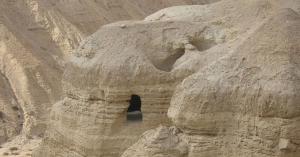
By Greg Schechter from San Francisco, USA (Isreal082) [CC BY 2.0 (http://creativecommons.org/licenses/by/2.0)], via Wikimedia Commons
Qumran is the place where we found the Dead Sea Scrolls. The Dead Sea Scrolls give us more than our earliest collection of Scripture manuscripts (150 BCE – 70 AD). They also give us commentaries on the Bible, which give us a window into what this group believed. They also give us documents that spell out all the rules of behavior for the Qumran community. We also have first-hand accounts on the Qumran community, also known as the Essenes, from the first-century Jewish writers Philo and Josephus (see http://essene.com/History/AncientHistoriansAndEssenes.html).
Chief among the beliefs at Qumran was their belief in communal living. Philo tells us, “There is but one purse for them all, and common expenses, common clothes, and common food in common meals.” Josephus says, “Contemptuous of wealth, they are amazing in their communal practice… Novices admitted to the sect must surrender their property to the order, so that among them all, neither humiliating poverty nor excessive wealth is ever seen.”
The Dead Sea Scrolls tell us that there was private ownership at Qumran, but all property had to be registered when someone joined, and all property had to be available for community use. If a person lied about their property, they could be excluded from the holy food for one year. (Compare with what happened to Ananias and Sapphira in Acts 5!) They were permitted to conduct trade with outsiders by special permission. They had to give two days’ wages per month into a common fund to help those in need among them.
The Qumran commune lived a rigidly simple lifestyle, wearing only white and wearing the same clothes and shoes until they wore out. In their meals, Philo says that they “are contented with the same dish day after day, loving sufficiency and rejecting great expense as harmful to mind and body.”
Qumran members had no need to carry luggage or supplies when they went on a trip, since there was always someone around to provide them hospitality. Josephus writes, “When adherents arrive from elsewhere, all local resources are put at their disposal…and men they have never seen before entertain them like old friends. And so when they travel, they carry no baggage at all, but only weapons to keep off bandits.” One will recall that Jesus sent his followers out this way, with nothing but a staff (Mark 6:7-11) – perhaps he had a similar network of sympathizers who would take them in.
The folks at Qumran were stricter than the Pharisees in their keeping of the Sabbath. According to the Dead Sea Scrolls, “On the day of the Sabbath, no one should say a useless or stupid word. He is not to lend anything to his fellow. He is not to take decisions with regard to riches or gain. He is not to speak about matters of work or of the task to be carried out on the following day…
“No one is to eat on the Sabbath day except what has been prepared…He is not to draw water with any vessel…No one should go after an animal to pasture it outside his city, except for 2000 cubits.” No one should move anything into or out of a house. “He is not to open a sealed vessel on the Sabbath…In his dwelling no one should lift a stone or dust. The wet-nurse should not lift the baby to go out or come in on the Sabbath…No one should help an animal give birth on the Sabbath day. And if it falls into a well or a pit, he should not take it out on the Sabbath…And any living man who falls into a place of water or into a reservoir, no one should take him out with a ladder or a rope or a utensil.” Yet Qumran was surprisingly lenient on punishing the violation of the Sabbath. The Law of Moses prescribes death, but Qumran decrees that the offender be put on probation for seven years.
Qumran was so determined to avoid immorality that many of them practiced celibacy. But their writings indicate that some of them were married, particularly those who lived away from Qumran scattered around Israel. The issue was ritual purity. The Law of Moses says that even married sex causes defilement until evening (Leviticus 15:18). Therefore, Qumran had a rule: “No one should sleep with a woman in the city of the temple,” which would make married life impractical at Qumran itself.
Because so few of them were married, Qumran kept their community going partly by taking in other people’s children, such as orphans. John the Baptist may have been raised at Qumran after the death of his aged parents.
Qumran was also strict in their teaching about oaths. We are told by Josephus, “Every word they speak is more binding than an oath. Swearing they reject as worse than perjury, for they say a person is already condemned if they cannot be believed without God being named.” And yet, when a person joined their group, they had to swear fearful oaths of loyalty to the community. Those who were kicked out of the community had to either eat grass and live off the land, or starve, because they had sworn not to eat the food of unbelievers. This may explain why John the Baptist lived on locusts and honey, and would not even eat bread or drink Passover wine (according to Josephus) – perhaps John had taken the same oath in the past.
Qumran had a long list of offenses for which you could be kicked out either temporarily or permanently. It took about two years of probation before you became a full member who could share the holy food and participate in decision-making. But anyone who deliberately disobeys the Torah can be kicked out permanently, or if by accident, they can be excluded for two years. There were penalties for indecent exposure (30 days, or six months for total nakedness). Falling asleep during a meeting was punished by 30 days’ penance. There were unspecified punishments for speaking foolishly, spitting or loud laughter in a meeting, interrupting a speech, insulting a companion, leaving a meeting more than three times, or bearing malice against a companion. Slandering the congregation or murmuring against its authority called for permanent expulsion.
Like many of the folks at Qumran, both Jesus and John the Baptist practiced celibacy. Jesus speaks critically of wealth, and advocates giving up one’s private possessions. (Luke 12:33: “Sell your possessions and give alms.” Luke 14:33: “Whoever does not renounce all that he has cannot be my disciple.”) Even the early church put this idea of communal living into practice. Like the folks at Qumran, Jesus forbids swearing. His sending out of the Twelve seems to presuppose that he’s got a network of hospitality to rely on (possibly followers of John).
But unlike the folks at Qumran, whose salvation was open only to a few, who excluded the handicapped, and who separated themselves from the unbelieving world, Jesus and John opened their movements to all, even tax collectors and hookers, and Jesus freely associated with sinners instead of withdrawing from them. Qumran yelled at the Pharisees, while Jesus was too far from Qumran’s beliefs for them to take him seriously. But Jesus was well-positioned to win people from Qumran who longed for a better way.
Previous Post

March 12, 2018
Pharisees: Unfairly Trashed
Next Post
March 19, 2018 Puzzles in the Trial of Jesus
Browse Our Archives
Select a Category Biblical ethic Biblical word studies Biblical world Creation Historical Jesus Uncategorized
Select a Month July 2018 June 2018 May 2018 April 2018 March 2018 February 2018 January 2018 December 2017 November 2017 October 2017 September 2017 August 2017 July 2017
Follow Us!
TAKE THE
Religious Wisdom Quiz
Who predicted Babylon's fall?
Select your answer to see how you score.
Ezekiel Isaiah Daniel Jeremiah
Books by This Author Books by Tom Hobson
Related posts from Biblical Words and World

Musonius Rufus, Women's Equality, and the New Testament


TRENDING AT PATHEOS Evangelical

How the author of the world's best hymn...
I've been working with John Newton for a while now. This makes...

Long before this Lectio Divina, Psalm 130 - the song - started...

What About the Trees? Another Living Parable
After I finished writing the last article about falling leaves as a...

Why Classical Education Is a Conversation, Not a...
Come and Read: Joy in Classical Education When I was a little...

Falling Leaves: A Living Parable on Letting Go
I’ve spent the vast majority of my life in the southeast corner...

Cornell University has received a great deal of negative publicity and intense...
view all Evangelical blogs
Ad-Free & Subscriber Log-In Subscription Support
- About Us
- 2026 Calendar
- Videos
- Podcasts
- Library of World Religions
- Faith In Media Tracker
- Advertise With Us
- Write for Us
- Privacy Policy
- Terms of Service
- Do Not Sell My Data
- Contact Us
- Radiant Digital
- Manage Newsletter Subscriptions
- Unsubscribe From Notifications
- Sitemap
Copyright 2008-2026, Patheos. All rights reserved.
Subscription Support Ad-Free & Subscriber Log-In
Follow Patheos