
BuddhistCatholicContemplativeEvangelicalGeneral ChristianHinduJewishLatter-day SaintMuslimNew VisionsProgressive Christian
Beliefs
- Buddhist
- Catholic
- Contemplative
- Evangelical
- General Christian
- Hindu
- Jewish
- Latter-day Saint
- More Voices
- Muslim
- New Visions
- Pagan
- Progressive Christian
Topics
- Religion News
- Food and Religion
- Sports and Religion
- Religious Art
- Religious Music and Entertainment
- Religious Events
- History and Religion
- Style and Religion
- Politics and Religion
- Women in Religion
- Recreation Outdoors and Religion
- Business Finance and Religion
- Careers Workplace and Religion
- Education and Religion
- Family Parenting and Religion
- Health Fitness and Religion
- Home and Religion
- Relationships and Religion
- Technology and Religion
- Travel and Religion
Columnists
- Buddhist Columnists
- Business Finance and Religion Columnists
- Careers Workplace and Religion Columnists
- Catholic Columnists
- Contemplative Columnists
- Education and Religion Columnists
- Evangelists Columnists
- Family Parenting and Religion Columnists
- General Christian Columnists
- Health Fitness and Religion Columnists
- Hindu Columnists
- History and Religion Columnists
- Home and Religion Columnists
- Jewish Columnists
- More Voices Columnists
- Latter Day Columnists
- Muslim Columnists
- New Visions Columnists
- Nonreligious Columnists
- Pagan Columnists
- Politics and Religion Columnists
- Progressive Columnists
- Recreation Outdoors and Religion Columnists
- Relationships and Religion Columnists
- Religion News Columnists
- Religious Art Columnists
- Religious Events Columnists
- Religious Music and Entertainment Columnists
- Sports and Religion Columnists
- Style and Religion Columnists
- Technology and Religion Columnists
- Travel and Religion Columnists
- Women in Religion Columnists
Resource Library
- 2026 Calendar
- Library of World Religions
- The 100 Most Holy Places on Earth
- Patheos Answers
- Podcasts
- Videos
- Faith Leaders Database
- Anglican Episcopalian
- Bahai
- Baptist
- Buddhism
- Christianity
- Confucianism
- Eastern Orthodoxy
- Hinduism
- Holiness and Pentecostal
- ISKCON
- Islam
- Judaism
- Lutheran
- Methodist
- The Church of Jesus Christ of Latter-day Saints
- New Age
- Paganism
- Presbytarian and Reformed
- Protestantism
- Religion Behind the Scenes
- Roman Catholic
- Scientology
- Shia Islam
- Sikhism
- Sufism
- Sunni Islam
- Taoism
- Zen
- See all religions
Research Tools
 Ad-Free & Subscriber Log-In Subscription Support
Ad-Free & Subscriber Log-In Subscription Support
Follow Patheos 

- Trending:
- Forgiveness
- |
- Marriage
- |
- Consciousness
- |
- Death Penalty
- |
- Election
- |
- Halloween
 Biblical Words and World
- Home
- Evangelical
- Eunuchs in Biblical Times
Eunuchs in Biblical Times
Last updated on: February 11, 2018 at 7:20 pm by Tom Hobson
Eunuchs in Biblical Times 2018-02-11T19:20:45-05:00 Tom Hobson
Patheos Explore the world's faith through different perspectives on religion and spirituality! Patheos has the views of the prevalent religions and spiritualities of the world.
Eunuchs have unfortunately become another attempted Biblical argument in favor of rewriting the Bible’s sexual ethic. The argument has been around for years, based on the story of the Ethiopian eunuch who comes to Christ in Acts 8:26-39.
It is sad to hear a passage that celebrates the first messenger of the Gospel to Africa, turned into a claim that the story was all about the sexual status of the Ethiopian official. Since this passage played a key role in convincing Arlo Duba, professor at Dubuque Seminary, to change his mind on homosexuality (see https://pres-outlook.org/2011/01/arlo-duba-interview/), this passage merits further discussion.
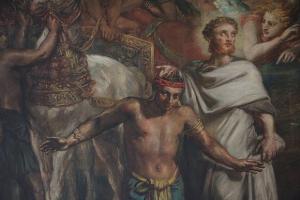
“Saint Philip the Deacon baptises the Ethiopian eunuch.” Photo: Father James Bradley. Creative Commons BY 2.0, via Flickr.
The Hebrew word sarīs can mean both “royal official” and “eunuch.” The word is used of Potiphar, Joseph’s Egyptian master in Genesis 39. Despite the fact that Potiphar’s wife appears there as a sex-starved “Desperate Housewife,” we have no reason to believe that her husband had been rendered incapable of normal marital relations.
The Hebrew term in question comes from Akkadian, the language of the Assyrians and Babylonians, where it may be seen even in the title Rab-Saris (chief official) in 2 Kings 18:17 and Jeremiah 39:3. There is no hint of emasculation in the term, but large numbers of royal servants were subjected to this procedure, although this is less likely in the few examples of sarīsīm cited in Israel (1 Samuel 8:15, 1 Kings 22:9, 2 Kings 24:15, and Ebed-Melech the Ethiopian in Jeremiah 38:7). Daniel and his three friends may have been emasculated as a condition of their service to the Babylonian king.
It is true that as a literal eunuchos, the Ethiopian official in Acts 8 would not have been able to go any further into the Temple than the Court of the Gentiles. However, unless he had converted to Judaism, he would not have been able to enter any further than that point, anyway. And the Mishnah (Yebamoth 8:1) states that if a priest has suffered the injury or loss of his genitals, he is still allowed to eat the holy offerings; he simply is not allowed to enter “the Assembly” (it is unclear whether this means only the Temple, or may also apply to the local synagogue).
The rabbis in the Mishnah (first two centuries AD) do not make eunuchs out to be evil people, and actually say very little about them. They make much less of an issue out of the eunuch’s sexual status than today’s defenders of the gay agenda, who wish to overstate the evidence by making the eunuch into a symbol for those who practice same-gender sexual intimacy.
Even though eunuchs were emasculated to prevent misconduct with women, they were still often stigmatized as immoral because of the belief that they were sexually active with their own gender. That is precisely why Deuteronomy 23:1 keeps them out of the sanctuary: because the vast majority of eunuchs in the Late Bronze Age and Iron Age I were made, not for government service, but for cultic male prostitution. The Mosaic prohibition no doubt was more sweeping than necessary, but is comparable to today’s prohibitions on who can donate blood. Who can enter God’s sanctuary was just as serious an issue.
So, is this a case where God commands a change in his own law? I would argue that God already announced such a change in Isaiah 56:4-5. God doesn’t explicitly say, “OK, you can come into the Temple now,” but God declares in this passage that eunuchs who keep the Sabbath and “choose the things that please me and hold fast my covenant” will receive “in my house and within my walls a monument and a name better than sons and daughters.” They will receive “an everlasting name that shall not be cut off.”
As I have argued in my book What’s on God’s Sin List for Today?, when God reaffirms an Old Testament command in the New Testament, and/or places a death penalty on the offense, these are signs that this is a moral principle that is timeless and universal. Deuteronomy 23:1 meets neither of these criteria. In fact, Acts 8:26-40 is there to explicitly reverse God’s previous command. When the eunuch asks, “Is there anything that prevents me from being baptized?,” the answer is, “Nothing!” By contrast, homosexual behavior both carries a death penalty and is reaffirmed on the New Testament sin lists in 1 Corinthians 6:9-11, 1 Timothy 1:9-11, and arguably on Jesus’ sin list in Mark 7:21-23 under the term aselgeia, translated as “licentiousness” (see my article “Aselgeia in Mark 7:22,” https://www.bsw.org/filologia-neotestamentaria/vol-21-2008/in-mark-7-22/523/).
There are no legitimate grounds for equating the issue of being a eunuch with the issue of same-gender sexual activity. For Jesus in Matthew 19:10-12, being a eunuch means nothing more or less than sexual abstinence (for both genders, presumably, based on how Jesus makes his argument in this passage). Jesus says that some abstain because they were born without the means to participate in sexual intercourse, some were artificially deprived of that ability, and some choose not to participate for reasons related to their devotion to God.
Jesus in effect agrees with the words of his disciples that it may be better not to marry at all. How does that fit with God’s words in the Garden, “It is not good for the human to be alone”? The bottom line is that Jesus affirms both: sexual abstinence, and lifelong faithful marriage between a man and a woman. But Jesus neither blesses nor endorses any third option.
Acts 8:26-40 is a wonderful account of an African royal treasurer who takes several months off from his job to travel 900 miles to seek the God of Israel. He even purchases an expensive personal copy of the Septuagint. Here is a man who fulfills Isaiah’s 700-year-old prophecy that worshippers will come to Jerusalem “from beyond the rivers of Sudan…from a nation tall and smooth…whose land the rivers divide” (Isaiah 18:1-7). He becomes the firstfruits of the Gospel in Africa. Let’s leave the account the way that Luke intended it to be read.
Previous Post

January 31, 2018
Does God Care How We Dress?
Next Post

February 8, 2018 Correcting Mother Teresa's Jesus
Browse Our Archives
Select a Category Biblical ethic Biblical word studies Biblical world Creation Historical Jesus Uncategorized
Select a Month July 2018 June 2018 May 2018 April 2018 March 2018 February 2018 January 2018 December 2017 November 2017 October 2017 September 2017 August 2017 July 2017
Follow Us!
TAKE THE
Religious Wisdom Quiz
Which parable tells of a shrewd manager who is commended for his cleverness?
Select your answer to see how you score.
The Unjust Steward The Lost Sheep The Wise Virgins The Good Samaritan
Books by This Author Books by Tom Hobson
Related posts from Biblical Words and World

Words I Never Heard in the Bible

Musonius Rufus, Women's Equality, and the New Testament

Theology by the Polls: Ten Billion Flies Can't...

TRENDING AT PATHEOS Evangelical

How the author of the world's best hymn...
I've been working with John Newton for a while now. This makes...

Long before this Lectio Divina, Psalm 130 - the song - started...

What About the Trees? Another Living Parable
After I finished writing the last article about falling leaves as a...

Why Classical Education Is a Conversation, Not a...
Come and Read: Joy in Classical Education When I was a little...

Falling Leaves: A Living Parable on Letting Go
I’ve spent the vast majority of my life in the southeast corner...

Cornell University has received a great deal of negative publicity and intense...
view all Evangelical blogs
Ad-Free & Subscriber Log-In Subscription Support
- About Us
- 2026 Calendar
- Videos
- Podcasts
- Library of World Religions
- Faith In Media Tracker
- Advertise With Us
- Write for Us
- Privacy Policy
- Terms of Service
- Do Not Sell My Data
- Contact Us
- Radiant Digital
- Manage Newsletter Subscriptions
- Unsubscribe From Notifications
- Sitemap
Copyright 2008-2026, Patheos. All rights reserved.
Subscription Support Ad-Free & Subscriber Log-In
Follow Patheos