
BuddhistCatholicContemplativeEvangelicalGeneral ChristianHinduJewishLatter-day SaintMuslimNew VisionsProgressive Christian
Beliefs
- Buddhist
- Catholic
- Contemplative
- Evangelical
- General Christian
- Hindu
- Jewish
- Latter-day Saint
- More Voices
- Muslim
- New Visions
- Pagan
- Progressive Christian
Topics
- Religion News
- Food and Religion
- Sports and Religion
- Religious Art
- Religious Music and Entertainment
- Religious Events
- History and Religion
- Style and Religion
- Politics and Religion
- Women in Religion
- Recreation Outdoors and Religion
- Business Finance and Religion
- Careers Workplace and Religion
- Education and Religion
- Family Parenting and Religion
- Health Fitness and Religion
- Home and Religion
- Relationships and Religion
- Technology and Religion
- Travel and Religion
Columnists
- Buddhist Columnists
- Business Finance and Religion Columnists
- Careers Workplace and Religion Columnists
- Catholic Columnists
- Contemplative Columnists
- Education and Religion Columnists
- Evangelists Columnists
- Family Parenting and Religion Columnists
- General Christian Columnists
- Health Fitness and Religion Columnists
- Hindu Columnists
- History and Religion Columnists
- Home and Religion Columnists
- Jewish Columnists
- More Voices Columnists
- Latter Day Columnists
- Muslim Columnists
- New Visions Columnists
- Nonreligious Columnists
- Pagan Columnists
- Politics and Religion Columnists
- Progressive Columnists
- Recreation Outdoors and Religion Columnists
- Relationships and Religion Columnists
- Religion News Columnists
- Religious Art Columnists
- Religious Events Columnists
- Religious Music and Entertainment Columnists
- Sports and Religion Columnists
- Style and Religion Columnists
- Technology and Religion Columnists
- Travel and Religion Columnists
- Women in Religion Columnists
Resource Library
- 2026 Calendar
- Library of World Religions
- The 100 Most Holy Places on Earth
- Patheos Answers
- Podcasts
- Videos
- Faith Leaders Database
- Anglican Episcopalian
- Bahai
- Baptist
- Buddhism
- Christianity
- Confucianism
- Eastern Orthodoxy
- Hinduism
- Holiness and Pentecostal
- ISKCON
- Islam
- Judaism
- Lutheran
- Methodist
- The Church of Jesus Christ of Latter-day Saints
- New Age
- Paganism
- Presbytarian and Reformed
- Protestantism
- Religion Behind the Scenes
- Roman Catholic
- Scientology
- Shia Islam
- Sikhism
- Sufism
- Sunni Islam
- Taoism
- Zen
- See all religions
Research Tools
 Ad-Free & Subscriber Log-In Subscription Support
Ad-Free & Subscriber Log-In Subscription Support
Follow Patheos 

- Trending:
- Forgiveness
- |
- Marriage
- |
- Consciousness
- |
- Death Penalty
- |
- Election
- |
- Halloween
 Biblical Words and World
- Home
- Evangelical
- No Room For the Inn
No Room For the Inn
Last updated on: December 26, 2017 at 9:36 am by Tom Hobson
No Room For the Inn 2017-12-26T09:36:59-05:00 Tom Hobson
Patheos Explore the world's faith through different perspectives on religion and spirituality! Patheos has the views of the prevalent religions and spiritualities of the world.
It was not an “inn” where there was no room for Jesus’ birth. The proof is in Mark 14:14 (= Luke 22:11), where Jesus books the same kind of place to eat the Last Supper. “Guest room” seems to be the best way to translate the Greek term katalyma used here and in Luke 2:7. The word pandocheion, used in Jesus’ parable of the Good Samaritan (Luke 10:34), is the word for what we would understand as an inn. Since katalyma is only used three times in the New Testament, a look at the fourteen times katalyma is used in the Greek translation of the Hebrew Bible is in order.
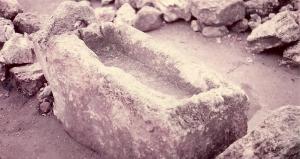
A stone manger like the one in which Jesus was laid, at an archaeological dig in Israel. Photo: Catherine Hobson.
In the Septuagint, the first time katalyma is used is in Exodus 4:24, where God meets Moses at a “lodging place” on the way back to Egypt and seeks to kill him; here, it likely means a camping place rather than a structure. Similarly, in 1 Samuel 1:18, Hannah and Eli are staying in a katalyma somewhere near the sanctuary in Shiloh, where they have come for an annual sacrifice (no word for lodging place is mentioned in the Hebrew text).
In 1 Samuel 9:22, katalyma appears to mean “banquet hall,” as it does in Mark 14:14 = Luke 22:11; here, it is where Samuel hosts Saul and his servant for a meal, along with about 30 townspeople. In 1 Chronicles 28:13, the Greek adds a reference to katalymata to describe accommodations which Solomon builds for the priests who will serve in the Temple.
God’s katalyma is first mentioned in Exodus 15:13, where it refers to God’s holy “habitation,” meaning either Sinai or possibly the Temple Mount, the place where God “lodges.” Similarly, when God kindly declines David’s offer to build him a house, God states that he has been living just fine in a katalyma and a tent (2 Samuel 7:6 = 1 Chronicles 17:5).
Out of the three times that katalyma is used in the Greek translation of Jeremiah, twice it refers to lodging places in the wilderness (14:8; 40:12), and once to a lion’s lair (32:38). Ezekiel 23:21 criticizes Oholibah the nymphomaniac for letting the Egyptians handle her breasts “at your lodging place” (another place where the word katalyma is added where there is no corresponding word in the Hebrew). And later on during the rule of the Greek king Antiochus IV, we are told in 1 Maccabees 3:45 that “Jerusalem was uninhabited like a desert… The sanctuary was trampled down, and aliens were in the citadel; it was a katalyma for the Gentiles.”
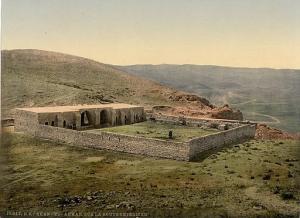
Possibly the site of the “inn” on the road to Jericho; the structure in the picture dates to the Middle Ages. By Snapshots Of The Past [CC BY-SA 2.0 (https://creativecommons.org/licenses/by-sa/2.0)], via Wikimedia Commons.
When Jesus is born in Bethlehem, Luke deliberately uses katalyma to describe the place where no room was to be found for the holy family. To stay in a pandocheion is out of the question. See Ken Bailey’s article “The Manger and the Inn” at http://www.biblearchaeology.org/post/2008/11/08/The-Manger-and-the-Inn.aspx.
To give us an idea how bad the public inns were, Clement of Alexandria (Stromateis 2.20.114.5) quotes the second-century AD Gnostic Valentinus, who says the heart is like an inn, which also “has holes bored in it and dug in it and is often filled with kopros [dung] where people stay there and behave outrageously (aselgōn, a word for shocking sexual excess) with no consideration for the place, as if it were nothing to them.”
The Jewish philosopher Philo uses the image of being “soiled and abused like someone entering a pandocheion.” A lost fragment of Philo states that a pandocheion is a place where people “fill themselves and vomit in their passions.” In the second-century AD Egerton Gospel Fragment line 8, a man says to Jesus, “While traveling and eating with lepers in the pandocheion, I myself also became a leper.” (The barn is starting to sound better and better.)
Josephus (Antiquities 3.376) gives a list of the types of women a priest is forbidden to marry, including women who earned their living by innkeeping (pandocheuein), apparently because so much of the time the job involved practicing prostitution. Even worse, the rabbis declared that cattle cannot be trusted with Gentiles at an inn, because they practice bestiality (Mishnah, Abodah Zarah 2:1). An inscription at a Roman inn included wine and bread for one Roman as (one sixteenth of a denarius), pulmentarium (food to go with the bread) for two asses, hay for the mule for two asses, and a “girl” for eight asses.
Rabbinic Hebrew borrows the Greek term pandocheion in the form pundaq. In the Mishnah, the word is used in a case where a man dies at an inn on the road to the Dead Sea, possibly the very spot Jesus has in mind in his parable in Luke 10. The rabbis are looking for evidence to prove that the man died, so that the widow can remarry. The rabbis accept the lone testimony of the woman innkeeper, but they do so because she is able to present the man’s staff, bag and Torah scroll as evidence (Yebamoth 16:7).
Yes, our Lord had a manger for a crib, but at least he wasn’t born in a pandocheion. That would have been truly the bottom of the barrel.
Previous Post

December 13, 2017
Messiah's Mother: Virgin or Young Woman?
Next Post
December 21, 2017 Born in Bethlehem: Fabrication or Fact?
Browse Our Archives
Select a Category Biblical ethic Biblical word studies Biblical world Creation Historical Jesus Uncategorized
Select a Month July 2018 June 2018 May 2018 April 2018 March 2018 February 2018 January 2018 December 2017 November 2017 October 2017 September 2017 August 2017 July 2017
Follow Us!
TAKE THE
Religious Wisdom Quiz
Who anointed Jesus with expensive perfume?
Select your answer to see how you score.
Mary Salome Martha Peter
Books by This Author Books by Tom Hobson
Related posts from Biblical Words and World

Words I Never Heard in the Bible
How Much Did Paul Get from Jesus?

Be Ye Perfect? What Does Jesus Mean?
What's the Difference Between Spirit and Soul?
TRENDING AT PATHEOS Evangelical

How the author of the world's best hymn...
I've been working with John Newton for a while now. This makes...

Long before this Lectio Divina, Psalm 130 - the song - started...

What About the Trees? Another Living Parable
After I finished writing the last article about falling leaves as a...

Why Classical Education Is a Conversation, Not a...
Come and Read: Joy in Classical Education When I was a little...

Falling Leaves: A Living Parable on Letting Go
I’ve spent the vast majority of my life in the southeast corner...

Cornell University has received a great deal of negative publicity and intense...
view all Evangelical blogs
Ad-Free & Subscriber Log-In Subscription Support
- About Us
- 2026 Calendar
- Videos
- Podcasts
- Library of World Religions
- Faith In Media Tracker
- Advertise With Us
- Write for Us
- Privacy Policy
- Terms of Service
- Do Not Sell My Data
- Contact Us
- Radiant Digital
- Manage Newsletter Subscriptions
- Unsubscribe From Notifications
- Sitemap
Copyright 2008-2026, Patheos. All rights reserved.
Subscription Support Ad-Free & Subscriber Log-In
Follow Patheos