
BuddhistCatholicContemplativeEvangelicalGeneral ChristianHinduJewishLatter-day SaintMuslimNew VisionsProgressive Christian
Beliefs
- Buddhist
- Catholic
- Contemplative
- Evangelical
- General Christian
- Hindu
- Jewish
- Latter-day Saint
- More Voices
- Muslim
- New Visions
- Pagan
- Progressive Christian
Topics
- Religion News
- Food and Religion
- Sports and Religion
- Religious Art
- Religious Music and Entertainment
- Religious Events
- History and Religion
- Style and Religion
- Politics and Religion
- Women in Religion
- Recreation Outdoors and Religion
- Business Finance and Religion
- Careers Workplace and Religion
- Education and Religion
- Family Parenting and Religion
- Health Fitness and Religion
- Home and Religion
- Relationships and Religion
- Technology and Religion
- Travel and Religion
Columnists
- Buddhist Columnists
- Business Finance and Religion Columnists
- Careers Workplace and Religion Columnists
- Catholic Columnists
- Contemplative Columnists
- Education and Religion Columnists
- Evangelists Columnists
- Family Parenting and Religion Columnists
- General Christian Columnists
- Health Fitness and Religion Columnists
- Hindu Columnists
- History and Religion Columnists
- Home and Religion Columnists
- Jewish Columnists
- More Voices Columnists
- Latter Day Columnists
- Muslim Columnists
- New Visions Columnists
- Nonreligious Columnists
- Pagan Columnists
- Politics and Religion Columnists
- Progressive Columnists
- Recreation Outdoors and Religion Columnists
- Relationships and Religion Columnists
- Religion News Columnists
- Religious Art Columnists
- Religious Events Columnists
- Religious Music and Entertainment Columnists
- Sports and Religion Columnists
- Style and Religion Columnists
- Technology and Religion Columnists
- Travel and Religion Columnists
- Women in Religion Columnists
Resource Library
- 2026 Calendar
- Library of World Religions
- The 100 Most Holy Places on Earth
- Patheos Answers
- Podcasts
- Videos
- Faith Leaders Database
- Anglican Episcopalian
- Bahai
- Baptist
- Buddhism
- Christianity
- Confucianism
- Eastern Orthodoxy
- Hinduism
- Holiness and Pentecostal
- ISKCON
- Islam
- Judaism
- Lutheran
- Methodist
- The Church of Jesus Christ of Latter-day Saints
- New Age
- Paganism
- Presbytarian and Reformed
- Protestantism
- Religion Behind the Scenes
- Roman Catholic
- Scientology
- Shia Islam
- Sikhism
- Sufism
- Sunni Islam
- Taoism
- Zen
- See all religions
Research Tools
 Ad-Free & Subscriber Log-In Subscription Support
Follow Patheos 

- Trending:
- Advent
- |
- Forgiveness
- |
- Thanksgiving
- |
- Election
- |
- Seasonal Holidays
- |
- Marriage
 Biblical Words and World
- Home
- Evangelical
- Brothers or Cousins of Jesus?
Brothers or Cousins of Jesus?
Last updated on: December 28, 2017 at 6:30 am by Tom Hobson
Brothers or Cousins of Jesus? 2017-12-27T11:28:24-05:00 Tom Hobson
Patheos Explore the world's faith through different perspectives on religion and spirituality! Patheos has the views of the prevalent religions and spiritualities of the world.
Are the “brothers” of Jesus in Mark 6:3 really his cousins, or his half-brothers? Can the word “brother” mean “cousin” in the Bible, and does the word “brother” mean “cousin” here in Mark’s description of Jesus’ nuclear family?
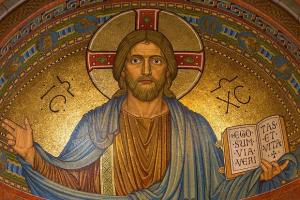
Picture by Didgeman. Public Domain (Creative Commons CC0 1.0, Universal Public Domain Dedication), via Wikimedia Commons.
Protestants and Jews read Matthew’s statement that Joseph and Mary had no sexual relations “until” (eōs) she gave birth to Jesus (Matthew 1:25) to strongly imply that they began a normal marital sex life after his birth. The fact that Mark names four brothers of Jesus and adds an unspecified number of sisters would support this understanding. The first-century Jewish historian Josephus also refers to James the Just as the “brother” of Jesus when describing James’s execution by Jewish leaders in 62 AD.
However, by the early second century there developed a belief among some Christians that Mary remained a lifelong virgin. To explain Jesus’ siblings, the early writer Epiphanius claimed that they were Joseph’s children by a previous marriage. Certainly the word “brother” permits this possibility; neither Greek nor Hebrew provides for a distinction between “brother” and “step-brother” or the like. However, there is no convincing case for Joseph having been previously married, even though the Protevangelium of James (mid-second century AD – http://www.earlychristianwritings.com/infancyjames.html) makes this claim.
Two voices in the early church firmly opposed the notion that Jesus was not blood-related to his reported siblings. One is the second-century AD writer Hegesippus, who refers to James as the “brother” of Jesus, while also mentioning an uncle and a cousin (anepsion) of Jesus. When he says “brother,” he obviously does not mean generic relative. Hegesippus also refers to Jude as a brother of Jesus “according to the flesh.”
The Latin writer Tertullian also insists that the brothers of Jesus were “true” (vērē) brothers. While Tertullian was a strong advocate of celibacy as being better than marriage, he firmly opposed the followers of Marcion and others with Docetic views of Jesus’ humanity. For him, the biological reality of Jesus’ mother and brothers was part of his case against those who denied Jesus’ true humanity.
What about the claim that the word “brothers” actually means “cousins” in Jesus’ case? If this were true, it would incline us to believe not only that Mary remained a lifelong virgin, but that Joseph fathered no children with anyone. I see no reason whatsoever to believe that, but it wouldn’t hurt to see if the word “brother” can be used in the Bible with the meaning of relatives outside one’s nuclear family.
The answer is that it can, but only rarely. In Genesis 14:14 and 14:16, Abram’s “brother” is his nephew Lot. In Genesis 31:37, 31:46, and 31:54, Jacob’s “brother” is his uncle Laban. In Leviticus 10:4, the “brothers” of Nadab and Abihu (who die because they offered “strange fire” to YHWH) are their cousins.
But the word “brother” in Biblical Hebrew can be and does get used even more broadly. In Exodus 2:11, Moses stops a fight with the appeal, “Men, you are brothers (= fellow Israelites)!” Throughout Deuteronomy, “brothers” means Israelites as opposed to foreigners. In Numbers 18:2 and 18:6, “brothers” means members of the same tribe. The term is also used broadly for extended family, such as the 42 brothers of King Ahaziah who are killed by Jehu in 2 Kings 10:13, or the 130 brothers of Joel son of Gershom in 1 Chronicles 15:7, or the 68 brothers of Obed-Edom in 1 Chronicles 16:38. (Granted, all these could be from prolific polygamous families, but they are more likely to mean extended family.)
Looked at in context, the brothers of Jesus are highly unlikely to have been anything other than the natural children of Joseph and Mary, to whom Jesus would have been a half-brother, if we accept (as I do) that Jesus was conceived without the help of Joseph or any human male (see my two December posts on the Virgin Birth: http://www.patheos.com/blogs/tomhobson/2017/12/logical-grounds-jesus-virgin-birth/ and http://www.patheos.com/blogs/tomhobson/2017/12/messiahs-mother-virgin-young-woman/).
But here we do have a genuine royal blood line, so to speak – not the one touted by Dan Brown and others who believed that Jesus married and fathered a line of descendants (the Hebrew word for that is “hogwash!”), but a blood line descended from Joseph and Mary. The early church gave them the name Desposynai (“Those Belonging to the Master”). Their existence has been traced down to 313 AD, when a delegation of them goes to Pope Sylvester and asks to be reinstated as leaders of the Jerusalem church (a request which was denied). See the post on the Desposynai at http://www.ccg.org/weblibs/study-papers/p232.html and the PBS chart of the descendants of Joseph and Mary whom we know by name at https://www.pbs.org/wgbh/pages/frontline/shows/religion/jesus/tree.html.
Wouldn’t it be cool if we knew someone who was a direct descendant of Joseph and Mary? Perhaps. But Jesus himself minimizes the significance of blood relationship to him during his earthly life, when his mother and brothers come to visit him on the road in Mark 3:31-35. What does Jesus say? “Whoever does the will of God, this is my brother and sister and mother.”
Previous Post

December 23, 2017
Was December 25 Jesus' Birthday After All?
Next Post
January 1, 2018 Controlled by the Calendar: Romans in Galatia
Browse Our Archives
Select a Category Biblical ethic Biblical word studies Biblical world Creation Historical Jesus Uncategorized
Select a Month July 2018 June 2018 May 2018 April 2018 March 2018 February 2018 January 2018 December 2017 November 2017 October 2017 September 2017 August 2017 July 2017
Follow Us!
TAKE THE
Religious Wisdom Quiz
Which prophet confronted King Ahab about his sins?
Select your answer to see how you score.
Ezekiel Jeremiah Elijah Elisha
Books by This Author Books by Tom Hobson
Related posts from Biblical Words and World

Words I Never Heard in the Bible
How Much Did Paul Get from Jesus?

Be Ye Perfect? What Does Jesus Mean?
What's the Difference Between Spirit and Soul?
TRENDING AT PATHEOS Evangelical

When you hear the word riches, what comes to mind? For most...

Don’t Miss the Parents: A Creative Christmas Meditation
As we enter the Advent Season, I see many people trying to...

Making Stones Into Bread: Choosing the “Right” Work
I was on my online arts ministry Zoom meeting with the International...

Ukraine’s exhausted Christians face fifth winter of war
By Julian Lukins The full-scale war in Ukraine is taking “a serious...

Russell Brand's Conviction is not anti-Christian Persecution
How do we shed the reputation that the Church is OK with...

Have you ever caught yourself saying, “I’ll do it tomorrow,” or “Now...
view all Evangelical blogs
Ad-Free & Subscriber Log-In Subscription Support
- About Us
- 2026 Calendar
- Videos
- Podcasts
- Library of World Religions
- Faith In Media Tracker
- Advertise With Us
- Write for Us
- Privacy Policy
- Terms of Service
- Do Not Sell My Data
- Contact Us
- Radiant Digital
- Manage Newsletter Subscriptions
- Unsubscribe From Notifications
- Sitemap
Copyright 2008-2026, Patheos, part of the Radiant Digital network of media brands. All rights reserved.
Subscription Support Ad-Free & Subscriber Log-In
Follow Patheos