
BuddhistCatholicContemplativeEvangelicalGeneral ChristianHinduJewishLatter-day SaintMuslimNew VisionsProgressive Christian
Beliefs
- Buddhist
- Catholic
- Contemplative
- Evangelical
- General Christian
- Hindu
- Jewish
- Latter-day Saint
- More Voices
- Muslim
- New Visions
- Pagan
- Progressive Christian
Topics
- Religion News
- Food and Religion
- Sports and Religion
- Religious Art
- Religious Music and Entertainment
- Religious Events
- History and Religion
- Style and Religion
- Politics and Religion
- Women in Religion
- Recreation Outdoors and Religion
- Business Finance and Religion
- Careers Workplace and Religion
- Education and Religion
- Family Parenting and Religion
- Health Fitness and Religion
- Home and Religion
- Relationships and Religion
- Technology and Religion
- Travel and Religion
Columnists
- Buddhist Columnists
- Business Finance and Religion Columnists
- Careers Workplace and Religion Columnists
- Catholic Columnists
- Contemplative Columnists
- Education and Religion Columnists
- Evangelists Columnists
- Family Parenting and Religion Columnists
- General Christian Columnists
- Health Fitness and Religion Columnists
- Hindu Columnists
- History and Religion Columnists
- Home and Religion Columnists
- Jewish Columnists
- More Voices Columnists
- Latter Day Columnists
- Muslim Columnists
- New Visions Columnists
- Nonreligious Columnists
- Pagan Columnists
- Politics and Religion Columnists
- Progressive Columnists
- Recreation Outdoors and Religion Columnists
- Relationships and Religion Columnists
- Religion News Columnists
- Religious Art Columnists
- Religious Events Columnists
- Religious Music and Entertainment Columnists
- Sports and Religion Columnists
- Style and Religion Columnists
- Technology and Religion Columnists
- Travel and Religion Columnists
- Women in Religion Columnists
Resource Library
- 2026 Calendar
- Library of World Religions
- The 100 Most Holy Places on Earth
- Patheos Answers
- Podcasts
- Videos
- Faith Leaders Database
- Anglican Episcopalian
- Bahai
- Baptist
- Buddhism
- Christianity
- Confucianism
- Eastern Orthodoxy
- Hinduism
- Holiness and Pentecostal
- ISKCON
- Islam
- Judaism
- Lutheran
- Methodist
- The Church of Jesus Christ of Latter-day Saints
- New Age
- Paganism
- Presbytarian and Reformed
- Protestantism
- Religion Behind the Scenes
- Roman Catholic
- Scientology
- Shia Islam
- Sikhism
- Sufism
- Sunni Islam
- Taoism
- Zen
- See all religions
Research Tools
 Ad-Free & Subscriber Log-In Subscription Support
Ad-Free & Subscriber Log-In Subscription Support
Follow Patheos 

- Trending:
- Forgiveness
- |
- Marriage
- |
- Consciousness
- |
- Death Penalty
- |
- Election
- |
- Halloween
 Biblical Words and World
- Home
- Evangelical
- Born in Bethlehem: Fabrication or Fact?
Born in Bethlehem: Fabrication or Fact?
Last updated on: December 27, 2017 at 2:43 pm by Tom Hobson
Born in Bethlehem: Fabrication or Fact? 2017-12-27T14:43:14-05:00 Tom Hobson
Patheos Explore the world's faith through different perspectives on religion and spirituality! Patheos has the views of the prevalent religions and spiritualities of the world.
In this holy season of the year, we encounter still another question raised by modern critical inquiry: Is the story of Jesus’ birth, as narrated by Matthew and Luke, a fabrication – a fairy tale with about as much truth as Santa Claus? The issues involve questions as to whether Jesus was really born in Bethlehem, was there really a census, and were there really Magi.
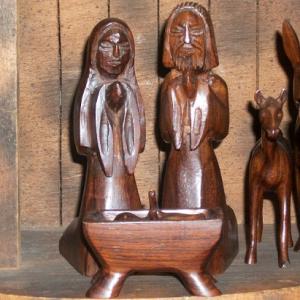
Part of a Brazilian manger scene that has been in the Hobson family for decades. Photo: Catherine Hobson.
First: Does it matter? It’s a matter of opinion. If we propose that it does not matter, then Jesus’ birth takes its place next to the legends of Santa Claus and Muhammad’s ascent to heaven. If we go that route, then the choice between faiths becomes a pointless dispute over “My concocted narrative is better than your concocted narrative.” (Or maybe all are equally well-meaning but dubious.)
The possibility that the canonical Gospel account of Jesus’ birth is true lends credibility to the rest of what the canonical Gospels have to say. One does not even have to accept every last detail. Whether the Magi saw a supernova witnessed by the Chinese in 5 BCE (http://www.tyndalehouse.com/tynbul/library/TynBull_1992_43_1_02_Humphreys_StarBethlehem.DOC), a conjunction of planets in 7-6 BCE, or whether they were guided by a moving light that no one else could have or would have seen, is not important, if the rest proves to be plausible. Scientists such as Sir John Polkinghorne and Francis Collins (director of the Human Genome Project) do not accept every detail in the Gospels, but because they are convinced that Jesus truly rose from the dead, they are careful not to jump to skeptical conclusions about belief-stretching claims in Scripture.
So, was Jesus really born in Bethlehem? Both Matthew and Luke agree that he was, but they get there by completely different routes. Luke’s default setting for his story is Nazareth; Luke just has to explain how the holy family got to Bethlehem. Matthew’s default scene is Bethlehem; he has to explain how Jesus ever got to Nazareth. Whether this is a flat contradiction rooted in a fictional basis for both narratives, or whether this is what we would expect from independent testimony, we will decide based on whether our attitude is one of default skepticism or default trust. One does not have to believe in the “inerrancy” of the Bible to believe that the Gospel accounts here are innocent until proven guilty.
(One might also ask why Matthew would invent the manger as a detail, or why Justin Martyr testifies to the location of the stable where Jesus was born, or why the emperor Hadrian defiles a shrine in a cave at Bethlehem in 135 AD.)
Historians have disputed Luke’s claim that there was any census under Quirinius until 6 AD. Suddenly, bumbling Josephus becomes more reliable than Saint Luke! But wait. Ethelbert Stauffer (Jesus and His Story, 33–35) argues that Luke 2:1 is referring to the apographē, the preliminary tax assessment, while what Josephus is talking about in 6 AD was the final head count (apotimēsis – see Acts 5:37). Stauffer argues that if Joseph had any property rights in his ancestral hometown, he would have had to appear there during this preliminary assessment, and while only the father had to appear in the case of Roman citizens, here in a province or client state such as Judea, women also had to appear.
(By the way, notice that Joseph and Mary are doing the opposite of what illegal immigrants do. Rather than evading the law, they are obeying the law even when it was costly to do so, and when it would have been tempting not to cooperate.)
A meteorologist named Ernest Martin argues in his 1996 book The Star That Astonished the World that the path of Jupiter in 2 BCE fits the phenomena described in Matthew. In the previous year, Jupiter passed so close to Regulus, the brightest star in the constellation Leo, that it may have appeared like a crown above the star, which could have easily been seen by the Magi as a sign of the birth of a king in Judea.
The behavior of Jupiter would help explain what otherwise might appear as a fanciful account of the star of Bethlehem going ahead of the Magi and standing still over the place where Jesus was (Matthew 2:9). Apparently, before dawn on December 25, 2 BCE, Jupiter stood still before beginning its yearly retrograde motion. Seen from Jerusalem, it stood at 68 degrees above the southern horizon, right over Bethlehem. I am unsure whether the theory is true, but here we see how a star that leads and then stands still, can suddenly turn from fancy into plausible fact.
(As for the question of whether the common consensus that Herod died in 4 BCE makes this proposal impossible, see my next post over the Christmas weekend, where several pieces of evidence point toward a re-dating of the death of Herod.)
Were there really Magi? A similar scene takes place in 66 AD, where Parthian magoi from the East come to Rome to bow before Nero, bearing gifts (Suetonius, Nero 13, 30; Tacitus, Annals 16:23). The possibility that this scene could have also happened to Jesus 70 years earlier is not implausible, given that signs in the sky had been seen not long before that were taken to be good omens for Augustus.
We don’t have You-Tube or cell-phone video to confirm the Christmas story. But what we have is enough to give the story the benefit of the doubt. We are not compelled to blow it off as legend, nor treat it as guilty of error until proven innocent. Instead, we can celebrate Jesus’ birth as the once for all time arrival of God in human flesh, to live the life we should have lived, and to die the death we should have died, so that we might have life forever that we never could have earned.
May we all take comfort and joy from the amazing plausible truths surrounding the birth of Jesus in this holy season. Merry Christmas!
Previous Post

December 18, 2017
No Room For the Inn
Next Post
December 23, 2017 Was December 25 Jesus' Birthday After All?
Browse Our Archives
Select a Category Biblical ethic Biblical word studies Biblical world Creation Historical Jesus Uncategorized
Select a Month July 2018 June 2018 May 2018 April 2018 March 2018 February 2018 January 2018 December 2017 November 2017 October 2017 September 2017 August 2017 July 2017
Follow Us!
TAKE THE
Religious Wisdom Quiz
What does "Shema," the central Jewish prayer, mean?
Select your answer to see how you score.
Peace Pray Hear Light
Books by This Author Books by Tom Hobson
Related posts from Biblical Words and World
How Much Did Paul Get from Jesus?

Jesus' Ascension: What Difference Does It Make?
Who Do the Polls Say That I Am?
Jesus as World Champion Exorcist, Part Two
TRENDING AT PATHEOS Evangelical

How the author of the world's best hymn...
I've been working with John Newton for a while now. This makes...

Long before this Lectio Divina, Psalm 130 - the song - started...

What About the Trees? Another Living Parable
After I finished writing the last article about falling leaves as a...

Why Classical Education Is a Conversation, Not a...
Come and Read: Joy in Classical Education When I was a little...

Falling Leaves: A Living Parable on Letting Go
I’ve spent the vast majority of my life in the southeast corner...

Cornell University has received a great deal of negative publicity and intense...
view all Evangelical blogs
Ad-Free & Subscriber Log-In Subscription Support
- About Us
- 2026 Calendar
- Videos
- Podcasts
- Library of World Religions
- Faith In Media Tracker
- Advertise With Us
- Write for Us
- Privacy Policy
- Terms of Service
- Do Not Sell My Data
- Contact Us
- Radiant Digital
- Manage Newsletter Subscriptions
- Unsubscribe From Notifications
- Sitemap
Copyright 2008-2026, Patheos. All rights reserved.
Subscription Support Ad-Free & Subscriber Log-In
Follow Patheos