
BuddhistCatholicContemplativeEvangelicalGeneral ChristianHinduJewishLatter-day SaintMuslimNew VisionsProgressive Christian
Beliefs
- Buddhist
- Catholic
- Contemplative
- Evangelical
- General Christian
- Hindu
- Jewish
- Latter-day Saint
- More Voices
- Muslim
- New Visions
- Pagan
- Progressive Christian
Topics
- Religion News
- Food and Religion
- Sports and Religion
- Religious Art
- Religious Music and Entertainment
- Religious Events
- History and Religion
- Style and Religion
- Politics and Religion
- Women in Religion
- Recreation Outdoors and Religion
- Business Finance and Religion
- Careers Workplace and Religion
- Education and Religion
- Family Parenting and Religion
- Health Fitness and Religion
- Home and Religion
- Relationships and Religion
- Technology and Religion
- Travel and Religion
Columnists
- Buddhist Columnists
- Business Finance and Religion Columnists
- Careers Workplace and Religion Columnists
- Catholic Columnists
- Contemplative Columnists
- Education and Religion Columnists
- Evangelists Columnists
- Family Parenting and Religion Columnists
- General Christian Columnists
- Health Fitness and Religion Columnists
- Hindu Columnists
- History and Religion Columnists
- Home and Religion Columnists
- Jewish Columnists
- More Voices Columnists
- Latter Day Columnists
- Muslim Columnists
- New Visions Columnists
- Nonreligious Columnists
- Pagan Columnists
- Politics and Religion Columnists
- Progressive Columnists
- Recreation Outdoors and Religion Columnists
- Relationships and Religion Columnists
- Religion News Columnists
- Religious Art Columnists
- Religious Events Columnists
- Religious Music and Entertainment Columnists
- Sports and Religion Columnists
- Style and Religion Columnists
- Technology and Religion Columnists
- Travel and Religion Columnists
- Women in Religion Columnists
Resource Library
- 2026 Calendar
- Library of World Religions
- The 100 Most Holy Places on Earth
- Patheos Answers
- Podcasts
- Videos
- Faith Leaders Database
- Anglican Episcopalian
- Bahai
- Baptist
- Buddhism
- Christianity
- Confucianism
- Eastern Orthodoxy
- Hinduism
- Holiness and Pentecostal
- ISKCON
- Islam
- Judaism
- Lutheran
- Methodist
- The Church of Jesus Christ of Latter-day Saints
- New Age
- Paganism
- Presbytarian and Reformed
- Protestantism
- Religion Behind the Scenes
- Roman Catholic
- Scientology
- Shia Islam
- Sikhism
- Sufism
- Sunni Islam
- Taoism
- Zen
- See all religions
Research Tools
 Ad-Free & Subscriber Log-In Subscription Support
Ad-Free & Subscriber Log-In Subscription Support
Follow Patheos 

- Trending:
- Forgiveness
- |
- Marriage
- |
- Consciousness
- |
- Death Penalty
- |
- Election
- |
- Halloween
 Biblical Words and World
- Home
- Evangelical
- Oppression: Stomping on the Powerless
Oppression: Stomping on the Powerless
Last updated on: November 27, 2017 at 6:30 am by Tom Hobson
Oppression: Stomping on the Powerless 2017-11-26T17:58:07-05:00 Tom Hobson
Patheos Explore the world's faith through different perspectives on religion and spirituality! Patheos has the views of the prevalent religions and spiritualities of the world.
Oppression is when powerless people get stomped on by those who have legal, political, or economic power. God’s law commands us repeatedly not to “oppress” the widow, the orphan, or the alien, the groups who were the most vulnerable to exploitation.
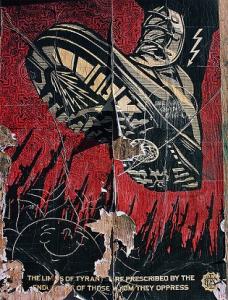
Photo by Jason OX4, who shot this poster with a quote from Frederick Douglass: “The limits of tyrants are prescribed by the endurance of those whom they oppress.” Creative Commons license ShareAlike 2.0 Generic via Flickr.
There are several different terms for “oppression” in the Hebrew Bible. Two of them are used in the same sentence in Exodus 22:21. One of them (lachatz) means to press someone hard. It is used for Balaam’s donkey shoving Balaam’s foot against a stone wall. It’s also used for when the Amorites shove the tribe of Dan back into the hills after they try to settle in the coastal plain. The other word (toneh) is a word that means to exploit someone. This word is used in Leviticus 25:14, where it says that in selling land, Israelites are not to exploit one another by charging more than the land is worth.
Another common word for oppression (‘ashaq) clearly means to practice extortion. Another word (‘innah) means to humble or subdue someone by treating them harshly. In Isaiah’s famous line “Seek justice, correct oppression” (Isaiah 1:17), the word is a rare word that means “ruthlessness.” And in Isaiah’s famous line “to let the oppressed go free” (Isa 58:6), the word means literally “those who have been crushed.”
One example of the use of power to coerce was Twitter’s lawsuit against a small Des Moines company who held the copyright on the use of the word “tweet.” (See http://siliconprairienews.com/2011/10/angry-birds-settle-twitter-iowa-based-twittad-hash-out-tweet-deal/.) Twitter sought to simply crush the small company’s right, because it had the muscle to do so. That’s how oppression works.
Eminent domain could be cited as another example of oppression. Leviticus 25:23 proclaims that all land belongs to God, and cannot be confiscated. The story of Naboth’s vineyard shows that even wicked king Ahab understood that he did not have eminent domain over the inalienable rights of Naboth to his ancestral inheritance (1 Kings 21:3). Only Jezebel, a Canaanite who had no moral hang-ups, sees the issue through modern eyes.
Deuteronomy 23:17 commands Israel not to exploit (toneh) escaped slaves, who were powerless and completely at the mercy of their hosts. Leviticus 25:14 also commands Israelites not to toneh their neighbor when selling land by unfair pricing.
What is a fair price or wage? Other contemporary law codes such as the Law of Hammurabi and the Law of Eshnunna gave official fair prices for wages, rent, and even doctor’s fees; the Hittite Law even gives a list of fair prices for merchandise. The Torah gives us none of these specific fair prices. I wish it had done so, but at least by not doing so, it avoids the problem in our U.S. Constitution of stating prices that are now woefully outdated. Even if the Torah had given us such prices, they would be useful for us only by comparison in the context of the time period in which it was decreed.
So, is a fair price always whatever the market can bear? There seems to be a difference between the price of a Super Bowl ticket or the price of lodging that night in that city, neither of which are necessities, and the price of necessities after a hurricane. Proverbs 11:26 would appear to apply here: “The people curse those who hold back grain [in order to gouge the public], but a blessing is on the head of those who sell it.”
The verb lachatz is used to describe the way the Egyptians treated the Hebrews, involving forced labor and violence. In Leviticus 25:44-46, where the Israelites are permitted to enslave pagan nations, Moses insists that slaves who are fellow Israelites must not be treated with “harshness.” Here, the word used is parek, the same word used for how the Israelites themselves were treated in Egypt (Exodus 1:13-14).
God’s commands on how to treat aliens in Israel deserve special attention. In Deuteronomy 24:14, Israel is forbidden to practice the exploitation (‘ashaq) of immigrants that prevailed in virtually all surrounding cultures at that time, which was similar to today’s treatment of illegals by smugglers, or by employers who exploit the immigration status of their workers with threats to deport them if they complain of unjust working conditions.
Any monopoly creates the kind of power that can lead to oppression, whether it be centralized health care (where who gets a kidney or heart operation may become a matter of political favoritism), or whether it be business versus union labor, a case that can work either way, depending on which side has collected more coercive power. One critic of unions writes that nobody has a moral right to force anyone to employ them at the price they demand, or to forcibly prevent the employer from hiring others. He says, “The attempt to use violence to force an employer to pay a desired non-economic wage is clearly robbery.” Both employers and unions have at times been guilty of using the kind of coercion that God’s law would call oppression.
It is from God’s word that we derive the principle that might does not make right. Without God’s word, naked power is answerable to no one.
Previous Post
November 23, 2017
God's Bill of Rights for the Poor
Next Post

November 30, 2017 Where Are the Chinese People in God's Word?
Browse Our Archives
Select a Category Biblical ethic Biblical word studies Biblical world Creation Historical Jesus Uncategorized
Select a Month July 2018 June 2018 May 2018 April 2018 March 2018 February 2018 January 2018 December 2017 November 2017 October 2017 September 2017 August 2017 July 2017
Follow Us!
TAKE THE
Religious Wisdom Quiz
Which king asked Elijah for help against the armies of Moab and Edom?
Select your answer to see how you score.
Joram Jehoshaphat Joash Jehoram
Books by This Author Books by Tom Hobson
Related posts from Biblical Words and World

Words I Never Heard in the Bible

Theology by the Polls: Ten Billion Flies Can't...

A Gospel of Glorious Half-Truth

Ham Sandwiches and Gay Sex: How Timeless Is...
TRENDING AT PATHEOS Evangelical

How the author of the world's best hymn...
I've been working with John Newton for a while now. This makes...

Long before this Lectio Divina, Psalm 130 - the song - started...

What About the Trees? Another Living Parable
After I finished writing the last article about falling leaves as a...

Why Classical Education Is a Conversation, Not a...
Come and Read: Joy in Classical Education When I was a little...

Falling Leaves: A Living Parable on Letting Go
I’ve spent the vast majority of my life in the southeast corner...

Cornell University has received a great deal of negative publicity and intense...
view all Evangelical blogs
Ad-Free & Subscriber Log-In Subscription Support
- About Us
- 2026 Calendar
- Videos
- Podcasts
- Library of World Religions
- Faith In Media Tracker
- Advertise With Us
- Write for Us
- Privacy Policy
- Terms of Service
- Do Not Sell My Data
- Contact Us
- Radiant Digital
- Manage Newsletter Subscriptions
- Unsubscribe From Notifications
- Sitemap
Copyright 2008-2026, Patheos. All rights reserved.
Subscription Support Ad-Free & Subscriber Log-In
Follow Patheos