
BuddhistCatholicContemplativeEvangelicalGeneral ChristianHinduJewishLatter-day SaintMuslimNew VisionsProgressive Christian
Beliefs
- Buddhist
- Catholic
- Contemplative
- Evangelical
- General Christian
- Hindu
- Jewish
- Latter-day Saint
- More Voices
- Muslim
- New Visions
- Pagan
- Progressive Christian
Topics
- Religion News
- Food and Religion
- Sports and Religion
- Religious Art
- Religious Music and Entertainment
- Religious Events
- History and Religion
- Style and Religion
- Politics and Religion
- Women in Religion
- Recreation Outdoors and Religion
- Business Finance and Religion
- Careers Workplace and Religion
- Education and Religion
- Family Parenting and Religion
- Health Fitness and Religion
- Home and Religion
- Relationships and Religion
- Technology and Religion
- Travel and Religion
Columnists
- Buddhist Columnists
- Business Finance and Religion Columnists
- Careers Workplace and Religion Columnists
- Catholic Columnists
- Contemplative Columnists
- Education and Religion Columnists
- Evangelists Columnists
- Family Parenting and Religion Columnists
- General Christian Columnists
- Health Fitness and Religion Columnists
- Hindu Columnists
- History and Religion Columnists
- Home and Religion Columnists
- Jewish Columnists
- More Voices Columnists
- Latter Day Columnists
- Muslim Columnists
- New Visions Columnists
- Nonreligious Columnists
- Pagan Columnists
- Politics and Religion Columnists
- Progressive Columnists
- Recreation Outdoors and Religion Columnists
- Relationships and Religion Columnists
- Religion News Columnists
- Religious Art Columnists
- Religious Events Columnists
- Religious Music and Entertainment Columnists
- Sports and Religion Columnists
- Style and Religion Columnists
- Technology and Religion Columnists
- Travel and Religion Columnists
- Women in Religion Columnists
Resource Library
- 2026 Calendar
- Library of World Religions
- The 100 Most Holy Places on Earth
- Patheos Answers
- Podcasts
- Videos
- Faith Leaders Database
- Anglican Episcopalian
- Bahai
- Baptist
- Buddhism
- Christianity
- Confucianism
- Eastern Orthodoxy
- Hinduism
- Holiness and Pentecostal
- ISKCON
- Islam
- Judaism
- Lutheran
- Methodist
- The Church of Jesus Christ of Latter-day Saints
- New Age
- Paganism
- Presbytarian and Reformed
- Protestantism
- Religion Behind the Scenes
- Roman Catholic
- Scientology
- Shia Islam
- Sikhism
- Sufism
- Sunni Islam
- Taoism
- Zen
- See all religions
Research Tools
 Ad-Free & Subscriber Log-In Subscription Support
Ad-Free & Subscriber Log-In Subscription Support
Follow Patheos 

- Trending:
- Forgiveness
- |
- Marriage
- |
- Consciousness
- |
- Death Penalty
- |
- Election
- |
- Halloween
 Biblical Words and World
- Home
- Evangelical
- What Was Wrong With Leah’s Eyes?
What Was Wrong With Leah’s Eyes?
Last updated on: October 13, 2017 at 7:27 am by Tom Hobson
What Was Wrong With Leah’s Eyes? 2017-10-13T07:27:46-05:00 Tom Hobson
Patheos Explore the world's faith through different perspectives on religion and spirituality! Patheos has the views of the prevalent religions and spiritualities of the world.
In the beauty contest between Leah and Rachel in Genesis 29:17, we are told that Leah’s eyes were “weak” (rakkoth), and (or “but”) Rachel was “beautiful of form and beautiful of appearance.” So what does that mean?
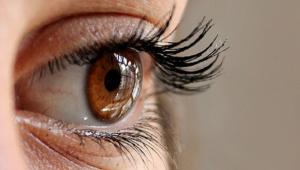
Photo: James Baker, “Women’s Black Mascara.” Creative Commons License, via https://bestreviewsbase.com, cropped.
English Bibles lean toward the opinion that Leah’s eyes were “weak,” but “soft,” “tender,” and “delicate” are also strong contenders for how to translate this line. Let’s take a look at all the uses of this adjective in the Hebrew Bible, and you can decide for yourself. (Please note that even the translation “but” versus “and” here is entirely based on our hunch as to whether a negative comparison is being made, or simply “here is Leah, and here is Rachel,” with no value judgment on either description.)
In Genesis 18:7, Abraham grabs a calf from the herd, “rak and good,” usually translated “tender.” In Proverbs 4:3, Solomon describes his earliest memories of his father’s teaching when he was rak (tender) and the only child of his mother. Ezekiel 17:22 speaks of plucking off a “tender” branch from the top of a tree.
“Tender and delicate” is an expression to describe both men and women who then become heartless cannibals of their own children (Deuteronomy 28:54, 56). It is also used in Isaiah 47:1 in a declaration to the virgin Babylon: “You shall no longer be called tender and delicate.”
The expression “tender of heart” is used in Deuteronomy 20:8, where military officers command the troops that anyone who is “fearful or tender of heart” to go home. It is also used three times in Chronicles to describe Solomon as “a boy and tender of heart” and therefore too inexperienced to run a Temple construction project, and Rehoboam (in a verbatim expression) as unable to stand up to bad advice from worthless scoundrels around him (see 1 Chronicles 22:5, 29:1; 2 Chronicles 13:7).
“Soft” is a good translation in famous lines such as Proverbs 15:1, “A soft answer turns away wrath,” and Proverbs 25:15, “A soft tongue can break a bone.” This meaning also fits in Job 40:27 about Leviathan: “Will he speak soft words to you?”
“Weak” seems to be the best way to translate this word in Genesis 33:13, where Jacob says he cannot keep up with the pace of his brother Esau, because his children are “weak/frail” and his flocks are nursing. A very revealing statement that uses this word is in 2 Samuel 3:39, where David makes excuses as to why he cannot punish Joab for murdering Abner, the opposing general who came to make peace: “Today I am weak, though I am anointed king. These men, the sons of Zeruiah, are too harsh for me.” (Sounds like David owed too much to the warriors who helped put him in power!)
The related stative verb form “to be tender” is used eight times in the Hebrew Bible. In 2 Kings 22:19 (= 2 Chronicles 34:27), Huldah the prophetess says that King Josiah’s heart was “penitent” (literally “was soft” as opposed to hard or stubborn). In Psalm 55:21, David says that his enemy’s words “were softer” than oil, but they were drawn swords. Isaiah (1:6) says that Zion’s wounds have not been “softened” with oil. And in three places, we find exhortations that the listeners’ hearts should not “be soft” or faint (Deuteronomy 20:3, Isaiah 7:4, Jeremiah 51:46), plus a declaration in Job 23:16 that God had made his heart that way.
That’s all the times this adjective rak and its related verb are used in the Hebrew Bible. So, which is it in the case of Leah’s eyes: weak, soft, tender, or delicate? You make the call. Just know what the options are. The truth of God’s word does not hang in the balance on which meaning we prefer.
So how does it all play out? One of my parishioners has suggested that while Jacob chooses Rachel as the winner of this beauty contest at the beginning of the story, in the end Leah ends up being more loved than Rachel, perhaps because of all of the children she bore to him. I’m not so sure I agree with him, but yes, I have always thought it was curious that Leah gets buried with Jacob in the family burial cave at Qiryat-Arba, while Rachel gets buried on the side of the road on the way to Bethlehem. How crazy that the line of Jacob’s royal descendants all seems to hang on a beauty contest between two sets of eyes!
If the account of Rachel and Leah is fiction, the above question is unanswerable and irrelevant (Rachel’s Tomb itself would become a fictionally-motivated name). But the fiction approach is unnecessary. Only the historical Jacob knows whether he ever came to truly love Leah as strongly as he loved Rachel. Their story becomes a living illustration of the downside of polygamy as a departure from God’s explicit intention for sex and marriage (see my recent post “God’s Sex Mandate” at http://www.patheos.com/blogs/tomhobson/2017/09/gods-sex-mandate-two-shall-become-one-flesh/), as well as a living illustration of why the later Law of Moses forbids marriage between a man and two sisters simultaneously (Leviticus 18:18).
It is uncanny how God is able to use messed-up sexual behavior that is contrary to his intention, in order to achieve important long-range sovereign plans. God overturns the results of the beauty contest between two sets of eyes. God actually uses the trickery of a pushy Syrian sheep rancher to con Jacob into a marriage he never would have chosen, in order for his unwanted wife to become the mother of the future royal line, and ultimately of the Messiah.
Leah’s “soft” eyes are eventually mirrored in the eyes of the earthly Jesus. But today, his eyes are a flame of fire as he awaits the appointed time for his return to Planet Earth.
Previous Post

October 9, 2017
Kill, Smite, or Wound in the Casualty Report?
Next Post

October 16, 2017 Laughing, Playing, and Beyond Child's Play
Browse Our Archives
Select a Category Biblical ethic Biblical word studies Biblical world Creation Historical Jesus Uncategorized
Select a Month July 2018 June 2018 May 2018 April 2018 March 2018 February 2018 January 2018 December 2017 November 2017 October 2017 September 2017 August 2017 July 2017
Follow Us!
TAKE THE
Religious Wisdom Quiz
Who was called by God to leave his home and go to a land God would show him?
Select your answer to see how you score.
Moses Abram Noah Jacob
Books by This Author Books by Tom Hobson
Related posts from Biblical Words and World

Words I Never Heard in the Bible

Be Ye Perfect? What Does Jesus Mean?

What's the Difference Between Spirit and Soul?
Soul or Life? The Double Meaning of Psychē
TRENDING AT PATHEOS Evangelical

How the author of the world's best hymn...
I've been working with John Newton for a while now. This makes...

Long before this Lectio Divina, Psalm 130 - the song - started...

What About the Trees? Another Living Parable
After I finished writing the last article about falling leaves as a...

Why Classical Education Is a Conversation, Not a...
Come and Read: Joy in Classical Education When I was a little...

Falling Leaves: A Living Parable on Letting Go
I’ve spent the vast majority of my life in the southeast corner...

Cornell University has received a great deal of negative publicity and intense...
view all Evangelical blogs
Ad-Free & Subscriber Log-In Subscription Support
- About Us
- 2026 Calendar
- Videos
- Podcasts
- Library of World Religions
- Faith In Media Tracker
- Advertise With Us
- Write for Us
- Privacy Policy
- Terms of Service
- Do Not Sell My Data
- Contact Us
- Radiant Digital
- Manage Newsletter Subscriptions
- Unsubscribe From Notifications
- Sitemap
Copyright 2008-2026, Patheos. All rights reserved.
Subscription Support Ad-Free & Subscriber Log-In
Follow Patheos