
BuddhistCatholicContemplativeEvangelicalGeneral ChristianHinduJewishLatter-day SaintMuslimNew VisionsProgressive Christian
Beliefs
- Buddhist
- Catholic
- Contemplative
- Evangelical
- General Christian
- Hindu
- Jewish
- Latter-day Saint
- More Voices
- Muslim
- New Visions
- Pagan
- Progressive Christian
Topics
- Religion News
- Food and Religion
- Sports and Religion
- Religious Art
- Religious Music and Entertainment
- Religious Events
- History and Religion
- Style and Religion
- Politics and Religion
- Women in Religion
- Recreation Outdoors and Religion
- Business Finance and Religion
- Careers Workplace and Religion
- Education and Religion
- Family Parenting and Religion
- Health Fitness and Religion
- Home and Religion
- Relationships and Religion
- Technology and Religion
- Travel and Religion
Columnists
- Buddhist Columnists
- Business Finance and Religion Columnists
- Careers Workplace and Religion Columnists
- Catholic Columnists
- Contemplative Columnists
- Education and Religion Columnists
- Evangelists Columnists
- Family Parenting and Religion Columnists
- General Christian Columnists
- Health Fitness and Religion Columnists
- Hindu Columnists
- History and Religion Columnists
- Home and Religion Columnists
- Jewish Columnists
- More Voices Columnists
- Latter Day Columnists
- Muslim Columnists
- New Visions Columnists
- Nonreligious Columnists
- Pagan Columnists
- Politics and Religion Columnists
- Progressive Columnists
- Recreation Outdoors and Religion Columnists
- Relationships and Religion Columnists
- Religion News Columnists
- Religious Art Columnists
- Religious Events Columnists
- Religious Music and Entertainment Columnists
- Sports and Religion Columnists
- Style and Religion Columnists
- Technology and Religion Columnists
- Travel and Religion Columnists
- Women in Religion Columnists
Resource Library
- 2026 Calendar
- Library of World Religions
- The 100 Most Holy Places on Earth
- Patheos Answers
- Podcasts
- Videos
- Faith Leaders Database
- Anglican Episcopalian
- Bahai
- Baptist
- Buddhism
- Christianity
- Confucianism
- Eastern Orthodoxy
- Hinduism
- Holiness and Pentecostal
- ISKCON
- Islam
- Judaism
- Lutheran
- Methodist
- The Church of Jesus Christ of Latter-day Saints
- New Age
- Paganism
- Presbytarian and Reformed
- Protestantism
- Religion Behind the Scenes
- Roman Catholic
- Scientology
- Shia Islam
- Sikhism
- Sufism
- Sunni Islam
- Taoism
- Zen
- See all religions
Research Tools
 Ad-Free & Subscriber Log-In Subscription Support
Ad-Free & Subscriber Log-In Subscription Support
Follow Patheos 

- Trending:
- Forgiveness
- |
- Marriage
- |
- Consciousness
- |
- Death Penalty
- |
- Election
- |
- Halloween
 Biblical Words and World
- Home
- Evangelical
- No Historical Adam Means Open Door to Racism
No Historical Adam Means Open Door to Racism
Last updated on: September 27, 2017 at 10:30 am by Tom Hobson
No Historical Adam Means Open Door to Racism 2017-09-27T10:30:50-05:00 Tom Hobson
Patheos Explore the world's faith through different perspectives on religion and spirituality! Patheos has the views of the prevalent religions and spiritualities of the world.
Unless we believe that the entire human race began with a single pair of ancestors, we open the door to racism. A lot hangs on the existence of an historical Adam and Eve.
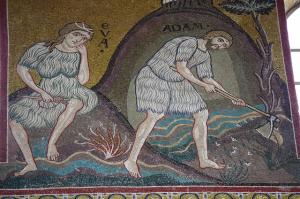
“The Toil of Adam and Eve,” Cattedrale di Monreale, Santicelli, Palermo, Italy. Photo by SNappa2006, Creative Commons license via Flickr.
The debate about the historical Adam began to heat up around ten years ago, when Francis Collins, who is both the biologist who headed up the Human Genome project and an evangelical Christian, declared in his book The Language of Science and Faith that the complexity of the human genome requires an original population of 10,000. The debate boils down to estimates made by population genomics as to the size of a population bottleneck 150,000 years ago from which the whole human species appears to have descended.
The issue became the main topic of the June 2011 edition of Christianity Today (see Richard Ostling’s article at http://www.christianitytoday.com/ct/2011/june/historicaladam.html for a summary). In an interview there, evangelical Bible scholar Bruce Waltke is quoted as saying that if genetics produces the conclusion that “Scripture has a collectivity represented as an individual, that doesn’t bother me.”
However, in his book Did Adam and Eve Really Exist?, Bible scholar John Collins (not to be confused with Francis Collins, the aforementioned genome specialist) urges extreme caution in the genetic discussion, because it is based heavily on guesswork, estimates, and assumptions. Expert guesses are what they are; they are subject to correction as we are able to find empirical means to test them, and we would certainly hesitate to fly on an airplane if aviation science were based on the same level of guesswork.
Aside from the question of whether we are a human race with only one pair of ancestors, there is also the question of where in ancient time do we locate such a pair of ancestors. Most efforts to distinguish Adam from earlier hominids place him in the early Paleolithic era, around 40,000 years ago, at a time where there appear to have been sizeable advancements in tools, weaponry, and art.
However, many observers point out that Genesis 4’s description of earliest civilization sounds much more Neolithic (post-10,000 BCE) than Paleolithic. Based on what hard data we possess at the moment, the first city-building, the first agriculture (including domestication of animals), and the first metallurgy all appear to have happened in Neolithic times.
What does that do to our picture of Cain and his descendants? If Cain and Abel are Adam’s immediate descendants, as it appears, we can choose to see them as hunter-gatherers (which may impact how we see the gifts they offer to God). But if the rest of the developments in Genesis 4 are much later, there would appear to be a huge gap between Cain and the cultural developments described in this chapter.
My approach is that, for the most part, I think the Biblical historian is telescoping or condensing the long stretch of time in question here. After Cain, we seem to hit the fast-forward button to Neolithic times. Virtually all parties are agreed that the genealogies are not strictly father-son, and even the names given are the names by which the Hebrews knew these figures, which may not have been what they were called in whatever language they spoke at that time.
(By the way, Genesis 4 gives us names hundreds of years older than Moses. Some come from Old Akkadian; some are even found in texts from that era. They are not names from later centuries. See Richard Hess’s book Studies in the Personal Names of Genesis 1-11.)
The status of language itself at this time is an open question. We have no hard evidence for how quickly language developed that is any earlier than the invention of writing approximately 5000 years ago. How long languages took to develop becomes highly conjectural, the same kind of guesswork that I took a dim view of earlier in this post. My trust in the Bible, plus the absence of strong reason to believe otherwise, leads me to believe that language began with this (Paleolithic?) pair we call Adam and Eve.
And although most of the data in Genesis 4 seems to be Neolithic, we should be prepared for surprises in the data that do not fit our preconceived compartmentalization of reality. We are told that Tubal-Cain as the ancestor of those who made iron tools (Genesis 4:22) is a hopeless anachronism, far too early for the Iron Age we know. But then we find the man who froze to death in the Alps in 3300 BCE carrying iron tools; maybe it is our preconceived notions about the Iron Age that need to be adjusted. We may also balk at the idea of music being invented so early, but the discovery of a bone whistle in Libya dating to at least 40,000 BCE makes it possible for us to date Jubal (Genesis 4:21) to Paleolithic times. (See Davis Young, “The Antiquity and the Unity of the Human Race Revisited,” http://www.asa3.org/ASA/resources/CSRYoung.html.)
Pastor Tim Keller is quoted in the above Christianity Today article as saying that the non-existence of an historical Adam undercuts the whole of what we believe about sin and redemption. I am in essential agreement. Waltke’s proposal of Adam being a collective representation of humankind and its universal fall, if the facts demanded it, can only be a “last-resort” possibility for me. Here is where my bias in favor of Biblical authority leads me to be skeptical of the purported claims of science until they are proven trustworthy. Too often guesswork can be agenda-driven.
The solidarity of the human race is indeed a critical issue for the reality of universal sin, as well as redemption for sinners. Sin is gobbledygook to an ape, as it probably was for ancient hominids. Without meaningful solidarity throughout the human species, the fall of the human race gets too complicated to be credible.
But even if we choose to believe that sin and redemption are not a problem with a pool of 10,000 original humans, there is still one more implication we must face. If we are not one blood, descended from the same pair of parents, then we can easily argue that my species of the genus Homo is superior to yours. Then the only grounds we will have for condemning racism is “because I said so.” And that argument won’t last long on the wrong end of Mao’s barrel of a gun. Then the shotgun will indeed sing the song.
Previous Post

September 18, 2017
How Equal Was Adam's Mate?
Next Post
September 25, 2017 Methuselah: Man of Vitality
Browse Our Archives
Select a Category Biblical ethic Biblical word studies Biblical world Creation Historical Jesus Uncategorized
Select a Month July 2018 June 2018 May 2018 April 2018 March 2018 February 2018 January 2018 December 2017 November 2017 October 2017 September 2017 August 2017 July 2017
Follow Us!
TAKE THE
Religious Wisdom Quiz
What is the biblical view of work?
Select your answer to see how you score.
Work is a curse Only kings should work Avoid work Work hard as for the Lord
Books by This Author Books by Tom Hobson
Related posts from Biblical Words and World

Musonius Rufus, Women's Equality, and the New Testament


TRENDING AT PATHEOS Evangelical

How the author of the world's best hymn...
I've been working with John Newton for a while now. This makes...

Long before this Lectio Divina, Psalm 130 - the song - started...

What About the Trees? Another Living Parable
After I finished writing the last article about falling leaves as a...

Why Classical Education Is a Conversation, Not a...
Come and Read: Joy in Classical Education When I was a little...

Falling Leaves: A Living Parable on Letting Go
I’ve spent the vast majority of my life in the southeast corner...

Cornell University has received a great deal of negative publicity and intense...
view all Evangelical blogs
Ad-Free & Subscriber Log-In Subscription Support
- About Us
- 2026 Calendar
- Videos
- Podcasts
- Library of World Religions
- Faith In Media Tracker
- Advertise With Us
- Write for Us
- Privacy Policy
- Terms of Service
- Do Not Sell My Data
- Contact Us
- Radiant Digital
- Manage Newsletter Subscriptions
- Unsubscribe From Notifications
- Sitemap
Copyright 2008-2026, Patheos. All rights reserved.
Subscription Support Ad-Free & Subscriber Log-In
Follow Patheos