
BuddhistCatholicContemplativeEvangelicalGeneral ChristianHinduJewishLatter-day SaintMuslimNew VisionsProgressive Christian
Beliefs
- Buddhist
- Catholic
- Contemplative
- Evangelical
- General Christian
- Hindu
- Jewish
- Latter-day Saint
- More Voices
- Muslim
- New Visions
- Pagan
- Progressive Christian
Topics
- Religion News
- Food and Religion
- Sports and Religion
- Religious Art
- Religious Music and Entertainment
- Religious Events
- History and Religion
- Style and Religion
- Politics and Religion
- Women in Religion
- Recreation Outdoors and Religion
- Business Finance and Religion
- Careers Workplace and Religion
- Education and Religion
- Family Parenting and Religion
- Health Fitness and Religion
- Home and Religion
- Relationships and Religion
- Technology and Religion
- Travel and Religion
Columnists
- Buddhist Columnists
- Business Finance and Religion Columnists
- Careers Workplace and Religion Columnists
- Catholic Columnists
- Contemplative Columnists
- Education and Religion Columnists
- Evangelists Columnists
- Family Parenting and Religion Columnists
- General Christian Columnists
- Health Fitness and Religion Columnists
- Hindu Columnists
- History and Religion Columnists
- Home and Religion Columnists
- Jewish Columnists
- More Voices Columnists
- Latter Day Columnists
- Muslim Columnists
- New Visions Columnists
- Nonreligious Columnists
- Pagan Columnists
- Politics and Religion Columnists
- Progressive Columnists
- Recreation Outdoors and Religion Columnists
- Relationships and Religion Columnists
- Religion News Columnists
- Religious Art Columnists
- Religious Events Columnists
- Religious Music and Entertainment Columnists
- Sports and Religion Columnists
- Style and Religion Columnists
- Technology and Religion Columnists
- Travel and Religion Columnists
- Women in Religion Columnists
Resource Library
- 2026 Calendar
- Library of World Religions
- The 100 Most Holy Places on Earth
- Patheos Answers
- Podcasts
- Videos
- Faith Leaders Database
- Anglican Episcopalian
- Bahai
- Baptist
- Buddhism
- Christianity
- Confucianism
- Eastern Orthodoxy
- Hinduism
- Holiness and Pentecostal
- ISKCON
- Islam
- Judaism
- Lutheran
- Methodist
- The Church of Jesus Christ of Latter-day Saints
- New Age
- Paganism
- Presbytarian and Reformed
- Protestantism
- Religion Behind the Scenes
- Roman Catholic
- Scientology
- Shia Islam
- Sikhism
- Sufism
- Sunni Islam
- Taoism
- Zen
- See all religions
Research Tools
 Ad-Free & Subscriber Log-In Subscription Support
Ad-Free & Subscriber Log-In Subscription Support
Follow Patheos 

- Trending:
- Forgiveness
- |
- Marriage
- |
- Consciousness
- |
- Death Penalty
- |
- Election
- |
- Halloween
 Biblical Words and World
- Home
- Evangelical
- Firmament: Dome or Atmosphere?
Firmament: Dome or Atmosphere?
Last updated on: September 4, 2017 at 6:45 am by Tom Hobson
Firmament: Dome or Atmosphere? 2017-09-03T20:01:19-05:00 Tom Hobson
Patheos Explore the world's faith through different perspectives on religion and spirituality! Patheos has the views of the prevalent religions and spiritualities of the world.
What is the “firmament” in the Genesis creation account? Is it a solid dome over the earth, as some claim? Or is Genesis talking about what we call the atmosphere?
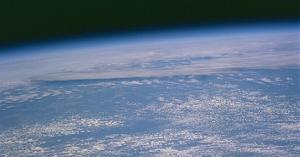
Could “firmament” in Genesis 1 be better translated “expanse” or “atmosphere”? Photo: NASA, Public Domain, via Wikimedia Commons.
The Hebrew word raqi‘a (most often translated “firmament”) is used nine times in Genesis 1. It is also used twice in Psalms, five times in Ezekiel, and once in Daniel. The raqi‘a is the focal point of the second day of creation: “Let there be a raqi‘a in the midst of the waters” to separate the waters above from the waters below, “and God called the raqi‘a Sky/Heaven.” In Psalm 19:1, the raqi‘a and “the heavens” are equated, paired there as poetic synonyms. In Psalm 150:1, God’s raqi‘a is paired poetically with “his sanctuary.” Daniel 12:3 pairs this same raqi‘a with the domain of the stars.
Ezekiel’s use of raqi‘a may or may not refer to the same heavenly part of creation. In the context of his vision of what almost appear to be spaceships, Ezekiel sees a raqi‘a (without the definite article “the” when it is first mentioned), with a throne above it, someone seated on it, and a voice that comes from there (Ezek 1:22-26, 10:1). Whether or not this is meant to be the universal heavenly canopy created in Genesis 1 is not entirely clear.
The use of the Greek stereōma and the Latin firmamentum to translate raqi‘a has led to the persistent claim that what God creates above the earth on the second day of creation is a solid dome. This has led to two different ways to understand the language used here. One is to conclude that that the Biblical narrator and audience were hopelessly prescientific slobs who really believed that the sky was a solid dome. The other approach is to understand the language as poetic and based on appearances, much as even modern scientists may refer to Mother Nature and sunrise.
Claims that the ancient Semitic world believed in such a dome separating the earthly and heavenly domains have been debunked by cuneiform scholars W.G. Lambert and Wayne Horowitz. One must travel several centuries after Genesis to the Greeks to find belief in a solid dome over the earth, and even this turns out to be one of several concentric solid spheres. It is perhaps this Greco-Roman belief that influenced the translations of the Septuagint and Vulgate toward the notion of a “firmament.” Yet even by the time of Basil, Christian scholars began to question how solid that object that separates us from space really was. So the notion of “firmament” as the way to translate raqi‘a is the result of bad Greco-Roman science.
But there is a better way to translate raqi‘a. The better option is to call it an “expanse.” The reason why is to be found in the meaning of the verbal root on which the noun is based. The verb raqa‘, used eleven times in the Hebrew Bible, means to hammer thin, to stamp, and/or to spread. It is used for the manufacture of gold leaf in Exodus 39:3. In Numbers 17:4, Eleazar hammers bronze censers into a covering for the ark. In 2 Samuel 22:43, David sings, “I crushed them, I stomped (or spread?) them like the mud of the streets.” Psalm 136:6 says that God “spread the earth upon the waters” (similarly, Isaiah 42:5 and 44:24). Isaiah 40:19 speaks of an artisan “overlaying” an idol with gold. Jeremiah 10:9 refers to “beaten” silver. And Ezekiel 6:11 and 25:6 both speak of “stomping” one’s feet.
Those who believe the raqi‘a to be a solid dome point to the verb’s use in metallurgy as evidence that the “firmament” is to be understood as a hard metal dome or vault (thus the entries in Holladay and Koehler-Baumgartner). The one verse lending support to this argument is Job 37:18: “Can you, like him, spread out the skies, hard as a molten mirror?” (NRSV) But almost every word in this verse is open to being read differently. A better translation might be, “Can you, like him, spread out the clouds, strong (or mighty), like a display that has been poured out?”
There is less about solidity in this verbal root raqa‘, than there is about thinness. Raqa‘ means to spread out material very thin. So “expanse” becomes a far superior translation for raqi‘a, whether or not one chooses to see that expanse as solid or otherwise. We don’t need to see the Biblical picture of the sky as if it were a dome with windows to hold back an ocean of water from above. “Windows” and the raqi‘a never appear together, and the language of “windows” is arguably not intended to be literal. As Younker and Davidson write, “One of the great ironies in recreating a Biblical cosmology is that scholars have tended to treat figurative usages as literal (such as Psalms and Job), while treating literal passages, such as Genesis, as figurative.”
Could one not see the atmosphere as that expanse or thin separation that God has created between earth and space? At the risk of being accused of reading into the Bible what one wants to find there, I would suggest that “expanse” is far more linguistically sound, consistent with the Biblical uses of the word, and both scientifically and theologically tenable. Such an approach also avoids condescension – it shows far more respect for the Biblical authors. You know, what they say is sometimes more profound than what they themselves could have grasped.
Previous Post

August 31, 2017
How Did Creation Happen?
Next Post

September 7, 2017 Sea Monsters in Genesis?
Browse Our Archives
Select a Category Biblical ethic Biblical word studies Biblical world Creation Historical Jesus Uncategorized
Select a Month July 2018 June 2018 May 2018 April 2018 March 2018 February 2018 January 2018 December 2017 November 2017 October 2017 September 2017 August 2017 July 2017
Follow Us!
TAKE THE
Religious Wisdom Quiz
What does the Bible say about pride?
Select your answer to see how you score.
It's always good Pride is the best It goes before a fall It's ignored
Books by This Author Books by Tom Hobson
Related posts from Biblical Words and World

Words I Never Heard in the Bible

Musonius Rufus, Women's Equality, and the New Testament


TRENDING AT PATHEOS Evangelical

How the author of the world's best hymn...
I've been working with John Newton for a while now. This makes...

Long before this Lectio Divina, Psalm 130 - the song - started...

What About the Trees? Another Living Parable
After I finished writing the last article about falling leaves as a...

Why Classical Education Is a Conversation, Not a...
Come and Read: Joy in Classical Education When I was a little...

Falling Leaves: A Living Parable on Letting Go
I’ve spent the vast majority of my life in the southeast corner...

Cornell University has received a great deal of negative publicity and intense...
view all Evangelical blogs
Ad-Free & Subscriber Log-In Subscription Support
- About Us
- 2026 Calendar
- Videos
- Podcasts
- Library of World Religions
- Faith In Media Tracker
- Advertise With Us
- Write for Us
- Privacy Policy
- Terms of Service
- Do Not Sell My Data
- Contact Us
- Radiant Digital
- Manage Newsletter Subscriptions
- Unsubscribe From Notifications
- Sitemap
Copyright 2008-2026, Patheos. All rights reserved.
Subscription Support Ad-Free & Subscriber Log-In
Follow Patheos