
BuddhistCatholicContemplativeEvangelicalGeneral ChristianHinduJewishLatter-day SaintMuslimNew VisionsProgressive Christian
Beliefs
- Buddhist
- Catholic
- Contemplative
- Evangelical
- General Christian
- Hindu
- Jewish
- Latter-day Saint
- More Voices
- Muslim
- New Visions
- Pagan
- Progressive Christian
Topics
- Religion News
- Food and Religion
- Sports and Religion
- Religious Art
- Religious Music and Entertainment
- Religious Events
- History and Religion
- Style and Religion
- Politics and Religion
- Women in Religion
- Recreation Outdoors and Religion
- Business Finance and Religion
- Careers Workplace and Religion
- Education and Religion
- Family Parenting and Religion
- Health Fitness and Religion
- Home and Religion
- Relationships and Religion
- Technology and Religion
- Travel and Religion
Columnists
- Buddhist Columnists
- Business Finance and Religion Columnists
- Careers Workplace and Religion Columnists
- Catholic Columnists
- Contemplative Columnists
- Education and Religion Columnists
- Evangelists Columnists
- Family Parenting and Religion Columnists
- General Christian Columnists
- Health Fitness and Religion Columnists
- Hindu Columnists
- History and Religion Columnists
- Home and Religion Columnists
- Jewish Columnists
- More Voices Columnists
- Latter Day Columnists
- Muslim Columnists
- New Visions Columnists
- Nonreligious Columnists
- Pagan Columnists
- Politics and Religion Columnists
- Progressive Columnists
- Recreation Outdoors and Religion Columnists
- Relationships and Religion Columnists
- Religion News Columnists
- Religious Art Columnists
- Religious Events Columnists
- Religious Music and Entertainment Columnists
- Sports and Religion Columnists
- Style and Religion Columnists
- Technology and Religion Columnists
- Travel and Religion Columnists
- Women in Religion Columnists
Resource Library
- 2026 Calendar
- Library of World Religions
- The 100 Most Holy Places on Earth
- Patheos Answers
- Podcasts
- Videos
- Faith Leaders Database
- Anglican Episcopalian
- Bahai
- Baptist
- Buddhism
- Christianity
- Confucianism
- Eastern Orthodoxy
- Hinduism
- Holiness and Pentecostal
- ISKCON
- Islam
- Judaism
- Lutheran
- Methodist
- The Church of Jesus Christ of Latter-day Saints
- New Age
- Paganism
- Presbytarian and Reformed
- Protestantism
- Religion Behind the Scenes
- Roman Catholic
- Scientology
- Shia Islam
- Sikhism
- Sufism
- Sunni Islam
- Taoism
- Zen
- See all religions
Research Tools
 Ad-Free & Subscriber Log-In Subscription Support
Ad-Free & Subscriber Log-In Subscription Support
Follow Patheos 

- Trending:
- Forgiveness
- |
- Marriage
- |
- Consciousness
- |
- Death Penalty
- |
- Election
- |
- Halloween
 Biblical Words and World
- Home
- Evangelical
- How Do We Explain Noah’s Flood?
How Do We Explain Noah’s Flood?
Last updated on: September 28, 2017 at 7:29 pm by Tom Hobson
How Do We Explain Noah’s Flood? 2017-09-28T19:29:21-05:00 Tom Hobson
Patheos Explore the world's faith through different perspectives on religion and spirituality! Patheos has the views of the prevalent religions and spiritualities of the world.
There was a real Flood. How deep it was, is open for discussion. But the concept of Biblical authority requires me to believe that a near-extinction of the human race took place in conjunction with a flood of unprecedented scale that was experienced worldwide. The possibility of “authoritative myth” for me is an unacceptable self-contradiction.
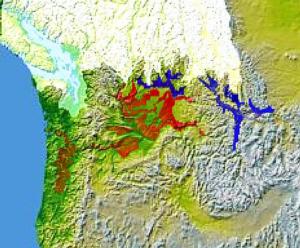
The Missoula Flood, along with other floods at the end of the last Ice Age, may be connected to Noah’s flood. NASA Topographical Map. Public Domain via Creative Commons Attribution ShareAlike 3.0.
Jesus spoke of the Flood as real (Matthew 24:37-39; Luke 17:26-27). Either Jesus knew better and was lying, or he did not know any better, or he was telling the truth. As to how to understand this flood, there are numerous explanations, none of which is without difficulties. But like the light from a distant star, the star may not look exactly like what I see, but there is a real star that is producing what I see.
Genesis 7:19 states in the Hebrew that “the waters grew very, very mighty [emphasis original] upon the earth (or land), and all the high mountains (or hills) were covered under the whole heaven (or sky).” The Hebrew permits, but does not require, the sense that the tops of the Himalayas were covered (15 cubits deep, according to the next verse). But the Hebrew also permits us to read “land,” “hills,” and “sky,” which would allow the sense of a flood that was less than six miles deep.
The word har can mean either mountain or hill. Zion is a har much shorter than Mount Everest, and not much higher than its surroundings; likewise, har in 1 Samuel 17:3 refers to hills in the coastal plain where David fought Goliath. The word eretz (used over 2500 times in the Hebrew Bible) is broad enough to mean “earth” as opposed to “sky / heaven” (Genesis 1:1), “land” in a more local sense (Genesis 12:1), “piece of property” (Genesis 23:15), or even “ground” in a directional sense (Genesis 18:2). Also, there is the question whether “all” in Scripture is always absolute (see Jeremiah 44:12-14, and also Exodus 9, where all the cattle are killed by disease, then more are killed in a subsequent plague by hail).
“If the plain sense of Scripture makes good sense, seek no other sense.” I heartily agree. But a flood six miles deep that covered the Himalayas would require multiple times as much water as we have on earth at present, which would require God to suddenly manufacture all that water out of thin air, and then make it disappear just as fast. Whitcomb and Morris argue in The Genesis Flood for a Himalaya-sized flood that to them accounts for the formation of rock and for fossils (the catastrophic model, as opposed to the uniformitarian model), but Christian geologist Davis Young argues in Creation and the Flood firmly against the catastrophic model.
A variation that seeks to explain the catastrophic amount of water required by the Flood is the hydroplate theory articulated by Walt Brown (Center for Scientific Creation: http://www.creationscience.com/onlinebook/HydroplateOverview2.html). Brown’s explanation is that catastrophic fissures in the earth’s tectonic plates released huge amounts of superheated underground water, much of which came down as rain, and eventually made its way underground again.
On the opposite end of the scholarly spectrum, Mallowan (“Noah’s Flood Reconsidered,” Iraq 26 1964: 62-82) argues for the historicity of a cataclysm in the Fertile Crescent around 3000 BCE. He notes that Noah floats the opposite way from where a huge river flood would carry him. In my opinion, this flood would be far too late to be the Genesis flood.
The human race appears to have gone through a near extinction around the end of the last Ice Age, just when we would predict a flood. The Missoula floods would be one such example. There are also signs of a catastrophic flood in Canada that flooded the St. Lawrence (8750 BCE, according to Al Gore’s Earth in the Balance) and in the Black Sea area (7400 BCE according to Ryan, 5500 BCE according to Ballard), where an early civilization along a much lower freshwater lakeshore suddenly saw the water level rise 200-400 feet, as seawater came rushing in. In his recent book The Long Ascent, physicist Robert Sheldon proposes a catastrophic flooding of a much lower Mediterranean Sea around this same time, at a time where an ice-bound Europe would have driven humans to gather in a much warmer basin. Under this theory, the pre-Flood civilization may be the one that lies behind memories of Atlantis, with the same geological explanation applicable to both.
Sightings of wood structures in the snow high on Mount Ararat have never been substantiated. But near the Turkish town of Doğubayazit (5000 feet elevation), there is a site with traces of a huge ancient boat (now disintegrated), plus anchor stones (http://www.arkdiscovery.com/noah%27s_ark.htm). The relics appear to be no older than 2000 BCE, and could be substantially later. They may be a very early monument to Noah, or a purely geological formation.
Francis Schaeffer states in Genesis in Space and Time that the universality of the flood (although he believes in it) should not be made a test of orthodoxy. I agree. But to me, it is important that a flood of unprecedented proportions came close to extinguishing the human race. I merely seek to correlate that Biblical teaching with the evidence that is available to us.
Previous Post
September 25, 2017
Methuselah: Man of Vitality
Next Post
October 2, 2017 More Tolerable for Sodom
Browse Our Archives
Select a Category Biblical ethic Biblical word studies Biblical world Creation Historical Jesus Uncategorized
Select a Month July 2018 June 2018 May 2018 April 2018 March 2018 February 2018 January 2018 December 2017 November 2017 October 2017 September 2017 August 2017 July 2017
Follow Us!
TAKE THE
Religious Wisdom Quiz
What does "Immanuel" mean in Hebrew?
Select your answer to see how you score.
The Lord reigns The Anointed One Prince of Peace God with us
Books by This Author Books by Tom Hobson
Related posts from Biblical Words and World

Words I Never Heard in the Bible

Musonius Rufus, Women's Equality, and the New Testament


TRENDING AT PATHEOS Evangelical

How the author of the world's best hymn...
I've been working with John Newton for a while now. This makes...

Long before this Lectio Divina, Psalm 130 - the song - started...

What About the Trees? Another Living Parable
After I finished writing the last article about falling leaves as a...

Why Classical Education Is a Conversation, Not a...
Come and Read: Joy in Classical Education When I was a little...

Falling Leaves: A Living Parable on Letting Go
I’ve spent the vast majority of my life in the southeast corner...

Cornell University has received a great deal of negative publicity and intense...
view all Evangelical blogs
Ad-Free & Subscriber Log-In Subscription Support
- About Us
- 2026 Calendar
- Videos
- Podcasts
- Library of World Religions
- Faith In Media Tracker
- Advertise With Us
- Write for Us
- Privacy Policy
- Terms of Service
- Do Not Sell My Data
- Contact Us
- Radiant Digital
- Manage Newsletter Subscriptions
- Unsubscribe From Notifications
- Sitemap
Copyright 2008-2026, Patheos. All rights reserved.
Subscription Support Ad-Free & Subscriber Log-In
Follow Patheos