
BuddhistCatholicContemplativeEvangelicalGeneral ChristianHinduJewishLatter-day SaintMuslimNew VisionsProgressive Christian
Beliefs
- Buddhist
- Catholic
- Contemplative
- Evangelical
- General Christian
- Hindu
- Jewish
- Latter-day Saint
- More Voices
- Muslim
- New Visions
- Pagan
- Progressive Christian
Topics
- Religion News
- Food and Religion
- Sports and Religion
- Religious Art
- Religious Music and Entertainment
- Religious Events
- History and Religion
- Style and Religion
- Politics and Religion
- Women in Religion
- Recreation Outdoors and Religion
- Business Finance and Religion
- Careers Workplace and Religion
- Education and Religion
- Family Parenting and Religion
- Health Fitness and Religion
- Home and Religion
- Relationships and Religion
- Technology and Religion
- Travel and Religion
Columnists
- Buddhist Columnists
- Business Finance and Religion Columnists
- Careers Workplace and Religion Columnists
- Catholic Columnists
- Contemplative Columnists
- Education and Religion Columnists
- Evangelists Columnists
- Family Parenting and Religion Columnists
- General Christian Columnists
- Health Fitness and Religion Columnists
- Hindu Columnists
- History and Religion Columnists
- Home and Religion Columnists
- Jewish Columnists
- More Voices Columnists
- Latter Day Columnists
- Muslim Columnists
- New Visions Columnists
- Nonreligious Columnists
- Pagan Columnists
- Politics and Religion Columnists
- Progressive Columnists
- Recreation Outdoors and Religion Columnists
- Relationships and Religion Columnists
- Religion News Columnists
- Religious Art Columnists
- Religious Events Columnists
- Religious Music and Entertainment Columnists
- Sports and Religion Columnists
- Style and Religion Columnists
- Technology and Religion Columnists
- Travel and Religion Columnists
- Women in Religion Columnists
Resource Library
- 2026 Calendar
- Library of World Religions
- The 100 Most Holy Places on Earth
- Patheos Answers
- Podcasts
- Videos
- Faith Leaders Database
- Anglican Episcopalian
- Bahai
- Baptist
- Buddhism
- Christianity
- Confucianism
- Eastern Orthodoxy
- Hinduism
- Holiness and Pentecostal
- ISKCON
- Islam
- Judaism
- Lutheran
- Methodist
- The Church of Jesus Christ of Latter-day Saints
- New Age
- Paganism
- Presbytarian and Reformed
- Protestantism
- Religion Behind the Scenes
- Roman Catholic
- Scientology
- Shia Islam
- Sikhism
- Sufism
- Sunni Islam
- Taoism
- Zen
- See all religions
Research Tools
 Ad-Free & Subscriber Log-In Subscription Support
Ad-Free & Subscriber Log-In Subscription Support
Follow Patheos 

- Trending:
- Forgiveness
- |
- Marriage
- |
- Consciousness
- |
- Death Penalty
- |
- Election
- |
- Halloween
 Biblical Words and World
- Home
- Evangelical
- Fun in the Latin Bible
Fun in the Latin Bible
Last updated on: August 21, 2017 at 7:00 am by Tom Hobson
Fun in the Latin Bible 2017-08-20T18:27:55-05:00 Tom Hobson
Patheos Explore the world's faith through different perspectives on religion and spirituality! Patheos has the views of the prevalent religions and spiritualities of the world.
The Latin Bible is full of surprising, sometimes peculiar, sometimes humorous fun details to explore. Here in this two-part post, I will package as many of them together as possible, for the benefit of those who have never had time to find them, and/or for those who have never had Latin. If you haven’t, never fear – no advance knowledge of Latin needed.
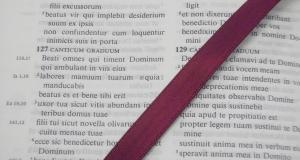
Jerome did his best to create one Latin Bible out of the huge number of private translations that were circulating in his day. Photo: Catherine Hobson.
Hanging out with Saint Jerome in his Latin version of the Bible has given me the chance to get to know him, as I watch how he renders the original text. I find that he often translates the Hebrew Bible more accurately than the Greek translators of 280 BCE (who were Jewish), possibly because he learned his Hebrew in Bethlehem rather than in Egypt. I also see that his version bears witness to a Hebrew text that is closer to the Massoretic or standard Hebrew text than the Hebrew original on which the Greek version is based. Jerome’s version gives us a glimpse of what a proto-Massoretic text looked like in 400 AD. I truly appreciate what Jerome and those who preceded him have given us!
In an age where large numbers of Latin-speaking Christians had their own private translation of the New Testament, with all sorts of variations of spelling, grammar, vocabulary, and textual originals, Jerome deserves a lot of credit for wading through the multiplicity of Old Latin texts and creating one standard version. One example would be where the angel urges Joseph to take Mary as his wife. Some Old Latin copies read uxorem, the standard word for “wife,” but some manuscripts say coniugem, “mate,” someone with whom one “mates” or “conjugates,” a word that implies a sexual relationship. Those translators who used the term uxorem seem to reject any notion of such a relationship between Joseph and Mary, even after Jesus is born. For his Vulgate, Jerome chose coniugem.
Jerome often puts explanatory notes that are not in the original Hebrew, straight into the text. In Deuteronomy 23:2, he quotes the Hebrew term mamzer (illegitimate child) by simply transliterating it, and then adding hoc est, de scortō natus (“that is, one who is born from a harlot”). In Joshua 3:16, he says that the waters of the Jordan drained away into mare Solitudinis, quod nunc vocatur Mortuum (“the Sea of the Desert, which is now called [Sea] of the Dead”). He explains the name Kiriath-Jearim in Joshua 15:9 by adding id est urbs silvārum, “that is, City of Forests.” He identifies Ararat as “Armenia” (Genesis 8:4). And 19 times he uses the Latin calendar term kalendae (“first of the month”) for “new moon.”
Jerome almost never uses the noun amor or the verb amāre to refer to either the love of God (three times) or love between believers (0 times); the noun he uses is caritas (from which we get “charity” in 1 Corinthians 13), and the verb he consistently uses is dīligere.
Jerome also uses the noun uterus in ways that are typical of Latin but are foreign to our ears. In Genesis 15:4, God speaks to Abraham of an heir who will be born de uterō tuō, “from your (Abraham’s!) uterus” (presumably meaning “body”). Likewise, David refers in 2 Samuel 16:11 to the son who came forth de uterō meō, “from my body.” The most surprising example is Jonah praying de uterō piscis, “from the belly of the fish” (Jonah 2:1). And in a large number of texts where we find the English term “womb,” we find the Latin word vulva rather than uterus (usually as the object of the verb “to open”); the two Latin words are even paired as synonyms in Job 3:11, Psalm 58:4 (Hebrew), Isaiah 46:3, and Jeremiah 1:5.
It is the Latin version that specifies whether the aetos crying woe on the earth in Revelation 8:13 is an eagle or a vulture (like the Hebrew nesher, aetos can mean either); the Latin tradition (whether it is correct, who knows?) says aquila, which can only mean “eagle”, not a vultur. The Latin identifies the almug wood of 1 Kings 10:11-12 as thyine or citron wood, the most expensive wood of Roman times. And it tells us in 1 Kings 15:13 that Asa removed Maacah from being queen mother because she had made a most obscene (turpissimum) image of Priapus. (Mom! How disgusting can you get?)
Stay tuned for more surprising, humorous sound bites from the Latin Bible next time!
Previous Post

August 17, 2017
Fun in the Septuagint
Next Post

August 24, 2017 More Fun in the Latin Bible
Browse Our Archives
Select a Category Biblical ethic Biblical word studies Biblical world Creation Historical Jesus Uncategorized
Select a Month July 2018 June 2018 May 2018 April 2018 March 2018 February 2018 January 2018 December 2017 November 2017 October 2017 September 2017 August 2017 July 2017
Follow Us!
TAKE THE
Religious Wisdom Quiz
In Isaiah 40, what voice cries out to prepare the way for the Lord?
Select your answer to see how you score.
A lion roaring A child singing A trumpet blasting A voice in the wilderness
Books by This Author Books by Tom Hobson
Related posts from Biblical Words and World

Words I Never Heard in the Bible

Musonius Rufus, Women's Equality, and the New Testament


TRENDING AT PATHEOS Evangelical

How the author of the world's best hymn...
I've been working with John Newton for a while now. This makes...

Long before this Lectio Divina, Psalm 130 - the song - started...

What About the Trees? Another Living Parable
After I finished writing the last article about falling leaves as a...

Why Classical Education Is a Conversation, Not a...
Come and Read: Joy in Classical Education When I was a little...

Falling Leaves: A Living Parable on Letting Go
I’ve spent the vast majority of my life in the southeast corner...

Cornell University has received a great deal of negative publicity and intense...
view all Evangelical blogs
Ad-Free & Subscriber Log-In Subscription Support
- About Us
- 2026 Calendar
- Videos
- Podcasts
- Library of World Religions
- Faith In Media Tracker
- Advertise With Us
- Write for Us
- Privacy Policy
- Terms of Service
- Do Not Sell My Data
- Contact Us
- Radiant Digital
- Manage Newsletter Subscriptions
- Unsubscribe From Notifications
- Sitemap
Copyright 2008-2026, Patheos. All rights reserved.
Subscription Support Ad-Free & Subscriber Log-In
Follow Patheos