
BuddhistCatholicContemplativeEvangelicalGeneral ChristianHinduJewishLatter-day SaintMuslimNew VisionsProgressive Christian
Beliefs
- Buddhist
- Catholic
- Contemplative
- Evangelical
- General Christian
- Hindu
- Jewish
- Latter-day Saint
- More Voices
- Muslim
- New Visions
- Pagan
- Progressive Christian
Topics
- Religion News
- Food and Religion
- Sports and Religion
- Religious Art
- Religious Music and Entertainment
- Religious Events
- History and Religion
- Style and Religion
- Politics and Religion
- Women in Religion
- Recreation Outdoors and Religion
- Business Finance and Religion
- Careers Workplace and Religion
- Education and Religion
- Family Parenting and Religion
- Health Fitness and Religion
- Home and Religion
- Relationships and Religion
- Technology and Religion
- Travel and Religion
Columnists
- Buddhist Columnists
- Business Finance and Religion Columnists
- Careers Workplace and Religion Columnists
- Catholic Columnists
- Contemplative Columnists
- Education and Religion Columnists
- Evangelists Columnists
- Family Parenting and Religion Columnists
- General Christian Columnists
- Health Fitness and Religion Columnists
- Hindu Columnists
- History and Religion Columnists
- Home and Religion Columnists
- Jewish Columnists
- More Voices Columnists
- Latter Day Columnists
- Muslim Columnists
- New Visions Columnists
- Nonreligious Columnists
- Pagan Columnists
- Politics and Religion Columnists
- Progressive Columnists
- Recreation Outdoors and Religion Columnists
- Relationships and Religion Columnists
- Religion News Columnists
- Religious Art Columnists
- Religious Events Columnists
- Religious Music and Entertainment Columnists
- Sports and Religion Columnists
- Style and Religion Columnists
- Technology and Religion Columnists
- Travel and Religion Columnists
- Women in Religion Columnists
Resource Library
- 2026 Calendar
- Library of World Religions
- The 100 Most Holy Places on Earth
- Patheos Answers
- Podcasts
- Videos
- Faith Leaders Database
- Anglican Episcopalian
- Bahai
- Baptist
- Buddhism
- Christianity
- Confucianism
- Eastern Orthodoxy
- Hinduism
- Holiness and Pentecostal
- ISKCON
- Islam
- Judaism
- Lutheran
- Methodist
- The Church of Jesus Christ of Latter-day Saints
- New Age
- Paganism
- Presbytarian and Reformed
- Protestantism
- Religion Behind the Scenes
- Roman Catholic
- Scientology
- Shia Islam
- Sikhism
- Sufism
- Sunni Islam
- Taoism
- Zen
- See all religions
Research Tools
 Ad-Free & Subscriber Log-In Subscription Support
Ad-Free & Subscriber Log-In Subscription Support
Follow Patheos 

- Trending:
- Forgiveness
- |
- Marriage
- |
- Consciousness
- |
- Death Penalty
- |
- Election
- |
- Halloween
 Biblical Words and World
- Home
- Evangelical
- More Fun in the Latin Bible
More Fun in the Latin Bible
Last updated on: August 24, 2017 at 7:00 am by Tom Hobson
More Fun in the Latin Bible 2017-08-23T19:32:28-05:00 Tom Hobson
Patheos Explore the world's faith through different perspectives on religion and spirituality! Patheos has the views of the prevalent religions and spiritualities of the world.
In this post, we continue our look at surprising, sometimes humorous fun details to be found in the Latin Bible (see http://www.patheos.com/blogs/tomhobson/2017/08/fun-latin-bible/ for last time).
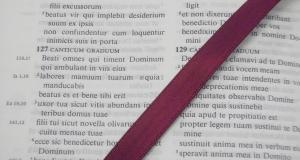
The Vulgate was Jerome’s magnum opus designed to render God’s word in the Latin language and style of the vulgus or common people. Photo: Catherine Hobson.
The Latin also adds punch to the evils spoken of in Job 31:11 (lusting for a virgin, or for someone’s wife) and Leviticus 20:13 (same-sex intercourse) as being not just malum (bad), but nefas (a notorious evil), the same word used by the people when Saul decreed that Jonathan should die (hoc nefas est! – 1 Samuel 14:45). And the evil demanded by the men of Gibeah is called scelus hoc contra naturam (Judges 19:24 – the words “contrary to nature” are added by Jerome to the text).
The heretic Marcion’s famous refrain of denial, Absit! (“Far be it!”, as quoted many times by Tertullian) is used 32x in the Latin Bible. Abraham says to God in Genesis 18:25, Absit a tē (“Far be it from thee”) to slay the righteous with the wicked! The people say to Joshua in Joshua 24:16, Absit a nobīs (“Far be it from us”) to forsake the Lord. And Absit! becomes the standard way to translate Paul’s famous line, Mē genoito! (“May it never be!”)
Sometimes, the Latin goes beyond the meaning of the original; while Jacob complains in Genesis 31:42 that Laban almost sent him away “empty” (rēqam), the Latin has him say nudum (“naked”!). In Esther 5:14, 8:7 and 9:25, a 75-foot gallows is called a crux (cross). Sometimes, there is even confusion: in Judges 15:19, where the Hebrew says that God opened the maktesh (ground-down or “hollow [place]”) at Lehi, and water came forth, the Latin says that God opened the molar tooth (another meaning of maktesh) in the jawbone (the meaning of the place-name Lehi) of the donkey (not in the text at all in this verse!), and water came forth (!). In 1 Samuel 15:4, where Saul numbers his troops “in Telaim,” the Latin reads quasi agnōs, “as if they were lambs.”
But sometimes the Latin is more literal than our Bibles. While the Hebrew of Judges 3:24 says that Eglon must be “covering his feet,” the Latin says purgat alvum (“he is emptying his bowel” – similarly, 1 Samuel 24:4). When the men of Gibeah demand that the Levite be brought out to them “so that we may know him” (Judges 19:22), the Greek says literally “know him,” but the Latin reads “so that we may abuse (abutamur) him.” In Genesis 43:34, while our Bibles says that Joseph’s brothers “were merry” with him, both the Latin, the Greek, and the Hebrew say that they “got drunk” with him (Hebrew wayyishkeru, Greek emethysthēsan, Latin inebriatī sunt). Which is one example of why we must not take a “monkey-see, monkey-do” approach to the behavior of Biblical characters, but must rely on clear ethical teaching passages such as Ephesians 5:18 in a case like this.
The Latin Bible is a wonderful supplement to textbooks such as Wheelock for those who are first learning Latin. There are copious examples of future active and passive participles, all four subjunctives, and both positive and negative question markers. Sarah asks in Genesis 18:13, Num vere paritura sum, anus? (“Am I, an old lady, really about to give birth?”) Num, a word used 54 times in the Vulgate, signals that she expects a “No” answer. Cain clearly implies a “No” answer when he asks in Genesis 4:9, Num custos fratris mei sum? The Latin Bible also regularly uses forms that Wheelock told us were rare, such as īvit for “he has gone” (20 times), the plural of inquit (inquiunt, “they said,” used seven times), and estō for “let it be” (82 times in the singular, 60 times in the plural estōte).
We are so thankful that somebody translated God’s word into the language of the Roman Empire, a resource destined to have a huge impact on the world for centuries. For Protestants like myself, the Vulgate carries no authority in itself as a version compared to others. Like the King James Version, it is merely a fascinating witness at one point in time to the text of God’s word that it translates, and it gives us clues to how that text was understood and was communicated to the vulgus (common people) who were that version’s intended audience.
Previous Post

August 21, 2017
Fun in the Latin Bible
Next Post

August 28, 2017 The Ancient Flat Earth? A Modern Lie
Browse Our Archives
Select a Category Biblical ethic Biblical word studies Biblical world Creation Historical Jesus Uncategorized
Select a Month July 2018 June 2018 May 2018 April 2018 March 2018 February 2018 January 2018 December 2017 November 2017 October 2017 September 2017 August 2017 July 2017
Follow Us!
TAKE THE
Religious Wisdom Quiz
What does "Moses" mean?
Select your answer to see how you score.
Drawn Out (of water) Born Amid Trouble Rescued Gifted
Books by This Author Books by Tom Hobson
Related posts from Biblical Words and World

Words I Never Heard in the Bible

Musonius Rufus, Women's Equality, and the New Testament


TRENDING AT PATHEOS Evangelical

How the author of the world's best hymn...
I've been working with John Newton for a while now. This makes...

Long before this Lectio Divina, Psalm 130 - the song - started...

What About the Trees? Another Living Parable
After I finished writing the last article about falling leaves as a...

Why Classical Education Is a Conversation, Not a...
Come and Read: Joy in Classical Education When I was a little...

Falling Leaves: A Living Parable on Letting Go
I’ve spent the vast majority of my life in the southeast corner...

Cornell University has received a great deal of negative publicity and intense...
view all Evangelical blogs
Ad-Free & Subscriber Log-In Subscription Support
- About Us
- 2026 Calendar
- Videos
- Podcasts
- Library of World Religions
- Faith In Media Tracker
- Advertise With Us
- Write for Us
- Privacy Policy
- Terms of Service
- Do Not Sell My Data
- Contact Us
- Radiant Digital
- Manage Newsletter Subscriptions
- Unsubscribe From Notifications
- Sitemap
Copyright 2008-2026, Patheos. All rights reserved.
Subscription Support Ad-Free & Subscriber Log-In
Follow Patheos