
BuddhistCatholicContemplativeEvangelicalGeneral ChristianHinduJewishLatter-day SaintMuslimNew VisionsProgressive Christian
Beliefs
- Buddhist
- Catholic
- Contemplative
- Evangelical
- General Christian
- Hindu
- Jewish
- Latter-day Saint
- More Voices
- Muslim
- New Visions
- Pagan
- Progressive Christian
Topics
- Religion News
- Food and Religion
- Sports and Religion
- Religious Art
- Religious Music and Entertainment
- Religious Events
- History and Religion
- Style and Religion
- Politics and Religion
- Women in Religion
- Recreation Outdoors and Religion
- Business Finance and Religion
- Careers Workplace and Religion
- Education and Religion
- Family Parenting and Religion
- Health Fitness and Religion
- Home and Religion
- Relationships and Religion
- Technology and Religion
- Travel and Religion
Columnists
- Buddhist Columnists
- Business Finance and Religion Columnists
- Careers Workplace and Religion Columnists
- Catholic Columnists
- Contemplative Columnists
- Education and Religion Columnists
- Evangelists Columnists
- Family Parenting and Religion Columnists
- General Christian Columnists
- Health Fitness and Religion Columnists
- Hindu Columnists
- History and Religion Columnists
- Home and Religion Columnists
- Jewish Columnists
- More Voices Columnists
- Latter Day Columnists
- Muslim Columnists
- New Visions Columnists
- Nonreligious Columnists
- Pagan Columnists
- Politics and Religion Columnists
- Progressive Columnists
- Recreation Outdoors and Religion Columnists
- Relationships and Religion Columnists
- Religion News Columnists
- Religious Art Columnists
- Religious Events Columnists
- Religious Music and Entertainment Columnists
- Sports and Religion Columnists
- Style and Religion Columnists
- Technology and Religion Columnists
- Travel and Religion Columnists
- Women in Religion Columnists
Resource Library
- 2026 Calendar
- Library of World Religions
- The 100 Most Holy Places on Earth
- Patheos Answers
- Podcasts
- Videos
- Faith Leaders Database
- Anglican Episcopalian
- Bahai
- Baptist
- Buddhism
- Christianity
- Confucianism
- Eastern Orthodoxy
- Hinduism
- Holiness and Pentecostal
- ISKCON
- Islam
- Judaism
- Lutheran
- Methodist
- The Church of Jesus Christ of Latter-day Saints
- New Age
- Paganism
- Presbytarian and Reformed
- Protestantism
- Religion Behind the Scenes
- Roman Catholic
- Scientology
- Shia Islam
- Sikhism
- Sufism
- Sunni Islam
- Taoism
- Zen
- See all religions
Research Tools
 Ad-Free & Subscriber Log-In Subscription Support
Ad-Free & Subscriber Log-In Subscription Support
Follow Patheos 

- Trending:
- Forgiveness
- |
- Marriage
- |
- Consciousness
- |
- Death Penalty
- |
- Election
- |
- Halloween
 Biblical Words and World
- Home
- Evangelical
- Fun in the Septuagint
Fun in the Septuagint
Last updated on: August 17, 2017 at 7:00 am by Tom Hobson
Fun in the Septuagint 2017-08-16T14:08:58-05:00 Tom Hobson
Patheos Explore the world's faith through different perspectives on religion and spirituality! Patheos has the views of the prevalent religions and spiritualities of the world.
The Greek version of the Old Testament, known as the Septuagint, is full of fascinating, surprising, often fun details, most of which you’ll never hear about unless you take the time to cruise through the text and find them for yourself. Not everyone is equipped to do so, of course, so I have attempted to package as many of those fun details as I can together here in one place. Even if you’re not a language geek like me, I invite you to skim through and glean what you can, and skip the parts that are too technical.
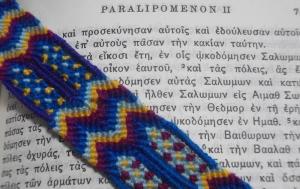
The Septuagint calls the book of Chronicles Paralipomenon, “The Things Left Out (of Samuel-Kings)”. Photo: Catherine Hobson.
I am currently reading the entire Hebrew Bible in Hebrew, Greek, and Latin. (I have already done this twice for the Pentateuch, but only in Hebrew and Greek. I am skimming the Greek and Latin.) The longer I hang out with the translators who began the Greek Bible project in Egypt around 280 BCE, the better I get to know them and how they predictably handle the vocabulary and grammar of God’s word.
In the Pentateuch, the Septuagint (known by the symbol LXX) tends to follow the Hebrew Massoretic Text (MT) slavishly. One can account for almost every word, often in the same order as the Hebrew. When it mistranslates (“proselyte” instead of “sojourner,” “power” vs. “army,” “man man” vs. “every man”, or its consistently awkward translation of infinitive absolutes), it does so repeatedly. So when the LXX adds, skips, or changes anything, take note! So in Genesis 11, the LXX adds “and he died” for each character on the genealogy. Exodus 1:11 adds to the two store-cities that the Hebrews built “and Ōn, which is Heliopolis.” Genesis 46:28 adds “to meet him at Hērōōn, a city in the land of Ramessē.”
The LXX often switches “God” and “Lord,” which leads to confusion for source critics who base their theory on the use of these names to identify sources. It often uses different pronouns than the MT (you or I, versus he). In many cases, the Hebrew text it is translating will switch the Hebrew letters daleth and resh (Numbers 33:12 – Raphaka versus Dophkah); likewise, “They crossed the crossing” (2 Samuel 19:18) becomes “they labored a labor”, reading a daleth for a resh. Several times in Exodus 25-30 the Greek reads “I will be known” (nifal form of yd‘) instead of “I will meet by appointment” (nifal of y‘d). Such transposition of letters is common in the LXX, such as in 2 Samuel 7:19, where it reads “you have loved me” (’ahabtani) instead of “you have brought me” (habi’otani, transposing the letter aleph to the front of the verb).
The LXX calls Nimrod a gigas (“giant,” from Greek mythology), as it also calls the Anakim (Deuteronomy 1:18). It calls the Rephaim “Titans” (2 Samuel 5:18). It calls the sea monsters “whales” (Genesis 1:21). It calls discharges gonorruēs. It calls Canaan “Phoenicia” once (Exodus 16:35) and the Sidonians “Phoenicians” (Deuteronomy 3:9). It calls the Caphtorim “Cappadocians” (Deuteronomy 2:23). It translates the Sukkim of 2 Chronicles 12:3 (a tribe from the western Egyptian desert) as Troglodytai, a Sudanese tribe (literally “hole-dwellers”). In Isaiah 23:1, it translates “Wail, O ships of Carthage” for Tyre (see also 23:10). The Septuagint provides much evidence that the Hebrew letter ‘ayin is pronounced like a g: it spells “Gomorrah” for ‘Omorrah, gomor for ‘omer (Exodus 16:16), Raguel for Re‘uel, Haggai for Ha-‘Ai (Genesis 13), and Gaibal for ‘Ebal (Deuteronomy 11:29).
The order of verses and sections of material in the LXX varies wildly in Exodus 35–40. In the Septuagint, Deuteronomy 27:23 adds “Cursed be whomever lies with his wife’s sister.” The LXX adds details on Nahash the Ammonite in 1 Samuel 11, while it shortens the account of David and Goliath, it drops the reference to Eli’s sons sleeping with the women who served at the sanctuary in 1 Samuel 2:22, and it shortens Jeremiah by 1/8 and drastically reorders its contents. In Numbers 24:7, the Septuagint reads “Gog” for “Agag”, and adds “a man shall come from his seed and rule over many nations.” And in Esther 8:17, when the Persian king comes out in defense of the Jews, many of the pagans not only “Judaized” (same word as Paul uses in Galatians 2:14), but also “circumcised themselves” (not in the Hebrew text).
Out of 28 times that the term Amen occurs in the Hebrew Bible, the Septuagint translates it 23 times with the word genoito. It uses exstasis for the tardemah or “deep sleep” that God puts on Adam before creating Eve. In Genesis 21:22 and 21:32, the Septuagint calls Phicol the king’s nymphagogos or “leader of the bride”. It calls the lords (seranim) of the Philistines satrapes (a much later Persian term). In Numbers 11:20, Israel shall eat quail “until it becomes cholera for you.” The name Elisheba becomes “Elizabeth” in Exodus 6:23. And although erōs and its related verb eraō are found nowhere in the New Testament, the two are found a total of five times in the Septuagint, including Esther 2:17 (“The king loved Esther”), Proverbs 4:6 (“Love wisdom”), Proverbs 7:18 (“let’s delight ourselves with love”), and Proverbs 30:16, where the Greek mistakenly reads “the erōs of a woman” rather than “the barren womb.”
The LXX uses the optative mood (a verb form used for wishes and hypothetical statements) more than 500 times (versus 67 times for the New Testament); Job is particularly chock-full of optatives. The LXX often uses edomai instead of phagomai as the future of esthiō, “I eat.” In Exodus 32:26, it uses the rare form itō as a future imperative of erchomai, “I come” (also used in a variant reading in John 7:34).
While the LXX Pentateuch transliterates beer as sikēra, 1 Samuel translates it very literally as methusma (“that which makes drunk”). In Song of Solomon, it translates “love” (dodim) as “breasts,” and “female companion” (re‘ah) as plēsion (“neighbor”). In Isaiah 24:20, the Septuagint uses the Greek term for “hangover” (kraipalaō). It often uses tharsei (“take courage”) for ’al-tiyra (“Do not fear” – Exodus 20:20), and it sometimes uses eusebeia for the fear of the Lord (Isaiah 11:2). It translates drakōn for tannin in Exodus 7:9, “donkey-centaur” for “satyr” (Isaiah 34:14), “sirens” for “jackals” (Isaiah 34:13, 43:20), and “dung” on the ground becomes a “pattern” on the ground in Jeremiah 8:2. And three times (including Esther 2:3 and 2:9) it uses the word smēgma, although in the Septuagint it refers to a facial beauty treatment, as opposed to what the word means in English (Red Dwarf fans know what I’m talking about!).
The Septuagint has hundreds of Greek words that occur nowhere else in Greek literature. They are usually not Egyptian dialectical words, but simply compound words that are easy enough to understand, but that no other Greek writer ever uses.
One more fun surprise in the Septuagint: in the kosher food lists, we find two unexpected creatures: an insect called the “snake-fighter” (Leviticus 11:22), and the giraffe (Deuteronomy 14:5). Who knew these were kosher?? For more on these two fun details, I refer you to my “Kosher in the Greek?” article in ZAR 19 (2014): 307-12 (see link at http://www.biblicalethic.org).
Previous Post
August 14, 2017
Christ the Builder?
Next Post

August 21, 2017 Fun in the Latin Bible
Browse Our Archives
Select a Category Biblical ethic Biblical word studies Biblical world Creation Historical Jesus Uncategorized
Select a Month July 2018 June 2018 May 2018 April 2018 March 2018 February 2018 January 2018 December 2017 November 2017 October 2017 September 2017 August 2017 July 2017
Follow Us!
TAKE THE
Religious Wisdom Quiz
Which king asked Elijah for help against the armies of Moab and Edom?
Select your answer to see how you score.
Joram Jehoshaphat Joash Jehoram
Books by This Author Books by Tom Hobson
Related posts from Biblical Words and World

Words I Never Heard in the Bible

Be Ye Perfect? What Does Jesus Mean?
What's the Difference Between Spirit and Soul?

Soul or Life? The Double Meaning of Psychē
TRENDING AT PATHEOS Evangelical

How the author of the world's best hymn...
I've been working with John Newton for a while now. This makes...

Long before this Lectio Divina, Psalm 130 - the song - started...

What About the Trees? Another Living Parable
After I finished writing the last article about falling leaves as a...

Why Classical Education Is a Conversation, Not a...
Come and Read: Joy in Classical Education When I was a little...

Falling Leaves: A Living Parable on Letting Go
I’ve spent the vast majority of my life in the southeast corner...

Cornell University has received a great deal of negative publicity and intense...
view all Evangelical blogs
Ad-Free & Subscriber Log-In Subscription Support
- About Us
- 2026 Calendar
- Videos
- Podcasts
- Library of World Religions
- Faith In Media Tracker
- Advertise With Us
- Write for Us
- Privacy Policy
- Terms of Service
- Do Not Sell My Data
- Contact Us
- Radiant Digital
- Manage Newsletter Subscriptions
- Unsubscribe From Notifications
- Sitemap
Copyright 2008-2026, Patheos. All rights reserved.
Subscription Support Ad-Free & Subscriber Log-In
Follow Patheos