
BuddhistCatholicContemplativeEvangelicalGeneral ChristianHinduJewishLatter-day SaintMuslimNew VisionsProgressive Christian
Beliefs
- Buddhist
- Catholic
- Contemplative
- Evangelical
- General Christian
- Hindu
- Jewish
- Latter-day Saint
- More Voices
- Muslim
- New Visions
- Pagan
- Progressive Christian
Topics
- Religion News
- Food and Religion
- Sports and Religion
- Religious Art
- Religious Music and Entertainment
- Religious Events
- History and Religion
- Style and Religion
- Politics and Religion
- Women in Religion
- Recreation Outdoors and Religion
- Business Finance and Religion
- Careers Workplace and Religion
- Education and Religion
- Family Parenting and Religion
- Health Fitness and Religion
- Home and Religion
- Relationships and Religion
- Technology and Religion
- Travel and Religion
Columnists
- Buddhist Columnists
- Business Finance and Religion Columnists
- Careers Workplace and Religion Columnists
- Catholic Columnists
- Contemplative Columnists
- Education and Religion Columnists
- Evangelists Columnists
- Family Parenting and Religion Columnists
- General Christian Columnists
- Health Fitness and Religion Columnists
- Hindu Columnists
- History and Religion Columnists
- Home and Religion Columnists
- Jewish Columnists
- More Voices Columnists
- Latter Day Columnists
- Muslim Columnists
- New Visions Columnists
- Nonreligious Columnists
- Pagan Columnists
- Politics and Religion Columnists
- Progressive Columnists
- Recreation Outdoors and Religion Columnists
- Relationships and Religion Columnists
- Religion News Columnists
- Religious Art Columnists
- Religious Events Columnists
- Religious Music and Entertainment Columnists
- Sports and Religion Columnists
- Style and Religion Columnists
- Technology and Religion Columnists
- Travel and Religion Columnists
- Women in Religion Columnists
Resource Library
- 2026 Calendar
- Library of World Religions
- The 100 Most Holy Places on Earth
- Patheos Answers
- Podcasts
- Videos
- Faith Leaders Database
- Anglican Episcopalian
- Bahai
- Baptist
- Buddhism
- Christianity
- Confucianism
- Eastern Orthodoxy
- Hinduism
- Holiness and Pentecostal
- ISKCON
- Islam
- Judaism
- Lutheran
- Methodist
- The Church of Jesus Christ of Latter-day Saints
- New Age
- Paganism
- Presbytarian and Reformed
- Protestantism
- Religion Behind the Scenes
- Roman Catholic
- Scientology
- Shia Islam
- Sikhism
- Sufism
- Sunni Islam
- Taoism
- Zen
- See all religions
Research Tools
 Ad-Free & Subscriber Log-In Subscription Support
Ad-Free & Subscriber Log-In Subscription Support
Follow Patheos 

- Trending:
- Forgiveness
- |
- Marriage
- |
- Consciousness
- |
- Death Penalty
- |
- Election
- |
- Halloween
 Biblical Words and World
- Home
- Evangelical
- Christ the Builder?
Christ the Builder?
Last updated on: August 14, 2017 at 7:00 am by Tom Hobson
Christ the Builder? 2017-08-13T21:45:09-05:00 Tom Hobson
Patheos Explore the world's faith through different perspectives on religion and spirituality! Patheos has the views of the prevalent religions and spiritualities of the world.
Was Jesus a carpenter, or a builder? Was he actually a construction worker?
Jesus’ father Joseph is commonly identified as being a “carpenter,” a word that implies that Jesus and his father worked with wood for a career. The term tektōn is found only twice in the New Testament, in a doubly-attested quote where Jesus is referred to as either “the carpenter” (Mark 6:3) or “the son of the carpenter” (Matthew 13:55). Further investigation, however, will show that tektōn is a generic word for “builder,” in the same sense that architektōn (= “architect”) means “chief builder” (1 Corinthians 3:10).
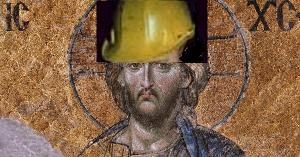
Christ the Builder? Patheos Media Library + Helmet (National Institute for Occupational Safety and Health – LeBlanc Construction Photos 2012), Public Domain via Wikimedia Commons
The Liddell-Scott lexicon of ancient Greek states that the use of tektōn to mean anything other than “carpenter” is relatively rare. But the Greek Old Testament (where tektōn is used 30 times) is a treasure trove of examples of tektōn being used in such ways. The Greek version often differentiates between a crafter “of wood,” a crafter “of stone,” or a crafter “of iron”. So in 1 Samuel 13:19, a “tektōn of iron” is a “blacksmith” (see also Isaiah 44:12). And in 2 Samuel 5:11, the “carpenters and masons” sent to David by King Hiram are “tektonas of wood” and “tektonas of stone,” while in 1 Kings 7:14, a half-Tyrian artisan named Hiram hired by Solomon is a “tektōn of bronze.” But in some passages, the tektones are distinguished from the “stonecutters” (latomoi – Ezra 3:7) and/or the “builders” (oikodomoi – 2 Chronicles 34:11). However, in each of these examples, there are specific Hebrew terms that explain the use of different Greek terms; the Hebrew charash (generic “craftsman”) is consistently translated by tektōn in the Greek, as seen in 2 Chronicles 34:11. Indeed, in Ezra 3:7, both words are translated into Latin as cementarius (a worker in cement, a mason).
Hosea 8:6 says of the golden calf in Samaria, “A tektōn made it; it is not God.” If this idol was solid metal rather than a gold-plated wood carving, then a tektōn does not necessarily work with a saw, hammer, and nails. Hosea 13:2 also speaks of those who construct molten images of silver as tektones. Likewise, Isaiah 40:19 speaks of a tektōn “casting” or “pouring” a molten idol, while in the very next verse a tektōn is crafting an idol of wood.
Josephus uses the plural of tektōn to refer to those who constructed Moses’ tabernacle (Antiquities 3:204). In his descriptions of the construction of Solomon’s and Herod’s temples, like the accounts in Kings and Chronicles, Josephus distinguishes between stonecutters and tektonas, with no indication whether the tektones are involved in the stone-laying process, or are only involved in woodwork. In Jewish War 3:78, Josephus calls the men who construct the Roman military camps tektones. And in Jewish War 3:171, Josephus tells that he ordered his tektonas to build a (presumably) stone fortification wall higher in order to defend his city (3:173 and 5:275 also refer to them building city walls).
Do these uses of tektōn throw more light on what Jesus and his earthly father did for a living? They certainly broaden the possibilities. They tell us that Jesus had muscle and technical skill. If not for the fact that Joseph and Mary offer the lowest-price option for their Temple sacrifice when Jesus is born, we might think that their family belonged to the upper middle class.
Later on, near the end of the first century AD, according to the historian Eusebius, Jesus’ nephews appear before the emperor Domitian, who is afraid that because that because these Christian leaders are descendants of David, they may try to rebel and set up their own kingdom. When he examines their hands, however, and see that they are rough from manual labor, and that these men had only a modest amount of land, he released them as being no danger to the empire. This is the only other clue we have that Jesus and his family could be classified as “blue collar.”
We may compare Jesus’ pre-ministry career with the professions held by other rabbis in Jesus’ day. We are told that Shammai was also a carpenter. Hillel was a day laborer. Others were shoemakers, shopkeepers, and professional writers. Saul of Tarsus was a tentmaker. But it does not appear that Jesus practiced his profession once he left Nazareth to proclaim God’s word; he appears to have relied on the hospitality of those who wished to benefit from his ministry. Luke 8:1-3 names some women of wealth who followed him and provided for him. This is not out of line with the practice of the above-named rabbis, who often could not earn enough by part-time labor to keep themselves out of poverty, and who survived only because of the additional generosity of others.
It is because the term tektōn is better translated “builder” rather than “carpenter” that I have rewritten the children’s TV theme song “Bob the Builder” and re-titled it “Christ the Builder.” Followers of Christ: hard hat, anyone?
Previous Post

August 9, 2017
What's Wrong With Getting Drunk?
Next Post

August 17, 2017 Fun in the Septuagint
Browse Our Archives
Select a Category Biblical ethic Biblical word studies Biblical world Creation Historical Jesus Uncategorized
Select a Month July 2018 June 2018 May 2018 April 2018 March 2018 February 2018 January 2018 December 2017 November 2017 October 2017 September 2017 August 2017 July 2017
Follow Us!
TAKE THE
Religious Wisdom Quiz
Which Christian group is known for pacifism?
Select your answer to see how you score.
Quakers Baptists Methodists Pentecostals
Books by This Author Books by Tom Hobson
Related posts from Biblical Words and World

Words I Never Heard in the Bible

Be Ye Perfect? What Does Jesus Mean?
What's the Difference Between Spirit and Soul?

Soul or Life? The Double Meaning of Psychē
TRENDING AT PATHEOS Evangelical

The REST of Your Life: A Creative Wrestles...
This week I had a conversation with a good friend from church....

How the author of the world's best hymn...
I've been working with John Newton for a while now. This makes...

Long before this Lectio Divina, Psalm 130 - the song - started...

What About the Trees? Another Living Parable
After I finished writing the last article about falling leaves as a...

Why Classical Education Is a Conversation, Not a...
Come and Read: Joy in Classical Education When I was a little...

Cornell University has received a great deal of negative publicity and intense...
view all Evangelical blogs
Ad-Free & Subscriber Log-In Subscription Support
- About Us
- 2026 Calendar
- Videos
- Podcasts
- Library of World Religions
- Faith In Media Tracker
- Advertise With Us
- Write for Us
- Privacy Policy
- Terms of Service
- Do Not Sell My Data
- Contact Us
- Radiant Digital
- Manage Newsletter Subscriptions
- Unsubscribe From Notifications
- Sitemap
Copyright 2008-2026, Patheos. All rights reserved.
Subscription Support Ad-Free & Subscriber Log-In
Follow Patheos