
BuddhistCatholicContemplativeEvangelicalGeneral ChristianHinduJewishLatter-day SaintMuslimNew VisionsProgressive Christian
Beliefs
- Buddhist
- Catholic
- Contemplative
- Evangelical
- General Christian
- Hindu
- Jewish
- Latter-day Saint
- More Voices
- Muslim
- New Visions
- Pagan
- Progressive Christian
Topics
- Religion News
- Food and Religion
- Sports and Religion
- Religious Art
- Religious Music and Entertainment
- Religious Events
- History and Religion
- Style and Religion
- Politics and Religion
- Women in Religion
- Recreation Outdoors and Religion
- Business Finance and Religion
- Careers Workplace and Religion
- Education and Religion
- Family Parenting and Religion
- Health Fitness and Religion
- Home and Religion
- Relationships and Religion
- Technology and Religion
- Travel and Religion
Columnists
- Buddhist Columnists
- Business Finance and Religion Columnists
- Careers Workplace and Religion Columnists
- Catholic Columnists
- Contemplative Columnists
- Education and Religion Columnists
- Evangelists Columnists
- Family Parenting and Religion Columnists
- General Christian Columnists
- Health Fitness and Religion Columnists
- Hindu Columnists
- History and Religion Columnists
- Home and Religion Columnists
- Jewish Columnists
- More Voices Columnists
- Latter Day Columnists
- Muslim Columnists
- New Visions Columnists
- Nonreligious Columnists
- Pagan Columnists
- Politics and Religion Columnists
- Progressive Columnists
- Recreation Outdoors and Religion Columnists
- Relationships and Religion Columnists
- Religion News Columnists
- Religious Art Columnists
- Religious Events Columnists
- Religious Music and Entertainment Columnists
- Sports and Religion Columnists
- Style and Religion Columnists
- Technology and Religion Columnists
- Travel and Religion Columnists
- Women in Religion Columnists
Resource Library
- 2026 Calendar
- Library of World Religions
- The 100 Most Holy Places on Earth
- Patheos Answers
- Podcasts
- Videos
- Faith Leaders Database
- Anglican Episcopalian
- Bahai
- Baptist
- Buddhism
- Christianity
- Confucianism
- Eastern Orthodoxy
- Hinduism
- Holiness and Pentecostal
- ISKCON
- Islam
- Judaism
- Lutheran
- Methodist
- The Church of Jesus Christ of Latter-day Saints
- New Age
- Paganism
- Presbytarian and Reformed
- Protestantism
- Religion Behind the Scenes
- Roman Catholic
- Scientology
- Shia Islam
- Sikhism
- Sufism
- Sunni Islam
- Taoism
- Zen
- See all religions
Research Tools
 Ad-Free & Subscriber Log-In Subscription Support
Ad-Free & Subscriber Log-In Subscription Support
Follow Patheos 

- Trending:
- Forgiveness
- |
- Marriage
- |
- Consciousness
- |
- Death Penalty
- |
- Election
- |
- Halloween
 Biblical Words and World
- Home
- Evangelical
- The Ancient Flat Earth? A Modern Lie
The Ancient Flat Earth? A Modern Lie
Last updated on: August 30, 2017 at 7:33 am by Tom Hobson
The Ancient Flat Earth? A Modern Lie 2017-08-30T07:33:01-05:00 Tom Hobson
Patheos Explore the world's faith through different perspectives on religion and spirituality! Patheos has the views of the prevalent religions and spiritualities of the world.
People in Biblical times believed that the earth was flat? It’s a modern lie, designed to depict the ancients as too backward for us to listen to. We call this “chronological snobbery,” and in this case, even the premise is woefully exaggerated. It is amazing how much was known about the size and shape of the earth at this time.
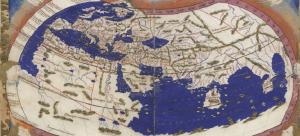
Ptolemy knew the world was round, and knew about lands from Norway to Java. Painting by Jacob d’Angelo after Claudius Ptolemaeus. Image by Nicolaus Germanus (www.polona.pl) [Public domain], via Wikimedia Commons.
For all the confusion of the ancients about the centrality of the earth versus the sun (which we will grant), Ptolemy spoke for the science of his day (circa 150 AD) when he declared that the earth was a sphere. He arrives at this hypothesis using logic that no doubt had been formulated by Phoenician sailors for centuries: “whenever we sail toward mountains or any high places from whatever angle and in whatever direction, we see their bulk little by little increasing as if they were arising from the sea, whereas they seemed submerged because of the curvature of the earth’s surface.” Strabo, writing around 100 AD, accepts the spherical shape of the earth as axiomatic, with north and south being its poles (poloi): “Let it be hypothesized that the earth together with the sea is sphairoeidēs (spherical).”
400 years before Ptolemy, Eratosthenes had used the angles cast by the sun at the summer solstice to calculate the circumference of the earth at 252,000 stadia (28,970 miles), as Strabo tells us (Geography 2.5.7). Ptolemy is the first writer to articulate latitude. He does so using length of day at the summer solstice at a given point on the globe, which gets longer the further north one goes. Ptolemy even knows about the Arctic Circle, the place where 24-hour day and 24-hour night each happen once a year.
Strabo is familiar with identifiable locations from Iernē (Ireland) and Thulē (Norway) to Taprobanē (Sri Lanka, which he called the “Cinnamon-Producer”) and Labadius (Java). He knows of the Golden (probably Malay) Peninsula, and the Great Gulf (Magnus Sinus). All of this belonged to what was called India Trans Gangem (India Across the Ganges). Long before Columbus, Strabo declares that “if the immensity of the Atlantic Ocean did not prevent it, we could sail from Iberia to India.”
Ptolemy relies partly on information from Marinus of Tyre (early second century AD), and partly on the help of a Greek sailor named Alexander. Alexander tells that the eastern destination for Roman traders was a Burmese city called Tamala on the Malay Peninsula, where Eastern merchants then crossed to reach the Perimulic Gulf (Gulf of Thailand). He knows an important port city in the Far East called Cattigara, which has been identified close to Saigon, the former capital of South Vietnam. Ptolemy thinks that the two Latin names for China refer to different locations; to him, Serica (at the end of the Silk Road) is not the same place as Sinae, the land of the Qin dynasty. Ptolemy also knows Africa as far as the mountains of Mozambique, from where he says there are another 74 degrees to the Pole.
A first century AD Greek text called the Periplus of the Erythraean Sea (https://sourcebooks.fordham.edu/ancient/periplus.asp) is another account of lands bordering the eastern Indian Ocean, written by an unnamed merchant. This writer also knows of a place that he pronounces Thinae, a great city where silk originates, in a land that stretches from the East all the way to the Caspian Sea. Even Josephus (Antiquities 8.164) knows enough about the Far East to theorize that the Golden Land (Aurea Chersonesus), which he says “belongs to India,” is actually Ophir, the place from which Solomon and his Phoenician ships imported huge amounts of gold (1 Kings 10:11, 22).
So people in the first century AD Biblical world were not locked in to the concept of a flat earth made up of Europe, northern Africa, and western Asia. Now, knowledge of the world was a bit sketchier when we go back a few centuries. The best maps we have for the ancient world from Iron Age II are the Sargon Geography map (eighth century BCE – see Wayne Horowitz, Mesopotamian Cosmic Geography – text at http://www.aakkl.helsinki.fi/melammu/database/gen_html/a0000526.php), and – surprise! – the Table of Nations in Genesis 10. Kenneth Kitchen has demonstrated that this chapter most likely reflects a tenth-century BCE date, based on the nations that appear and do not appear in it (Kitchen, On the Reliability of the Old Testament).
So what was the Hebrew conception of the earth? The word eretz (used over 2500 times in the Hebrew Bible) was broad enough to mean “earth” as opposed to “sky / heaven” (Genesis 1:1), “land” in a more local sense (Genesis 12:1), “piece of property” (Genesis 23:15), or even “ground” in a directional sense (Genesis 18:2). However, the word tēbēl (used 36 times) is a narrower term, virtually always meaning “world” or “planet.” Sometimes eretz and tēbēl are paired as poetic synonyms; sometimes they are glued together into a single expression (Job 37:12) to mean “the whole earth.” Interestingly, the Greek version usually uses oikoumenē (inhabited world) to translate tēbēl, while Jerome, working around 400 AD, uses the Latin orbis, which can mean either a circle or a sphere.
The same Job who refers to the “pillars” of the earth in Job 9:6 (mentioned elsewhere only in Psalm 75:4, and in 1 Samuel 2:8, where a different word for pillar is used) also says in Job 26:7 that God “hangs the earth upon nothing.” Neither description needs to be taken as an authoritative teaching on geology, especially not in a context from the mouth of Job. The “foundations of the earth” (mentioned only in 2 Samuel 22:16 = Psalm 18:16, and Isaiah 40:21) are less difficult to explain from our point of view than pillars; we may understand them as the “core” or mantle upon which the earth’s crust rests.
Today’s post is the first of several posts dealing with issues in early Genesis. Log on next time, when we’ll take a closer look at the meaning of “creation,” and the method and timetable by which it happened, followed by posts on the nature of the “firmament,” what were the “sea monsters” created on the fifth day, and what does “dominion” over creation mean? And more!
Previous Post

August 24, 2017
More Fun in the Latin Bible
Next Post

August 31, 2017 How Did Creation Happen?
Browse Our Archives
Select a Category Biblical ethic Biblical word studies Biblical world Creation Historical Jesus Uncategorized
Select a Month July 2018 June 2018 May 2018 April 2018 March 2018 February 2018 January 2018 December 2017 November 2017 October 2017 September 2017 August 2017 July 2017
Follow Us!
TAKE THE
Religious Wisdom Quiz
What was rolled away from Jesus’ tomb?
Select your answer to see how you score.
A stone A fence A wall A door
Books by This Author Books by Tom Hobson
Related posts from Biblical Words and World

Words I Never Heard in the Bible

Musonius Rufus, Women's Equality, and the New Testament


TRENDING AT PATHEOS Evangelical

How the author of the world's best hymn...
I've been working with John Newton for a while now. This makes...

Long before this Lectio Divina, Psalm 130 - the song - started...

What About the Trees? Another Living Parable
After I finished writing the last article about falling leaves as a...

Why Classical Education Is a Conversation, Not a...
Come and Read: Joy in Classical Education When I was a little...

Falling Leaves: A Living Parable on Letting Go
I’ve spent the vast majority of my life in the southeast corner...

Cornell University has received a great deal of negative publicity and intense...
view all Evangelical blogs
Ad-Free & Subscriber Log-In Subscription Support
- About Us
- 2026 Calendar
- Videos
- Podcasts
- Library of World Religions
- Faith In Media Tracker
- Advertise With Us
- Write for Us
- Privacy Policy
- Terms of Service
- Do Not Sell My Data
- Contact Us
- Radiant Digital
- Manage Newsletter Subscriptions
- Unsubscribe From Notifications
- Sitemap
Copyright 2008-2026, Patheos. All rights reserved.
Subscription Support Ad-Free & Subscriber Log-In
Follow Patheos