
BuddhistCatholicContemplativeEvangelicalGeneral ChristianHinduJewishLatter-day SaintMuslimNew VisionsProgressive Christian
Beliefs
- Buddhist
- Catholic
- Contemplative
- Evangelical
- General Christian
- Hindu
- Jewish
- Latter-day Saint
- More Voices
- Muslim
- New Visions
- Pagan
- Progressive Christian
Topics
- Religion News
- Food and Religion
- Sports and Religion
- Religious Art
- Religious Music and Entertainment
- Religious Events
- History and Religion
- Style and Religion
- Politics and Religion
- Women in Religion
- Recreation Outdoors and Religion
- Business Finance and Religion
- Careers Workplace and Religion
- Education and Religion
- Family Parenting and Religion
- Health Fitness and Religion
- Home and Religion
- Relationships and Religion
- Technology and Religion
- Travel and Religion
Columnists
- Buddhist Columnists
- Business Finance and Religion Columnists
- Careers Workplace and Religion Columnists
- Catholic Columnists
- Contemplative Columnists
- Education and Religion Columnists
- Evangelists Columnists
- Family Parenting and Religion Columnists
- General Christian Columnists
- Health Fitness and Religion Columnists
- Hindu Columnists
- History and Religion Columnists
- Home and Religion Columnists
- Jewish Columnists
- More Voices Columnists
- Latter Day Columnists
- Muslim Columnists
- New Visions Columnists
- Nonreligious Columnists
- Pagan Columnists
- Politics and Religion Columnists
- Progressive Columnists
- Recreation Outdoors and Religion Columnists
- Relationships and Religion Columnists
- Religion News Columnists
- Religious Art Columnists
- Religious Events Columnists
- Religious Music and Entertainment Columnists
- Sports and Religion Columnists
- Style and Religion Columnists
- Technology and Religion Columnists
- Travel and Religion Columnists
- Women in Religion Columnists
Resource Library
- 2026 Calendar
- Library of World Religions
- The 100 Most Holy Places on Earth
- Patheos Answers
- Podcasts
- Videos
- Faith Leaders Database
- Anglican Episcopalian
- Bahai
- Baptist
- Buddhism
- Christianity
- Confucianism
- Eastern Orthodoxy
- Hinduism
- Holiness and Pentecostal
- ISKCON
- Islam
- Judaism
- Lutheran
- Methodist
- The Church of Jesus Christ of Latter-day Saints
- New Age
- Paganism
- Presbytarian and Reformed
- Protestantism
- Religion Behind the Scenes
- Roman Catholic
- Scientology
- Shia Islam
- Sikhism
- Sufism
- Sunni Islam
- Taoism
- Zen
- See all religions
Research Tools
 Ad-Free & Subscriber Log-In Subscription Support
Ad-Free & Subscriber Log-In Subscription Support
Follow Patheos 

- Trending:
- Forgiveness
- |
- Marriage
- |
- Consciousness
- |
- Death Penalty
- |
- Election
- |
- Halloween
 To Do Justice
- Home
- Progressive Christian
- Politics and Religion
- What is Progressive Christianity?
What is Progressive Christianity?
Last updated on: April 7, 2018 at 7:13 am by Rebecca Todd Peters
What is Progressive Christianity? 2018-04-07T07:13:09-04:00 Rebecca Todd Peters
Patheos Explore the world's faith through different perspectives on religion and spirituality! Patheos has the views of the prevalent religions and spiritualities of the world.
The term “progressive” has long been used to represent an understanding of Christianity marked by an awareness of social sin; a consciousness of institutional and human potential and shortcomings; and, an emphasis on the church’s mission to engage the world. The root of the term is “progress” and denotes the ways that humans over the centuries have become more conscious of our common nature and our common needs and acted out of compassion and our concern for justice to address those needs. Rather than focusing on charity alone, progressive Christians seek to transform the social systems and economic structures of society that marginalize people and the natural world. The term “progress” does not imply a single, uniform social goal. Progressive Christians draw upon a variety of rich resources (Christian teachings and tradition, science, experience, social sciences, philosophy, etc.) to gain a greater understanding of the problems that we are facing and to work in collaboration with others to help our society, our world, and the church to make progress towards God’s vision of a new earth.
Progressive Christianity and scripture
Progressive Christians find firm footing for their social justice pursuits in scripture. At the heart of the biblical witness are the concepts of justice, covenant, and hospitality. Prophetic books have provided us with some of the most memorable verses referring to justice in scripture. The prophet Micah gives one of the clearest and most memorable references to God’s concern for justice. In the sixth chapter of Micah, God challenges the Hebrew people to remember how God acted to liberate them from the oppression of the Egyptians in the Exodus. God called people like Moses to lead them from bondage toward a more promising future. Micah challenges the Hebrew people to remember God’s justice as the foundation of human action. What does the Lord require of you but to do justice, and to love kindness, and to walk humbly with God? (Micah 6:8) Jesus is remembered in the gospels as standing within a larger Jewish prophetic tradition. Through his teachings and actions Jesus resisted the unjust laws of his time that served to marginalize and oppress. He reminded others of their larger commitment to God’s covenant relationship; a covenant implying the responsibility to seek justice for the most vulnerable.
Our common narrative as a faith community in rooted in the covenant relationship that God established with creation. This covenant tradition begins with Noah, is renewed with the descendants of Abraham, Sarah, and Hagar, and again by Moses on behalf of the Israelites. The covenant tradition implies, not only a relationship between God and the people of God, but it implies that the people of God are a community bound together by bonds of kinship, faith, and responsibility. Through God’s covenant the whole creation experiences God’s blessing. The term “blessing” is often misused in contemporary conversations to refer to individual economic and material well-being. Biblical notions of covenant and hospitality fly in the face of the dominant social attitudes of power, responsibility, and individual freedom. The New Testament describes the actions of Jesus in the world as renewing the covenant between God and God’s people to enjoy God’s blessing, one in which the believing community is not only accountable to their kin and to God, but they are charged with offering hospitality to their neighbor. As Jesus interprets the Great Commandment “to love your neighbor as yourself” in the parable of the Good Samaritan in Luke 10, Jesus challenges his listeners to remember their hospitality codes and obligations to include strangers, enemies, and those who are in peril. Jesus did not say, “Help those who are deserving.” Rather, quite the opposite. In Matthew 25:34-40 he instructs his followers to feed the hungry, give drink to the thirsty, welcome the stranger, clothe the naked, care for the sick, and visit with prisoners. The call of Christ to offer hospitality in the world is rooted in the common humanity that we all share as children of God.
Progressive Christianity’s Impact on Society
Progressive Christian movements have had a long-term impact in our society and the church. The abolitionists successfully humanized the conscience of many people and captured the attention of elected officials who could create laws that instigated change. Although it took seventy-two years from the first Women’s Rights Convention until the nineteenth amendment was added to the Constitution, women did finally win the right to vote. Many of the reforms advocated for by the Social Gospelers became part of President Roosevelt’s New Deal**:** Social Security programs and federally defined fair labor standards are benefits still enjoyed by millions of Americans. No one can dismiss the power of the Civil Rights Movement that resulted in desegregation, increased voting rights for blacks, and a movement toward equality between the races that continues today.
The goal of progressive Christianity has been a truer freedom, that is, the freedom spoken about in the Constitution, but held to greater accountability by faith. When the Constitution originally protected the right of slaveholders and the slave trade, progressive Christians could not avoid Paul’s statement that “in Christ there is no east or west, slave nor free.” They saw themselves like the early Christian community described in the book of Acts which continued to teach and participate in acts of healing after Jesus’ death so that “many signs and wonders were done among the people through the apostles” (Acts 5:12). Progressive Christians today must draw upon this rich legacy and speak out clearly and loudly on social issues in hope of transforming the unjust systems in our world. The mission of the church in the public forum is to continue the work of healing, restoration, and reconciliation within God’s creation.
Progressive Christian Worldview Rooted in Three Principles
A progressive Christian worldview is distinct from that of other groups. A worldview is the lens we use to understand and interpret the world. Worldviews represent a set of ideas that shape how we see the world. The ideas that constitute our worldview are influenced by many things, including our religious beliefs, our race, class, and gender, our education, and even the part of the country where we were raised. A progressive Christian worldview is rooted in three important principles that shape attitudes about the relationship between religion and politics and about what it means to be a Christian in the world:
- Christian faithfulness requires public action on the part of the churches and people of faith.
- Christian social witness should conform to accepted practices of deliberative democracies.
- The cause of social problems is structural or systemic.
These three principles represent claims made by progressive Christians about our world, human nature, the divine, and our faith that help make sense of our problems as we seek solutions. These principles are rooted in Christian faith and tradition and have the potential to offer a more comprehensive way of understanding and correcting social problems. Certainly, a better understanding of our problems will help lead us to more effective solutions to those same problems.
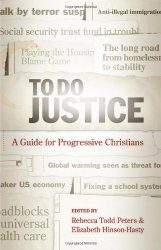
This post is excerpted and edited from the Introduction to To Do Justice: A Guide for Progressive Christians co-written by Rebecca Todd Peters and Elizabeth Hinson-Hasty.
SaveSave
SaveSave
Previous Post

March 27, 2018
Will You Go to Church on Easter?
Next Post

April 28, 2018 Paul Ryan Surprised to Find Christianity is Political
Browse Our Archives
Select a Category book review christian ethics christianity college/higher education economics ecumenism environment feminism feminism and feminist theology justice motherhood parenting politics poverty public policy reproductive justice sexuality social change solidarity Uncategorized
Select a Month September 2018 July 2018 June 2018 May 2018 April 2018 March 2018 February 2017 January 2017 November 2016 October 2016 September 2016 August 2016 July 2016 May 2016 April 2016 March 2016 February 2016 January 2016 December 2015 November 2015 October 2015 September 2015 August 2015 July 2015 June 2015 May 2015 April 2015 March 2015 February 2015
Follow Us!
TAKE THE
Religious Wisdom Quiz
Who found Moses' basket in the Nile?
Select your answer to see how you score.
Miriam Pharaoh's daughter Jochebed Zipporah
Related posts from To Do Justice


Kavanaugh and the Threat to Women

Women’s Unalienable Rights Cannot Be Subject to Whims...

Last Week Was Hard: Moving Reproductive Justice Forward...
TRENDING AT PATHEOS Progressive Christian

What Being a Modern-Day Apostle Means to Me
In my last column, I discussed the ins and outs of modern-day...

Did Ancient China Once Worship the God of...
Across human history, a common thread weaves through the origins of the...

Love Your Neighbor – Including Earth-Kin: Lev. 19,...
God’s command to love your neighbor means acting in an ethical and...

Lead a Church Study of “Jesus and Lao...
Guest writer Jack Thomas (The Irreverent Reverend) reflects on leading his church...

Pastoral Wisdom for Responding to Sermon Pushback
Getting sermon pushback on your social justice sermon? Learn practical, Proverbs-based strategies...

Principles for Understanding the Apostolic Ministry Today
Whenever people discover that my formal ministry title is "apostle," as in...
view all Progressive Christian blogs
Ad-Free & Subscriber Log-In Subscription Support
- About Us
- 2026 Calendar
- Videos
- Podcasts
- Library of World Religions
- Faith In Media Tracker
- Advertise With Us
- Write for Us
- Privacy Policy
- Terms of Service
- Do Not Sell My Data
- Contact Us
- Radiant Digital
- Manage Newsletter Subscriptions
- Unsubscribe From Notifications
- Sitemap
Copyright 2008-2026, Patheos. All rights reserved.
Subscription Support Ad-Free & Subscriber Log-In
Follow Patheos