
BuddhistCatholicContemplativeEvangelicalGeneral ChristianHinduJewishLatter-day SaintMuslimNew VisionsProgressive Christian
Beliefs
- Buddhist
- Catholic
- Contemplative
- Evangelical
- General Christian
- Hindu
- Jewish
- Latter-day Saint
- More Voices
- Muslim
- New Visions
- Pagan
- Progressive Christian
Topics
- Religion News
- Food and Religion
- Sports and Religion
- Religious Art
- Religious Music and Entertainment
- Religious Events
- History and Religion
- Style and Religion
- Politics and Religion
- Women in Religion
- Recreation Outdoors and Religion
- Business Finance and Religion
- Careers Workplace and Religion
- Education and Religion
- Family Parenting and Religion
- Health Fitness and Religion
- Home and Religion
- Relationships and Religion
- Technology and Religion
- Travel and Religion
Columnists
- Buddhist Columnists
- Business Finance and Religion Columnists
- Careers Workplace and Religion Columnists
- Catholic Columnists
- Contemplative Columnists
- Education and Religion Columnists
- Evangelists Columnists
- Family Parenting and Religion Columnists
- General Christian Columnists
- Health Fitness and Religion Columnists
- Hindu Columnists
- History and Religion Columnists
- Home and Religion Columnists
- Jewish Columnists
- More Voices Columnists
- Latter Day Columnists
- Muslim Columnists
- New Visions Columnists
- Nonreligious Columnists
- Pagan Columnists
- Politics and Religion Columnists
- Progressive Columnists
- Recreation Outdoors and Religion Columnists
- Relationships and Religion Columnists
- Religion News Columnists
- Religious Art Columnists
- Religious Events Columnists
- Religious Music and Entertainment Columnists
- Sports and Religion Columnists
- Style and Religion Columnists
- Technology and Religion Columnists
- Travel and Religion Columnists
- Women in Religion Columnists
Resource Library
- 2026 Calendar
- Library of World Religions
- The 100 Most Holy Places on Earth
- Patheos Answers
- Podcasts
- Videos
- Faith Leaders Database
- Anglican Episcopalian
- Bahai
- Baptist
- Buddhism
- Christianity
- Confucianism
- Eastern Orthodoxy
- Hinduism
- Holiness and Pentecostal
- ISKCON
- Islam
- Judaism
- Lutheran
- Methodist
- The Church of Jesus Christ of Latter-day Saints
- New Age
- Paganism
- Presbytarian and Reformed
- Protestantism
- Religion Behind the Scenes
- Roman Catholic
- Scientology
- Shia Islam
- Sikhism
- Sufism
- Sunni Islam
- Taoism
- Zen
- See all religions
Research Tools
 Ad-Free & Subscriber Log-In Subscription Support
Ad-Free & Subscriber Log-In Subscription Support
Follow Patheos 

- Trending:
- Forgiveness
- |
- Marriage
- |
- Consciousness
- |
- Death Penalty
- |
- Election
- |
- Halloween
 To Do Justice
- Home
- Progressive Christian
- Politics and Religion
- How White People Gather to Undermine White Supremacy
How White People Gather to Undermine White Supremacy
Last updated on: February 10, 2017 at 1:46 pm by Rebecca Todd Peters
How White People Gather to Undermine White Supremacy 2017-02-10T13:46:29-04:00 Rebecca Todd Peters
Patheos Explore the world's faith through different perspectives on religion and spirituality! Patheos has the views of the prevalent religions and spiritualities of the world.
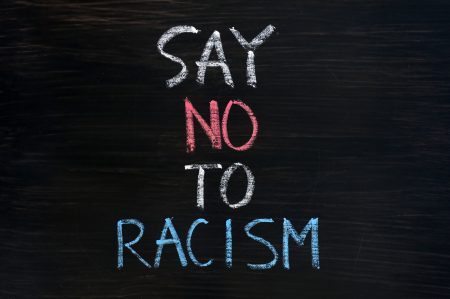
Copyright: bbbar / 123RF Stock Photo
Last Sunday, two colleagues and I greeted a group of thirty-three people over a shared meal in a church social hall to talk together about race and racism. With five different churches from four different traditions – UCC, Methodist, Lutheran, and Presbyterian – we came together to talk about the problem of racism in our community and in our world.
We are all white and we represent predominantly white churches. Nevertheless, for some people, it feels uncomfortable to get together as white people. This is a bit paradoxical since many of us are often in exclusively white groups much of the time. From our families and work spaces, to the restaurants we frequent and the churches we attend. Many white people are exclusively surrounded by white people a lot of the time.
Living in “white only” spaces
But, we say to ourselves, “this isn’t by design – it’s just happenstance.” In other words, most of us didn’t intentionally marry someone of our race for reasons of so-called “racial purity.” Nor do we work in an office or an organization because our colleagues are white. And our church? Well, we go there because it is where we feel comfortable, welcome, at home.
However, each of these “choices” begs the question of how we are defining “comfort” or what we mean when we say that the fact that we inhabit largely white spaces isn’t “by design.” In a country where de facto segregation continues to shape both formal and informal social spaces we need to interrogate exactly what we mean be “design.”
I expect what many people mean is that their behavior is not a result of intentionally seeking out exclusively white spaces. But, I wonder – do you (white person reading this blog) notice when you are in exclusively white spaces? Do you ever feel uncomfortable when you realize you are in an exclusively white space?
Increasingly, I do notice. And increasingly, I feel super uncomfortable.
Does it matter if white people live and work in diverse spaces?
To be sure, many of us (and yes, the “us” here is white people because I am talking to white people about whiteness) also work in places with people from minoritized communities. Or we eat at restaurants where there are people from different racial backgrounds. Or we attend churches where there are diverse communities represented.
Some of us live in bi-racial (or multi-racial) families. Some of us live in diverse neighborhoods or communities. Invariably, the degree of comfort or discomfort one feels either in racially diverse spaces or in “white” segregated spaces is related to the degree of diversity in our existing social networks as well as our history and experience of interacting with people who are racially different from us.
This reality of the racially segregated patterns of our lives in the US was a significant factor in the recent election. When analyzing the recent election, political scientist Lee Drutman noted,
“The biggest difference between the two parties is the urban-rural divide. That gap widened. Politically, that translates into race and identity as the main political dividing line. Rural and exurban America is very white, and generally inward-looking. Urban America is very diverse and cosmopolitan.”
Talking about whiteness
And so, that takes us back to our Sunday afternoon gathering. Thirty-six white people sharing a meal on a Sunday afternoon – preparing to spend six weeks together interrogating our whiteness and the role that white people can and should play in dismantling racism.
Because we are the majority racial group, white people often do not notice our whiteness and even more rarely do we talk about it. In fact, as one participant in the group pointed out “what should I tell my friends about what I did this afternoon? That I met with a “whites only” group of Christians?” That feels an awful lot like what white supremacists in our country are advocating.
But intentionality matters. Yes, it is true that we are gathering as white people. But why we are gathering and what we hope to do together matters. While we are gathering together as white people, we are not excluding others from participating. We would not bar people of color from our workshops. But we might explain to them that as white people, we have some work that we need to do in thinking about and examining racism in our country and what it means to be white.
Attending to privilege
Most white people in the US rarely talk about our own racial identity. Pulling the logs out of our eyes is an essential task in allowing us to see more clearly what is happening around race and racism in our country.
As well-intentioned white Christians, the folks who are gathering together over these six weeks seek to be part of the healing of the world. All of us recognize the dangerous spectre that “race” and racism pose for the health and well-being of our communities, our country, and our world.
We are joining together to “Practice Solidarity” as a pathway towards healing and justice. Solidarity is a practice of building bridges across lines of difference in order to work together to seek justice. As I point in my book Solidarity Ethics, the first step toward solidarity for people with privilege is examining our privilege. For white people living in a racist world – we cannot forge relationships of solidarity until we attend to our whiteness and our privilege.
Covenanting for justice
We ended our first week together by joining in a ritual of covenant in which we pledged to each other to be open to challenge, to embrace ambiguity, to strive for honesty, and to risk being vulnerable.
And we opened our hearts before God and asked for guidance, mercy, and discernment as we strive to be a more faithful people.
Previous Post
February 7, 2017
Practicing Solidarity: The Power of Churches to Challenge Hate
Next Post

February 13, 2017 How to Reject Xenophobia – Have Lunch Instead!
Browse Our Archives
Select a Category book review christian ethics christianity college/higher education economics ecumenism environment feminism feminism and feminist theology justice motherhood parenting politics poverty public policy reproductive justice sexuality social change solidarity Uncategorized
Select a Month September 2018 July 2018 June 2018 May 2018 April 2018 March 2018 February 2017 January 2017 November 2016 October 2016 September 2016 August 2016 July 2016 May 2016 April 2016 March 2016 February 2016 January 2016 December 2015 November 2015 October 2015 September 2015 August 2015 July 2015 June 2015 May 2015 April 2015 March 2015 February 2015
Follow Us!
TAKE THE
Religious Wisdom Quiz
Which city did David conquer and make his capital?
Select your answer to see how you score.
Gibeon Hebron Bethel Jerusalem
Related posts from To Do Justice


Kavanaugh and the Threat to Women

Women’s Unalienable Rights Cannot Be Subject to Whims...

Last Week Was Hard: Moving Reproductive Justice Forward...
TRENDING AT PATHEOS Progressive Christian

Why Christians Have a Sacred Duty to Vote:...
The Bible offers strong support for the sacred duty to vote. Here...

What Being a Modern-Day Apostle Means to Me
In my last column, I discussed the ins and outs of modern-day...

Did Ancient China Once Worship the God of...
Across human history, a common thread weaves through the origins of the...

Love Your Neighbor – Including Earth-Kin: Lev. 19,...
God’s command to love your neighbor means acting in an ethical and...

Lead a Church Study of “Jesus and Lao...
Guest writer Jack Thomas (The Irreverent Reverend) reflects on leading his church...

Principles for Understanding the Apostolic Ministry Today
Whenever people discover that my formal ministry title is "apostle," as in...
view all Progressive Christian blogs
Ad-Free & Subscriber Log-In Subscription Support
- About Us
- 2026 Calendar
- Videos
- Podcasts
- Library of World Religions
- Faith In Media Tracker
- Advertise With Us
- Write for Us
- Privacy Policy
- Terms of Service
- Do Not Sell My Data
- Contact Us
- Radiant Digital
- Manage Newsletter Subscriptions
- Unsubscribe From Notifications
- Sitemap
Copyright 2008-2026, Patheos. All rights reserved.
Subscription Support Ad-Free & Subscriber Log-In
Follow Patheos