
BuddhistCatholicContemplativeEvangelicalGeneral ChristianHinduJewishLatter-day SaintMuslimNew VisionsProgressive Christian
Beliefs
- Buddhist
- Catholic
- Contemplative
- Evangelical
- General Christian
- Hindu
- Jewish
- Latter-day Saint
- More Voices
- Muslim
- New Visions
- Pagan
- Progressive Christian
Topics
- Religion News
- Food and Religion
- Sports and Religion
- Religious Art
- Religious Music and Entertainment
- Religious Events
- History and Religion
- Style and Religion
- Politics and Religion
- Women in Religion
- Recreation Outdoors and Religion
- Business Finance and Religion
- Careers Workplace and Religion
- Education and Religion
- Family Parenting and Religion
- Health Fitness and Religion
- Home and Religion
- Relationships and Religion
- Technology and Religion
- Travel and Religion
Columnists
- Buddhist Columnists
- Business Finance and Religion Columnists
- Careers Workplace and Religion Columnists
- Catholic Columnists
- Contemplative Columnists
- Education and Religion Columnists
- Evangelists Columnists
- Family Parenting and Religion Columnists
- General Christian Columnists
- Health Fitness and Religion Columnists
- Hindu Columnists
- History and Religion Columnists
- Home and Religion Columnists
- Jewish Columnists
- More Voices Columnists
- Latter Day Columnists
- Muslim Columnists
- New Visions Columnists
- Nonreligious Columnists
- Pagan Columnists
- Politics and Religion Columnists
- Progressive Columnists
- Recreation Outdoors and Religion Columnists
- Relationships and Religion Columnists
- Religion News Columnists
- Religious Art Columnists
- Religious Events Columnists
- Religious Music and Entertainment Columnists
- Sports and Religion Columnists
- Style and Religion Columnists
- Technology and Religion Columnists
- Travel and Religion Columnists
- Women in Religion Columnists
Resource Library
- 2026 Calendar
- Library of World Religions
- The 100 Most Holy Places on Earth
- Patheos Answers
- Podcasts
- Videos
- Faith Leaders Database
- Anglican Episcopalian
- Bahai
- Baptist
- Buddhism
- Christianity
- Confucianism
- Eastern Orthodoxy
- Hinduism
- Holiness and Pentecostal
- ISKCON
- Islam
- Judaism
- Lutheran
- Methodist
- The Church of Jesus Christ of Latter-day Saints
- New Age
- Paganism
- Presbytarian and Reformed
- Protestantism
- Religion Behind the Scenes
- Roman Catholic
- Scientology
- Shia Islam
- Sikhism
- Sufism
- Sunni Islam
- Taoism
- Zen
- See all religions
Research Tools
 Ad-Free & Subscriber Log-In Subscription Support
Ad-Free & Subscriber Log-In Subscription Support
Follow Patheos 

- Trending:
- Forgiveness
- |
- Marriage
- |
- Consciousness
- |
- Death Penalty
- |
- Election
- |
- Halloween
 To Do Justice
- Home
- Progressive Christian
- Politics and Religion
- Consumerism Gone Wild: How Swiffers are Sweeping Away our Common Sense
Consumerism Gone Wild: How Swiffers are Sweeping Away our Common Sense
Last updated on: November 30, 2015 at 9:21 am by Rebecca Todd Peters
Consumerism Gone Wild: How Swiffers are Sweeping Away our Common Sense 2015-11-30T09:21:32-04:00 Rebecca Todd Peters
Patheos Explore the world's faith through different perspectives on religion and spirituality! Patheos has the views of the prevalent religions and spiritualities of the world.

Swiffers represent all that is disordered about US American consumerism.
For many thousands of years, people have made and used brooms to clean our homes and living spaces. In all parts of the world, throughout generations of human history – not only have brooms kept us clean but they have been constructed of local goods that are completely biodegradable. Well-constructed brooms might last for decades or longer.
And then, in 1999, Proctor and Gamble introduced the “Swiffer.” This product went way beyond the model of “planned obsolescence” in which the lifetime of a product was intentionally limited so consumers would need to replace it. With Swiffers, consumers basically brought a broomstick that required them to purchase replacement parts on a regular basis. These products proved to be a goldmine.
So why do these products bother me so much? They bother me because they represent the ability of corporations and marketing campaigns to manufacture need.
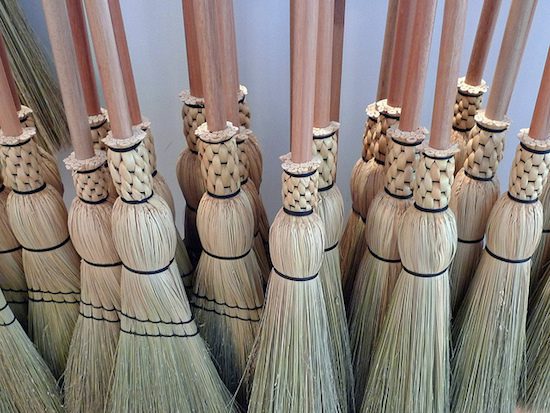
photo by Ruth Hartnup
No one really needs a Swiffer. Brooms are far cheaper. Brooms are aesthetically more pleasing. Brooms clean the dust and dirt from our homes. Brooms are ecologically more responsible.
And yet, they were an instant success. Millions of people have cast aside their trusted brooms and embraced the Swiffer.
For those of you who love your Swiffer, my point is not simply to bash this particular product. My point is to reflect on what products like Swiffer represent in our culture.
I will highlight just three problems that I see represented by Swiffers in our burgeoning consumer culture today.
First is the remarkable power that corporations and marketing campaigns hold in our culture today. Yes, I get that we live in a free market and that marketing is a form of free speech. And yet, from a moral perspective, I think we ought to pause and consider the amount of power we have ceded to corporations in our world to shape our understanding of who we are and what we want. Of course, people still retain our freedom of choice and we are able to exercise that freedom through our consumer dollars. But there is ample social-scientific research that documents the psychological power of marketing to influence behavior. Particularly among children and young people.
Second, Swiffers represent an obsession in our culture with convenience over quality. Now, don’t get me wrong, I am a working mother and convenience is an important factor in my life! Modern technology has an enormous impact on my life and my ability to be a working mother.
But there is also a qualitative difference between the convenience of running water and washing machines compared to the convenience of a product like a Swiffer over a traditional broom. Our cultural attraction to bigger, better, faster, cheaper represents not only a potential loss of quality products and craftsmanship, it also represents a move to a disposable culture.
This leads me to my third concern – our move away from sustainable habits and practices to an unsustainable lifestyle. Sweeping, cooking, washing dishes and clothes – these are all habits and practices that sustain daily life. These are habits and practices that are shared across cultures, across historical time periods, and across geographic barriers. These are the reproductive practices of our life, the practices that cultivate, shape, and sustain our lives. Some people enjoy various aspects of these practices, others hate all of them in every way, shape, or form. Nevertheless, these practices are essential to life. For too many of us, we have moved away from sustainable reproductive practices to unsustainable practices that are having a detrimental impact on our planet as a whole.
As Patheos readers consider consumption this month, I encourage you to think about these problems I have identified as well as your own relationship with consumerism and consumption.
We are all consumers. There is nothing inherently wrong with consuming. How could there be? We must eat. We need clothes. We own things that give us pleasure. Having possessions is not the problem.
So what, then, is the problem?
Well, truly, the problems are legion, like the demons that plagued the Gerasene demoniac in the gospel of Luke. If only we could figure out how to cast the demonic aspects of consumerism into a herd of swine and drown them so that we, too, might be free from the vice represented by the dis-ordering of our normal and healthy needs.
What do I mean by this?
Well, if consumption is necessary to survive that means we ought to be able to recognize the very real value of many consumer goods in our society.
The problem arises when our healthy desires are dis-ordered by greed, marketing ploys, jealousy, the longing to “keep up with the Jones’.” As we consider the idea of “consumerism gone wild,” we would do well to reflect on the difference between need and want, necessity and desire.
To be sure, there is also nothing inherently wicked about wanting or desiring something. The problem, here again, is one of scale, motivation, and consequences.
As you consider your own habits of consumption, I invite you to distinguish your healthy desires from the unhealthy ones and figure out ways of casting aside those demons.
Swine are optional.

Next Post

December 1, 2015 Homegrown Terrorism: Why Colorado is NOT the Action of a Lone Gunman
Browse Our Archives
Select a Category book review christian ethics christianity college/higher education economics ecumenism environment feminism feminism and feminist theology justice motherhood parenting politics poverty public policy reproductive justice sexuality social change solidarity Uncategorized
Select a Month September 2018 July 2018 June 2018 May 2018 April 2018 March 2018 February 2017 January 2017 November 2016 October 2016 September 2016 August 2016 July 2016 May 2016 April 2016 March 2016 February 2016 January 2016 December 2015 November 2015 October 2015 September 2015 August 2015 July 2015 June 2015 May 2015 April 2015 March 2015 February 2015
Follow Us!
TAKE THE
Religious Wisdom Quiz
What were the first man and woman’s names in the Bible?
Select your answer to see how you score.
Jacob and Rachel Adam and Eve Samson and Delilah Joseph and Mary
Related posts from To Do Justice


Kavanaugh and the Threat to Women

Women’s Unalienable Rights Cannot Be Subject to Whims...

Republican Voices for Choice Retreat Amidst Increased Polarization
TRENDING AT PATHEOS Progressive Christian

Why Christians Have a Sacred Duty to Vote:...
The Bible offers strong support for the sacred duty to vote. Here...

What Being a Modern-Day Apostle Means to Me
In my last column, I discussed the ins and outs of modern-day...

Did Ancient China Once Worship the God of...
Across human history, a common thread weaves through the origins of the...

Love Your Neighbor – Including Earth-Kin: Lev. 19,...
God’s command to love your neighbor means acting in an ethical and...

Lead a Church Study of “Jesus and Lao...
Guest writer Jack Thomas (The Irreverent Reverend) reflects on leading his church...

Principles for Understanding the Apostolic Ministry Today
Whenever people discover that my formal ministry title is "apostle," as in...
view all Progressive Christian blogs
Ad-Free & Subscriber Log-In Subscription Support
- About Us
- 2026 Calendar
- Videos
- Podcasts
- Library of World Religions
- Faith In Media Tracker
- Advertise With Us
- Write for Us
- Privacy Policy
- Terms of Service
- Do Not Sell My Data
- Contact Us
- Radiant Digital
- Manage Newsletter Subscriptions
- Unsubscribe From Notifications
- Sitemap
Copyright 2008-2026, Patheos. All rights reserved.
Subscription Support Ad-Free & Subscriber Log-In
Follow Patheos