
BuddhistCatholicContemplativeEvangelicalGeneral ChristianHinduJewishLatter-day SaintMuslimNew VisionsProgressive Christian
Beliefs
- Buddhist
- Catholic
- Contemplative
- Evangelical
- General Christian
- Hindu
- Jewish
- Latter-day Saint
- More Voices
- Muslim
- New Visions
- Pagan
- Progressive Christian
Topics
- Religion News
- Food and Religion
- Sports and Religion
- Religious Art
- Religious Music and Entertainment
- Religious Events
- History and Religion
- Style and Religion
- Politics and Religion
- Women in Religion
- Recreation Outdoors and Religion
- Business Finance and Religion
- Careers Workplace and Religion
- Education and Religion
- Family Parenting and Religion
- Health Fitness and Religion
- Home and Religion
- Relationships and Religion
- Technology and Religion
- Travel and Religion
Columnists
- Buddhist Columnists
- Business Finance and Religion Columnists
- Careers Workplace and Religion Columnists
- Catholic Columnists
- Contemplative Columnists
- Education and Religion Columnists
- Evangelists Columnists
- Family Parenting and Religion Columnists
- General Christian Columnists
- Health Fitness and Religion Columnists
- Hindu Columnists
- History and Religion Columnists
- Home and Religion Columnists
- Jewish Columnists
- More Voices Columnists
- Latter Day Columnists
- Muslim Columnists
- New Visions Columnists
- Nonreligious Columnists
- Pagan Columnists
- Politics and Religion Columnists
- Progressive Columnists
- Recreation Outdoors and Religion Columnists
- Relationships and Religion Columnists
- Religion News Columnists
- Religious Art Columnists
- Religious Events Columnists
- Religious Music and Entertainment Columnists
- Sports and Religion Columnists
- Style and Religion Columnists
- Technology and Religion Columnists
- Travel and Religion Columnists
- Women in Religion Columnists
Resource Library
- 2026 Calendar
- Library of World Religions
- The 100 Most Holy Places on Earth
- Patheos Answers
- Podcasts
- Videos
- Faith Leaders Database
- Anglican Episcopalian
- Bahai
- Baptist
- Buddhism
- Christianity
- Confucianism
- Eastern Orthodoxy
- Hinduism
- Holiness and Pentecostal
- ISKCON
- Islam
- Judaism
- Lutheran
- Methodist
- The Church of Jesus Christ of Latter-day Saints
- New Age
- Paganism
- Presbytarian and Reformed
- Protestantism
- Religion Behind the Scenes
- Roman Catholic
- Scientology
- Shia Islam
- Sikhism
- Sufism
- Sunni Islam
- Taoism
- Zen
- See all religions
Research Tools
 Ad-Free & Subscriber Log-In Subscription Support
Ad-Free & Subscriber Log-In Subscription Support
Follow Patheos 

- Trending:
- Forgiveness
- |
- Marriage
- |
- Consciousness
- |
- Death Penalty
- |
- Election
- |
- Halloween
 To Do Justice
- Home
- Progressive Christian
- Politics and Religion
- How Capitalism is Destroying Higher Education: Why David Brooks Got it Wrong
How Capitalism is Destroying Higher Education: Why David Brooks Got it Wrong
Last updated on: October 7, 2015 at 9:11 am by Rebecca Todd Peters
How Capitalism is Destroying Higher Education: Why David Brooks Got it Wrong 2015-10-07T09:11:17-04:00 Rebecca Todd Peters
Patheos Explore the world's faith through different perspectives on religion and spirituality! Patheos has the views of the prevalent religions and spiritualities of the world.
![By MPD01605 from Sterling, Virginia, United States, United States (Alamance Building) [CC BY-SA 2.0 (http://creativecommons.org/licenses/by-sa/2.0)], via Wikimedia Commons](https://wp-media.patheos.com/blogs/sites/583/2015/10/Alamance_Building_Elon_University.jpg)
By MPD01605 from Sterling, Virginia, United States, United States (Alamance Building) [CC BY-SA 2.0 (http://creativecommons.org/licenses/by-sa/2.0)], via Wikimedia Commons
In his latest New York Times op-ed, David Brooks mourns what he sees as a shift away from the task of moral formation that was once at the heart of higher education. He writes, “academic research and teaching replaced character formation at the core of the university’s mission.”
As a Christian ethicist and a university professor, I have to say that this assessment of the problem is a gross misunderstanding (on several levels) of the very problem he hopes to address. Ultimately, I think Brooks is trying to challenge the threat to the liberal arts that is a clear and present danger in higher ed. For this effort, I applaud him. However, the issues that Brooks raises are complicated and he collapses several distinct and important issues that deserve clarification. Let’s examine three of these.
First, the suggestion that an emphasis on academic research and teaching means that faculty are less interested or involved in character formation is to profoundly misunderstand the nature of research and of teaching, particularly in the humanities.
As an example, my scholarship focuses on a variety of areas of social injustice, including poverty, globalization, reproductive rights, inequality, racism, and privilege. My approach is both descriptive, in that it seeks to describe and analyze particular problems of social injustice and normative, in that I develop standards of justice rooted in (but not exclusive to) Christian tradition that I argue ought to shape and guide the behavior of Christians. While scholarly, my work is clearly about moral formation.
As an ethics professor, much of what I do in the classroom is moral formation. Though, let’s be clear, my role in the classroom is not to teach students what is right and wrong – that is not moral formation, that is catechism. What I mean by moral formation is teaching students how to understand the difference between right and wrong and requiring them to critically examine their own values, worldviews, and beliefs in order to figure out who they are and what they believe.The task of teaching religion at the college level is not to teach students what to believe but rather to teach them how to think.
To suggest that when faculty focus on research and teaching that we (or our universities) are not also engaged in moral formation is simply wrong.
Second, there remain many colleges and universities (mostly private) that not only include character formation in our mission statements but that shape our curricula, classrooms, and campus life around seeking to embody this commitment.
Here is the mission statement of my university:
Elon University embraces its founders’ vision of an academic community that transforms mind, body, and spirit and encourages freedom of thought and liberty of conscience.
Like many private colleges and universities across the country, Elon was founded by a religious institution and continues to identify as “historically-related” to the United Church of Christ (UCC). Our mission reflects the original intentions of our Christian founders while also allowing us to open up to the inclusion of students who practice other faith traditions.
Brooks suggestion that professors dropped spiritual language and moral prescription because we “didn’t know what to say” or because we didn’t want to “alienate our diversifying constituencies” betrays a misunderstanding of best practices in teaching and in the changing nature of the college classroom. Professors dropped spiritual language and moral prescription precisely because we are professors and not Sunday school teachers and because we stopped assuming that our classrooms were or should be filled with Christian students.
At Elon, as in many institutions across the country, we embody our mission in both our curricular and co-curricular approaches to our students.
On the co-curricular side, instead of a campus ministry or chaplaincy program that focuses exclusively on the needs and formation of Christian students, campuses across the country are responding to the changing demographics of the country and their campuses in creative and meaningful ways.
Two and half years ago, my university built a new multi-faith building that now hosts the Truitt Center for Religious and Spiritual Life. In addition to a University chaplain, we also have a Protestant, Catholic, and Jewish chaplain and a Muslim Life Coordinator on staff.
In our curriculum, the emphasis on critical thinking that guides my own teaching is also a dominant aspect of many academic disciplines and college classrooms, but teaching students how to think critically about ideas (philosophy), religion and belief systems (religious studies), literature (English), and the arts (art history and musicology) is at the heart of the humanities.
After all, studying, understanding, interrogating, critiquing and creating new forms of human culture is the purpose of the humanities and engaging in these pursuits is a fundamental aspect of shaping character and helping young people develop, exercise, and practice their moral muscles. It is the valuing of this traditional aspect of higher education that is most at risk in the current culture which leads me to my last point.
Third, and perhaps most significantly, the threat to the liberal arts is very real and Brooks rightly identifies the increasing problem of professionalism and its impact on higher education. While this problem is most pronounced at public institutions, it is also increasingly impacting private liberal arts institutions as cultural forces question the value of the humanities and seek to replace our moral compass with economic benchmarks.
However, it is important to recognize that the emphasis on professionalism is a direct result of an increased embracing of neoliberalism, which is an extreme (and dis-ordered) form of capitalism. Neoliberalism, which focuses on growth, trade, and deregulation, is also sometimes referred to as laissez-faire or supply-side capitalism. It is also associated with the Reagan era aphorism “a rising tide lifts all boats.” While a nice image, thirty-five years of a neoliberal economic approach has only increased inequality in the US and internationally rather than delivering the increased standard of living that this ideology promises to workers.
When we, as a culture, allow an economic ideology like this to infiltrate our minds and hearts and replace our moral compass, it is increasingly difficult for colleges and universities to participate in responsible moral formation. What does it look like when an economic ideology replaces our moral compass, you might ask?
*Instead of recognizing the value of a well-developed mind rich with cultural, historical, and scientific knowledge, an economic ideology only cares about what job you can get after college.
*Instead of valuing a mind that is agile, quick, thoughtful, and able to engage in complex problem-solving in new and varied situations, an economic ideology reduces education to narrowly defined professional training for specific job tracks – nursing, business, communications, teaching (nb. nurses, business and communication professionals and teachers can and often do benefit from broader liberal arts educations).
*Instead of recognizing the value of being able to understand and identify what we mean when we invoke principles like the “common good” or “sustainability” or “social justice,” an economic ideology only cares about cost-benefit ratios, efficiency, and utility.
While there is a generic cultural drift in higher ed as students increasingly track themselves (or are pushed by parents) into pre-professional tracks, the most dangerous aspect of this mentality is evident in right-wing politicians who seek to peg funding of public universities to the ability of graduates to get jobs.
Republican governors in North Carolina, Texas, Florida and Wisconsin have all questioned the value of the liberal arts and humanities degrees at public colleges and universities. In NC, Governor Pat McCrory has taken this to the extreme in his proposed legislation to change the formula for how education money is allocated to public institutions across the state. In 2013 McCrory argued that public funding for community colleges and universities should be “based on how well they do at placing their students in the job market.” In one speech, McCrory stated that he wanted to “reform and adapt the U.N.C. brand to the ever-changing competitive environment of the twenty-first century” and to “[hone] in on skills and subjects employers need.”
Clearly McCrory and his cronies haven’t done their homework. The Association of American Colleges and Universities has published two important studies here and here in the past five years that demonstrate employers have a much more robust understanding of “job readiness” than the neoliberal camp and their professionalization buddies.
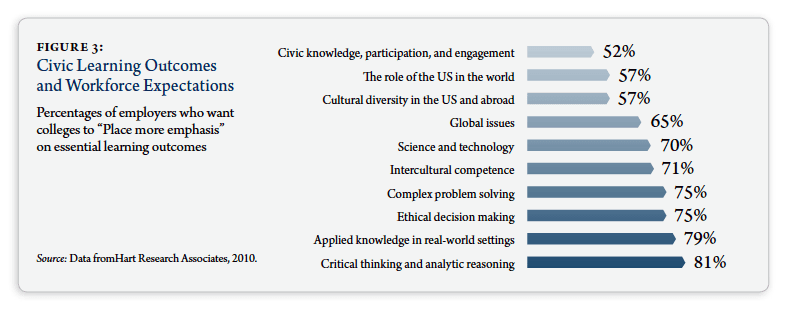
From A Crucible Moment, AACU – https://www.aacu.org/crucible
Certainly, those college administrators who are cutting back or attempting to cut back their support of the liberal arts need to read these reports as well!
No doubt, smart people have to know “stuff,” but they also have to know how to think – critically, morally, analytically, historically, aesthetically – and that is the real value of a liberal arts education.
Perhaps David Brooks ought to talk to some humanities professors before writing his next op-ed about what we do.
Previous Post

October 5, 2015
Why K-Cups Are Going To Kill Us

Browse Our Archives
Select a Category book review christian ethics christianity college/higher education economics ecumenism environment feminism feminism and feminist theology justice motherhood parenting politics poverty public policy reproductive justice sexuality social change solidarity Uncategorized
Select a Month September 2018 July 2018 June 2018 May 2018 April 2018 March 2018 February 2017 January 2017 November 2016 October 2016 September 2016 August 2016 July 2016 May 2016 April 2016 March 2016 February 2016 January 2016 December 2015 November 2015 October 2015 September 2015 August 2015 July 2015 June 2015 May 2015 April 2015 March 2015 February 2015
Follow Us!
TAKE THE
Religious Wisdom Quiz
True or False: The feast of Purim commemorates the Jewish people's deliverance from Haman's plot.
Select your answer to see how you score.
FALSE TRUE
Related posts from To Do Justice


Kavanaugh and the Threat to Women

Women’s Unalienable Rights Cannot Be Subject to Whims...

Last Week Was Hard: Moving Reproductive Justice Forward...
TRENDING AT PATHEOS Progressive Christian

Why Christians Have a Sacred Duty to Vote:...
The Bible offers strong support for the sacred duty to vote. Here...

What Being a Modern-Day Apostle Means to Me
In my last column, I discussed the ins and outs of modern-day...

Did Ancient China Once Worship the God of...
Across human history, a common thread weaves through the origins of the...

Love Your Neighbor – Including Earth-Kin: Lev. 19,...
God’s command to love your neighbor means acting in an ethical and...

Lead a Church Study of “Jesus and Lao...
Guest writer Jack Thomas (The Irreverent Reverend) reflects on leading his church...

Principles for Understanding the Apostolic Ministry Today
Whenever people discover that my formal ministry title is "apostle," as in...
view all Progressive Christian blogs
Ad-Free & Subscriber Log-In Subscription Support
- About Us
- 2026 Calendar
- Videos
- Podcasts
- Library of World Religions
- Faith In Media Tracker
- Advertise With Us
- Write for Us
- Privacy Policy
- Terms of Service
- Do Not Sell My Data
- Contact Us
- Radiant Digital
- Manage Newsletter Subscriptions
- Unsubscribe From Notifications
- Sitemap
Copyright 2008-2026, Patheos. All rights reserved.
Subscription Support Ad-Free & Subscriber Log-In
Follow Patheos