
BuddhistCatholicContemplativeEvangelicalGeneral ChristianHinduJewishLatter-day SaintMuslimNew VisionsProgressive Christian
Beliefs
- Buddhist
- Catholic
- Contemplative
- Evangelical
- General Christian
- Hindu
- Jewish
- Latter-day Saint
- More Voices
- Muslim
- New Visions
- Pagan
- Progressive Christian
Topics
- Religion News
- Food and Religion
- Sports and Religion
- Religious Art
- Religious Music and Entertainment
- Religious Events
- History and Religion
- Style and Religion
- Politics and Religion
- Women in Religion
- Recreation Outdoors and Religion
- Business Finance and Religion
- Careers Workplace and Religion
- Education and Religion
- Family Parenting and Religion
- Health Fitness and Religion
- Home and Religion
- Relationships and Religion
- Technology and Religion
- Travel and Religion
Columnists
- Buddhist Columnists
- Business Finance and Religion Columnists
- Careers Workplace and Religion Columnists
- Catholic Columnists
- Contemplative Columnists
- Education and Religion Columnists
- Evangelists Columnists
- Family Parenting and Religion Columnists
- General Christian Columnists
- Health Fitness and Religion Columnists
- Hindu Columnists
- History and Religion Columnists
- Home and Religion Columnists
- Jewish Columnists
- More Voices Columnists
- Latter Day Columnists
- Muslim Columnists
- New Visions Columnists
- Nonreligious Columnists
- Pagan Columnists
- Politics and Religion Columnists
- Progressive Columnists
- Recreation Outdoors and Religion Columnists
- Relationships and Religion Columnists
- Religion News Columnists
- Religious Art Columnists
- Religious Events Columnists
- Religious Music and Entertainment Columnists
- Sports and Religion Columnists
- Style and Religion Columnists
- Technology and Religion Columnists
- Travel and Religion Columnists
- Women in Religion Columnists
Resource Library
- 2026 Calendar
- Library of World Religions
- The 100 Most Holy Places on Earth
- Patheos Answers
- Podcasts
- Videos
- Faith Leaders Database
- Anglican Episcopalian
- Bahai
- Baptist
- Buddhism
- Christianity
- Confucianism
- Eastern Orthodoxy
- Hinduism
- Holiness and Pentecostal
- ISKCON
- Islam
- Judaism
- Lutheran
- Methodist
- The Church of Jesus Christ of Latter-day Saints
- New Age
- Paganism
- Presbytarian and Reformed
- Protestantism
- Religion Behind the Scenes
- Roman Catholic
- Scientology
- Shia Islam
- Sikhism
- Sufism
- Sunni Islam
- Taoism
- Zen
- See all religions
Research Tools
 Ad-Free & Subscriber Log-In Subscription Support
Ad-Free & Subscriber Log-In Subscription Support
Follow Patheos 

- Trending:
- Forgiveness
- |
- Marriage
- |
- Consciousness
- |
- Death Penalty
- |
- Election
- |
- Halloween
 Tinsel
- Home
- Religious Music & Entertainment
- “1000 Times Good Night” Deserves Your Attention for an Evening
“1000 Times Good Night” Deserves Your Attention for an Evening
Last updated on: November 5, 2014 at 1:58 pm by Andrew Spitznas
“1000 Times Good Night” Deserves Your Attention for an Evening 2014-11-05T13:58:16-06:00 Andrew Spitznas
Patheos Explore the world's faith through different perspectives on religion and spirituality! Patheos has the views of the prevalent religions and spiritualities of the world.

Juliette Binoche as Rebecca, in “1000 Times Good Night”
Erik Poppe’s movies exemplify two of the main reasons I love writing about films. First, for Americans anyway, the work by this Norwegian director is still a tad obscure, so it’s a pleasure to introduce his movies to a wider audience. More importantly, his three most recent films have shown consistent excellence, as affecting stories enveloped in a lush visual style.
With 1000 Times Good Night, Poppe manages to be both more personal and more global. His two preceding films – Hawaii, Oslo and Troubled Water – focused on small ensembles intersecting in a single city or neighborhood. With his latest, Poppe draws from his experiences as a war photographer around the world and the impact his dangerous vocation had upon his wife and children. (Indeed, some of the imagery in this film comes from a documentary made by Poppe in Africa for the Norwegian Refugee Council.)
In 1000 Times, however, the genders are reversed from the director’s true-life experiences. Rebecca (Juliette Binoche) travels to war zones, while her husband Marcus (Nikolaj Coster-Waldau) and their two daughters worry about her safety.
The film commences with a sound-and-vision tour-de-force. For fifteen tense, nearly wordless minutes, we observe Rebecca as she photographs a group of women ritually preparing a female suicide bomber in Kabul, Afghanistan. The hijab-covered females murmur their prayers; dust rises ghost-like from the aspiring martyr; and Rebecca notes in horror the children who will be caught in the blast. All of this culminates in an explosion that gravely injures Rebecca.
After a brief dreamlike interlude in a Dubai hospital, shell-shocked Rebecca returns with her husband to their home on the Irish coast, to reunite with their two daughters. It rapidly becomes apparent that all is not well in the family. Marcus has reached his breaking point, no longer willing to wait for the dreaded phone call informing him of Rebecca’s violent demise. In addition, though their younger daughter Lisa seems well-adjusted, teenage Steph has involuted into somber silence.

Rebecca with her husband Marcus (Nikolaj Coster-Waldau)
The remainder of 1000 Times revolves around both the internal and external tug of war between domestic placidity and a dangerous calling, as Rebecca wrestles with the pro’s and con’s of returning to work or salvaging her relationships with her husband and daughter. This struggle is communicated with near perfection, courtesy of dialogue that resonates with authenticity and convincing acting by all of the key personae.
In an interview, Poppe stated that some of 1000 Times’ dialogue was drawn from actual words uttered by his children. I can believe it: when Lisa in one breath exclaims to her returning mom that people thought she had died, and with the next asks if she brought any presents back with her, this feels like something a blunt, optimistic little girl would say.
The words spoken by Rebecca about her work in various settings also ring true. When Steph asks her mother about the anger driving her efforts, Rebecca responds forcefully, “I want people to choke on their coffee when they open the paper and see [my pictures].” At a dinner party with colleagues of Marcus, when someone innocently asks about her job, she replies that anytime she discusses her work, it ruins the meal.
(I can completely relate to this, by the way. During my five years as a counselor with combat veterans, I was entrusted with many grisly war narratives and felt that same sense of estrangement among “civilians.” I also have to say, that from a psychological standpoint, Binoche’s performance is perhaps the best, yet most unobtrusive, depiction of post-traumatic stress that I’ve ever seen at the movies.)
From an acting standpoint, Binoche and Coster-Waldau interact like a long-married couple, currently alienated yet still capable of much tenderness, as when Marcus applies eyeliner for Rebecca, because her still-shaking hands can’t manage the task. One senses the passion for justice that initially drew these two together. Each in their own way is striving to undo some of the awful damage that humans have inflicted upon the world: Marcus as a biologist documenting the effects of radiation upon marine wildlife, Rebecca by taking photographs that will shame powerful people into taking right action.
Carrying even more emotional weight are the scenes involving Rebecca and Steph (the latter wonderfully played by a newcomer to the screen, Lauryn Canny). Slowly and subtly we discover that behind Steph’s irritability and withdrawal is a young woman with her own impressive, flowering artistic talent who longs to emulate her mom. Rebecca first learns this in leafing through Steph’s scrapbook and sketchpad, gradually finding out more through travels and conversations together.
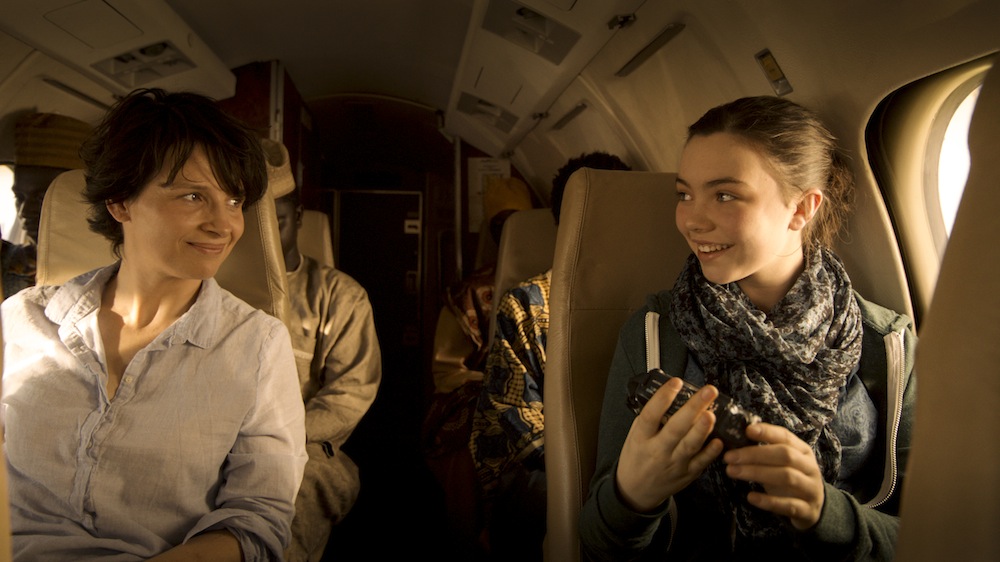
Rebecca and her daughter Steph (Lauryn Canny), travelling together
These elements combine to form a drama of substantial heft and momentum, but Poppe’s visuals take 1000 Times to a higher level of artistry. In a way that is unpretentious (with only one exception; more on that below), certain repeated motifs effectively stir the spirit and urge further contemplation. Water symbolizes both the placid shores of home and the peril of drowning in unfulfillment; the eye enables creativity, yet also forces us to bear witness and become responsible citizens; and the hand is the source of contact and intimacy, with the ring worn by Rebecca representing commitment to husband and children.
The on-location filming in Afghanistan and Kenya, plus the timely insertion of photographs taken by Rebecca (I suspect by Poppe in actuality), potently bring to life the ongoing tragedies in our world. Like Rebecca and her family, we the viewers are faced with images of child soldiers and sex slaves, as well as a Kenyan refugee camp that is scarcely safer than war-sundered Sudan. Rebecca and Poppe want us to be more concerned by these outrages than the latest misadventures of Paris Hilton.
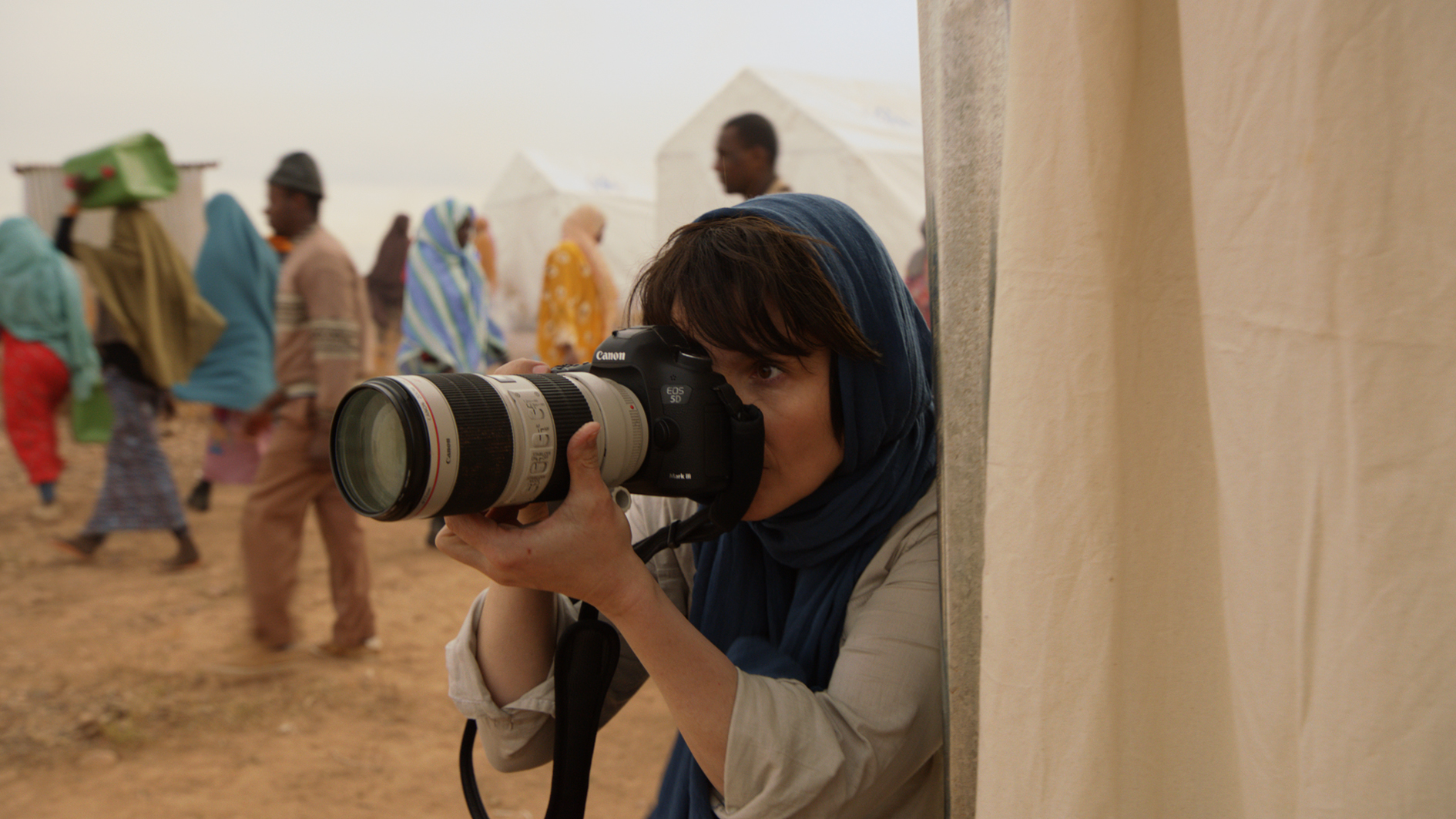
Rebecca and her camera’s eye in a Kenyan refugee camp
Only in the closing moments does Poppe clumsily overstep. Clearly he wants to demonstrate that parents, whether a zealot in Afghanistan or a humanist in Ireland, too often are guilty of sacrificing their children on the altar of their calling. Unfortunately, Poppe works too hard to press this message, resulting in a too-tidy conclusion.
Nonetheless, 1000 Times Good Night is still easily one of the best films I’ve seen this year. Poppe is to be commended for superb use of his storytelling skills and visual style. He hauntingly challenges our indifference to injustice and confronts his and our willingness to use children as a means to our own ostensibly virtuous ends.
4.5 out of 5 stars
(Parents’ guide: 1000 Times Good Night has not been rated by the MPAA. It contains scenes of violence, a discreetly handled sexual situation, and some rough language. I would consider this film appropriate and even beneficial for teens 14 and older to view and discuss with their parents.)

Next Post

November 7, 2014 Review: Cozy Familiarity in 'Big Hero 6'
Browse Our Archives
Select a Category Becky's Picks Children's Movies DVD releases Entertainment News Faith on Film Featured Hunger Games In Theaters Interviews Life, Etc. Mixed Nuts Movie Reviews Poliflix Scroogewatch slider Television Uncategorized
Select a Month December 2014 November 2014 October 2014 September 2014 August 2014 July 2014 June 2014 May 2014 April 2014 March 2014 February 2014 January 2014 December 2013 November 2013 October 2013 September 2013 August 2013 July 2013 June 2013 May 2013 April 2013 March 2013 February 2013 January 2013 December 2012 November 2012 October 2012 September 2012 August 2012 July 2012 June 2012 May 2012 April 2012 March 2012 February 2012 January 2012 December 2011 November 2011 October 2011 September 2011 August 2011 July 2011 June 2011 April 2011 March 2011
Follow Us!
TAKE THE
Religious Wisdom Quiz
Who built the ark to survive the flood?
Select your answer to see how you score.
Elijah Noah Moses Abraham
Related posts from Tinsel

'The Overnighters:' Q&A with Director Jesse Moss

Gratitude for Five Years at Patheos - Moving...

Despite its Title, Stephen Hawking’s Biopic Earns an...

Video: Watch the Trailer for 'The Bible' Sequel...
TRENDING AT PATHEOS Religious Music & Entertainment

Dolly Parton’s Last Song Wins Dove Award with...
Bluegrass band The Grascals, speaking on the red carpet at the 57th...

The Image: On the Horror of Capitalism and...
The Image Then went the Pharisees, and took counsel how they might...

We are approaching the date of our new American national holiday: October...

Letters on Living the Faith by C.S. Lewis
Most of us met C.S. Lewis as a public intellectual. Mere Christianity....

When Halloween Unmasks Married Hearts
Written by Dr. David K. Ewen from Eternal Truth Bible College Behind...

Aristotle. He’s been called the father of logic, the father of the...
view all Religious Music & Entertainment blogs
Ad-Free & Subscriber Log-In Subscription Support
- About Us
- 2026 Calendar
- Videos
- Podcasts
- Library of World Religions
- Faith In Media Tracker
- Advertise With Us
- Write for Us
- Privacy Policy
- Terms of Service
- Do Not Sell My Data
- Contact Us
- Radiant Digital
- Manage Newsletter Subscriptions
- Unsubscribe From Notifications
- Sitemap
Copyright 2008-2026, Patheos. All rights reserved.
Subscription Support Ad-Free & Subscriber Log-In
Follow Patheos