
BuddhistCatholicContemplativeEvangelicalGeneral ChristianHinduJewishLatter-day SaintMuslimNew VisionsProgressive Christian
Beliefs
- Buddhist
- Catholic
- Contemplative
- Evangelical
- General Christian
- Hindu
- Jewish
- Latter-day Saint
- More Voices
- Muslim
- New Visions
- Pagan
- Progressive Christian
Topics
- Religion News
- Food and Religion
- Sports and Religion
- Religious Art
- Religious Music and Entertainment
- Religious Events
- History and Religion
- Style and Religion
- Politics and Religion
- Women in Religion
- Recreation Outdoors and Religion
- Business Finance and Religion
- Careers Workplace and Religion
- Education and Religion
- Family Parenting and Religion
- Health Fitness and Religion
- Home and Religion
- Relationships and Religion
- Technology and Religion
- Travel and Religion
Columnists
- Buddhist Columnists
- Business Finance and Religion Columnists
- Careers Workplace and Religion Columnists
- Catholic Columnists
- Contemplative Columnists
- Education and Religion Columnists
- Evangelists Columnists
- Family Parenting and Religion Columnists
- General Christian Columnists
- Health Fitness and Religion Columnists
- Hindu Columnists
- History and Religion Columnists
- Home and Religion Columnists
- Jewish Columnists
- More Voices Columnists
- Latter Day Columnists
- Muslim Columnists
- New Visions Columnists
- Nonreligious Columnists
- Pagan Columnists
- Politics and Religion Columnists
- Progressive Columnists
- Recreation Outdoors and Religion Columnists
- Relationships and Religion Columnists
- Religion News Columnists
- Religious Art Columnists
- Religious Events Columnists
- Religious Music and Entertainment Columnists
- Sports and Religion Columnists
- Style and Religion Columnists
- Technology and Religion Columnists
- Travel and Religion Columnists
- Women in Religion Columnists
Resource Library
- 2026 Calendar
- Library of World Religions
- The 100 Most Holy Places on Earth
- Patheos Answers
- Podcasts
- Videos
- Faith Leaders Database
- Anglican Episcopalian
- Bahai
- Baptist
- Buddhism
- Christianity
- Confucianism
- Eastern Orthodoxy
- Hinduism
- Holiness and Pentecostal
- ISKCON
- Islam
- Judaism
- Lutheran
- Methodist
- The Church of Jesus Christ of Latter-day Saints
- New Age
- Paganism
- Presbytarian and Reformed
- Protestantism
- Religion Behind the Scenes
- Roman Catholic
- Scientology
- Shia Islam
- Sikhism
- Sufism
- Sunni Islam
- Taoism
- Zen
- See all religions
Research Tools
 Ad-Free & Subscriber Log-In Subscription Support
Ad-Free & Subscriber Log-In Subscription Support
Follow Patheos 

- Trending:
- Forgiveness
- |
- Marriage
- |
- Consciousness
- |
- Death Penalty
- |
- Election
- |
- Halloween
 Tinsel
- Home
- Religious Music & Entertainment
- Why ‘Blackish’ Matters
Why ‘Blackish’ Matters
Last updated on: October 16, 2014 at 4:07 pm by Rebecca Cusey
Why ‘Blackish’ Matters 2014-10-16T16:07:04-06:00 Rebecca Cusey
Patheos Explore the world's faith through different perspectives on religion and spirituality! Patheos has the views of the prevalent religions and spiritualities of the world.

We’re not as far apart as we sometimes think we are. I’m struck by this every time I go to our local mall. There I see black shoppers and white shoppers, women in hijab, women in saris, people from Korea and people from Japan, Jewish folk, Christian folk, nothing-much-folk.
Nobody wants to fight. They just want good deals at The Gap.
America is where racial, ethnic, and religious strife comes to fade away. Sure, we may have our tensions, but they do not end in a sidewalk bomb or a shooting war.
I think that despite our very real tension between white and black in America, in the end, everyone wants the same things: To be treated with dignity, to have opportunity, and to raise children in peace and prosperity.
Which is why I really enjoyed the season opener of Black-ish and hope the show lives up to its promise.
Anthony Anderson plays André Johnson, a dad and husband who is living the American Dream. He works for an advertising firm and is moving up the ladder there. His surgeon wife (Tracee Elis Ross) is a typical working mom: Busy, direct, unshakable. The family lives in a large, nice home in a leafy, nice suburb of Los Angeles. It’s not a black neighborhood. In fact, the pilot seems to imply it’s mostly white.
The trouble comes when André starts to feel, with the constant needling of his father (Laurence Fishburne) that his family is losing their black identity. He can’t let that happen. But first, he’s got to figure out what his own black identity is.
All of this takes some pretty silly paths: An African coming of age ceremony with a miserable 13 year old and some questionable African clothes.
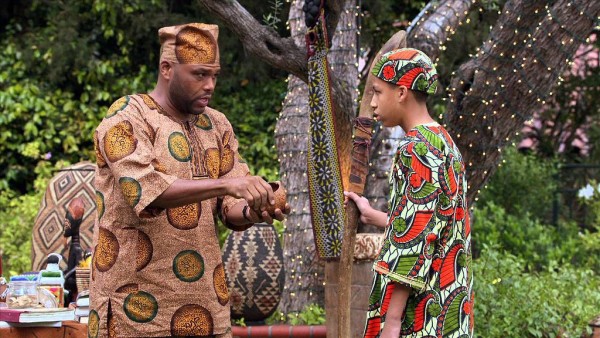
But the silliness does beg the question: What is “Black” besides just “not white?” Is it “urban” or “African” or “hip-hop?” And who gets to decide?
One thing I liked about the show is that the characters have a backstory of their thoughts about race. André chose to work in a mainstream firm, not a black firm, because he wanted to break down barriers. He’s made choices in the past that have led him here, choices I’d personally like to know more about. I like that the characters talk about their own inter-African-American (to coin a phrase) concepts of race. Is Mrs. Johnson less black because she’s more mixed blood? Who decides that?
Pilots necessarily paint in big strokes and this pilot staked out its territory from the first frames. In the opening sequence, André imagines a tour bus pointing out his family like specimens in a zoo: The noble, beautiful, successful black family. Some of the brushstrokes are a little clumsy: Why write that his black son wants a bar-mitzvah? It’s almost a cliche trope for teen identity crisis.
On the other hand, however, those broad strokes leave the audience wanting to know more about the characters and setting. Why is Mrs. Johnson named Rainbow? Is she a product of free-love hippy culture? Are there any other races in Los Angeles than black and white (I’ve heard there are)? What differentiates André’s honorary-black white assistant from his white-privilige white colleague?
And is it ok to say “black” now? Was there a memo?
Ultimately, Black-ish promises several things:
It opens a conversation with humor about what we want and where we are going, not just as black or white, but as a country that has to, indeed is privileged to, live together. It points out that we all, black, white, brown, or other, have a human tendency to take ourselves way too seriously.
For the first time in a long, long time (*Cough, cough..Cosbys*), it gives us a sitcom that appeals to both black and white audiences. Viewership is so fragmented, it’s almost a public service to bring people of different demographic segments to the same show.
Finally, as André himself points out, ethnic identity is important. But there are things that are more important than focusing merely on race. Things we all share like family and justice and disappointment in our children’s sports choices.
I’ll be watching more Black-ish and blogging each episode. I’d love you to join me.
Update: Here are my thoughts on later episodes:
Episode Two: The Talk. In which both parents try to connect with teens. Not my favorite episode. (Because of S.E.X.)
Episode Three: The Nod. In which Dre tries to instill in his son the special bond all black men share. Does not end well.
Episode Four: Crazy Mom. In which Dre takes over child duties from Bow. And succeeds. But not in a good way.
Previous Post

October 1, 2014
Watch New Video: Just Released Exodus: Gods and Kings Trailer
Next Post
October 2, 2014 Black-ish Recap: 'The Talk,' Sex, and Hair
Browse Our Archives
Select a Category Becky's Picks Children's Movies DVD releases Entertainment News Faith on Film Featured Hunger Games In Theaters Interviews Life, Etc. Mixed Nuts Movie Reviews Poliflix Scroogewatch slider Television Uncategorized
Select a Month December 2014 November 2014 October 2014 September 2014 August 2014 July 2014 June 2014 May 2014 April 2014 March 2014 February 2014 January 2014 December 2013 November 2013 October 2013 September 2013 August 2013 July 2013 June 2013 May 2013 April 2013 March 2013 February 2013 January 2013 December 2012 November 2012 October 2012 September 2012 August 2012 July 2012 June 2012 May 2012 April 2012 March 2012 February 2012 January 2012 December 2011 November 2011 October 2011 September 2011 August 2011 July 2011 June 2011 April 2011 March 2011
Follow Us!
TAKE THE
Religious Wisdom Quiz
Who was the tax collector that Jesus called to follow Him?
Select your answer to see how you score.
Matthew Levi Zacchaeus Nicodemus
Related posts from Tinsel
'The Overnighters:' Q&A with Director Jesse Moss

Gratitude for Five Years at Patheos - Moving...

Despite its Title, Stephen Hawking’s Biopic Earns an...

Video: Watch the Trailer for 'The Bible' Sequel...
TRENDING AT PATHEOS Religious Music & Entertainment

The First Eucharistic Controversy: Christ’s Real Presence
For Catholics, the Eucharist is the source and summit of the Christian...

How to Make a Decision When You Can't...
Main point: It’s much more valuable to stay close to God so...

Archdiocese Hosts Military Marriage Retreat in Germany
RASTATT, Germany — The transient military lifestyle, with its frequent deployments and...

Nearly every morning, I make the drive to Detroit with my high-school-age...

The Real AI Story Is Adoption Without Trust
Artificial intelligence has crossed a political threshold. It is no longer a...

A new article, written by Jeff Lindsay and Gale L. Pooley,...
view all Religious Music & Entertainment blogs
Ad-Free & Subscriber Log-In Subscription Support
- About Us
- 2026 Calendar
- Videos
- Podcasts
- Library of World Religions
- Faith In Media Tracker
- Advertise With Us
- Write for Us
- Privacy Policy
- Terms of Service
- Do Not Sell My Data
- Contact Us
- Radiant Digital
- Manage Newsletter Subscriptions
- Unsubscribe From Notifications
- Sitemap
Copyright 2008-2026, Patheos. All rights reserved.
Subscription Support Ad-Free & Subscriber Log-In
Follow Patheos