
BuddhistCatholicContemplativeEvangelicalGeneral ChristianHinduJewishLatter-day SaintMuslimNew VisionsProgressive Christian
Beliefs
- Buddhist
- Catholic
- Contemplative
- Evangelical
- General Christian
- Hindu
- Jewish
- Latter-day Saint
- More Voices
- Muslim
- New Visions
- Pagan
- Progressive Christian
Topics
- Religion News
- Food and Religion
- Sports and Religion
- Religious Art
- Religious Music and Entertainment
- Religious Events
- History and Religion
- Style and Religion
- Politics and Religion
- Women in Religion
- Recreation Outdoors and Religion
- Business Finance and Religion
- Careers Workplace and Religion
- Education and Religion
- Family Parenting and Religion
- Health Fitness and Religion
- Home and Religion
- Relationships and Religion
- Technology and Religion
- Travel and Religion
Columnists
- Buddhist Columnists
- Business Finance and Religion Columnists
- Careers Workplace and Religion Columnists
- Catholic Columnists
- Contemplative Columnists
- Education and Religion Columnists
- Evangelists Columnists
- Family Parenting and Religion Columnists
- General Christian Columnists
- Health Fitness and Religion Columnists
- Hindu Columnists
- History and Religion Columnists
- Home and Religion Columnists
- Jewish Columnists
- More Voices Columnists
- Latter Day Columnists
- Muslim Columnists
- New Visions Columnists
- Nonreligious Columnists
- Pagan Columnists
- Politics and Religion Columnists
- Progressive Columnists
- Recreation Outdoors and Religion Columnists
- Relationships and Religion Columnists
- Religion News Columnists
- Religious Art Columnists
- Religious Events Columnists
- Religious Music and Entertainment Columnists
- Sports and Religion Columnists
- Style and Religion Columnists
- Technology and Religion Columnists
- Travel and Religion Columnists
- Women in Religion Columnists
Resource Library
- 2026 Calendar
- Library of World Religions
- The 100 Most Holy Places on Earth
- Patheos Answers
- Podcasts
- Videos
- Faith Leaders Database
- Anglican Episcopalian
- Bahai
- Baptist
- Buddhism
- Christianity
- Confucianism
- Eastern Orthodoxy
- Hinduism
- Holiness and Pentecostal
- ISKCON
- Islam
- Judaism
- Lutheran
- Methodist
- The Church of Jesus Christ of Latter-day Saints
- New Age
- Paganism
- Presbytarian and Reformed
- Protestantism
- Religion Behind the Scenes
- Roman Catholic
- Scientology
- Shia Islam
- Sikhism
- Sufism
- Sunni Islam
- Taoism
- Zen
- See all religions
Research Tools
 Ad-Free & Subscriber Log-In Subscription Support
Follow Patheos 

- Trending:
- Advent
- |
- Forgiveness
- |
- Thanksgiving
- |
- Election
- |
- Seasonal Holidays
- |
- Marriage
 Tinsel
- Home
- Religious Music & Entertainment
- Review: ‘Dawn of the Planet of the Apes’ 2014
Review: ‘Dawn of the Planet of the Apes’ 2014
Last updated on: July 11, 2014 at 5:20 am by Rebecca Cusey
Review: ‘Dawn of the Planet of the Apes’ 2014 2014-07-11T05:20:46-06:00 Rebecca Cusey
Patheos Explore the world's faith through different perspectives on religion and spirituality! Patheos has the views of the prevalent religions and spiritualities of the world.

If one of the unique characteristics of homo sapien sapien is that we are aware of our own existence and ask questions about ourself, another is that we wage war. 2011’s Rise of the Planet of the Apes chronicled sentient chimpanzee Caesar’s coming into self-knowledge and now Dawn of the Planet of the Apes takes the so-far inevitable next step in the story of intelligent lifeforms: armed conflict.
Dawn of the Planet of the Apes is the most successfully anti-war war movie in years.
Rather than make a heavy-handed case against war in any situation or create a flag-waving ode to combat bravery, the film explores the complexities of what makes man – or manlike creatures – take up arms against man.
And manages to be downright entertaining in the process.
As it starts, Caesar the Chimpanzee (Andy Serkis) is now the leader of a band of intelligent apes establishing a rudimentary civilization in the Muir Woods of California. He has a family he loves, represented by his nearly mature son Blue-Eyes (Nick Thurston), a home he has built, and a future in which to believe.
As the apes create their civilization, their human relatives lose theirs to a devastating plague. A remnant gathers in San Francisco, led by Dreyfus (Gary Oldman). The survivors are confused, desperate, traumatized, and eager for someone to blame.
Humanity meets ape when a work brigade hikes up to the woods to restart a hydroelectric dam. The deep mistrust that already exists between the species is only exasperated by a panicked act of violence. It is up to the human leader Malcolm (Jason Clarke) to forge bonds of trust with his ape counterpart in order to stave off war that will be devastating to both groups.
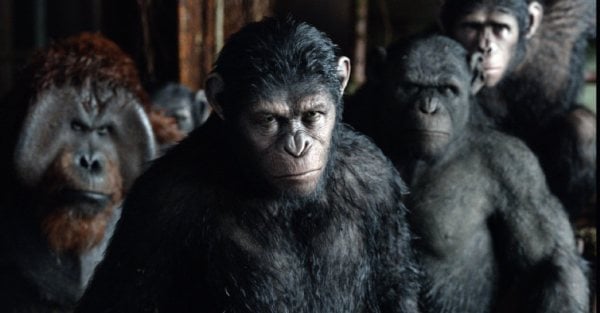
Just as Malcolm has trigger-happy, bitter, and frightened humans in his care, Caesar must contend with Koba (Toby Kebbell), a former victim of human experimentation that left him scarred inside and out.
The film sets up excellent parallels between Malcolm and Caesar, both of whom have families to lose and a small civilization depending on their efforts. After witnessing the implosion of the human race, Malcolm only wants to rebuild with his wife Elle (Kerry Russell) and son Alexander (Kodi Smitt-McPhee) while Caesar wants to be left alone to build his.
The 1968 original and its sequels were largely a metaphor for American black-white relations in the Civil Rights Era, but this film expands to consider any potential enemy, whether divided by race or religion or species or border.
By taking the audience inside the ape civilization, and making it care about it even though it is qualitatively “other” from human experience, the movie forces the audience to see mankind in a new light. The apes are decidedly not human. Yet they have a system of self-governance, something close to a monarchy. They have a rudimentary moral and legal code, the beginning of which is “Ape not kill ape.” Their language is developing, some of it vocal but most of it through sign language. A good deal of the ape dialog is in sign language, with subtitles, making this one of the few sign language films created for mass market.
Very differently than the older films, the chimpanzees, gorillas, and orang utans that populate this story are not merely human beings with more hair. They hoot and vocalize like simians. They move with agility when swinging from branches but clumsily on the ground. They go through the dominance displays and submissive responses that researchers tell us mark ape culture. None of this would be possible without the fantastic acting of Andy Serkis, who plays Caesar wholly convincingly. He is as well-rounded and sympathetic as any man onscreen, quite a miracle for someone acting another species via green screen and motion capture technology.
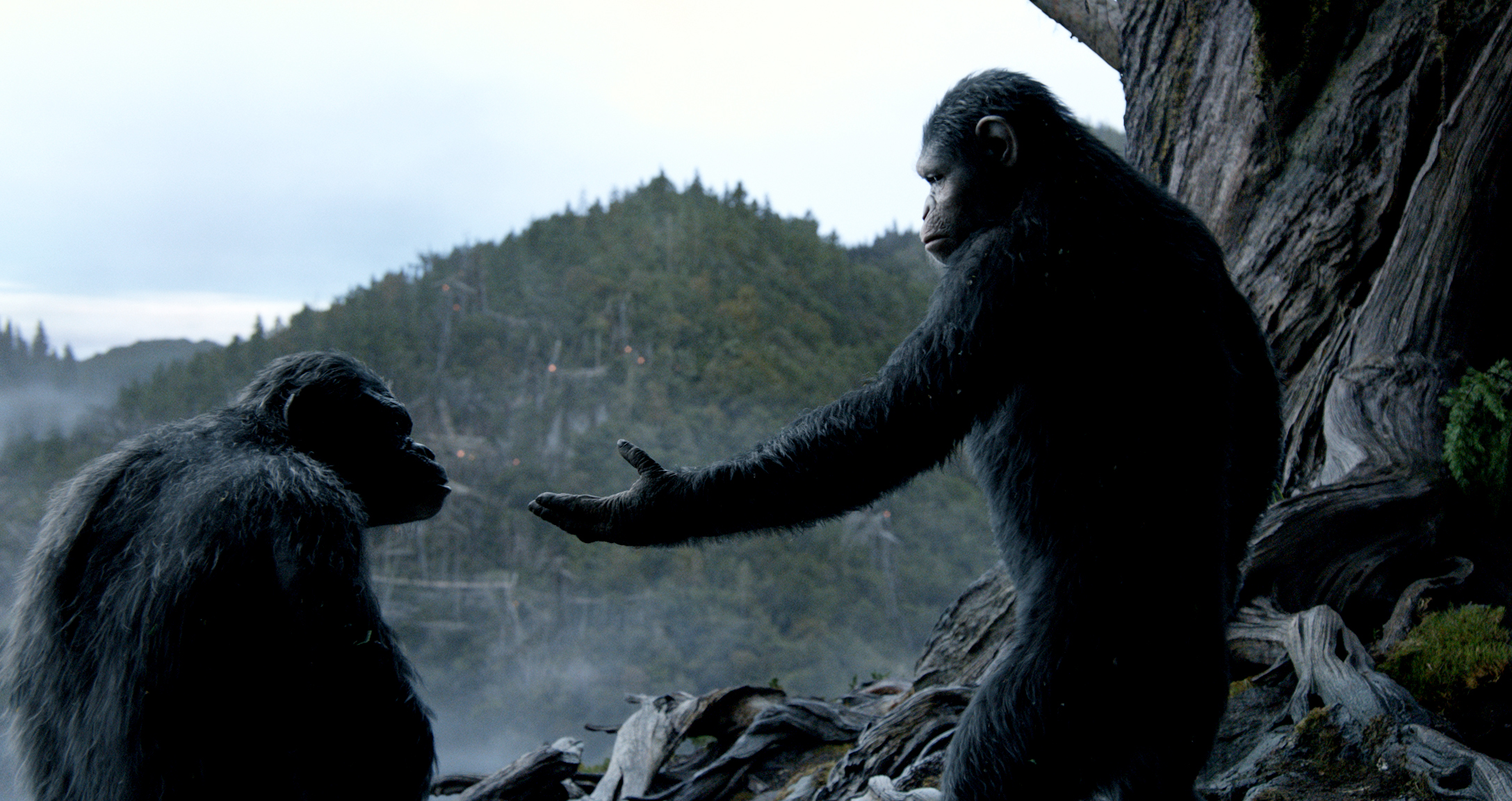
The action sequences are exciting, but equally complex as the general set-up. They certainly don’t glorify violence. They create the feeling that fighting is a great tragedy. Yet, they also don’t condemn warriors as victims, cowards, or hypocrites. Courage and honor exist in the humans ready to defend their homes just as in the apes resolved to defend theirs.
Confusion, misunderstanding, and ignorance block trust between the two tribes, made worse by the prejudice displayed by individuals on both sides.
However, the two sides are not so different at all. The greatest warriors fight for peace. Although both Caesar and Malcolm recognize there are things worth fighting for and outcomes worse than war, they both will go great lengths and risk their own lives to avoid a conflict that will bring havoc on those they love. And neither is so unwise as to overlook deceit and injustice in his own ranks nor nobility in the others’.
This is a nuance not often seen in movies about war, especially American movies made in the still-long shadow of Vietnam. Ultimately, the violence comes from elements within each group, and both are at fault. Caesar and Malcolm, like great leaders before them, must shepherd their people through conflict not of their choosing, trying to generate the best outcome for those who rely on them.
This is not a bumper-sticker movie, easily co-opted by warhawks or peaceniks, by pro-gun or anti-gun lobbies, by conservatives or progressives.
It’s more mature than that.
Conflict may be inevitable. Despite our best efforts, it may be unavoidable. When it starts, how do we execute it well, end it quickly, and maintain our humanity or ape-anity in the process?
Mankind is a long way from figuring this out, as the state of our world so depressingly demonstrates. At least this movie earnestly tries.
Dawn of the Planet of the Apes is rated PG-13, mostly for intense action and some violence. There are some moments of violence that may be disturbing to younger viewers. There is no sexuality and only very light language. Appropriate for teens and preteens who can handle action and some violence.
Read my review of 2011’s Rise of the Planet of the Apes.
Dawn of the Planet of the Apes
Previous Post

July 3, 2014
Review: Charming 'Earth to Echo' Celebrates Boyhood
Next Post

July 11, 2014 AFI DOCS Review: Three Fantastic Documentaries to Watch
Browse Our Archives
Select a Category Becky's Picks Children's Movies DVD releases Entertainment News Faith on Film Featured Hunger Games In Theaters Interviews Life, Etc. Mixed Nuts Movie Reviews Poliflix Scroogewatch slider Television Uncategorized
Select a Month December 2014 November 2014 October 2014 September 2014 August 2014 July 2014 June 2014 May 2014 April 2014 March 2014 February 2014 January 2014 December 2013 November 2013 October 2013 September 2013 August 2013 July 2013 June 2013 May 2013 April 2013 March 2013 February 2013 January 2013 December 2012 November 2012 October 2012 September 2012 August 2012 July 2012 June 2012 May 2012 April 2012 March 2012 February 2012 January 2012 December 2011 November 2011 October 2011 September 2011 August 2011 July 2011 June 2011 April 2011 March 2011
Follow Us!
TAKE THE
Religious Wisdom Quiz
What is the lesson in the Parable of the Lost Coin?
Select your answer to see how you score.
Keep your house clean Riches must be counted God values each lost person Money is a blessing
Related posts from Tinsel
'The Overnighters:' Q&A with Director Jesse Moss

Gratitude for Five Years at Patheos - Moving...

Despite its Title, Stephen Hawking’s Biopic Earns an...

Video: Watch the Trailer for 'The Bible' Sequel...
TRENDING AT PATHEOS Religious Music & Entertainment

Reflections on the Evangelical Theological Society
As I mentioned before, this year, for the first time since 2005,...

Demmed if it do and demmed if it...
"First Presidency Announces Salt Lake Temple Rededication Date" Apropos of that,...

Stop Making Thanksgiving Problematic And Just Give Thanks
“What if, today, we were grateful for everything?” –Charlie Brown I...

Sunday Readings: Stay Awake and Hope
The First Sunday of Advent begins a new liturgical year, and the...

Are You a Scrooge or an Ebenezer?
A Call to Remember As the Christmas season begins, will we remember...

Noah’s Ark Archaeologists: Gopher Wood or Should We...
Ancient wood, a boat-shaped formation and dates that invite a second look:...
view all Religious Music & Entertainment blogs
Ad-Free & Subscriber Log-In Subscription Support
- About Us
- 2026 Calendar
- Videos
- Podcasts
- Library of World Religions
- Faith In Media Tracker
- Advertise With Us
- Write for Us
- Privacy Policy
- Terms of Service
- Do Not Sell My Data
- Contact Us
- Radiant Digital
- Manage Newsletter Subscriptions
- Unsubscribe From Notifications
- Sitemap
Copyright 2008-2026, Patheos, part of the Radiant Digital network of media brands. All rights reserved.
Subscription Support Ad-Free & Subscriber Log-In
Follow Patheos