
BuddhistCatholicContemplativeEvangelicalGeneral ChristianHinduJewishLatter-day SaintMuslimNew VisionsProgressive Christian
Beliefs
- Buddhist
- Catholic
- Contemplative
- Evangelical
- General Christian
- Hindu
- Jewish
- Latter-day Saint
- More Voices
- Muslim
- New Visions
- Pagan
- Progressive Christian
Topics
- Religion News
- Food and Religion
- Sports and Religion
- Religious Art
- Religious Music and Entertainment
- Religious Events
- History and Religion
- Style and Religion
- Politics and Religion
- Women in Religion
- Recreation Outdoors and Religion
- Business Finance and Religion
- Careers Workplace and Religion
- Education and Religion
- Family Parenting and Religion
- Health Fitness and Religion
- Home and Religion
- Relationships and Religion
- Technology and Religion
- Travel and Religion
Columnists
- Buddhist Columnists
- Business Finance and Religion Columnists
- Careers Workplace and Religion Columnists
- Catholic Columnists
- Contemplative Columnists
- Education and Religion Columnists
- Evangelists Columnists
- Family Parenting and Religion Columnists
- General Christian Columnists
- Health Fitness and Religion Columnists
- Hindu Columnists
- History and Religion Columnists
- Home and Religion Columnists
- Jewish Columnists
- More Voices Columnists
- Latter Day Columnists
- Muslim Columnists
- New Visions Columnists
- Nonreligious Columnists
- Pagan Columnists
- Politics and Religion Columnists
- Progressive Columnists
- Recreation Outdoors and Religion Columnists
- Relationships and Religion Columnists
- Religion News Columnists
- Religious Art Columnists
- Religious Events Columnists
- Religious Music and Entertainment Columnists
- Sports and Religion Columnists
- Style and Religion Columnists
- Technology and Religion Columnists
- Travel and Religion Columnists
- Women in Religion Columnists
Resource Library
- 2026 Calendar
- Library of World Religions
- The 100 Most Holy Places on Earth
- Patheos Answers
- Podcasts
- Videos
- Faith Leaders Database
- Anglican Episcopalian
- Bahai
- Baptist
- Buddhism
- Christianity
- Confucianism
- Eastern Orthodoxy
- Hinduism
- Holiness and Pentecostal
- ISKCON
- Islam
- Judaism
- Lutheran
- Methodist
- The Church of Jesus Christ of Latter-day Saints
- New Age
- Paganism
- Presbytarian and Reformed
- Protestantism
- Religion Behind the Scenes
- Roman Catholic
- Scientology
- Shia Islam
- Sikhism
- Sufism
- Sunni Islam
- Taoism
- Zen
- See all religions
Research Tools
 Ad-Free & Subscriber Log-In Subscription Support
Ad-Free & Subscriber Log-In Subscription Support
Follow Patheos 

- Trending:
- Forgiveness
- |
- Marriage
- |
- Consciousness
- |
- Death Penalty
- |
- Election
- |
- Halloween
 Tinsel
- Home
- Religious Music & Entertainment
- Book Discussion: ‘How the West Really Lost God’ by Mary Eberstadt
Book Discussion: ‘How the West Really Lost God’ by Mary Eberstadt
Last updated on: June 17, 2014 at 12:01 pm by Rebecca Cusey
Book Discussion: ‘How the West Really Lost God’ by Mary Eberstadt 2014-06-17T12:01:07-06:00 Rebecca Cusey
Patheos Explore the world's faith through different perspectives on religion and spirituality! Patheos has the views of the prevalent religions and spiritualities of the world.
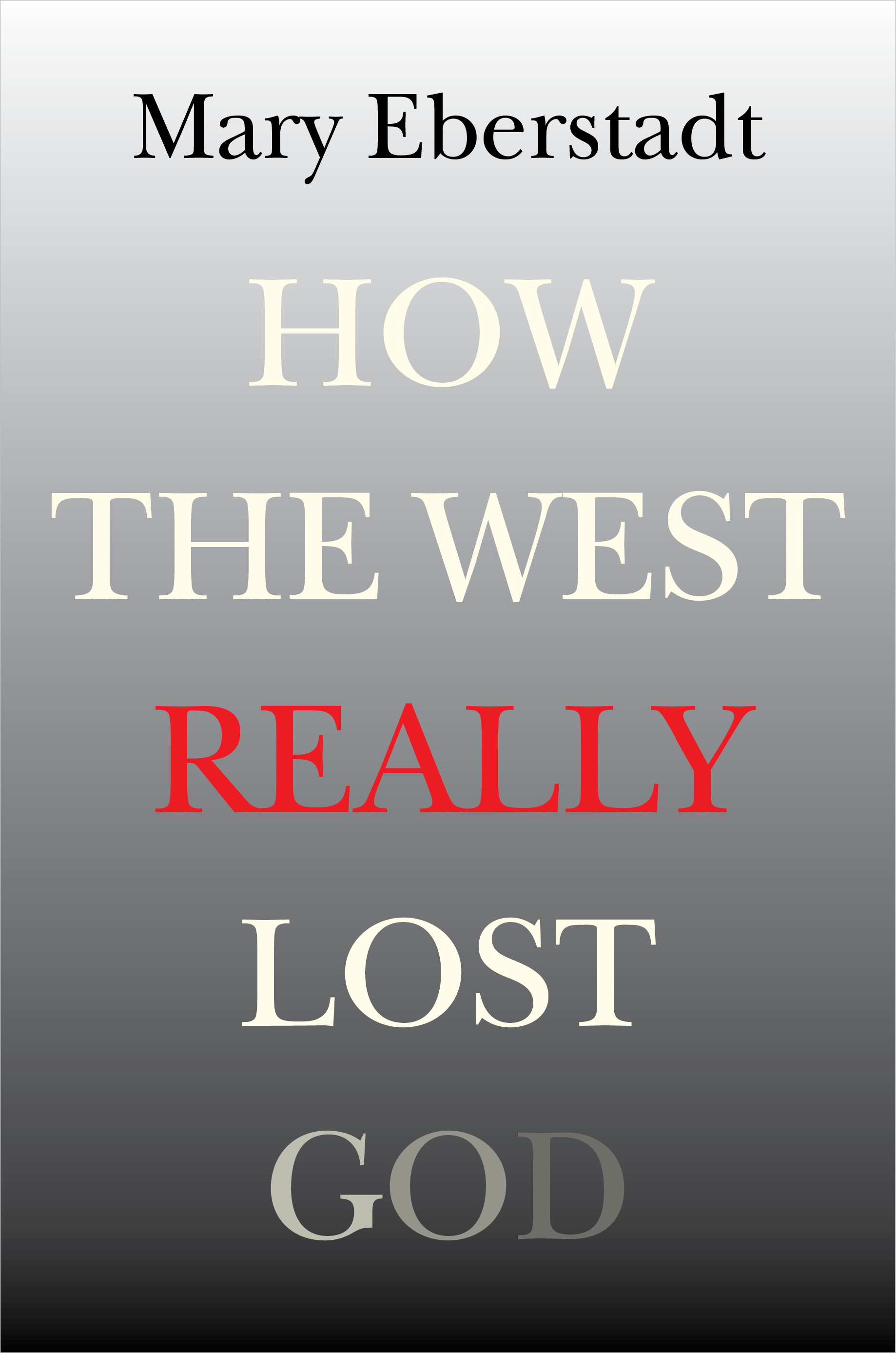 Mary Eberstadt’s new book How The West Really Lost God covers some familiar ground, but with a new twist.
Everyone knows that expressions of faith, any way you measure it, have fallen off throughout Western Europe, and to a lesser extent, in the United States. The great cathedrals of Europe are little more than tourist draws, the parish church, the duomo of Italy, dom of Germany, and dóme of France stand empty and vastly underused. Abbeys and monasteries are converted into condos. Attendance is down, baptisms are down, everything is in free fall.
I saw this firsthand when I toured Italy last summer, although the vibrant parish at Bovolone and the revered churches of Assisi were exceptions.
Everyone also knows that by any measure, the traditional family of married opposite sex parents and biological children, has been on the decline as well. The effects are greater so in Europe than America, but demonstrable both sides of the Atlantic. Fewer people marry, they marry later, fewer have children, they have fewer numbers of children, and they often do not raise those children with their full set of biological parents. Furthermore, almost no one lives with extended family.
Everyone knows this.
But Eberstadt does two things with this presumptive truth: She questions the conventional wisdom to see if it holds up, then she draws some intriguing connections.
What if the decline in faith is not only a cause of but an effect of the decline in family?
Like the chicken and egg, it’s hard to tell what came first. Did people stop having families, at least in the traditional sense, because they stopped believing in the teachings of the church? Or did they stop believing because they don’t experience the community, sacrifice, and transcendence of family life?
Eberstadt makes a good case for both.
Rather, she makes a case that, like a chicken and egg, the two forces are interwoven, existentially connected to one another. Families make churches. Churches make families.
Eberstadt writes from a Catholic vantage, but she rigorously addresses all the questions that a devil’s advocate would raise, up to and including “Why should we care?”
She grounds her arguments in solid social science. In fact, no social science is more firmly established than the benefits to children of being raised by married parents. Almost equally established is the benefit people of faith bring to society, from charitable giving to foster care, to feeding the homeless.
What I liked most, however, is that embedded in all the academic questioning and social science research, Eberstadt allows that people aren’t primarily logical. Secular thinkers can’t adequately explain either the decline of faith or the stubborn persistence of faith because, as Eberstadt posits, “secular modern thinkers have never had an adequate explanation for why people believe in God in the first place.” (pg 213).
We debate a lot about ideas in this country. Is the Bible infallible? Was the world created or evolved? Does sin exist? What behaviors constitute sin and how do you defend that? And so on.
But the thing is, very few are convinced by argument. People may say they are convinced by the logic of atheism or by the apologetics of C.S. Lewis, and no doubt some are, but most of us are brought to faith or away from faith by something more primal. There is a breath across our souls that convinces and logic is only one factor.
Eberstadt rather mystically suggests that the very atmosphere of family breeds transcendence: participating in creation by bringing new life into the world; the awe over a little one’s tiny foot or a young adult’s growth; the knowledge that a parent would sacrifice their life for their child without hesitation; that a spouse continually lays down their own interests for their beloved.
Conversely, more adults live longer alone: A prolonged time between childhood and childbearing, if it happens at all, and an extended solitude after children have left. Could it be that this solitude, this absence from community, makes it easy to avoid the community of the Creator?
This connection is fascinating and I’m glad Mary Eberstadt was sufficiently intrigued to write a book about it. I will certainly ponder these ideas at length.
Previous Post
June 16, 2014
The Gospel According to Saint Angelina
Next Post

June 18, 2014 New DVD releases and What the Critics Said
Browse Our Archives
Select a Category Becky's Picks Children's Movies DVD releases Entertainment News Faith on Film Featured Hunger Games In Theaters Interviews Life, Etc. Mixed Nuts Movie Reviews Poliflix Scroogewatch slider Television Uncategorized
Select a Month December 2014 November 2014 October 2014 September 2014 August 2014 July 2014 June 2014 May 2014 April 2014 March 2014 February 2014 January 2014 December 2013 November 2013 October 2013 September 2013 August 2013 July 2013 June 2013 May 2013 April 2013 March 2013 February 2013 January 2013 December 2012 November 2012 October 2012 September 2012 August 2012 July 2012 June 2012 May 2012 April 2012 March 2012 February 2012 January 2012 December 2011 November 2011 October 2011 September 2011 August 2011 July 2011 June 2011 April 2011 March 2011
Follow Us!
TAKE THE
Religious Wisdom Quiz
Who said, "Let my tongue cling to the roof of my mouth if I do not remember you"?
Select your answer to see how you score.
Isaiah Elijah Psalmist Solomon
Related posts from Tinsel

Review: 'Interstellar' and The Meaning of Life, The...

Review: Cozy Familiarity in 'Big Hero 6'

Review: Nothing is Missing in 'Gone Girl'

TRENDING AT PATHEOS Religious Music & Entertainment

Catholic Evangelization: Sharing Your Faith Every Day
Welcome back to the Graceful Awakening mini-series called, “From Faith to Mission.” ...

The Pillar of the Boatmen: the Ancient Monument...
The Pillar of the Boatmen is a Romano-Gaulish sculpture that dates from...

In one sense walking into Westminster Abbey is like walking down the...

'Super Scam Me' Exposes AI Jon Bon Jovi...
Leslie Pickett believed she was in a relationship with Jon Bon Jovi....

The Brazilian Remake of Kendricks' 'Flywheel' Opens in...
“Flywheel,” the story that launched the Kendrick Brothers’ filmmaking career is getting...

The Dangers of Gradual Accommodation (Winking at Sin)
Recently, the “law of gradualness” resurfaced during the opening of a weeklong,...
view all Religious Music & Entertainment blogs
Ad-Free & Subscriber Log-In Subscription Support
- About Us
- 2026 Calendar
- Videos
- Podcasts
- Library of World Religions
- Faith In Media Tracker
- Advertise With Us
- Write for Us
- Privacy Policy
- Terms of Service
- Do Not Sell My Data
- Contact Us
- Radiant Digital
- Manage Newsletter Subscriptions
- Unsubscribe From Notifications
- Sitemap
Copyright 2008-2026, Patheos. All rights reserved.
Subscription Support Ad-Free & Subscriber Log-In
Follow Patheos