
BuddhistCatholicContemplativeEvangelicalGeneral ChristianHinduJewishLatter-day SaintMuslimNew VisionsProgressive Christian
Beliefs
- Buddhist
- Catholic
- Contemplative
- Evangelical
- General Christian
- Hindu
- Jewish
- Latter-day Saint
- More Voices
- Muslim
- New Visions
- Pagan
- Progressive Christian
Topics
- Religion News
- Food and Religion
- Sports and Religion
- Religious Art
- Religious Music and Entertainment
- Religious Events
- History and Religion
- Style and Religion
- Politics and Religion
- Women in Religion
- Recreation Outdoors and Religion
- Business Finance and Religion
- Careers Workplace and Religion
- Education and Religion
- Family Parenting and Religion
- Health Fitness and Religion
- Home and Religion
- Relationships and Religion
- Technology and Religion
- Travel and Religion
Columnists
- Buddhist Columnists
- Business Finance and Religion Columnists
- Careers Workplace and Religion Columnists
- Catholic Columnists
- Contemplative Columnists
- Education and Religion Columnists
- Evangelists Columnists
- Family Parenting and Religion Columnists
- General Christian Columnists
- Health Fitness and Religion Columnists
- Hindu Columnists
- History and Religion Columnists
- Home and Religion Columnists
- Jewish Columnists
- More Voices Columnists
- Latter Day Columnists
- Muslim Columnists
- New Visions Columnists
- Nonreligious Columnists
- Pagan Columnists
- Politics and Religion Columnists
- Progressive Columnists
- Recreation Outdoors and Religion Columnists
- Relationships and Religion Columnists
- Religion News Columnists
- Religious Art Columnists
- Religious Events Columnists
- Religious Music and Entertainment Columnists
- Sports and Religion Columnists
- Style and Religion Columnists
- Technology and Religion Columnists
- Travel and Religion Columnists
- Women in Religion Columnists
Resource Library
- 2026 Calendar
- Library of World Religions
- The 100 Most Holy Places on Earth
- Patheos Answers
- Podcasts
- Videos
- Faith Leaders Database
- Anglican Episcopalian
- Bahai
- Baptist
- Buddhism
- Christianity
- Confucianism
- Eastern Orthodoxy
- Hinduism
- Holiness and Pentecostal
- ISKCON
- Islam
- Judaism
- Lutheran
- Methodist
- The Church of Jesus Christ of Latter-day Saints
- New Age
- Paganism
- Presbytarian and Reformed
- Protestantism
- Religion Behind the Scenes
- Roman Catholic
- Scientology
- Shia Islam
- Sikhism
- Sufism
- Sunni Islam
- Taoism
- Zen
- See all religions
Research Tools
 Ad-Free & Subscriber Log-In Subscription Support
Ad-Free & Subscriber Log-In Subscription Support
Follow Patheos 

- Trending:
- Forgiveness
- |
- Marriage
- |
- Consciousness
- |
- Death Penalty
- |
- Election
- |
- Halloween
 Tinsel
- Home
- Religious Music & Entertainment
- What We Talk About When We Talk About Noah
What We Talk About When We Talk About Noah
Last updated on: February 19, 2014 at 2:41 pm by Rebecca Cusey
What We Talk About When We Talk About Noah 2014-02-19T14:41:54-06:00 Rebecca Cusey
Patheos Explore the world's faith through different perspectives on religion and spirituality! Patheos has the views of the prevalent religions and spiritualities of the world.
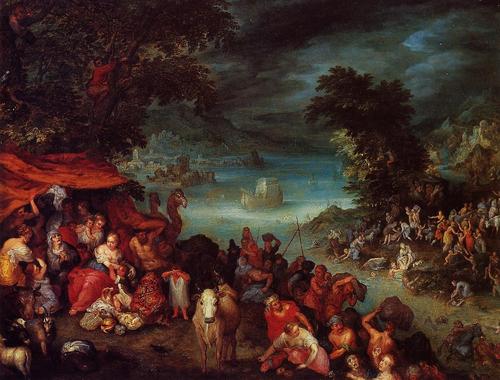
The Flood with Noah’s Ark, one of the most famous Renaissance-High Oil Paintings painted by artist Jan Brueghel il Vecchio.
On Sunday, December 26, 2004 – you probably remember – a powerful earthquake caused a tsunami that, suddenly and without warning, ended the lives of 230,000 people in a few minutes. Before that, a cyclone whiped out 500,000 in Bangladesh. After, the Haiti earthquake killed 139,000. And so it goes, all the way back to Pompeii, to Noah.
We think we have control of our destiny, but our lives can end in a second, with an earthquake or a sinkhole or a misstep on the sidewalk.
This is the story of Noah. It is dark and horrifying.
Noah is the story of judgement, of a God who exterminated all but a tiny fragment of humanity in a devastating flood.
People wonder how a loving God could do such a thing, but as I learn more of the world, I marvel that He holds back his hand. When I think of a nine year old girl chained to a bed and forced into sexual slavery in Thailand, when I think of the suffering in North Korea, of little boys forced to carry guns and kill in Sudan, I think maybe a mass judgement isn’t such a bad idea.
Judgement carries the promise of justice, of freedom for that girl, of justice for that boy. Things being set straight.
When we think of Noah, though, we frame it as a story of redemption.
Why do we Christians usually place ourselves on the ark, as God’s faithful servant escaping His wrath as he brings judgement on the world?
We’re on God’s side. We, rightly, escape. Such assurance in our own righteousness.
But we are more likely to be the people who mock, who carry on with our lives, who scoff at the idea of getting on the ship, who wonder what those odd animals are doing but not enough to truly search, and who writhe in the water as it covers our heads.
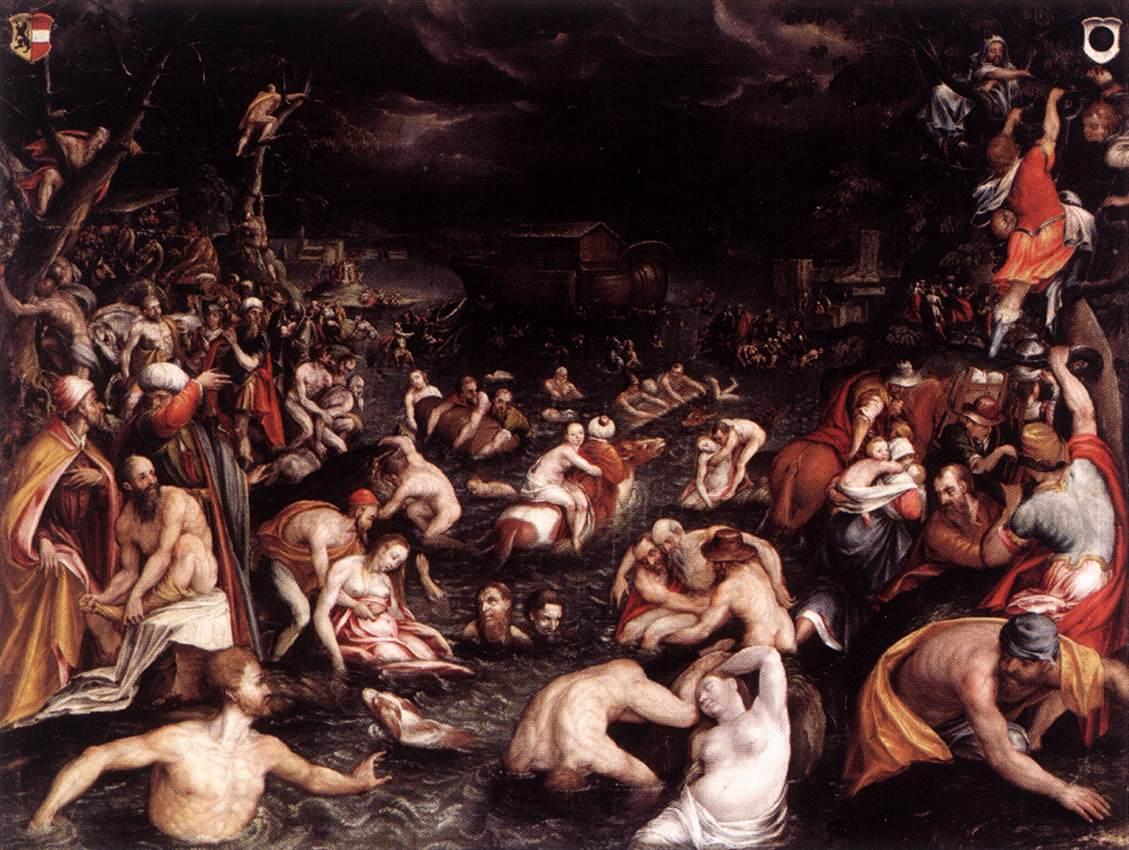
“Noah’s Ark Cycle: 3. The Flood” Kaspar Memberger
We are all under judgement. We all live under the crest of the tsunami, ten seconds prior to the earthquake, the week before the flood.
The Biblical story we paint in cute sunshiny rainbows on nursery walls and teach to our children in sing-song.
The Lord told Noah there’s going to be a floody, floody.
Get those animals out of the muddy, muddy.
This is a story we would rather fit on a nursery wall than consider in its rawness. It is a story we would rather clap our hand to than hold our hands over our eyes weeping. Safer that way.
It is a story of our own death, our own peril under the inevitable hand of justice, the unrelenting hand of judgement, the hand that will come whether we die in our beds at a ripe age or on a normal September Tuesday in the Twin Towers.
This is what we cavalierly talk about when we talk about Noah.
It is also a story of a surviving. We frame this as victory, and it is, but it is a hard and heavy victory. When you speak to the ones who clung to a balcony as the water swirled around and claimed others, who walked out of the towers just before they fell, who sat on the right side of the airplane, they say, they know two things.
One, there was no particular reason they survived. They were not faster or smarter or stronger or better or more worthy.
Secondly, there was a reason they survived. God had a plan. A purpose for saving them.
They generally say this with a sense of heaviness, a Saving Private Ryan sense of burden. Even a touch of PTSD. When you carry the weight of those who died, you carry it forever. You carry it uneasily. We once knew this in the aftermath of World Wars, but most of us have forgotten.
This is also what we talk about when we talk about Noah. Responsibility that is unbearable. Memories that are searing. Trauma that is unexplainable. Carrying on after the unimaginable. No reason to boast. Only to fall on our knees.
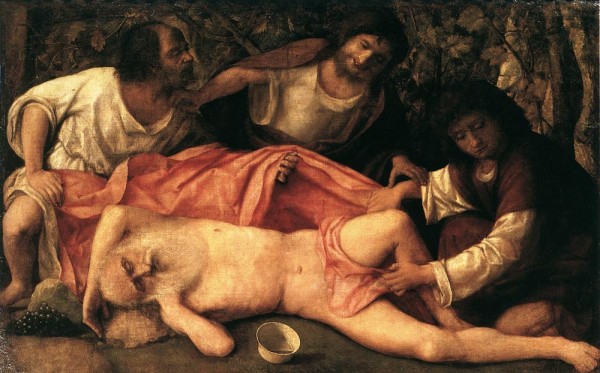
“Drunkeness of Noah” by Bellini
No wonder the man drank. He was only human, which is to say weak and inadequate.
I am glad a director with the insight and dark vision of Darren Aronofsky has taken on this story. It needs to be removed from nursery walls. It needs to be de-stuffed-animalized. It needs to be woken up.
I trust the vision of a director of Black Swan, somehow, more than those of us who sing:
The sun came out and dried up the landy landy….
Everything was fine and dandy, dandy.
It was not fine. It was not dandy.
This is what we talk about. This is Noah.
Previous Post
February 19, 2014
The Cynical Opportunism of Anti-'Noah' Group Faith Driven Consumer
Next Post
February 20, 2014 Vote Along with Our Writers in The Patheos Movie Awards
Browse Our Archives
Select a Category Becky's Picks Children's Movies DVD releases Entertainment News Faith on Film Featured Hunger Games In Theaters Interviews Life, Etc. Mixed Nuts Movie Reviews Poliflix Scroogewatch slider Television Uncategorized
Select a Month December 2014 November 2014 October 2014 September 2014 August 2014 July 2014 June 2014 May 2014 April 2014 March 2014 February 2014 January 2014 December 2013 November 2013 October 2013 September 2013 August 2013 July 2013 June 2013 May 2013 April 2013 March 2013 February 2013 January 2013 December 2012 November 2012 October 2012 September 2012 August 2012 July 2012 June 2012 May 2012 April 2012 March 2012 February 2012 January 2012 December 2011 November 2011 October 2011 September 2011 August 2011 July 2011 June 2011 April 2011 March 2011
Follow Us!
TAKE THE
Religious Wisdom Quiz
Who said: "Anyone who listens to the word but does not do what it says is like someone who looks at his face in a mirror"?
Select your answer to see how you score.
Peter Jesus James Paul
Related posts from Tinsel
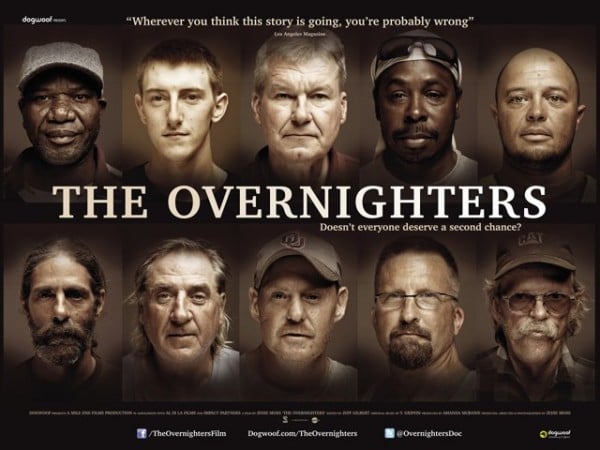
'The Overnighters:' Q&A with Director Jesse Moss
Gratitude for Five Years at Patheos - Moving...

Despite its Title, Stephen Hawking’s Biopic Earns an...
Video: Watch the Trailer for 'The Bible' Sequel...
TRENDING AT PATHEOS Religious Music & Entertainment

When Halloween Unmasks Married Hearts
Written by Dr. David K. Ewen from Eternal Truth Bible College Behind...

Aristotle. He’s been called the father of logic, the father of the...

Methodist Central Hall and Westminster Abbey
Situated on the same square is Methodist Central Hall and Westminster Abbey. ...

57th Dove Awards Honor Dolly Parton, Crown New...
On gospel music’s biggest night, the 57th annual GMA Dove Awards honored...

The First Eucharistic Controversy: Christ’s Real Presence
For Catholics, the Eucharist is the source and summit of the Christian...

What a Stop Sign Can Teach Us About...
How to Make a Decision When You Can't Hear God Main point:...
view all Religious Music & Entertainment blogs
Ad-Free & Subscriber Log-In Subscription Support
- About Us
- 2026 Calendar
- Videos
- Podcasts
- Library of World Religions
- Faith In Media Tracker
- Advertise With Us
- Write for Us
- Privacy Policy
- Terms of Service
- Do Not Sell My Data
- Contact Us
- Radiant Digital
- Manage Newsletter Subscriptions
- Unsubscribe From Notifications
- Sitemap
Copyright 2008-2026, Patheos. All rights reserved.
Subscription Support Ad-Free & Subscriber Log-In
Follow Patheos