
BuddhistCatholicContemplativeEvangelicalGeneral ChristianHinduJewishLatter-day SaintMuslimNew VisionsProgressive Christian
Beliefs
- Buddhist
- Catholic
- Contemplative
- Evangelical
- General Christian
- Hindu
- Jewish
- Latter-day Saint
- More Voices
- Muslim
- New Visions
- Pagan
- Progressive Christian
Topics
- Religion News
- Food and Religion
- Sports and Religion
- Religious Art
- Religious Music and Entertainment
- Religious Events
- History and Religion
- Style and Religion
- Politics and Religion
- Women in Religion
- Recreation Outdoors and Religion
- Business Finance and Religion
- Careers Workplace and Religion
- Education and Religion
- Family Parenting and Religion
- Health Fitness and Religion
- Home and Religion
- Relationships and Religion
- Technology and Religion
- Travel and Religion
Columnists
- Buddhist Columnists
- Business Finance and Religion Columnists
- Careers Workplace and Religion Columnists
- Catholic Columnists
- Contemplative Columnists
- Education and Religion Columnists
- Evangelists Columnists
- Family Parenting and Religion Columnists
- General Christian Columnists
- Health Fitness and Religion Columnists
- Hindu Columnists
- History and Religion Columnists
- Home and Religion Columnists
- Jewish Columnists
- More Voices Columnists
- Latter Day Columnists
- Muslim Columnists
- New Visions Columnists
- Nonreligious Columnists
- Pagan Columnists
- Politics and Religion Columnists
- Progressive Columnists
- Recreation Outdoors and Religion Columnists
- Relationships and Religion Columnists
- Religion News Columnists
- Religious Art Columnists
- Religious Events Columnists
- Religious Music and Entertainment Columnists
- Sports and Religion Columnists
- Style and Religion Columnists
- Technology and Religion Columnists
- Travel and Religion Columnists
- Women in Religion Columnists
Resource Library
- 2026 Calendar
- Library of World Religions
- The 100 Most Holy Places on Earth
- Patheos Answers
- Podcasts
- Videos
- Faith Leaders Database
- Anglican Episcopalian
- Bahai
- Baptist
- Buddhism
- Christianity
- Confucianism
- Eastern Orthodoxy
- Hinduism
- Holiness and Pentecostal
- ISKCON
- Islam
- Judaism
- Lutheran
- Methodist
- The Church of Jesus Christ of Latter-day Saints
- New Age
- Paganism
- Presbytarian and Reformed
- Protestantism
- Religion Behind the Scenes
- Roman Catholic
- Scientology
- Shia Islam
- Sikhism
- Sufism
- Sunni Islam
- Taoism
- Zen
- See all religions
Research Tools
 Ad-Free & Subscriber Log-In Subscription Support
Ad-Free & Subscriber Log-In Subscription Support
Follow Patheos 

- Trending:
- Forgiveness
- |
- Marriage
- |
- Consciousness
- |
- Death Penalty
- |
- Election
- |
- Halloween
 Tinsel
- Home
- Religious Music & Entertainment
- “Breaking Bad” Season 6 Episode 6: The Fall of “Ozymandias”
“Breaking Bad” Season 6 Episode 6: The Fall of “Ozymandias”
Last updated on: September 16, 2013 at 2:01 pm by Andrew Johnson
“Breaking Bad” Season 6 Episode 6: The Fall of “Ozymandias” 2013-09-16T14:01:58-06:00 Andrew Johnson
Patheos Explore the world's faith through different perspectives on religion and spirituality! Patheos has the views of the prevalent religions and spiritualities of the world.
Nothing beside remains. Round the decay
Of that colossal wreck, boundless and bare
The lone and level sands stretch far away.
–Percy Shelley, “Ozymandias”
And so begins the fall of an empire.
The sixth episode of Season 6 of Breaking Bad (or, more accurately, the fourteenth episode of Season 5) is aptly titled “Ozymandias” after the poem of the same name. It’s an allusion that was used in a lot of the marketing in the lead-up to this half-season, and now we finally get to see why. This is an episode that finds Walt “on the sand, half sunk, a shattered visage,” with only a truck and eleven million dollars left of all his accumulated wealth. He can’t talk or scheme his way out of this mess, and by the time the credits roll, he is completely alone.
“Ozymandias” was directed by Rian Johnson, one of the most talented young filmmakers working in Hollywood (check out Brick and Looper if you haven’t already) and the man behind two of Breaking Bad’s most memorable episodes: “Fly,” in which Walt’s obsession with squashing a housefly was used as a metaphor for his guilt about letting Jane die, and “Fifty-One,” in which Skyler actively began trying to move the kids away from Walt’s moral toxicity. Both of them are masterfully crafted, and “Ozymandias” is no different—this the best episode of this season so far. Every scene feels perfectly executed, and over the course of an hour Walt goes from his most villainous to actually showing signs of growth.
The episode opens with a flashback of Walt and Jesse on their first cook, a brilliant reminder of how far they’ve come from those days in the RV. We see how naïve they are, and how inexperienced Walt is at deception. We witness the first of many lies to come, as he tells Skyler he’ll be home late because there’s work to be done at the car wash. He’ll make another call to her—and, I’d argue, another quasi-lie—at the end of the episode. But first, he and Jesse and the RV dissolve into thin air, remnants of the past. When we return to the same shot after the break, it’s a year later, and that initial lie has snowballed into horrors far beyond anything Walt ever expected.
Paul wrote in Romans 7 about the struggle between his dual natures. In verse 18 he says, “I have the desire to do good, but I cannot carry it out.” That’s Walter White in a nutshell, a man constantly battling a desire to do what’s best for his family against a more narcissistic desire to do what’s best for himself. This is in many ways an episode about the final showdown of Walt’s dueling natures, and the fallout of last week’s shootout reveals his two very distinct personalities.
First, there’s his good nature. Gomie is dead and Hank is injured, but before Jack can finish the job Walt rushes to his defense (something I predicted might happen). This is Walter White, a family man who is willing to set aside pride (and 80 million dollars) in order to save a person he’s been in a cat-and-mouse game with for weeks. He is a good man. But Hank knows that it’s too late, and he remains steadfast to the end, refusing to compromise himself. Jack shoots him in the head, and Walt collapses in shock, unable to cope with the fact that part of the family he swore to protect now lies dead in the sand.
When he stands back up, he’s pure Heisenberg. If you ever wondered what it would look like when he hit moral rock bottom, this is it: Walt has never been as evil as he is here. He denies his own culpability and places all the blame on Jesse. After all, you can practically hear him thinking, it was Jesse who cooperated with the DEA. It was Jesse who refused to dialogue about Brock’s poisoning. It’s because of Jesse that Hank was out here to begin with. And so, after a year of psychological abusing this young man, Walt hands him over to be tortured and killed, but not before finally admits to letting Jane die. It’s his last secret, and the final twist of the knife. He doesn’t just want to kill Jesse’s body, he wants to kill his soul. “Look at my works, Ye mighty, and despair!”
The scene where Walt wheels his last remaining barrel of cash through the desert is a perfect summation of Heisenberg left uncaged; he is alone, with only his money left to love. A wise man once said that the love of money is the root of all evil–it’s Walt’s greed that has led him here, his egotistical desire for more money, more power, more credit. The soundtrack for this segment is “Take My True Love By The Hand” by The Limeliters, and the lyrics are perfect: “Take my true love by the hand, lead her through the town…” That barrel of money is Heisenberg’s true love, and it will be close by for the remainder of the episode.
As a result of his greed, Walt’s worst fears start to come true. First, he loses his reputation. This is a big deal. Walt has said multiple times throughout the series that when he dies he wants his son to have good memories of him rather than recalling him as sick and pathetic. Unfortunately, those good memories were founded on a lie, and when Walter Jr. is told the truth about his father, they all come crashing down. Walter Jr.’s last memory of his father won’t be of a kind teacher dying of cancer, it will be of an abusive liar threatening his mother. The great Heisenberg won’t go down in history as so great after all.
Secondly, he loses his family. Hank’s death is the last straw. Skyler spent a year collaborating in Walt’s misdeeds, all in the name of protecting her children from the knowledge that their father is a criminal. Once the truth is out and there’s no longer any guarantee that her family is safe, there’s no reason for her to stick by him. When she picked up that kitchen knife and took a stand, I wanted to cheer. That’s something she should have done a long time ago, and as she tells Junior, she’ll spend the rest of her life wondering why she waited so long. I was briefly concerned that her struggle with Walt would take a tragic turn, but that would be too easy. Walt’s family may still very well be dead by the end of the series, but if that happens I don’t think it will be by his hand—it’ll be the delayed result of that chemical reaction, that chain of lies, that began a year ago.
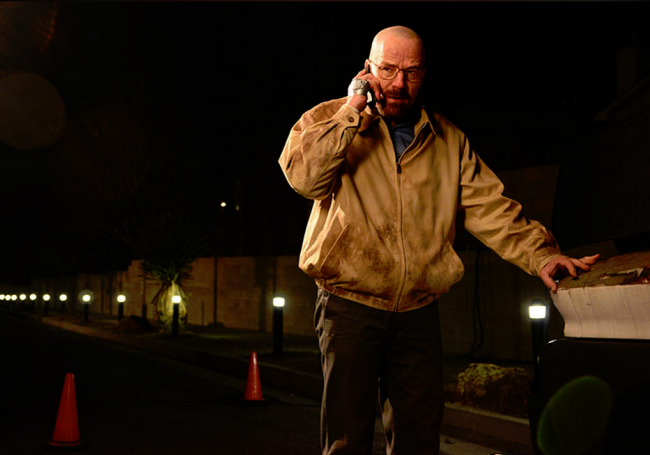
Walt’s final phone call with Skyler may very well end up being the defining moment of the entire series, and I’ll be dumbstruck if it doesn’t earn Cranston an Emmy. It’s a scene that finally reveals the uncomfortable truth at the heart of Breaking Bad: that no matter how many times characters call Walter White the Devil, he’s just a man. We’ve seen him do terrible things, but even now, he is not completely lost. The backbone of the entire series has been the internal struggle between Walter White and Heisenberg, a Jekyll-and-Hyde battle for one man’s soul, and while he may now be facing the consequences of Heisenberg’s actions, that doesn’t mean that Heisenberg has completely taken over. The truth is far more poignant: Walter White is still in there, somewhere, a good man now reaping what his sinful pride has sown.
There’s a debate about whether he means everything he says to Skyler on the phone or if it’s all just another lie. The truth is, it’s both. If begging for Hank’s life was Walt’s good side and condemning Jesse to torture and death was Heisenberg, this phone call is the synthesis of both of them into one man. There’s a grain of truth to everything Walt says here; part of him has always thought Skyler and her morals were keeping him from reaching his full potential. Though he claims to have done it all for his family, deep down he sees them as just another chain tying him to a dead-end life he was never meant to have. (This is also exactly the sort of criticism Anna Gunn has faced from viewers who see Walt as a hero and Skyler as the nagging wife holding him back. Showrunner Vince Gilligan uses this scene to reveal just what a wrong-headed, sexist, and morally repulsive line of thought that is). But I also don’t think Walt fully means what he’s saying. He is, like all of us, a paradox, a mess of contradictory emotions capable of great good and great evil at the same time. His family may have rejected him (deservedly so), but to completely reject them in return would be to acknowledge that everything he’s done was based on a lie. I think this is one time where Walt’s ego is actually helping him do the right thing, and to recognize that the only way for Skyler to escape jail time is for everyone to finally see him as the monster he’s become.
Note that he makes the call next to the fire station where he’ll drop off Holly. By the time he dials that number, he’s made his decision, and he knows the police are listening. Nabbing Holly was a last act of desperation to hold onto a family, any family, even if it’s just him and his daughter. But he ultimately realizes that this is just an extension of the lie that started it all: that he broke bad for the people he loves, when he really just did it for himself. His phone call seems on the surface to be the final nail in his moral coffin, but it may actually be his most altruistic action in the entire series, a moment in which he takes all the blame upon himself. The irony is delicious: his most selfless act requires everyone to see him as a selfish lunatic. In order to save his family, he has to lose them. Walter White and Heisenberg are finally in balance.
Alas, I think it may be too late. As dark as “Ozymandias” got at times, I have a feeling this was only the beginning of a whirlwind of consequences that will continue to play out over the next two hours. Walt may have finally begun to realize he’s the cancer infecting everyone around him, but moving away won’t magically fix everything. The damage is done. I have a theory about how the next episode will play out, and I’ll let you know next week if I was correct (or you can message me on Twitter and ask for my prediction), but suffice it to say I think Walt’s empire still has a long way to fall.
—
What did you think of this episode of Breaking Bad? Let us know in the comments below!
—
Read More:
Breaking Bad Season 6 Episode 1: Blood Money.
Breaking Bad Season 6 Episode 2: Buried
Breaking Bad Season 6 Episode 3: Confessions
Breaking Bad Season 6 Episode 4: Rabid Dog
Breaking Bad Season 6 Episode 5: To’hajiilee
Vote on how the series should end here.
Previous Post

September 14, 2013
'Grace Unplugged' Author Melody Carlson:
Next Post

September 25, 2013 "Breaking Bad" Season 6 Episode 7: Stuck In A "Granite State"
Browse Our Archives
Select a Category Becky's Picks Children's Movies DVD releases Entertainment News Faith on Film Featured Hunger Games In Theaters Interviews Life, Etc. Mixed Nuts Movie Reviews Poliflix Scroogewatch slider Television Uncategorized
Select a Month December 2014 November 2014 October 2014 September 2014 August 2014 July 2014 June 2014 May 2014 April 2014 March 2014 February 2014 January 2014 December 2013 November 2013 October 2013 September 2013 August 2013 July 2013 June 2013 May 2013 April 2013 March 2013 February 2013 January 2013 December 2012 November 2012 October 2012 September 2012 August 2012 July 2012 June 2012 May 2012 April 2012 March 2012 February 2012 January 2012 December 2011 November 2011 October 2011 September 2011 August 2011 July 2011 June 2011 April 2011 March 2011
Follow Us!
TAKE THE
Religious Wisdom Quiz
Which Christian symbol looks like a fish and spells "ichthys" in Greek?
Select your answer to see how you score.
The anchor The dove The triangle The Jesus Fish
Related posts from Tinsel
'The Overnighters:' Q&A with Director Jesse Moss

Gratitude for Five Years at Patheos - Moving...

Despite its Title, Stephen Hawking’s Biopic Earns an...

Video: Watch the Trailer for 'The Bible' Sequel...
TRENDING AT PATHEOS Religious Music & Entertainment

The Problem with False Prophets
Miller’s Station UMC| 10/18/26| Anchor Verse: Jeremiah 23: 1, 9-23 I...

Emotion in Early Christianity by Andrew Crislip
Andrew Crislip’s Emotion in Early Christianity examines an often overlooked dimension of...

16 Spiritual Touchstones for a More Grounded Life
After decades of spiritual study, here are 16 principles I try...

Catholic Evangelization: Sharing Your Faith Every Day
Welcome back to the Graceful Awakening mini-series called, “From Faith to Mission.” ...

The Pillar of the Boatmen: the Ancient Monument...
The Pillar of the Boatmen is a Romano-Gaulish sculpture that dates from...

In one sense walking into Westminster Abbey is like walking down the...
view all Religious Music & Entertainment blogs
Ad-Free & Subscriber Log-In Subscription Support
- About Us
- 2026 Calendar
- Videos
- Podcasts
- Library of World Religions
- Faith In Media Tracker
- Advertise With Us
- Write for Us
- Privacy Policy
- Terms of Service
- Do Not Sell My Data
- Contact Us
- Radiant Digital
- Manage Newsletter Subscriptions
- Unsubscribe From Notifications
- Sitemap
Copyright 2008-2026, Patheos. All rights reserved.
Subscription Support Ad-Free & Subscriber Log-In
Follow Patheos