
BuddhistCatholicContemplativeEvangelicalGeneral ChristianHinduJewishLatter-day SaintMuslimNew VisionsProgressive Christian
Beliefs
- Buddhist
- Catholic
- Contemplative
- Evangelical
- General Christian
- Hindu
- Jewish
- Latter-day Saint
- More Voices
- Muslim
- New Visions
- Pagan
- Progressive Christian
Topics
- Religion News
- Food and Religion
- Sports and Religion
- Religious Art
- Religious Music and Entertainment
- Religious Events
- History and Religion
- Style and Religion
- Politics and Religion
- Women in Religion
- Recreation Outdoors and Religion
- Business Finance and Religion
- Careers Workplace and Religion
- Education and Religion
- Family Parenting and Religion
- Health Fitness and Religion
- Home and Religion
- Relationships and Religion
- Technology and Religion
- Travel and Religion
Columnists
- Buddhist Columnists
- Business Finance and Religion Columnists
- Careers Workplace and Religion Columnists
- Catholic Columnists
- Contemplative Columnists
- Education and Religion Columnists
- Evangelists Columnists
- Family Parenting and Religion Columnists
- General Christian Columnists
- Health Fitness and Religion Columnists
- Hindu Columnists
- History and Religion Columnists
- Home and Religion Columnists
- Jewish Columnists
- More Voices Columnists
- Latter Day Columnists
- Muslim Columnists
- New Visions Columnists
- Nonreligious Columnists
- Pagan Columnists
- Politics and Religion Columnists
- Progressive Columnists
- Recreation Outdoors and Religion Columnists
- Relationships and Religion Columnists
- Religion News Columnists
- Religious Art Columnists
- Religious Events Columnists
- Religious Music and Entertainment Columnists
- Sports and Religion Columnists
- Style and Religion Columnists
- Technology and Religion Columnists
- Travel and Religion Columnists
- Women in Religion Columnists
Resource Library
- 2026 Calendar
- Library of World Religions
- The 100 Most Holy Places on Earth
- Patheos Answers
- Podcasts
- Videos
- Faith Leaders Database
- Anglican Episcopalian
- Bahai
- Baptist
- Buddhism
- Christianity
- Confucianism
- Eastern Orthodoxy
- Hinduism
- Holiness and Pentecostal
- ISKCON
- Islam
- Judaism
- Lutheran
- Methodist
- The Church of Jesus Christ of Latter-day Saints
- New Age
- Paganism
- Presbytarian and Reformed
- Protestantism
- Religion Behind the Scenes
- Roman Catholic
- Scientology
- Shia Islam
- Sikhism
- Sufism
- Sunni Islam
- Taoism
- Zen
- See all religions
Research Tools
 Ad-Free & Subscriber Log-In Subscription Support
Ad-Free & Subscriber Log-In Subscription Support
Follow Patheos 

- Trending:
- Forgiveness
- |
- Marriage
- |
- Consciousness
- |
- Death Penalty
- |
- Election
- |
- Halloween
 Tinsel
- Home
- Religious Music & Entertainment
- Review: Pro-Marriage ‘Hope Springs’ Highlights Grown-up Romance
Review: Pro-Marriage ‘Hope Springs’ Highlights Grown-up Romance
Last updated on: August 8, 2012 at 10:22 am by Rebecca Cusey
Review: Pro-Marriage ‘Hope Springs’ Highlights Grown-up Romance 2012-08-08T10:22:55-06:00 Rebecca Cusey
Patheos Explore the world's faith through different perspectives on religion and spirituality! Patheos has the views of the prevalent religions and spiritualities of the world.

It’s become quite fashionable to cluck and sigh at romantic comedies that end with the girl getting her guy and, perhaps, a ring.
“That’s just the beginning,” we scold, “What happens after that? What about grown-up romances? The ones that happen after ten or twenty-seven years of marriage? What about love that lasts?”
Hope Springs, opening Wednesday August 8, is just the kind of pro-marriage, grown-up romance we say we want.
In fact, quite grown-up. As in Baby Boomer.
Some might even say old.
Kay, played by the luminescent 63 year old Meryl Streep, celebrates her thirty-first anniversary with Arnold, played by Tommy Lee Jones, who is closing in on his 66th birthday. With two children recently launched into adulthood, a comfortable but not wealthy life, and an expectation of at least a decade of good health, the two Boomers should be settling into a period of freedom and adventure.
But it’s not that easy.
Kay is miserably unhappy. Arnold has been a good husband: faithful, respectful, and hard-working. Over the years, however, they’ve drifted into a sort of intimate separation, a close-knit estrangement. Although practically able to read each other’s minds on matters like what to eat for dinner or whether to turn down the air conditioning, they sleep in separate bedrooms.
They never touch, except a route kiss on the cheek in the morning. They certainly never make love.
Kay, now that the work of childrearing and career-building is behind them, wants the marriage they once had. She packs a protesting Arnold up and heads to an intensive marriage retreat at the office of Dr. Feld (Steve Carell, in a serious, non-comedic role).
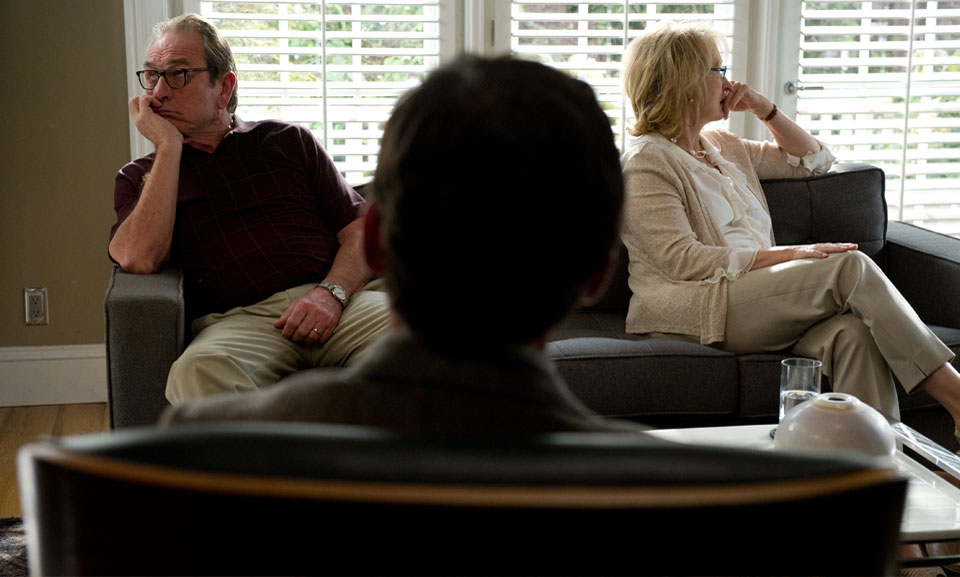
That’s it. That’s the movie.
Most of the action takes place as Kay and Arnold nervously perch on Dr. Feld’s couch or argue in their rented Econo-Lodge room. There’s no shocking revelation or dramatic showdowns or attractive third party, just two former lovers trying to find their way back to each other.
In any other hands, such a film would be insufferable. However, Streep is so adept at inhabiting any role she plays, she makes the film very good. Leaving behind the strong characters she’s created in Margaret Thatcher and Julia Child, Streep makes Kay all passive passion and wounded energy, a woman lost in her own desire for something she is not sure exists. Jones’ gruff, grumpy cowboy persona is exactly right here, as he harumphs and grumbles his way through counseling.
It feels like watching a real couple.
There’s one particularly fine moment when, in the midst of an emotional and draining argument, Arnold mentions something about one of their children that they both affectionately find ridiculous. Through all the tears and growls, they both chuckle. It’s not the full-blown belly-laugh of first love, but that long-term, intimate, shorthand chuckle that says, “You are funny. I acknowledge the funny comment. Indeed, you’re the funniest person I know and we’ve been laughing at this particular thing for decades and I still find it funny, although neither one of us requires a full laugh to reinforce that fact.”
Long-time couples will know exactly what I’m talking about.
It’s one of the finest aspects of marriage, that jokes stretch out over decades and become richer and funnier over time then they ever were at the start, even as the actual laughter becomes less raucous.
Only master actors can pull off such a moment of intimacy.
Those little moments of intimacy make the audience root for the marriage to succeed. Losing them would create a void in the universe.
The film is rated PG-13 because much of their discussion comes down to sex, sexual acts, and their feelings about such acts. There are also moments of attempted or realized sexual activity, with the action shown although no Boomer nudity is shown (or other nudity, for that matter). Frankly, the acting out of sex is much less uncomfortable than hearing the two awkwardly and haltingly discuss sex. This is not a wildly explicit film, but neither is a film for children. I doubt it would appeal to children anyway.
When Dr. Feld encourages the couple, saying that even great marriages have a few rough years and they should push through, not give up, those who know that to be true will want to stand up and cheer. The movie is the strongest pro-marriage movie I’ve ever seen.
Still, with all this beauty and determination at the heart of the laudable film, there’s also an assumption at its core that makes me uncomfortable.
The question comes down to what the purpose of marriage is.
Baby Boomers – the generation of Streep and Jones and the intended audience for the film – essentially redefined marriage as an institution whose primary goal was to make the couple happy. Prior to that generation, couples chose well or poorly, jumped with both feet, and hoped for happiness. Marriage was more a matter of duty, of fulfilling a promise, of aiding society by taking care of children and parents and each other, of working together.
Sometimes this worked and sometimes it created its own brand of misery, but the definition of marriage was fundamentally different than today.
In a moment when it seems possible that Kay may leave Arnold, she murmurs that maybe she might be happier alone than with him. Even with his gruffness and insensitivity, I found myself wondering if she really could leave this man to face old age alone, to endure the coldness of the world alone, the advancement of ill health and death alone, for something as trivial as unhappiness.
That’s a serious desertion.
This is not to say unhappiness is unimportant, only that Kay is focused on her feelings and not her duty. She focuses on her sad emotions – which spring from admittedly valid roots – and not on a determination to do good for another human being. The elusive quality of happiness is paramount.
The Me-Generation’s tendency to self-focus feels so natural we almost forget to question it.
A supreme irony emerges here. Those who prioritize a quest for happiness most often find despair while those who prioritize serving others and doing one’s duty usually find happiness as a byproduct.
This leaves me of two minds about this very watchable movie. On one hand, it’s fantastic to watch a couple fight not just for their marriage, but for their marriage to be excellent. On the other, it pales in comparison to some of the real-life, truly heroic marriages I’ve seen.
Previous Post

August 7, 2012
An Object Lesson and Breaking Bad's Next Move
Browse Our Archives
Select a Category Becky's Picks Children's Movies DVD releases Entertainment News Faith on Film Featured Hunger Games In Theaters Interviews Life, Etc. Mixed Nuts Movie Reviews Poliflix Scroogewatch slider Television Uncategorized
Select a Month December 2014 November 2014 October 2014 September 2014 August 2014 July 2014 June 2014 May 2014 April 2014 March 2014 February 2014 January 2014 December 2013 November 2013 October 2013 September 2013 August 2013 July 2013 June 2013 May 2013 April 2013 March 2013 February 2013 January 2013 December 2012 November 2012 October 2012 September 2012 August 2012 July 2012 June 2012 May 2012 April 2012 March 2012 February 2012 January 2012 December 2011 November 2011 October 2011 September 2011 August 2011 July 2011 June 2011 April 2011 March 2011
Follow Us!
TAKE THE
Religious Wisdom Quiz
Who was turned into a pillar of salt?
Select your answer to see how you score.
Ruth Lot Naomi Lot's wife
Related posts from Tinsel
'The Overnighters:' Q&A with Director Jesse Moss

Gratitude for Five Years at Patheos - Moving...

Despite its Title, Stephen Hawking’s Biopic Earns an...

Video: Watch the Trailer for 'The Bible' Sequel...
TRENDING AT PATHEOS Religious Music & Entertainment

In one sense walking into Westminster Abbey is like walking down the...

'Super Scam Me' Exposes AI Jon Bon Jovi...
Leslie Pickett believed she was in a relationship with Jon Bon Jovi....

The Brazilian Remake of Kendricks' 'Flywheel' Opens in...
“Flywheel,” the story that launched the Kendrick Brothers’ filmmaking career is getting...

The Dangers of Gradual Accommodation (Winking at Sin)
Recently, the “law of gradualness” resurfaced during the opening of a weeklong,...

The Iron Gates and the Lion of the...
Yesterday, I didn't finish my report about, well, yesterday. So I'll...

The Image: On the Horror of Capitalism and...
The Image Then went the Pharisees, and took counsel how they might...
view all Religious Music & Entertainment blogs
Ad-Free & Subscriber Log-In Subscription Support
- About Us
- 2026 Calendar
- Videos
- Podcasts
- Library of World Religions
- Faith In Media Tracker
- Advertise With Us
- Write for Us
- Privacy Policy
- Terms of Service
- Do Not Sell My Data
- Contact Us
- Radiant Digital
- Manage Newsletter Subscriptions
- Unsubscribe From Notifications
- Sitemap
Copyright 2008-2026, Patheos. All rights reserved.
Subscription Support Ad-Free & Subscriber Log-In
Follow Patheos