
BuddhistCatholicContemplativeEvangelicalGeneral ChristianHinduJewishLatter-day SaintMuslimNew VisionsProgressive Christian
Beliefs
- Buddhist
- Catholic
- Contemplative
- Evangelical
- General Christian
- Hindu
- Jewish
- Latter-day Saint
- More Voices
- Muslim
- New Visions
- Pagan
- Progressive Christian
Topics
- Religion News
- Food and Religion
- Sports and Religion
- Religious Art
- Religious Music and Entertainment
- Religious Events
- History and Religion
- Style and Religion
- Politics and Religion
- Women in Religion
- Recreation Outdoors and Religion
- Business Finance and Religion
- Careers Workplace and Religion
- Education and Religion
- Family Parenting and Religion
- Health Fitness and Religion
- Home and Religion
- Relationships and Religion
- Technology and Religion
- Travel and Religion
Columnists
- Buddhist Columnists
- Business Finance and Religion Columnists
- Careers Workplace and Religion Columnists
- Catholic Columnists
- Contemplative Columnists
- Education and Religion Columnists
- Evangelists Columnists
- Family Parenting and Religion Columnists
- General Christian Columnists
- Health Fitness and Religion Columnists
- Hindu Columnists
- History and Religion Columnists
- Home and Religion Columnists
- Jewish Columnists
- More Voices Columnists
- Latter Day Columnists
- Muslim Columnists
- New Visions Columnists
- Nonreligious Columnists
- Pagan Columnists
- Politics and Religion Columnists
- Progressive Columnists
- Recreation Outdoors and Religion Columnists
- Relationships and Religion Columnists
- Religion News Columnists
- Religious Art Columnists
- Religious Events Columnists
- Religious Music and Entertainment Columnists
- Sports and Religion Columnists
- Style and Religion Columnists
- Technology and Religion Columnists
- Travel and Religion Columnists
- Women in Religion Columnists
Resource Library
- 2026 Calendar
- Library of World Religions
- The 100 Most Holy Places on Earth
- Patheos Answers
- Podcasts
- Videos
- Faith Leaders Database
- Anglican Episcopalian
- Bahai
- Baptist
- Buddhism
- Christianity
- Confucianism
- Eastern Orthodoxy
- Hinduism
- Holiness and Pentecostal
- ISKCON
- Islam
- Judaism
- Lutheran
- Methodist
- The Church of Jesus Christ of Latter-day Saints
- New Age
- Paganism
- Presbytarian and Reformed
- Protestantism
- Religion Behind the Scenes
- Roman Catholic
- Scientology
- Shia Islam
- Sikhism
- Sufism
- Sunni Islam
- Taoism
- Zen
- See all religions
Research Tools
 Ad-Free & Subscriber Log-In Subscription Support
Ad-Free & Subscriber Log-In Subscription Support
Follow Patheos 

- Trending:
- Forgiveness
- |
- Marriage
- |
- Consciousness
- |
- Death Penalty
- |
- Election
- |
- Halloween

- Home
- Pagan
- Cofradia y Hermandades: The Survival of the Misterios
Cofradia y Hermandades: The Survival of the Misterios
Last updated on: June 15, 2020 at 5:18 pm by Guest Contributor
Cofradia y Hermandades: The Survival of the Misterios 2020-06-15T17:18:39-04:00 Guest Contributor
Patheos Explore the world's faith through different perspectives on religion and spirituality! Patheos has the views of the prevalent religions and spiritualities of the world.
Catholicism provided the perfect veneer to safeguard ancestral indigenous and African spiritual practices. In the Dominican Republic, the way that the people came together to celebrate the Misterios and carry out group rituals was under the cover of a Cofradia or Hermandad. The Cofradias are social groups that all center themselves around upholding Catholic morals, supporting the community through acts of charity and goodness, and working for the social good. A Hermandad, which means “brotherhood,” is often a smaller group of the same nature. In spite of the names both groups are coed.
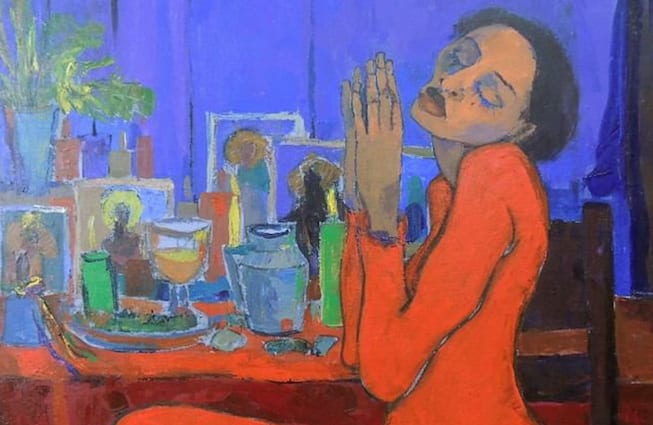
Cofradias were established by and backed by the Catholic Church. The church also heavily encouraged the participation of all slaves as their way of working to convert slaves to the new religion. Although, technically Hermandades and Cofradias could be formed by any group of people, at first the Catholics only allowed white slave masters to do so. So, there were and are Cofradias and Hermandades that are totally Catholic and not connected in any way to the 21 Divisions. Priests then decided it was important for the slaves to be given time to participate in the activities of the Cofradia. Likewise, the slaves were to not work on the feast days of the patron saints and were to be given time to socialize and spend together.
Quickly noticing how the slaves embrace the saints and their dedication, the priests decided that they should be allowed to open their own Cofradias. Many of the Catholic priests, happy to see the slaves participating, also slowly allowed for African practices to be brought in, thinking it would further encourage conversion. They felt it would be good for the slaves to incorporate a bit of their own culture and “make it theirs,” so to speak. Unknowingly and unwittingly, they ended up helping preserve the Misterios, the very thing they worked so hard to eradicate. Convinced that the slaves were embracing the new religion of Catholicism, they didn’t mind if they brought in a bit of their culture.
However, the way it worked in the Dominican Republic for the African slaves was that often either a family or a group of brujos would band together to form the Cofradia. The Cofradias therefore became the storehouse for the knowledge and traditions of the 21 Divisions. Many of these Cofradias were some of the first establishments of African spiritual practices in the Americas and continue to operate in various parts of the island.
A Cofradia required a group of at least nine individuals with each charged with a task. Cofradias were a highly organized structure as to their governing and activities. They all were dedicated to a specific saint and celebrated the feast of this patron annually. On these dates, a novena or velada was held in honor of the patron saint. A novena is a prayer process that takes place over nine consecutive days.
During veladas, candle vigils were placed near the icon of the patron saint, and various members took turns “watching” the saint by staying up all night long and praying constantly until the ultimate time of the feast. On the feast day, the Cofradia went out with the Catholic church in a procession for the saint. The processions and celebrations of the Cofradias were always accompanied and followed by dances, African drumming, and music.
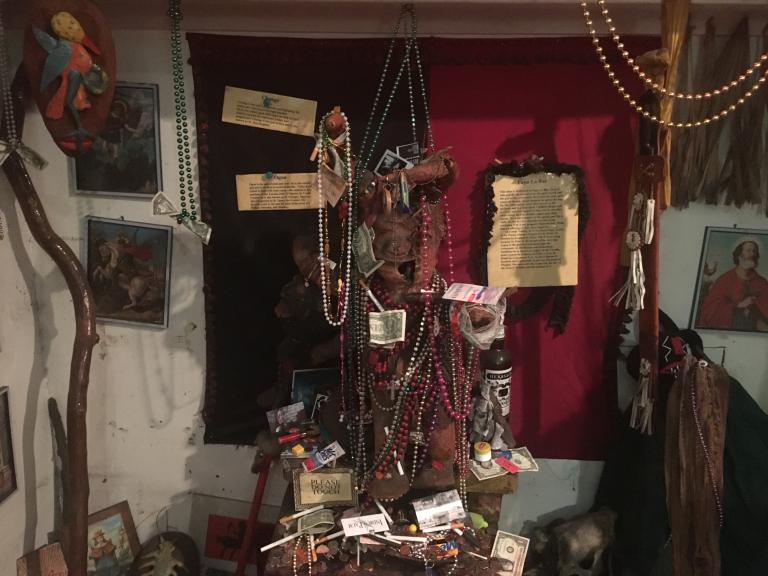
Voodoo Altar at the New Orleans Museum of Voodoo.
After all the Catholic rituals had been carried out, the slaves were allowed to relax and socialize. Not understanding the practices of the slaves, their oppressors simply saw them holding a social event while, in actuality, this is when the service to the Misterios would begin. Communal feasting was always also a central activity within this part of the events. The altar, initially set up in honor of the saint, was now laden with food offerings to the Misterios.
The music would encompass both the saints and the Misterios. The drums beat the rhythms of the African ancestors, particularly those of the Kongo, as the dances became the method through which the souls of the servants would ascend into heaven, leaving the body an empty vessel so that the Divine Misterios could descend within them. Now the rum, the sacred drinks, perfumes, and tobaccos could all come out and be employed in service to the Divine.
This is the way the 21 Divisions and the Misterios survived— all right under the eyes of the slave masters. Naturally due to the circumstances, many elements of rituals and ceremonies had to be altered and adapted. Tools used had to be minimal and things that could be utilized right out in the open. The servants of the 21 Divisions learned to perfect their capacity to allow the Misterios to possess them and be able to do great spiritual work with very little accoutrements.
Due to the laws of those times, a white Dominican could go to a slave Cofradia’s event but not vice versa. So the slaves had to be very careful about their activities. They could face an influx of outsiders at any time. What was Catholic and what was Voodoo had to become well enmeshed, undetectable. Many of the Misterios’ Voodoo names and Catholic saints are now synonymous. Some Misterios with lesser followingshave even lost their African names altogether and are only known by their Catholic counterparts.
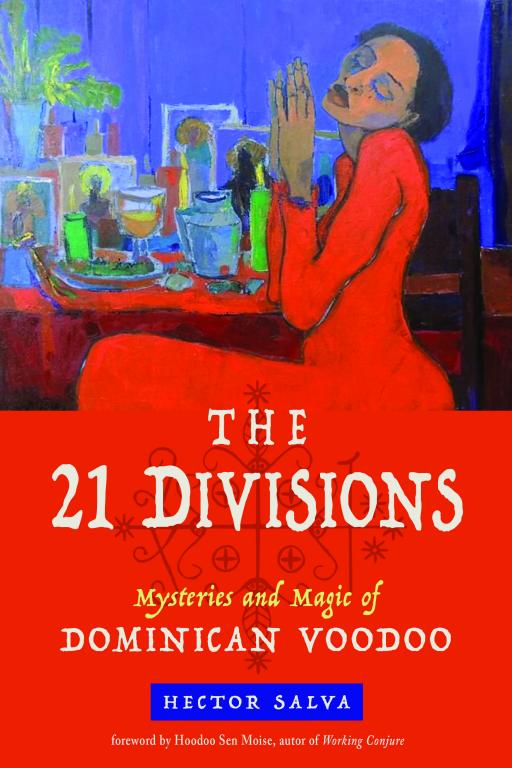
Common Roots: 21 Divisions and Haitian Vodou
The Tcha Tcha lineage existed on both sides of the island before it was divided between the French and Spanish. Haitian Vodou and Dominican Voodoo thus share the same root. However, each practice evolved differently based on the different European influences. Each practice grew in the manner in which it could survive and thrive. Likewise, there were fewer Indians mixed into the blood on the French side, as by the time the French arrived there were fewer Indians overall. So each type of practice took on influences to varying egrees from the various tribes of the African slaves, Tainos, and Arawaks in the respective areas, alongside of the dominating culture of either French or Spanish. For example, the language of practice in Haiti became Kreyol and in the Dominican Republic Spanish.
Now, because each was evolving in different cultures under different circumstances, the Misterios adapted to the needs of their people and the capacities of the same as they always do. But the essence of the Misterios and the Mystery itself remained the same. You’ll also see that they share many terms and words, although the way they define those terms and the connotations that they carry may be different. Practices are also shared among the two.
So what are the major differences?
As mentioned before, the French didn’t stress conversion to Catholicism as much as the Spanish did. Furthermore, the Haitians were able to liberate themselves from the French much sooner, and a large percentage of the first enslaved Haitians were actually first-generation Africans. Out from under French rule, the Haitians were able to practice their Voodoo more freely. Thus, they were able to retain larger parts of their African cultures and beliefs.
Haitian Vodou retained many more of the aspects of the religions originating in Africa as well. Because its practitioners viewed it as a religion, the mindset and memory of the ancestral ways were more entrenched. Haitian Vodou includes Catholic rituals, but not to the same degree, and they are obviously much more of a veneer. In Haiti it is common for Vodou priests to operate in temples, and in some Haitian temples all Catholic elements have been removed or were never even incorporated.
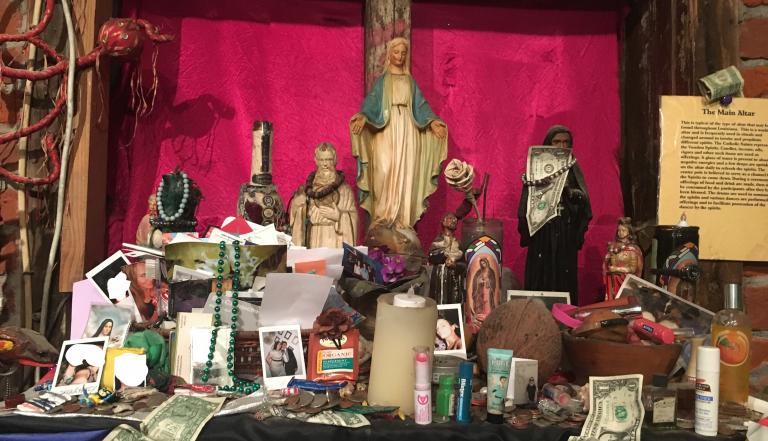
Altar at the New Orleans Museum of Voodoo.
Dominican Voodoo, on the other hand, became much more magical in orientation. Its value comes less from its religious aspect as from its practicality, the results of its magic, and its pragmatism. Dominican Vodouisants almost always consider themselves Catholics as far as their religion goes and the 21 Divisions as their spiritual practice. In the 21 Divisions, it is the altar room of the brujo that’s the central ceremonial space. There are no temples. This altar room is usually a room in the priest’s own house. While temples do exist, they are way less common.
Catholic rituals and ceremonies are also an integral part of the 21 Divisions and their magic. For many of the Dominican Misterios, the Catholic saint has become intrinsically connected to the Misterio and that never changes. In Haitian Vodou, it is not uncommon for the Misterios’ Catholic counterparts to change from region to region or in fact from temple to temple.
Public and group rituals that were common in African and Indian practices and therefore were retained in the Haitian form of Voodoo are uncommon in the 21 Divisions. Also, whereas the community is central to the Haitian Vodou priest, the brujo of the 21 Divisions most commonly works in private. Another area of difference is the music and drumming. The songs, the drum rhythms, and the dances between the two traditions have diverged.
_______________
Adapted, and reprinted with permission from Weiser Books, an imprint of Red Wheel/Weiser, The 21 Divisions by Hector Salva is available wherever books and ebooks are sold or directly from the publisher at www.redwheelweiser.com or 800-423-7087

About Hector Salva
Born and raised in a family of brujos (witchdoctors, healers, and sorcerers) that practiced 21 Divisions, Sanse, and Puerto Rican Espiritismo, Hector Salva (Papa Hector) started training as a brujo in 1989 and initiated in his family lineages of 21 Divisions and Sanse. He was raised by his grandmother, Dona Juana Acevedo, bruja and Espiritista. In 2003, Papa Hector was initiated into Haitian Voodoo as a Houngan Asogwe, a high priest of the Asson lineage. Papa Hector is the author HectorSalva.com, the internet’s largest source of information on Haitian, Dominican, and Puerto Rican Voodoo traditions. He is also the author of las21divisiones.com, sansereligion.com and over a half a dozen other spiritual websites. In addition to the author’s strong online presence, he teaches workshops domestically and internationally. You can read more about the author here.
Previous Post
June 4, 2020
The African River Horse
Next Post

June 18, 2020 Patheos Pagan Writers on the Summer Solstice
Browse Our Archives
Select a Category Conversations Interviews Pagan Voices Uncategorized
Select a Month December 2020 October 2020 September 2020 August 2020 June 2020 May 2020 April 2020 February 2020 December 2019 November 2019 September 2019 August 2019 June 2019 May 2019 April 2019 March 2019 February 2019 January 2019 December 2018 October 2018 September 2018 August 2018 June 2018 May 2018 April 2018 March 2018 February 2018 January 2018 December 2017 October 2017 August 2017 July 2017 June 2017 April 2017 March 2017 February 2017 December 2016 November 2016 October 2016 September 2016 August 2016 July 2016 June 2016 May 2016 April 2016 March 2016 February 2016 January 2016 December 2015 November 2015 October 2015 September 2015 August 2015 August 2011 July 2011 June 2011
TAKE THE
Religious Wisdom Quiz
Though the fig tree does not bud and there are no grapes on the vines, yet I will rejoice in the Lord. What will God make my feet like?
Select your answer to see how you score.
A gazelle's legs The feet of a deer Eagles' wings Lions' paws
Related posts from Through the Grapevine
Patheos Pagan Writers on Yule 2020
Common Magical Tools in Witchcraft
Patheos Pagan Writers On the 2020 Presidential Election
TRENDING AT PATHEOS Pagan

I was recently chatting with someone on Instagram. She asked me what...

While there are many people who share their results, the end of...

On July 23, I saw Christopher Nolan's The Odyssey which is Homer’s...

As I write this two big events have just finished up. One...

Restoring the Watershed of Divine Love
Perhaps cooperation is not something we manufacture through legislation, ideology, or moral...

Many UUs don’t pray because of bad experiences in a previous religion,...
view all Pagan blogs
Ad-Free & Subscriber Log-In Subscription Support
- About Us
- 2026 Calendar
- Videos
- Podcasts
- Library of World Religions
- Faith In Media Tracker
- Advertise With Us
- Write for Us
- Privacy Policy
- Terms of Service
- Do Not Sell My Data
- Contact Us
- Radiant Digital
- Manage Newsletter Subscriptions
- Unsubscribe From Notifications
- Sitemap
Copyright 2008-2026, Patheos. All rights reserved.
Subscription Support Ad-Free & Subscriber Log-In
Follow Patheos