
BuddhistCatholicContemplativeEvangelicalGeneral ChristianHinduJewishLatter-day SaintMuslimNew VisionsProgressive Christian
Beliefs
- Buddhist
- Catholic
- Contemplative
- Evangelical
- General Christian
- Hindu
- Jewish
- Latter-day Saint
- More Voices
- Muslim
- New Visions
- Pagan
- Progressive Christian
Topics
- Religion News
- Food and Religion
- Sports and Religion
- Religious Art
- Religious Music and Entertainment
- Religious Events
- History and Religion
- Style and Religion
- Politics and Religion
- Women in Religion
- Recreation Outdoors and Religion
- Business Finance and Religion
- Careers Workplace and Religion
- Education and Religion
- Family Parenting and Religion
- Health Fitness and Religion
- Home and Religion
- Relationships and Religion
- Technology and Religion
- Travel and Religion
Columnists
- Buddhist Columnists
- Business Finance and Religion Columnists
- Careers Workplace and Religion Columnists
- Catholic Columnists
- Contemplative Columnists
- Education and Religion Columnists
- Evangelists Columnists
- Family Parenting and Religion Columnists
- General Christian Columnists
- Health Fitness and Religion Columnists
- Hindu Columnists
- History and Religion Columnists
- Home and Religion Columnists
- Jewish Columnists
- More Voices Columnists
- Latter Day Columnists
- Muslim Columnists
- New Visions Columnists
- Nonreligious Columnists
- Pagan Columnists
- Politics and Religion Columnists
- Progressive Columnists
- Recreation Outdoors and Religion Columnists
- Relationships and Religion Columnists
- Religion News Columnists
- Religious Art Columnists
- Religious Events Columnists
- Religious Music and Entertainment Columnists
- Sports and Religion Columnists
- Style and Religion Columnists
- Technology and Religion Columnists
- Travel and Religion Columnists
- Women in Religion Columnists
Resource Library
- 2026 Calendar
- Library of World Religions
- The 100 Most Holy Places on Earth
- Patheos Answers
- Podcasts
- Videos
- Faith Leaders Database
- Anglican Episcopalian
- Bahai
- Baptist
- Buddhism
- Christianity
- Confucianism
- Eastern Orthodoxy
- Hinduism
- Holiness and Pentecostal
- ISKCON
- Islam
- Judaism
- Lutheran
- Methodist
- The Church of Jesus Christ of Latter-day Saints
- New Age
- Paganism
- Presbytarian and Reformed
- Protestantism
- Religion Behind the Scenes
- Roman Catholic
- Scientology
- Shia Islam
- Sikhism
- Sufism
- Sunni Islam
- Taoism
- Zen
- See all religions
Research Tools
 Ad-Free & Subscriber Log-In Subscription Support
Ad-Free & Subscriber Log-In Subscription Support
Follow Patheos 

- Trending:
- Forgiveness
- |
- Marriage
- |
- Consciousness
- |
- Death Penalty
- |
- Election
- |
- Halloween

- Home
- Pagan
- Pagan Interviews: Morgan Daimler
Pagan Interviews: Morgan Daimler
Last updated on: November 30, 2015 at 11:52 am by Sean Harbaugh
Pagan Interviews: Morgan Daimler 2015-11-30T11:52:42-05:00 Sean Harbaugh
Patheos Explore the world's faith through different perspectives on religion and spirituality! Patheos has the views of the prevalent religions and spiritualities of the world.
Morgan Daimler is a Heathen, a witch, and a Celtic Reconstructionist. She’s also a prolific writer and teacher. In between all that she also contributes here at Patheos Pagan where she writes at Agora under the subheading Irish-American Witchcraft. (Jason is also trying to get Morgan to write here full time too!) She sat down with our own Sean Harbaugh for a wide ranging interview.
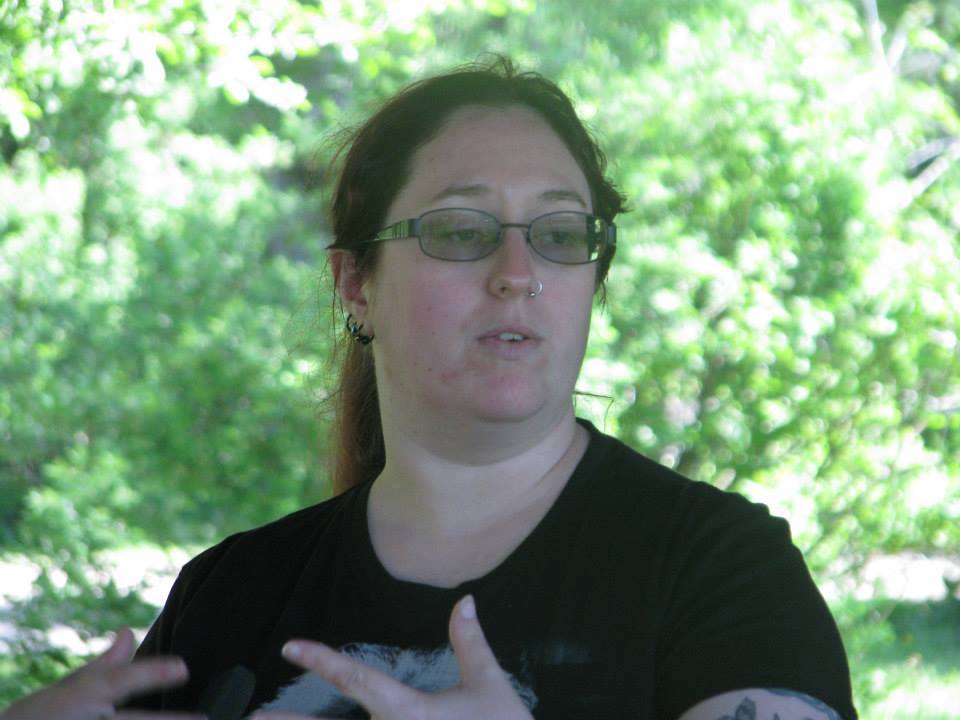 Sean Harbugh: Hi Morgan, thanks for taking time to be interviewed. Let’s start with telling us about yourself.
Morgan Daimler: I’ve been pagan since the early ‘90’s with a focus on Irish paganism and the Good Neighbors (fairies). I started teaching locally around 2000, and got into Heathenry in 2006. I’ve always been a weird blend of faith and fact; it’s really important to me to be accurate and understand the roots of things, but at the same time I’m very mystically inclined. For example I consider myself a Seer and have a lot of faith omens but the structure I prefer is reconstructed from ancient Irish and Norse seership methods. I think that was what drew me to CR to begin with, the feeling that it was using scholarship to create something deeply spiritually meaningful.
You are a prolific writer. In fact I remember you writing your book Pagan Portals – The Morrigan: Meeting the Great Queens in something like 10 days. How do you do this?
[laughing] Yes I wrote Pagan Portals the Morrigan in 9 days, but I’ll plead exceptional circumstances on that one. I attended the Morrigan’s Call Retreat in 2014 and I had this moment of Imbas, of inspiration where I realized that there was a need for a simple, short introductory book for the Morrigan that would help beginners get a solid grounding in her material and that could be used in conjunction with or to clarify longer more in depth works. There so much material out there, good, bad, and terrible.
So when I came home from the Retreat I wrote the book, starting on a Friday the 13th and ending on the summer solstice, which seemed pretty auspices since the summer solstice was supposed to be when the Tuatha De Danann won Ireland from the Fir Bolg. Anyway, I was just glad my publisher liked the manuscript enough to go forward with it, and people seem to find it useful. I think it achieved the goal I set out to achieve with it anyway.
Most books take a bit longer than that to write, but I do seem to be on the fast end I guess. I’m not sure why. I like to write, I love to research, and once I start on a project I can generally get between 1,000 and 3,000 words a day written, sometimes a bit more; fiction tends to go a lot faster than things that require citations. People ask me how I do it, with three kids at home to take care of and a life and all that, and the truth is, I’m not entirely sure. I write fast is one thing, and I don’t sleep very much because of my youngest son, so I figure if I’m awake I may as well be writing is another.
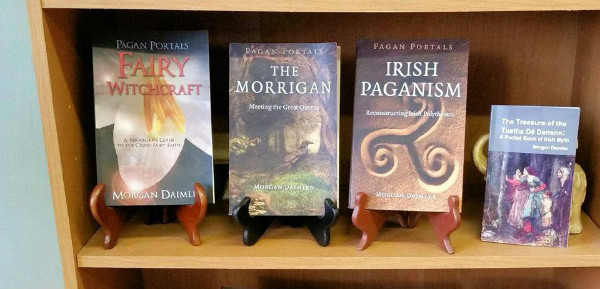
You are a person of many traditions. In your book Where the Hawthorn Grows: An American Druid’s Reflections you call yourself a druid (which is unusual in the CR community), you’ve written a book on Fairy Witchcraft, and you are a self-professed Heathen. How do you reconcile all of these paths?
That’s a good question. I am an Irish polytheist and I also honor Germanic Gods, particularly Wodan, Frau Holle, and Berchta. I keep those two practices separate – different holidays, for example – and different ritual framework within a reconstructionist methodology, so it only seems appropriate to use the different labels in different contexts. I’m a witch because I practice witchcraft, and a Druid in part because I earned that through the Order I belong to, Ord na Darach Ghile, and in part because I see that as the best title for the role of public clergy, for me. The common thread in everything I do though is respecting and honoring the Good People – the aos sidhe, the alfar – and that’s something that’s consistent between my Druidism, my Heathenry, and my witchcraft. It’s what holds everything together and makes it cohesive for me.
What does your personal practice look like?
At this point, with three children, it’s pretty simple. I’m a huge fan of daily devotionals, but those are often simple daily prayers, lighting some incense or a candle, and offerings. I love using older prayers, but I have no hesitance to modernize them or make them more pagan. I also write a lot of my own. My ritual practice has also been simplified because of children, but I don’t think that’s a bad thing.
It’s funny actually one of the last conversations I remember having with Alexie Kondratiev on the old Celtic Nation e-list he was advocating for simple rituals as the ancient norm (I believe we were looking at Indo-European into early Celtic) and I remember thinking it just wouldn’t feel like a satisfying ritual without all the steps and bells and whistles. Now here I am more than 5 years later and I’m doing things a lot like he’d been describing, fire, water, simple prayers and offerings, and it’s a lot more fulfilling than I expected.
Of course I also belong to groups that have specific ritual structures, like ADF White Oak and my Heathen Kindred, and in those situations I follow the structure they use.
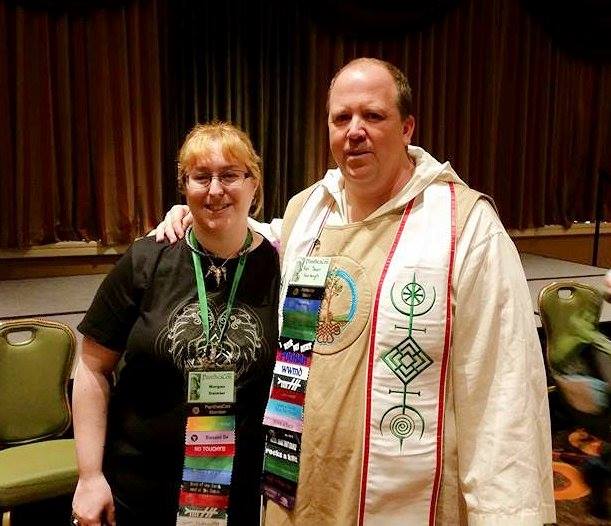
Morgan and Sean
In your latest book, Pagan Portals – Irish Paganism: Reconstructing Irish Polytheism, you have put together a good guide book to learning the pathway to working with Irish polytheism. Your devotion to putting out scholastic material is appreciated across the pagan spectrum. How do you choose the next topic to write about? What gives you the inspiration?
Honestly every time I write a non-fiction book I finish it and say “that’s it, no more writing, I’m done”. But what usually happens is a topic comes up and there just seems to be a need for it, or else someone asks me to tackle a subject. I wrote Pagan Portals Fairy Witchcraft because I saw one to many posts on social media about fluffy twee fairies and witchcraft and I realized that there just weren’t any good resources for Neopagans to learn about the traditional Fairy beliefs in a Neopagans context because everything out there was not based on the actual old beliefs.
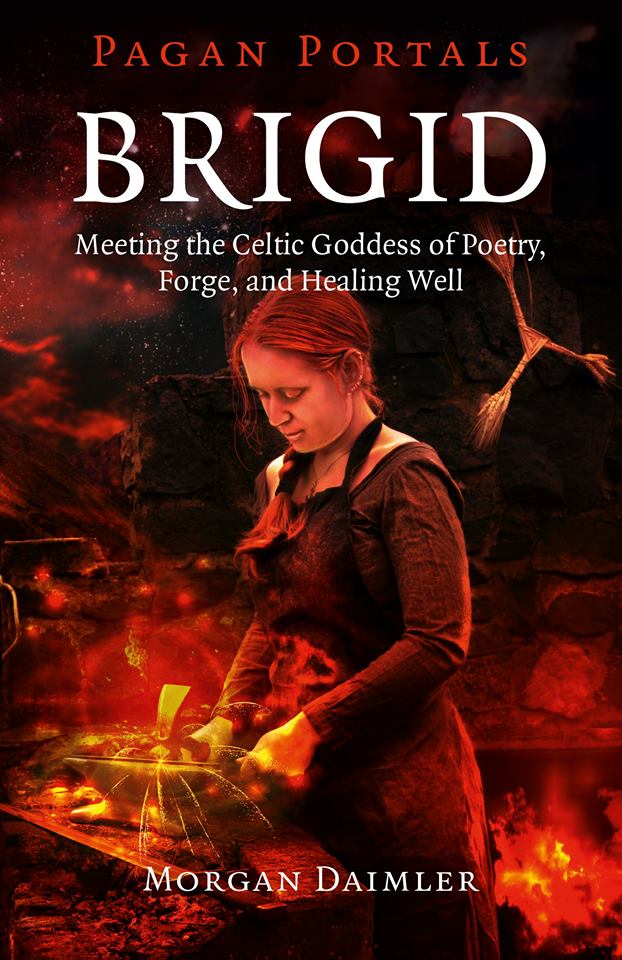
So I decided instead of complaining about it I would try to do something about it. I have a Pagan Portals on Brigid coming out next March which was written because someone on my Facebook author page asked about more goddess-themed pagan portals and included a list of several goddesses they wanted to see; when I mentioned it to my editor he asked if I’d be willing to do one on Brigid. I also have a full length Fairy Witchcraft book that should be out next year that happened because people liked the Pagan Portals and asked for a longer one.
Your next book is Pagan Portals – Brigid: Meeting The Celtic Goddess Of Poetry, Forge, And Healing Well. What is going to make this book stand out as a good source book as opposed to other books on Brigid?
Much like Pagan Portals the Morrigan it’s not meant to be “instead of” but rather “with”. Pagan Portals Brigid is meant to introduce readers to who Brigid was in the Celtic cultures that honored her, her history, her myth, and her associations in as simple and straightforward a way as possible. Again there are so many resources out there on Brigid, good, bad, and in some cases strange, that hopefully this book will make it easier for people to understand who she is. I’m encouraged that so far the feedback from early readers has been good and it’s gotten some very positive endorsements.
 Reconstructionist Paganism is a fast growing segment in the Neopagan community—or is it? Do you actually feel reconstructionist paganism as a part of the Neopagan community or is polytheism something completely separate?
Personally I’m a big tent person and I always have been, I identify as both a pagan and a polytheist. But I think people and communities have a right to self-identify and self-define so I respect polytheists who feel they aren’t Neopagans, just like Heathens who feel they aren’t Neopagans.
I do agree that reconstructionism seems to be a fast growing concept.
How do you see the recon communities growing and evolving?
I think there’s a real interest in the history and older myths which is fueling the growth. If we want to really grow though we need to start having a more solid sense of community among ourselves and better ways for new people to learn. There is a huge dearth of beginner material, especially in CR, and what is out there tends to be very group specific. We tend to ask new people to reinvent the wheel instead of offering guidance although that has gotten slowly better. I think – hope – that part of our evolution will be more real world groups and more cohesive online community, which will make it easier for new people to find their way. Obviously my new book was an attempt to offer some good beginner material.
The Morrigan seems to be making her presence felt the past few years in big fashion. Why do you think she is making her presence felt now in such a big way? Do you think it could be due to the state of our world?
I think She is clearly gathering followers and making her presence known. However I tend to think this has more to do with the growth of paganism in general and of better resources. We might feel we live in frightening times but the history of the world has seen far worse. Not that I couldn’t be wrong, but so far I’ve seen her urging people to reclaim sovereignty, to live with honor, to heal their own broken places – but not to go off grid and stockpile for the zombie apocalypse.
Morgan, you also write fiction. Do you find the same satisfaction in fiction as you do with non-fiction? Do you prefer one over the other?
Fiction for me is pure fun. I write an alternate reality urban fantasy with paranormal romance overtones. It’s full of Celtic mythology references, and magical theory, and I really like my characters. It’s pure storytelling and there’s an appeal to that. Non-fiction I always worry the whole time that I’m being fair, that I’m acknowledging my own biases, that I’m presenting all the options to the reader; fiction doesn’t have that. But it’s like apples and oranges, I can’t say I like one better than the other.
What projects do you have on the horizon?
At the moment I’m writing the fourth novel in my fiction series. After that, who knows?
Morgan, thank you so much for taking time to answer these questions. Do you have anything else you’d like to add?
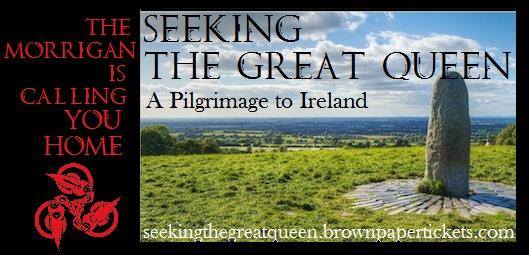
My friend Lora has said I’m bad at marketing myself and she’s right so I suppose I should say here that I have 14 books on the market, available on amazon.com, with another (Fairycraft) forthcoming and a 16th being written. Next year I’ll be at the 3rd annual Morrigan’s Call Retreat in June, which is a great event held in Connecticut. I’ll be teaching workshops as will Stephanie Woodfield, and Lora O’Brien is our headliner which I’m super excited about. Also next year in late October/early November I’m going to be part of sacred sites tour for the Morrigan in Ireland.
Previous Post

November 19, 2015
The Yawning Pit
Next Post

December 1, 2015 World AIDS day: Elemental Blessings for Change
Browse Our Archives
Select a Category Conversations Interviews Pagan Voices Uncategorized
Select a Month December 2020 October 2020 September 2020 August 2020 June 2020 May 2020 April 2020 February 2020 December 2019 November 2019 September 2019 August 2019 June 2019 May 2019 April 2019 March 2019 February 2019 January 2019 December 2018 October 2018 September 2018 August 2018 June 2018 May 2018 April 2018 March 2018 February 2018 January 2018 December 2017 October 2017 August 2017 July 2017 June 2017 April 2017 March 2017 February 2017 December 2016 November 2016 October 2016 September 2016 August 2016 July 2016 June 2016 May 2016 April 2016 March 2016 February 2016 January 2016 December 2015 November 2015 October 2015 September 2015 August 2015 August 2011 July 2011 June 2011
TAKE THE
Religious Wisdom Quiz
Who killed Goliath the giant?
Select your answer to see how you score.
Moses Adam Joseph David
Related posts from Through the Grapevine
Lilith Dorsey in a Voodoo Universe
She's a Witch Indeed: Lisa Wagoner
The Tea Addicted Witch: Scarlet Magdalene
The Best of Patheos Pagan 2018
TRENDING AT PATHEOS Pagan

I was recently chatting with someone on Instagram. She asked me what...

While there are many people who share their results, the end of...

On July 23, I saw Christopher Nolan's The Odyssey which is Homer’s...

As I write this two big events have just finished up. One...

Restoring the Watershed of Divine Love
Perhaps cooperation is not something we manufacture through legislation, ideology, or moral...

Many UUs don’t pray because of bad experiences in a previous religion,...
view all Pagan blogs
Ad-Free & Subscriber Log-In Subscription Support
- About Us
- 2026 Calendar
- Videos
- Podcasts
- Library of World Religions
- Faith In Media Tracker
- Advertise With Us
- Write for Us
- Privacy Policy
- Terms of Service
- Do Not Sell My Data
- Contact Us
- Radiant Digital
- Manage Newsletter Subscriptions
- Unsubscribe From Notifications
- Sitemap
Copyright 2008-2026, Patheos. All rights reserved.
Subscription Support Ad-Free & Subscriber Log-In
Follow Patheos