
BuddhistCatholicContemplativeEvangelicalGeneral ChristianHinduJewishLatter-day SaintMuslimNew VisionsProgressive Christian
Beliefs
- Buddhist
- Catholic
- Contemplative
- Evangelical
- General Christian
- Hindu
- Jewish
- Latter-day Saint
- More Voices
- Muslim
- New Visions
- Pagan
- Progressive Christian
Topics
- Religion News
- Food and Religion
- Sports and Religion
- Religious Art
- Religious Music and Entertainment
- Religious Events
- History and Religion
- Style and Religion
- Politics and Religion
- Women in Religion
- Recreation Outdoors and Religion
- Business Finance and Religion
- Careers Workplace and Religion
- Education and Religion
- Family Parenting and Religion
- Health Fitness and Religion
- Home and Religion
- Relationships and Religion
- Technology and Religion
- Travel and Religion
Columnists
- Buddhist Columnists
- Business Finance and Religion Columnists
- Careers Workplace and Religion Columnists
- Catholic Columnists
- Contemplative Columnists
- Education and Religion Columnists
- Evangelists Columnists
- Family Parenting and Religion Columnists
- General Christian Columnists
- Health Fitness and Religion Columnists
- Hindu Columnists
- History and Religion Columnists
- Home and Religion Columnists
- Jewish Columnists
- More Voices Columnists
- Latter Day Columnists
- Muslim Columnists
- New Visions Columnists
- Nonreligious Columnists
- Pagan Columnists
- Politics and Religion Columnists
- Progressive Columnists
- Recreation Outdoors and Religion Columnists
- Relationships and Religion Columnists
- Religion News Columnists
- Religious Art Columnists
- Religious Events Columnists
- Religious Music and Entertainment Columnists
- Sports and Religion Columnists
- Style and Religion Columnists
- Technology and Religion Columnists
- Travel and Religion Columnists
- Women in Religion Columnists
Resource Library
- 2026 Calendar
- Library of World Religions
- The 100 Most Holy Places on Earth
- Patheos Answers
- Podcasts
- Videos
- Faith Leaders Database
- Anglican Episcopalian
- Bahai
- Baptist
- Buddhism
- Christianity
- Confucianism
- Eastern Orthodoxy
- Hinduism
- Holiness and Pentecostal
- ISKCON
- Islam
- Judaism
- Lutheran
- Methodist
- The Church of Jesus Christ of Latter-day Saints
- New Age
- Paganism
- Presbytarian and Reformed
- Protestantism
- Religion Behind the Scenes
- Roman Catholic
- Scientology
- Shia Islam
- Sikhism
- Sufism
- Sunni Islam
- Taoism
- Zen
- See all religions
Research Tools
 Ad-Free & Subscriber Log-In Subscription Support
Ad-Free & Subscriber Log-In Subscription Support
Follow Patheos 

- Trending:
- Forgiveness
- |
- Marriage
- |
- Consciousness
- |
- Death Penalty
- |
- Election
- |
- Halloween
 Through Catholic Lenses
- Home
- Catholic
- Religion News
- Relationality in Disability Ministry in I Believe in You
Relationality in Disability Ministry in I Believe in You
Last updated on: August 30, 2021 at 6:35 pm by Fr. Matthew P. Schneider, LC
Relationality in Disability Ministry in I Believe in You 2021-08-30T18:35:57-04:00 Fr. Matthew P. Schneider, LC
Patheos Explore the world's faith through different perspectives on religion and spirituality! Patheos has the views of the prevalent religions and spiritualities of the world.
Luca Badetti, the director of community life at L’Arche in Chicago, recently wrote a book talking about how disabled and non-disabled people can learn love from each other. New City Press published I Believe in You: Wisdom from community with persons with disabilities on believing in ourselves and the other. I think this book is helpful for those who work in disability ministry but likely also helpful for others.
Most of this book is about relationships, and as such, hard to summarize for a review like this. I will give three points from his overall message then summarize three examples of these relational stories.
Three Points from Badetti’s Message
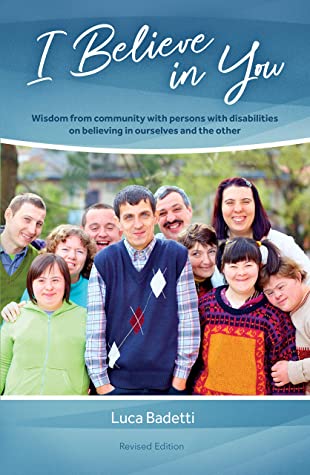
Cover of I Believe in You by Luca Badetti (fair use)
Badetii gives what might be a thesis statement rather early. He notes, “I believe people with intellectual disabilities do have a special gift that can help transform society so that it becomes more human. I have found inspiration in this, but I have also found inspiration in the people without intellectual disabilities who live community with them.” (16) Society tends to focus on a one-size-fits-all and tends to lose human dignity in our over-focus on what people can do instead of who they are.
Badetti notes an issue that is very present for most autistics who are able to fake being non-autistic for periods (like myself): the issue of masking. But he makes it more general. We all wear masks that likely “consist of inner dynamics and mechanisms that may be the product of years of pressures we have put on ourselves to match our own idealized self-image or to be how others want us to be, insofar as these distanced us from our own reality. Our masks may be the result of habits, patterns, and roles we created for ourselves as our fears and insecurities came up against threats from the external world.” (27) These masks can be an obstacle to prayer as God wants to know how we are without a mask. Often seeing people who don’t use masks (including those with intellectual disabilities) can help us drop our own masks.
Badetti also points out a major error in our culture: “Our society is obsessed with doing. A person is often valued in terms of activity and productivity. This leaves people with disabilities consistently at the tail end of the social scale.” In opposition, he notes, “We are who we are, not what we do or what we produce.” (31) This being over having is a tough but important point for today. In this respect, he recounts how one resident compared L’Arche to her former institution. He notes, “When she was younger, before coming to community, Karen lived in an institution with other people with disabilities… She describes the institution as if it were an enclosed prison, with no possibility of escape. On the outskirts of a small city surrounded by vast cornfields, hidden from the public eye, in an alienating and overcrowded space (hundreds of people lived there), residents were subject to inconsiderate and cruel treatment by staff. Some even died of abuse.” (50)
Lucia Communicates
One of the residents Badetti mentions is Lucia who is unable to speak or as far as I can tell use AAC or similar to communicate in a widely recognized way. She would sit rocking and looking Badetti would sit beside her to be present and she would grab his hand or his scarf. He struggles to understand her and even after years being with her, he notes, “I am still learning the language of Lucia.” (67) some things she wants to communicate but in those little actions he often sees a communication of presence, of relationship that can’t really be put into words.
He reflects on how this physical communication is the exact opposite of what we so commonly have with online communication where it is all words and no physicality. Badetti notes, “In living community with others, our bodily communication has the capacity to express the care with which we treat them as people and what we want to reveal to them.” (70) It is this bodily friendship that can often be missing today.
Nick and The Flintstones
In the epilogue, Badetti speaks of an interaction with Nick who loves The Flintstones. Nick was almost always joyful, despite some difficulties in this life. Nick gets Badetti to read him a book, then they put on an episode of the cartoon. Once it’s going, Badetti moves to pick up a theology book, but Nick brings him back to the presence of the moment enjoying time watching Fred and Wilma. This touched me, maybe as I could totally see myself in Badetti’s shoes here: “OK, you’re occupied with a cartoon so I’m going to pick up my dense theology text.” He notes, that instead of this theology, “He asked that I be present to him, which made sense to me, as that was precious for him-and for me. Watching an animated sitcom alongside him was enough.” (113)
Cautions
I have three cautions about the book nonetheless. First, he uses “with autism” instead of “autistic” and similar when the overwhelming majority of those with such a diagnosis prefer the latter which makes me wonder about his full commitment to accompanying disabled people where they are. Second, a few of the stories border on “inspiration porn.” Inspiration porn is widely hated in the disability community when it infantilizes a disabled person showing “wow! They can also do this thing that almost everyone can,” or when it seems to make the disabled exist simply for none disabled folks to draw inspiration from. I think a few stories tend in that direction, and he could show more stories of the intellectually disabled learning from him rather than focusing just on the other direction to show a mutual relationship, not something one-way. However, he avoids anything too clearly “inspiration porn” and this tendency is not overwhelming. Third, I’m not sure how much can be taken from the fact this is a reprint where the main difference seems to be removing a foreword by Jean Vanier and adding discussion questions. After recent revelations of sexual abuse, it is obvious that Vanier should be removed, but I doubt Badetti knew anything so I can’t judge him for not being omniscient.
Conclusion
Overall, I would recommend Badetti. I think it deserves 4/5 stars. Most of the book is quite good but the first two cautions I noted just above prevent it from reaching 5 stars. We do need to be remembering and being, over doing; and stop to be present to others such as the disabled.
Notes:
- New City Press sent me a free review copy of this book.
- Please support me on Patreon so I can keep writing more analysis of Catholicism and autism.
Previous Post

August 27, 2021
Bridgeport: The Best Vaccine Mandate Instruction Yet
Next Post
September 17, 2021 Missing the Point about Remote Cooperation / Appropriation
Browse Our Archives
Select a Category Autism Bioethics Book Review Business and Economics Catholic Social Teaching Culture Diocesan Life Disability Discipleship Euthanasia Family Life Genetics Global Politics History Immigration Inspiration Interview Liturgy Moral Theology My Life News Analysis Original Articles Prayer Privacy Pro-Life Science Sexual orientation or identity Social Media Sports Technology Theology Uncategorized US Politics Vatican
Select a Month March 2022 February 2022 January 2022 December 2021 November 2021 October 2021 September 2021 August 2021 July 2021 June 2021 April 2021 March 2021 February 2021 January 2021 December 2020 November 2020 October 2020 September 2020 August 2020 July 2020 June 2020 May 2020 April 2020 March 2020 February 2020 January 2020 December 2019 November 2019 October 2019 September 2019 August 2019 July 2019 June 2019 May 2019 April 2019 March 2019 February 2019 January 2019 December 2018 November 2018 October 2018 September 2018 August 2018 July 2018 June 2018 May 2018
Follow Us!
TAKE THE
Religious Wisdom Quiz
In 1 Peter, what did the prophets search intently and with great care about?
Select your answer to see how you score.
The salvation of Israel The day of the Lord The sufferings of the Messiah and the glories that would follow The end times
Support this
Column


Related posts from Through Catholic Lenses

Why Such a Focus on Extraordinary Form in...

Sensory-Friendly Mass Directory Now Available

Greg Locke, Autism Is not Demonic

Catholic Media: Fides Quarens Rem Publicam
TRENDING AT PATHEOS Catholic

Rejecting Doom: Christian Hope And Human Action
Christianity is a religion of hope. We are to have hope and...

It’s What Comes From Within Which Matters
One of the most difficult things for us to understand is why...

Why I Choose the Eucharist Over the Sermon
Choose the Eucharist, Not the Sermon What are we supposed to get...

5 Design Elements Found in Spiritually Rooted Homes
Putting Spirituality Into Home Decor Our homes are more than our living...

Credo: A Story of God Told with the...
About 10 years ago, I began to imagine a personal "Credo" that...

The Anatomy of Divine Revelation in Catholic Thought
The claim that God has made Himself known to human beings is...
view all Catholic blogs
Ad-Free & Subscriber Log-In Subscription Support
- About Us
- 2026 Calendar
- Videos
- Podcasts
- Library of World Religions
- Faith In Media Tracker
- Advertise With Us
- Write for Us
- Privacy Policy
- Terms of Service
- Do Not Sell My Data
- Contact Us
- Radiant Digital
- Manage Newsletter Subscriptions
- Unsubscribe From Notifications
- Sitemap
Copyright 2008-2026, Patheos. All rights reserved.
Subscription Support Ad-Free & Subscriber Log-In
Follow Patheos