
BuddhistCatholicContemplativeEvangelicalGeneral ChristianHinduJewishLatter-day SaintMuslimNew VisionsProgressive Christian
Beliefs
- Buddhist
- Catholic
- Contemplative
- Evangelical
- General Christian
- Hindu
- Jewish
- Latter-day Saint
- More Voices
- Muslim
- New Visions
- Pagan
- Progressive Christian
Topics
- Religion News
- Food and Religion
- Sports and Religion
- Religious Art
- Religious Music and Entertainment
- Religious Events
- History and Religion
- Style and Religion
- Politics and Religion
- Women in Religion
- Recreation Outdoors and Religion
- Business Finance and Religion
- Careers Workplace and Religion
- Education and Religion
- Family Parenting and Religion
- Health Fitness and Religion
- Home and Religion
- Relationships and Religion
- Technology and Religion
- Travel and Religion
Columnists
- Buddhist Columnists
- Business Finance and Religion Columnists
- Careers Workplace and Religion Columnists
- Catholic Columnists
- Contemplative Columnists
- Education and Religion Columnists
- Evangelists Columnists
- Family Parenting and Religion Columnists
- General Christian Columnists
- Health Fitness and Religion Columnists
- Hindu Columnists
- History and Religion Columnists
- Home and Religion Columnists
- Jewish Columnists
- More Voices Columnists
- Latter Day Columnists
- Muslim Columnists
- New Visions Columnists
- Nonreligious Columnists
- Pagan Columnists
- Politics and Religion Columnists
- Progressive Columnists
- Recreation Outdoors and Religion Columnists
- Relationships and Religion Columnists
- Religion News Columnists
- Religious Art Columnists
- Religious Events Columnists
- Religious Music and Entertainment Columnists
- Sports and Religion Columnists
- Style and Religion Columnists
- Technology and Religion Columnists
- Travel and Religion Columnists
- Women in Religion Columnists
Resource Library
- 2026 Calendar
- Library of World Religions
- The 100 Most Holy Places on Earth
- Patheos Answers
- Podcasts
- Videos
- Faith Leaders Database
- Anglican Episcopalian
- Bahai
- Baptist
- Buddhism
- Christianity
- Confucianism
- Eastern Orthodoxy
- Hinduism
- Holiness and Pentecostal
- ISKCON
- Islam
- Judaism
- Lutheran
- Methodist
- The Church of Jesus Christ of Latter-day Saints
- New Age
- Paganism
- Presbytarian and Reformed
- Protestantism
- Religion Behind the Scenes
- Roman Catholic
- Scientology
- Shia Islam
- Sikhism
- Sufism
- Sunni Islam
- Taoism
- Zen
- See all religions
Research Tools
 Ad-Free & Subscriber Log-In Subscription Support
Ad-Free & Subscriber Log-In Subscription Support
Follow Patheos 

- Trending:
- Forgiveness
- |
- Marriage
- |
- Consciousness
- |
- Death Penalty
- |
- Election
- |
- Halloween
 Through Catholic Lenses
- Home
- Catholic
- Religion News
- An Autistic Mental Breakdown Doesn’t Excuse Shooting a 13-Year-Old
An Autistic Mental Breakdown Doesn’t Excuse Shooting a 13-Year-Old
Last updated on: September 18, 2020 at 11:23 am by Fr. Matthew P. Schneider, LC
An Autistic Mental Breakdown Doesn’t Excuse Shooting a 13-Year-Old 2020-09-18T11:23:07-04:00 Fr. Matthew P. Schneider, LC
Patheos Explore the world's faith through different perspectives on religion and spirituality! Patheos has the views of the prevalent religions and spiritualities of the world.
In Salt Lake City, a 13-year-old autistic boy had a mental breakdown. The mom called 911 to help, but when police showed up they shot him. This emphasizes a problem with how police are trained to deal with autistics and others with disabilities. I will cover the incident, note the training issues that are known then provide a short moral analysis.
The Incident
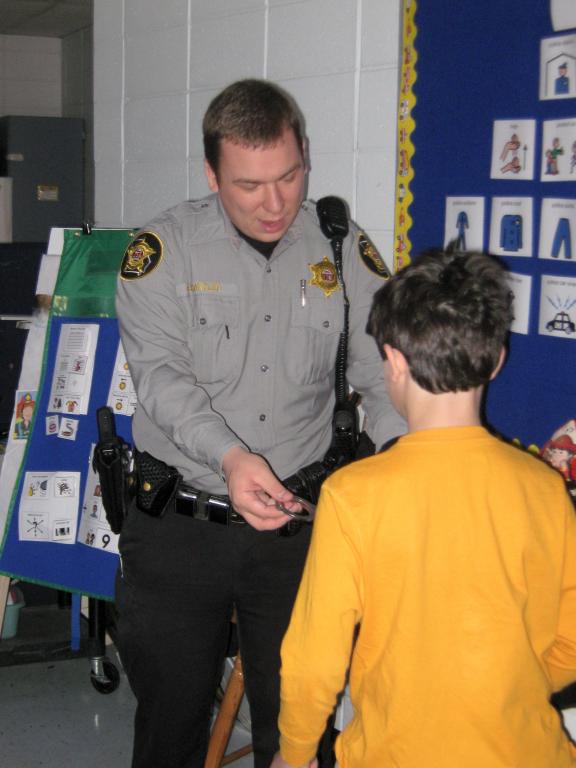
Police Officer visiting Special Ed class (CC BY-NC 2.0 Nicole Mays)
CNN reported:
A 13-year-old boy was seriously injured after being shot by a police officer in Salt Lake City on Friday night, according to his mother.
Golda Barton said that her son Linden Cameron, who has Asperger syndrome, experienced a “mental breakdown” earlier in the day. It had been her first day back at work in nearly a year, and Linden was having trouble coping, she confirmed to CNN in an email.
Barton also confirmed she called the police and asked for a crisis intervention team to help her manage the situation and get her son treatment.
“I said, ‘Look, he’s unarmed. He doesn’t have anything. He just gets mad and he starts yelling and screaming,'” Barton told… KUTV about her call to police. “He’s a kid he’s trying to get attention. He doesn’t know how to regulate.”When police arrived, Barton said her son ran away. She told KUTV that she heard someone yell “get down on the ground” three times, followed by several gunshots.
“Why didn’t they tase him? Why didn’t they shoot him with a rubber bullet?” Barton told the station. “He’s a small child. Why don’t you just tackle him? You are big police officers with massive amounts of resources.”
Another report noted that the mother had informed the police he was unarmed and wondered how two grown men could not have subdued a 1-year-old even with a weapon by tackling him rather than shooting him.
The Problem of Training
The issue often goes back to a lack of training on mental health issues or developmental disorders by police officers. I don’t expect them to have a full psych degree but given that a large part of their encounters are with people with such issues, why not train them to understand these issues so they can properly approach them?
Psychology Today notes:
A 2012 study conducted by researchers at Drexel University measured how common it was for youth with ASD to be stopped and questioned by police or arrested. They found that by age 21, 20 percent of youth with ASD had been stopped by police, and almost 5 percent had been arrested.
It also talks about the causes:
When considering why encounters with police may be more dangerous for those with ASD compared to the general population, experts point to multiple factors. One factor is features of ASD can look similar to what individuals in law enforcement would consider “suspicious behavior” (e.g. lack of eye contact, reduced or repetitive speech, or repetitive motor movements). […]
Another reason why encounters with law enforcement can be dangerous for those on the spectrum is lack of autism-specific training. In 2008, New Jersey passed a statute requiring training for first responders in how to interact with those with disabilities. Unfortunately, a 2017 study of first responders in New Jersey found that 23 percent of first responders said their agency had not provided training in how to recognize and interact with individuals with ASD. Of respondents who did receive training, almost half (46 percent) felt that the training was either only “somewhat effective” or “not effective.”
Taken together, these results paint a troubling picture, as they suggest that even in a state which requires this type of training for first responders, 23 percent are not receiving this training at all, and almost half of those who do receive training do not experience it as being effective.
The evident conclusion is to better train police both formally, and when encountering someone on the spectrum. If we autistics represent 2% of the population and are more likely to have encounters with police, training to be able to handle what is something in the range of 1/20 of their encounters should be important.
Spectrum News reached similar conclusions. They went more in-depth talking about specific training programs.
Of the 18 large U.S. police departments that responded to Spectrum’s queries — including some in Florida and New Jersey —15 say they offer some form of autism-specific training, but these programs vary considerably. For instance, the New York City Police Department, which employs more than 36,000 uniformed officers, says every in-service officer receives training each year to help them recognize autism traits. In Harris County, Texas — which includes the city of Houston — all 2,249 sworn officers are required to attend a one- to three-hour presentation on signs of autism. The training also includes response strategies: Be patient, speak calmly and don’t touch the person or stop their repetitive motions unless it’s necessary for safety reasons. The representatives of three departments in New York, Georgia and Arizona told Spectrum these tactics are woven into basic training or broader crisis-intervention courses. […]
Training for autism is particularly complicated because of the condition’s heterogeneity. “We can’t teach police, ‘Well, because you interacted or saw this video about this one person with this presentation of autism, now you know autism and you’d be able to spot it anywhere,’” says Yona Lunsky, professor of psychiatry at the University of Toronto. Lunsky led the Canadian study linking aggression and police contact in people with autism. She says researchers need to continue to study these interactions and encourage police departments to be vigilant about training.
There is a lot more over there.
Moral Issues
There are two moral issues here. One is discrimination and the other is innocent until proven guilty or reasonable use of force.
As Christians, we should be against all forms of discrimination. We can initially think of discrimination just as treating people differently based on what type of person they are. This is not always treating people all the same. For example, I assume a different understanding of money from a toddler and an adult. It would be good if everyone knew how to deal with conditions like autism. Nonetheless, police have a special duty to be able to recognize and adapt to different conditions. If they don’t recognize, they easily assume things like lacking eye contact are suspicious rather than just autistic, which is discrimination.
On the second issue, I think there is an issue of easy misinterpretation of autistic actions that can lead police to presume guilt or use excessive force. These are both unethical as they go against human dignity.
Hopefully, we can keep educating the police so such problems are overcome.
Note: Please support me on Patreon so I can write more about autism and Catholicism.
Previous Post

September 16, 2020
Portland Bans Most Facial Recognition
Next Post
October 1, 2020 Living Catholicism with Illness or Disability
Browse Our Archives
Select a Category Autism Bioethics Book Review Business and Economics Catholic Social Teaching Culture Diocesan Life Disability Discipleship Euthanasia Family Life Genetics Global Politics History Immigration Inspiration Interview Liturgy Moral Theology My Life News Analysis Original Articles Prayer Privacy Pro-Life Science Sexual orientation or identity Social Media Sports Technology Theology Uncategorized US Politics Vatican
Select a Month March 2022 February 2022 January 2022 December 2021 November 2021 October 2021 September 2021 August 2021 July 2021 June 2021 April 2021 March 2021 February 2021 January 2021 December 2020 November 2020 October 2020 September 2020 August 2020 July 2020 June 2020 May 2020 April 2020 March 2020 February 2020 January 2020 December 2019 November 2019 October 2019 September 2019 August 2019 July 2019 June 2019 May 2019 April 2019 March 2019 February 2019 January 2019 December 2018 November 2018 October 2018 September 2018 August 2018 July 2018 June 2018 May 2018
Follow Us!
TAKE THE
Religious Wisdom Quiz
In 1 Peter, what did the prophets search intently and with great care about?
Select your answer to see how you score.
The salvation of Israel The day of the Lord The sufferings of the Messiah and the glories that would follow The end times
Support this
Column


Related posts from Through Catholic Lenses

Sensory-Friendly Mass Directory Now Available

Greg Locke, Autism Is not Demonic

The Church Cannot Change Teaching on Homosexuality (Hollerich...
21 of the Most Dynamic Signs at March...
TRENDING AT PATHEOS Catholic

Rejecting Doom: Christian Hope And Human Action
Christianity is a religion of hope. We are to have hope and...

It’s What Comes From Within Which Matters
One of the most difficult things for us to understand is why...

Why I Choose the Eucharist Over the Sermon
Choose the Eucharist, Not the Sermon What are we supposed to get...

5 Design Elements Found in Spiritually Rooted Homes
Putting Spirituality Into Home Decor Our homes are more than our living...

Credo: A Story of God Told with the...
About 10 years ago, I began to imagine a personal "Credo" that...

The Anatomy of Divine Revelation in Catholic Thought
The claim that God has made Himself known to human beings is...
view all Catholic blogs
Ad-Free & Subscriber Log-In Subscription Support
- About Us
- 2026 Calendar
- Videos
- Podcasts
- Library of World Religions
- Faith In Media Tracker
- Advertise With Us
- Write for Us
- Privacy Policy
- Terms of Service
- Do Not Sell My Data
- Contact Us
- Radiant Digital
- Manage Newsletter Subscriptions
- Unsubscribe From Notifications
- Sitemap
Copyright 2008-2026, Patheos. All rights reserved.
Subscription Support Ad-Free & Subscriber Log-In
Follow Patheos