
BuddhistCatholicContemplativeEvangelicalGeneral ChristianHinduJewishLatter-day SaintMuslimNew VisionsProgressive Christian
Beliefs
- Buddhist
- Catholic
- Contemplative
- Evangelical
- General Christian
- Hindu
- Jewish
- Latter-day Saint
- More Voices
- Muslim
- New Visions
- Pagan
- Progressive Christian
Topics
- Religion News
- Food and Religion
- Sports and Religion
- Religious Art
- Religious Music and Entertainment
- Religious Events
- History and Religion
- Style and Religion
- Politics and Religion
- Women in Religion
- Recreation Outdoors and Religion
- Business Finance and Religion
- Careers Workplace and Religion
- Education and Religion
- Family Parenting and Religion
- Health Fitness and Religion
- Home and Religion
- Relationships and Religion
- Technology and Religion
- Travel and Religion
Columnists
- Buddhist Columnists
- Business Finance and Religion Columnists
- Careers Workplace and Religion Columnists
- Catholic Columnists
- Contemplative Columnists
- Education and Religion Columnists
- Evangelists Columnists
- Family Parenting and Religion Columnists
- General Christian Columnists
- Health Fitness and Religion Columnists
- Hindu Columnists
- History and Religion Columnists
- Home and Religion Columnists
- Jewish Columnists
- More Voices Columnists
- Latter Day Columnists
- Muslim Columnists
- New Visions Columnists
- Nonreligious Columnists
- Pagan Columnists
- Politics and Religion Columnists
- Progressive Columnists
- Recreation Outdoors and Religion Columnists
- Relationships and Religion Columnists
- Religion News Columnists
- Religious Art Columnists
- Religious Events Columnists
- Religious Music and Entertainment Columnists
- Sports and Religion Columnists
- Style and Religion Columnists
- Technology and Religion Columnists
- Travel and Religion Columnists
- Women in Religion Columnists
Resource Library
- 2026 Calendar
- Library of World Religions
- The 100 Most Holy Places on Earth
- Patheos Answers
- Podcasts
- Videos
- Faith Leaders Database
- Anglican Episcopalian
- Bahai
- Baptist
- Buddhism
- Christianity
- Confucianism
- Eastern Orthodoxy
- Hinduism
- Holiness and Pentecostal
- ISKCON
- Islam
- Judaism
- Lutheran
- Methodist
- The Church of Jesus Christ of Latter-day Saints
- New Age
- Paganism
- Presbytarian and Reformed
- Protestantism
- Religion Behind the Scenes
- Roman Catholic
- Scientology
- Shia Islam
- Sikhism
- Sufism
- Sunni Islam
- Taoism
- Zen
- See all religions
Research Tools
 Ad-Free & Subscriber Log-In Subscription Support
Ad-Free & Subscriber Log-In Subscription Support
Follow Patheos 

- Trending:
- Forgiveness
- |
- Marriage
- |
- Consciousness
- |
- Death Penalty
- |
- Election
- |
- Halloween
 Through Catholic Lenses
- Home
- Catholic
- Religion News
- What Autistics Want Their Fellow Catholics to Know About Us
What Autistics Want Their Fellow Catholics to Know About Us
Last updated on: April 3, 2020 at 2:59 pm by Fr. Matthew P. Schneider, LC
What Autistics Want Their Fellow Catholics to Know About Us 2020-04-03T14:59:30-04:00 Fr. Matthew P. Schneider, LC
Patheos Explore the world's faith through different perspectives on religion and spirituality! Patheos has the views of the prevalent religions and spiritualities of the world.
I think sometimes, it is hard for people who are not autistic to see things from our perspective. If you learn a foreign language beyond a dozen words, you start noticing a bit of a difference. For example, in many other languages like Spanish or Latin, inanimate objects are male or female. When I taught English to native Spanish-speakers, I learned to get inside their way of thinking.
Autism is like that but at the level of brain structure, not language structure. I was preparing a talk to a parish on accepting and helping autistic parishioners, so I asked fellow autistics what they would like the average person at a parish to know about autism. Some of these responses will go in the talk but I thought it was worth sharing online too.
I’ve divided the responses into a few helpful categories. Although these replies can be found publicly if one tries, as the respondents are not public figures, I’ve decided to use pseudonyms. If you prefer it on video, here you go.
Don’t Worry About Differences at Mass
The first thing I think many autistics want others to know is to realize we process things differently and sometimes we act differently. We don’t want you to be alarmed by this. A few parents and one autistic talked about Mass.
“[Autistics] are paying attention [at Mass]; [they] are listening and are reverent, even if they are moving (or stimming). My son says that he really is taking the Mass, prayers, worship seriously even if you see him moving around.” –Samantha
Likewise, “Autistics are not undisciplined brats. Patience and charity, not a judgment from others would help autistics in parishes. Dirty looks and nasty notes are not okay. Autistics do not ruin Mass.” –Shirley
“Let my child be at mass and partake in her own way without disapproving glares. (My daughter has recently started shouting, ‘It’s Jesus in there!’ during the consecration.) If she could process how to whisper, she would.” –Stella
“I tried to get my son to wear something dressier than sweatpants and a t-shirt to Mass but it is either he wears that or behaves like he has a thousand ants crawling over him during mass which is not something that is helpful,” –Shawn
“I use squishy toys to keep my mind and body calm. Another way to do that is by keeping things the same. Self-regulation is the fancy word for that. But it’s relevant because I’m trying to do well.” –Sandra
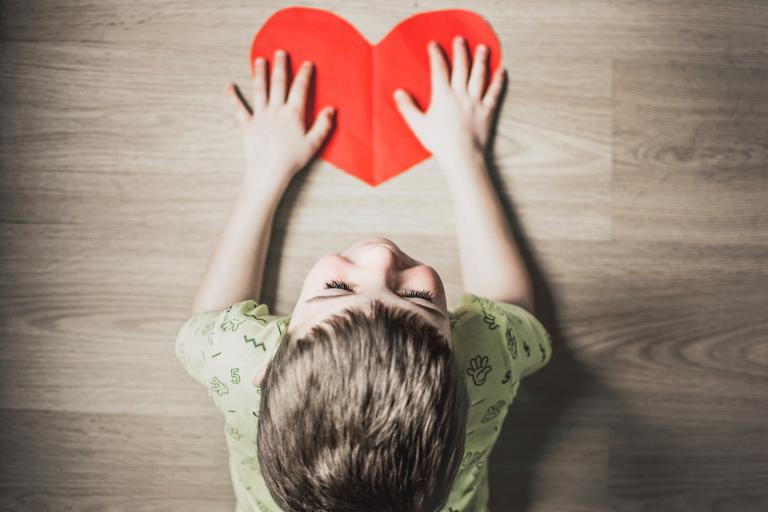
Autistic Boy with Heart (CC0 Anna Kolosyuk on Unsplash)
Autistics Can Pray Too
We might pray a little different but it is valuable to see how we pray. Several described their own prayers in a way.
“[Please don’t] dismiss our spiritual/mystical experiences just because we’re autistic. A lot of times when I talk about my spiritual experiences, they’re dismissed as me just being mentally unstable because I’m autistic” –Jane
“We want to be Christ’s disciples too, fully involved in the Mission of God and fully part of the fellowship that is the Church. We are called just as much as everyone else.” –James
“Autistics have the same right as neurotypicals [people with the most common neurological structure] to receive the Sacraments, to attend Mass, and to be accepted despite their differences.” –Jessica
“A very practical thing for the Mass would be for neurotypical people to realize is that not everyone wishes to engage in conversation. Especially during the passing of the peace. I find that the most difficult time. If someone is kneeling in prayer, just leave them be.” –John
P.s. during the sign of peace, there should not really be conversation beyond saying “peace be with you,” or similar to fellow parishioners. This is about proper liturgy, not just autism.
“As a parent of a 22-year-old with autism: the predictability, the universality of the Mass, is a COMFORT to him. The repetition and ritual are a balm – at the end of or beginning of a chaotic week.” –Julia
“We see, hear, and think everything differently from others- so we’re going to perceive say, the Readings, the music, the homily, the prayers differently.” –Joy
All Different
Several wanted to speak about autistic similarities and differences. There is a saying common in autistic circles: “if you’ve seen one autistic, you’ve seen one autistic.” Autism is a collection of traits where a person needs to check of a certain number of boxes but different autistics check off different boxes. Here some also describe autistic advantages.
“Just because it well documented that autistic people have those traits it doesn’t mean we all have them. I have an awkward time about people not looking in my eyes for the peace at church because they heard about that. I respect them for trying but leaves us feeling off too.” –Tamara
“We aren’t afflicted by being autistic. Parts of our neurology can be difficult but being autistic is beautiful and most of us have a perfectly valid, although different, way of experiencing our faith. We don’t need to act neurotypical to experience Jesus the ‘right’ way.” –Teresa
“Don’t insist on physical contact or eye contact. My daughter can do quick eye contact and a peace sign at the passing of the peace, but she will not shake hands. Physical touch is painful for her. My son is also autistic, but he gives hugs and shakes hands.” –Tabitha
One person even wanted to note how there may be more autistics around at the parish than most realize.
“Some of you are probably on the Autism Spectrum yourselves, and you never even suspected. ‘And no one around you was clued in enough to help you understand what was going on.’” –Thomas
Challenges
Some people wanted to mention the specific challenges we often struggle with.
“The sensory issues associated that make attending worship hard.”–Kate
“How hard it is for parents with young non-verbal autistic children to go to church or find spiritual direction for them and their little ones.” –Kathryn
“I WANT to be present at every Mass. It can be SO overwhelming, though. Between the people and the sensory overload, sometimes I get so overwhelmed that I don’t know what to do. PLEASE be patient with us. Sometimes speaking to other parishioners is just more than I can handle.” –Kaitlyn
“That it is sometimes hard for us to believe. That we want to find our place in the church and help. That we care deeply. That we don’t always want to be the ones reaching out but when we don’t it seems that nobody does. This is before or after Mass not during. When we do believe God it is very deep and we want to share Him!” –Kimberly
“We have our own faith journeys; we aren’t just accessories to other people’s faith. And we need as much companionship and accompaniment as anyone else on that road.” –Kristen
“Many autistics are socially anxious. Don’t try to force us into sharing groups or into volunteer roles that force us to interact with strangers.” –Kyla
“There should be opportunities to volunteer ‘behind the scenes.’ Also, I do not need/want to be brought ‘out of my shell.’ Don’t suggest that.” –Katherine
“Don’t presume malice even if we do serious harm. Don’t treat us like we are in a state of mortal sin when we wrong you. When we fail, it is because we lack skills rather than the desire to please.” –Keith
Conclusion
In this piece, I have tried to offer relatively unfiltered voices from autistics and their families about what they want the average Catholic to know, especially about prayer and Mass. Many of these things have obvious consequences in actions. Hopefully, this helps you better integrate autistics into your parishes.
Note: I rely on generosity from people like you to keep writing. Please consider a regular donation via Patreon.
Previous Post
April 1, 2020
Why is Public Mass Suspended? 4 Case Studies Show Why
Next Post
April 7, 2020 Bible Storytime with Fr. Matthew: Reading the Passion for Kids
Browse Our Archives
Select a Category Autism Bioethics Book Review Business and Economics Catholic Social Teaching Culture Diocesan Life Disability Discipleship Euthanasia Family Life Genetics Global Politics History Immigration Inspiration Interview Liturgy Moral Theology My Life News Analysis Original Articles Prayer Privacy Pro-Life Science Sexual orientation or identity Social Media Sports Technology Theology Uncategorized US Politics Vatican
Select a Month March 2022 February 2022 January 2022 December 2021 November 2021 October 2021 September 2021 August 2021 July 2021 June 2021 April 2021 March 2021 February 2021 January 2021 December 2020 November 2020 October 2020 September 2020 August 2020 July 2020 June 2020 May 2020 April 2020 March 2020 February 2020 January 2020 December 2019 November 2019 October 2019 September 2019 August 2019 July 2019 June 2019 May 2019 April 2019 March 2019 February 2019 January 2019 December 2018 November 2018 October 2018 September 2018 August 2018 July 2018 June 2018 May 2018
Follow Us!
TAKE THE
Religious Wisdom Quiz
Who was the high priest when Jesus was crucified?
Select your answer to see how you score.
Annas Nicodemus Gamaliel Caiaphas
Support this
Column


Related posts from Through Catholic Lenses

Why Such a Focus on Extraordinary Form in...
Russia Was Consecrated in 1984 to the Immaculate...

Sensory-Friendly Mass Directory Now Available

Greg Locke, Autism Is not Demonic
TRENDING AT PATHEOS Catholic

Rejecting Doom: Christian Hope And Human Action
Christianity is a religion of hope. We are to have hope and...

It’s What Comes From Within Which Matters
One of the most difficult things for us to understand is why...

Why I Choose the Eucharist Over the Sermon
Choose the Eucharist, Not the Sermon What are we supposed to get...

5 Design Elements Found in Spiritually Rooted Homes
Putting Spirituality Into Home Decor Our homes are more than our living...

Credo: A Story of God Told with the...
About 10 years ago, I began to imagine a personal "Credo" that...

The Anatomy of Divine Revelation in Catholic Thought
The claim that God has made Himself known to human beings is...
view all Catholic blogs
Ad-Free & Subscriber Log-In Subscription Support
- About Us
- 2026 Calendar
- Videos
- Podcasts
- Library of World Religions
- Faith In Media Tracker
- Advertise With Us
- Write for Us
- Privacy Policy
- Terms of Service
- Do Not Sell My Data
- Contact Us
- Radiant Digital
- Manage Newsletter Subscriptions
- Unsubscribe From Notifications
- Sitemap
Copyright 2008-2026, Patheos. All rights reserved.
Subscription Support Ad-Free & Subscriber Log-In
Follow Patheos