
BuddhistCatholicContemplativeEvangelicalGeneral ChristianHinduJewishLatter-day SaintMuslimNew VisionsProgressive Christian
Beliefs
- Buddhist
- Catholic
- Contemplative
- Evangelical
- General Christian
- Hindu
- Jewish
- Latter-day Saint
- More Voices
- Muslim
- New Visions
- Pagan
- Progressive Christian
Topics
- Religion News
- Food and Religion
- Sports and Religion
- Religious Art
- Religious Music and Entertainment
- Religious Events
- History and Religion
- Style and Religion
- Politics and Religion
- Women in Religion
- Recreation Outdoors and Religion
- Business Finance and Religion
- Careers Workplace and Religion
- Education and Religion
- Family Parenting and Religion
- Health Fitness and Religion
- Home and Religion
- Relationships and Religion
- Technology and Religion
- Travel and Religion
Columnists
- Buddhist Columnists
- Business Finance and Religion Columnists
- Careers Workplace and Religion Columnists
- Catholic Columnists
- Contemplative Columnists
- Education and Religion Columnists
- Evangelists Columnists
- Family Parenting and Religion Columnists
- General Christian Columnists
- Health Fitness and Religion Columnists
- Hindu Columnists
- History and Religion Columnists
- Home and Religion Columnists
- Jewish Columnists
- More Voices Columnists
- Latter Day Columnists
- Muslim Columnists
- New Visions Columnists
- Nonreligious Columnists
- Pagan Columnists
- Politics and Religion Columnists
- Progressive Columnists
- Recreation Outdoors and Religion Columnists
- Relationships and Religion Columnists
- Religion News Columnists
- Religious Art Columnists
- Religious Events Columnists
- Religious Music and Entertainment Columnists
- Sports and Religion Columnists
- Style and Religion Columnists
- Technology and Religion Columnists
- Travel and Religion Columnists
- Women in Religion Columnists
Resource Library
- 2026 Calendar
- Library of World Religions
- The 100 Most Holy Places on Earth
- Patheos Answers
- Podcasts
- Videos
- Faith Leaders Database
- Anglican Episcopalian
- Bahai
- Baptist
- Buddhism
- Christianity
- Confucianism
- Eastern Orthodoxy
- Hinduism
- Holiness and Pentecostal
- ISKCON
- Islam
- Judaism
- Lutheran
- Methodist
- The Church of Jesus Christ of Latter-day Saints
- New Age
- Paganism
- Presbytarian and Reformed
- Protestantism
- Religion Behind the Scenes
- Roman Catholic
- Scientology
- Shia Islam
- Sikhism
- Sufism
- Sunni Islam
- Taoism
- Zen
- See all religions
Research Tools
 Ad-Free & Subscriber Log-In Subscription Support
Ad-Free & Subscriber Log-In Subscription Support
Follow Patheos 

- Trending:
- Forgiveness
- |
- Marriage
- |
- Consciousness
- |
- Death Penalty
- |
- Election
- |
- Halloween
 Through Catholic Lenses
- Home
- Catholic
- Religion News
- We Should Treat Autistics Like Jesus Treated Lazarus (Homily: 5th Sunday of Lent)
We Should Treat Autistics Like Jesus Treated Lazarus (Homily: 5th Sunday of Lent)
Last updated on: March 27, 2020 at 5:14 pm by Fr. Matthew P. Schneider, LC
We Should Treat Autistics Like Jesus Treated Lazarus (Homily: 5th Sunday of Lent) 2020-03-27T17:14:16-04:00 Fr. Matthew P. Schneider, LC
Patheos Explore the world's faith through different perspectives on religion and spirituality! Patheos has the views of the prevalent religions and spiritualities of the world.
I was invited to give the homily at all the Masses this weekend at Our Lady of the Martyrs in Queens. This was in preparation for World Autism Awareness day on next Thursday (April 2, 2020). Obviously, this has been canceled as there are no public Masses happening this week in the US Roman Catholic Church. However, as I wrote the homily before specifically on the Gospel of the raising of Lazarus, I decided to record it for the parish and for you.
Gospel
This weekend, the Gospel is the raising of Lazarus in John 11. You can read John 11:1-45 on the USCCB site, but if you remember it, go ahead as I don’t get into detailed exegesis. I preach on the Gospel only and don’t mention the other readings.
Video
Here’s the video. I have the notes I used below which are approximately what I said although not exactly.
Homily Notes
Jesus said to Lazarus, “Come forth.”
Lazarus comes out and says, “But I don’t see three other people in the tomb.”
Most of us probably laughed at that play on words as the sound “forth” has two diverse meanings in English. And we assume other people find it at least moderately funny too because we assume everyone processes language in a similar way. We generally assume others process other senses the same as us. When we meet someone who is colorblind who says they can’t tell the difference between two things that are obviously different colors to us, we realize this is not always true.
Being diagnosed with autism in my 30s was akin to realizing I’ve been colorblind my whole life. I was a little devastated at first. But once I understood it, it helped me. I remember reading that most people processed the facial expressions of those they were talking with subconsciously. Like, you all do this automatically. I was shocked. I had to ask a few people to confirm this as I always thought you all just did this slightly better not that you managed this with your subconscious.
Deacon Greg Kandra and Bishop Sanchez invited me here this weekend to speak on autism, as this Thursday [April 2] is World Autism Awareness Day. I think today’s Gospel gives us a bit of an outline of how all of us can help autistics to live their Catholic faith better. I will cover three points of how Jesus acted, and share how this relates to what autistics want the rest of you to know.
Jesus went to meet them where they were
-
When the centurion came, Jesus cured from a distance.
-
Oftentimes, I feel like people think of the disabled, the autistic as “other.” Or we consider them just those we minister to. Bob Quinlan of the National Catholic Partnership on Disability says otherwise. He explained, “Regarding the people with disabilities, I’m not just trying to help them out in a one-way channel that comes back and helps me. But I want to help them to become good. I want to help them to give back as they would or can.”
-
When I asked autistics and their families what they wanted you to know themes like this came up:
-
One mother said, “[Autistics] are paying attention [at Mass]; [they] are listening and are reverent, even if they are moving (or stimming). My son says that he really is taking the Mass, prayers, worship seriously even if you see him moving around.”
- Several others echoed this idea that we might fidget or stim in Mass. We might wear sunglasses or clothes that aren’t itchy as we can be extra sensitive to certain sense impressions. None of this takes away from our focus at Mass.
-
“We want to be Christ’s disciples too, fully involved in the Mission of God and fully part of the fellowship that is the Church. We are called just as much as everyone else.”
-
Often autistics will be great volunteers behind the scenes. We can help build the mission of the Church. Just like we try to find the right spot for others, the same thing can be done for autistics.
-
This leads us to point two…
-
Jesus cared for each individual personally and treated Martha and Mary differently
-
Martha was outside running while Mary stayed praying in the house – neither is wrong.
-
It is important to note that not different autistics have different struggles. Many would not be able to preach as I am now. In fact, the lights and sounds of a parish Mass can be too much for some.
-
As an example of this, I want to read two different responses I got about autism and eye contact from Fellow autistics:
- “Don’t insist on physical contact or eye contact. My daughter can do quick eye contact and a peace sign at the passing of the peace, but she will not shake hands. Physical touch is painful for her. My son is also autistic, but he gives hugs and shakes hands.”
- “Just because it well documented that autistic people have those traits it don’t mean we all have them. I have an awkward time about people not looking in my eyes for the peace at church because they heard about that. I respect them for trying but leaves us feeling off too.”
-
The variety among autistics means we need to see what accommodations are needed in each place. For me, for example, one big change after my diagnosis was to move away from being a pastor or chaplain at a school to do more study and become a seminary professor. Right now, I ‘m writing a doctoral thesis on genetic privacy. It’s not that I can’t be at a parish for a bit – I mean I’ll be here after Mass if people want to talk – but as I need to do a lot more work to grasp other people’s social interaction, I’ll need time to recover from the effort I’ll put out this weekend.
-
One autistic wanted to tell parishioners, “We see, hear, and think everything differently from others- so we’re going to perceive say, the Readings, the music, the homily, the prayers differently.”
- In fact, some recent research indicates that most neurotypical (non-autistic) brains are wired the same but our brains are wired quite differently from most people and also from our fellow autistics.
-
Jesus transformed Lazarus
-
Through helping him, Jesus completely transformed Lazarus from a dead man to being alive again.
-
I think we can transform how we help autistics in the Church. Obviously, we aren’t dead but so often we are sidelined in the Church and struggle to be integrated.
-
One autistic noted how we can accidentally do things that are rude or uncharitable due to our lack of social understanding: “Don’t presume malice even if we do serious harm. Don’t treat us like [a huge sin] when we wrong you. When we fail, it is because we lack skills rather than the desire to please.”
- How transformed his life would be if people were able to recognize that. I know that I am more often rude unintentionally than others. If I come across that way, sorry.
-
Another autistic spoke about the challenge going to Mass; “I WANT to be present at every Mass. It can be SO overwhelming, though. Between the people and the sensory overload, sometimes I get so overwhelmed that I don’t know what to do. PLEASE be patient with us. Sometimes speaking to other parishioners is just more than I can handle.”
-
Finally, one spoke about autistic prayer: “[Please don’t] dismiss our spiritual/mystical experiences just because we’re autistic. A lot of times when I talk about my spiritual experiences, they’re dismissed as me just being mentally unstable because I’m autistic”
-
-
I think these types of changes in attitude can help all autistics to better integrate into a parish.
-
I am working on presenting the Gospel in an autistic manner for the other part of such a way of welcoming autistics. If anyone wants to help me with that, talk to me after. However, I think most people will do more in this first part of welcoming than that.
Conclusion
Jesus loves everyone. He calls each to love him and love others. This call does not depend on whether one is autistic or not, or whether the person you should love is autistic or not. Let’s look at each person around and try to love them in a way that helps them. In loving each person, we might need to ask what they need. Such love will also transform them.
Note: please help me with donations such as monthly donations via Patreon. My community relies on donations to sustain ourselves.
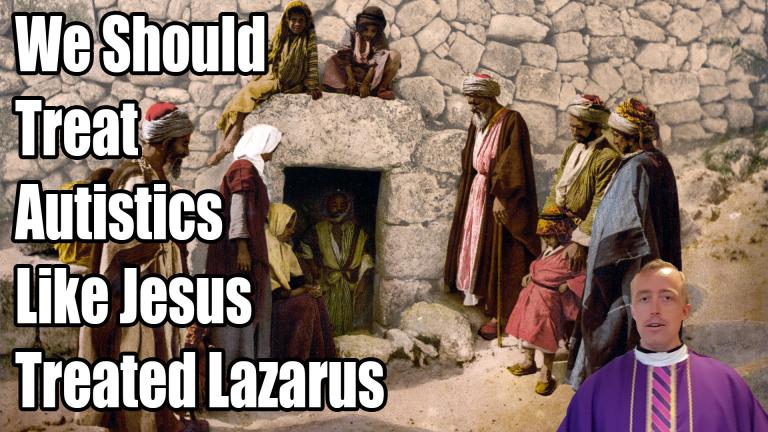
Video Title screen (Background image from publicdomainpictures.net)
Previous Post

March 24, 2020
Exercises to Keep Body, Mind & Soul at Peace (Catholic)
Next Post

March 31, 2020 How Parishes Can Avoid Laying Off Staff
Browse Our Archives
Select a Category Autism Bioethics Book Review Business and Economics Catholic Social Teaching Culture Diocesan Life Disability Discipleship Euthanasia Family Life Genetics Global Politics History Immigration Inspiration Interview Liturgy Moral Theology My Life News Analysis Original Articles Prayer Privacy Pro-Life Science Sexual orientation or identity Social Media Sports Technology Theology Uncategorized US Politics Vatican
Select a Month March 2022 February 2022 January 2022 December 2021 November 2021 October 2021 September 2021 August 2021 July 2021 June 2021 April 2021 March 2021 February 2021 January 2021 December 2020 November 2020 October 2020 September 2020 August 2020 July 2020 June 2020 May 2020 April 2020 March 2020 February 2020 January 2020 December 2019 November 2019 October 2019 September 2019 August 2019 July 2019 June 2019 May 2019 April 2019 March 2019 February 2019 January 2019 December 2018 November 2018 October 2018 September 2018 August 2018 July 2018 June 2018 May 2018
Follow Us!
TAKE THE
Religious Wisdom Quiz
What was the name of the Roman governor who sentenced Jesus to death?
Select your answer to see how you score.
Tiberius Herod Antipas Caesar Augustus Pontius Pilate
Support this
Column


Related posts from Through Catholic Lenses

Why Such a Focus on Extraordinary Form in...

Sensory-Friendly Mass Directory Now Available

Greg Locke, Autism Is not Demonic
Catholic Media: Fides Quarens Rem Publicam
TRENDING AT PATHEOS Catholic

Rejecting Doom: Christian Hope And Human Action
Christianity is a religion of hope. We are to have hope and...

It’s What Comes From Within Which Matters
One of the most difficult things for us to understand is why...

Why I Choose the Eucharist Over the Sermon
Choose the Eucharist, Not the Sermon What are we supposed to get...

5 Design Elements Found in Spiritually Rooted Homes
Putting Spirituality Into Home Decor Our homes are more than our living...

Credo: A Story of God Told with the...
About 10 years ago, I began to imagine a personal "Credo" that...

The Anatomy of Divine Revelation in Catholic Thought
The claim that God has made Himself known to human beings is...
view all Catholic blogs
Ad-Free & Subscriber Log-In Subscription Support
- About Us
- 2026 Calendar
- Videos
- Podcasts
- Library of World Religions
- Faith In Media Tracker
- Advertise With Us
- Write for Us
- Privacy Policy
- Terms of Service
- Do Not Sell My Data
- Contact Us
- Radiant Digital
- Manage Newsletter Subscriptions
- Unsubscribe From Notifications
- Sitemap
Copyright 2008-2026, Patheos. All rights reserved.
Subscription Support Ad-Free & Subscriber Log-In
Follow Patheos