
BuddhistCatholicContemplativeEvangelicalGeneral ChristianHinduJewishLatter-day SaintMuslimNew VisionsProgressive Christian
Beliefs
- Buddhist
- Catholic
- Contemplative
- Evangelical
- General Christian
- Hindu
- Jewish
- Latter-day Saint
- More Voices
- Muslim
- New Visions
- Pagan
- Progressive Christian
Topics
- Religion News
- Food and Religion
- Sports and Religion
- Religious Art
- Religious Music and Entertainment
- Religious Events
- History and Religion
- Style and Religion
- Politics and Religion
- Women in Religion
- Recreation Outdoors and Religion
- Business Finance and Religion
- Careers Workplace and Religion
- Education and Religion
- Family Parenting and Religion
- Health Fitness and Religion
- Home and Religion
- Relationships and Religion
- Technology and Religion
- Travel and Religion
Columnists
- Buddhist Columnists
- Business Finance and Religion Columnists
- Careers Workplace and Religion Columnists
- Catholic Columnists
- Contemplative Columnists
- Education and Religion Columnists
- Evangelists Columnists
- Family Parenting and Religion Columnists
- General Christian Columnists
- Health Fitness and Religion Columnists
- Hindu Columnists
- History and Religion Columnists
- Home and Religion Columnists
- Jewish Columnists
- More Voices Columnists
- Latter Day Columnists
- Muslim Columnists
- New Visions Columnists
- Nonreligious Columnists
- Pagan Columnists
- Politics and Religion Columnists
- Progressive Columnists
- Recreation Outdoors and Religion Columnists
- Relationships and Religion Columnists
- Religion News Columnists
- Religious Art Columnists
- Religious Events Columnists
- Religious Music and Entertainment Columnists
- Sports and Religion Columnists
- Style and Religion Columnists
- Technology and Religion Columnists
- Travel and Religion Columnists
- Women in Religion Columnists
Resource Library
- 2026 Calendar
- Library of World Religions
- The 100 Most Holy Places on Earth
- Patheos Answers
- Podcasts
- Videos
- Faith Leaders Database
- Anglican Episcopalian
- Bahai
- Baptist
- Buddhism
- Christianity
- Confucianism
- Eastern Orthodoxy
- Hinduism
- Holiness and Pentecostal
- ISKCON
- Islam
- Judaism
- Lutheran
- Methodist
- The Church of Jesus Christ of Latter-day Saints
- New Age
- Paganism
- Presbytarian and Reformed
- Protestantism
- Religion Behind the Scenes
- Roman Catholic
- Scientology
- Shia Islam
- Sikhism
- Sufism
- Sunni Islam
- Taoism
- Zen
- See all religions
Research Tools
 Ad-Free & Subscriber Log-In Subscription Support
Ad-Free & Subscriber Log-In Subscription Support
Follow Patheos 

- Trending:
- Forgiveness
- |
- Marriage
- |
- Consciousness
- |
- Death Penalty
- |
- Election
- |
- Halloween
 Through Catholic Lenses
- Home
- Catholic
- Religion News
- Francis & John Paul II: Holiness Over Numbers in Priestly Vocations
Francis & John Paul II: Holiness Over Numbers in Priestly Vocations
Last updated on: February 12, 2020 at 11:25 am by Fr. Matthew P. Schneider, LC
Francis & John Paul II: Holiness Over Numbers in Priestly Vocations 2020-02-12T11:25:14-05:00 Fr. Matthew P. Schneider, LC
Patheos Explore the world's faith through different perspectives on religion and spirituality! Patheos has the views of the prevalent religions and spiritualities of the world.
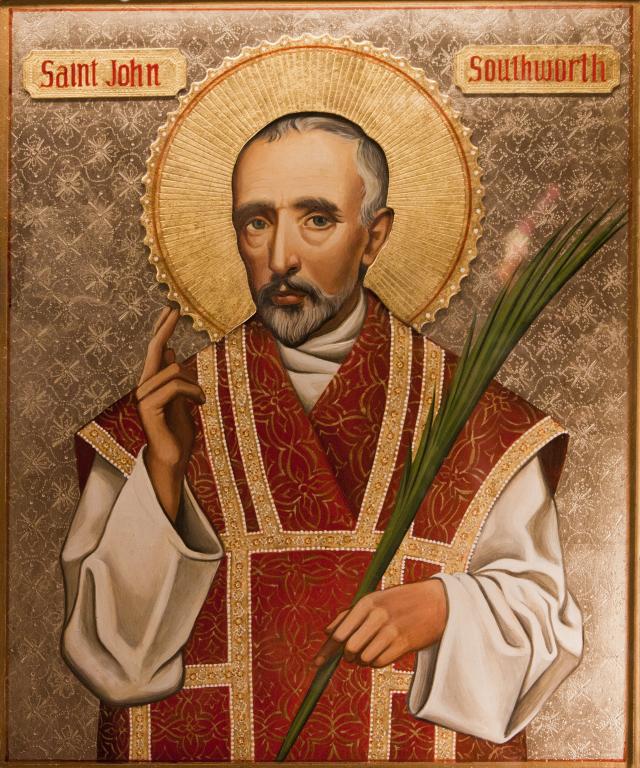
St John Southworth (Fr. Lawerence Lew, OP CC BY-NC-ND 2.0)
The big, but unsurprising, news today is that Pope Francis did not put a proposal for relaxing priestly celibacy in his document on the Amazon. Surely, allowing married men would have increased the number of priests. However, in his section on the priesthood, he focuses on holiness, not primarily on numbers. This harkens back to how John Paul II spoke about the priesthood. I want to quote Francis and John Paul II with minimal commentary. After, I will briefly note the Hermeneutic of continuity as the right way to read Francis.
Pope Francis in Querida Amazonia
In today’s post-synodal apostolic exhortation on the Amazon, Pope Francis emphasizes holiness:
Inculturation should also be increasingly reflected in an incarnate form of ecclesial organization and ministry. If we are to inculturate spirituality, holiness and the Gospel itself, how can we not consider an inculturation of the ways we structure and carry out ecclesial ministries? […]
The first conclusion, then, is that the exclusive character received in Holy Orders qualifies the priest alone to preside at the Eucharist. That is his particular, principal and non-delegable function. There are those who think that what distinguishes the priest is power, the fact that he is the highest authority in the community. Yet Saint John Paul II explained that, although the priesthood is considered “hierarchical”, this function is not meant to be superior to the others, but rather is “totally ordered to the holiness of Christ’s members”. When the priest is said to be a sign of “Christ the head”, this refers principally to the fact that Christ is the source of all grace: he is the head of the Church because “he has the power of pouring out grace upon all the members of the Church”.
A little later he points out that simply ordaining more men is not the solution:
Consequently, it is not simply a question of facilitating a greater presence of ordained ministers who can celebrate the Eucharist. That would be a very narrow aim, were we not also to strive to awaken new life in communities. We need to promote an encounter with God’s word and growth in holiness through various kinds of lay service that call for a process of education – biblical, doctrinal, spiritual and practical – and a variety of programmes of ongoing formation.
Francis encourages more vocations and even asks bishops to be generous with priests feeling the call to missionaries to remote places like this. However, he never adopts an attitude focusing on the number of vocations but on ways to get the Eucharist to everyone with however many holy priests there are.
John Paull II on Holiness over Numbers
In various places, John Paul II emphasized holiness and formation over numbers in the priesthood. Here are the sources I found from him.
Pastores Dabo Vobis
In his 1992 post-synodal apostolic exhortation on priestly formation, John Paul II began with the universal call to holiness:
Through the Spirit, Jesus belongs totally and exclusively to God and shares in the infinite holiness of God, who calls him, chooses him and sends him forth. In this way the Spirit of the Lord is revealed as the source of holiness and of the call to holiness.
This name “Spirit of the Lord” is “upon” the entire People of God, which becomes established as a people “consecrated” to God and “sent” by God to announce the Gospel of salvation. The members of the People of God are “inebriated” and “sealed” with the Spirit (cf. 1 Cor. 12:13; 2 Cor. 1:21ff.; Eph. 1:13; 4:30) and called to holiness.
Then he moved to the specifically priestly call to holiness:
The [Second Vatican] Council’s Decree on Priestly Life and Ministry gives us a particularly rich and thought – provoking synthesis of the priest’s “spiritual life” and of the gift and duty to become “saints”: “By the sacrament of orders priests are configured to Christ the priest so that as ministers of the head and co – workers with the episcopal order they may build up and establish his whole body which is the Church. Like all Christians they have already received in the consecration of baptism the sign and gift of their great calling and grace which enables and obliges them even in the midst of human weakness to seek perfection (cf. 2 Cor. 12:9), according to the Lord’s word: ‘You, therefore, must be perfect, as your heavenly Father is perfect’ (Mt. 5:48).
But priests are bound in a special way to strive for this perfection, since they are consecrated to God in a new way by their ordination. They have become living instruments of Christ the eternal priest, so that through the ages they, can accomplish his wonderful work of reuniting the whole human race with heavenly power. Therefore, since every priest in his own way represents the person of Christ himself, he is endowed with a special grace. By this grace the priest, through his service of the people committed to his care and all the People of God, is able the better to pursue the perfection of Christ, whose place he takes. The human weakness of his flesh is remedied by the holiness of him who became for us a high priest ‘holy, innocent, undefiled, separated from sinners’ (Heb. 7:26).”
The Council first affirms the “common” vocation to holiness. This vocation is rooted in baptism, which characterizes the priest as one of the “faithful” (Christifedelis), as a “brother among brothers,” a member of the People of God, joyfully sharing in the gifts of salvation (cf. Eph. 4:4-6) and in the common duty of walking “according to the Spirit” in the footsteps of the one master and Lord. We recall the celebrated words of St. Augustine: “For you I am a bishop, with you I am a Christian. The former title speaks of a task undertaken, the latter of grace; the former betokens danger, the latter salvation.”
With the same clarity the conciliar text also speaks of a “specific” vocation to holiness, or more precisely of a vocation based on the sacrament of holy orders – as a sacrament proper and specific to the priest – and thus involving a new consecration to God through ordination. St. Augustine also alludes to this specific vocation when, after the words “For you I am a bishop, with you I am a Christian, he goes on to say: “If therefore it is to me a greater cause for joy to have been rescued with you than to have been placed as your leader, following the Lord’s command, I will devote myself to the best of my abilities to serve you, so as not to show myself ungrateful to him who rescued me with that price which has made me your fellow servant.”
1996 Letter to Priests
John Paul II would write an annual letter to priests for Holy Thursday. In 1996, he called us priests to holiness:
All the disciples of Christ, persevering in prayer and praising God (cf. Acts 2:42-47), should present themselves as a living sacrifice, holy and pleasing to God (cf. Rom 12:1). Everywhere on earth they must bear witness to Christ and give an answer to those who seek an account of that hope of eternal life which is in them (cf. 1 Pet 3:15). Though they differ from one another in essence and not only in degree, the common priesthood of the faithful and the ministerial or hierarchical priesthood are nonetheless interrelated. Each of them in its own special way is a participation in the one priesthood of Christ. The ministerial priest, by the sacred power he enjoys, moulds and rules the priestly people. Acting in the person of Christ, he brings about the Eucharistic Sacrifice, and offers it to God in the name of all the people. For their part, the faithful join in the offering of the Eucharist by virtue of their royal priesthood. They likewise exercise that priesthood by receiving the sacraments, by prayer and thanksgiving, by the witness of a holy life, and by self-denial and active charity’.
He concluded that letter with a prayer for priests, which included the following lines.
We, the Church which proclaims
your glory, implore you:
let there never be lacking holy priests
to serve the Gospel;
let there solemnly resound in every Cathedral
and in every corner of the world
the hymn ‘Veni, Creator Spiritus’.
Come, o Creator Spirit!
1998 Letter to Priests
In 1998, he spoke about the Holy Spirit and noted:
By the power of the Holy Spirit, this Sacrifice, offered once and for all on Calvary, is entrusted to the Apostles as the Most Blessed Sacrament of the Church. Seeking the mysterious intervention of the Spirit, the Church begs before the words of consecration: “And so, Father, we bring you these gifts. We ask you to make them holy by the power of your Holy Spirit, that they may become the Body and Blood of your Son, our Lord Jesus Christ, at whose command we celebrate this Eucharist” (Eucharistic Prayer III).
The Hermeneutic of Continuity
Throughout Francis’s papacy, many have tried to interpret him as discordant with the tradition of prior Popes. However, repeatedly, Francis has returned to the hermeneutic of continuity. Pope Francis follows in the tradition of the Popes before him. I noted this issue the weekend after Amoris Laetitia came out and explained it more fully in a Homiletic and Pastoral Review article:
The hermeneutic of continuity sees this organic development of dogma as the growth of a tree. A new dogmatic statement cannot contradict a previous statement but it can add details only implicit before. For example, the Church’s teaching on the death penalty developed from Thomas Aquinas justifying it in order to safeguard the common good, to John Paul II and Francis arguing it should be abolished since modern man has ways to protect himself and society, and so we should give criminals a chance to reform their lives. These statements are not contradictory, but show a development based on more secure prisons and a deeper understanding of human dignity.
A hermeneutic of continuity sees the Holy Spirit guiding the Church through the hierarchy, even in what might seem like human ways. In an article showing how Paul VI was an example of this hermeneutic, Matthew Albright notes, “The key here is to recognize that the cardinals were guided by the Holy Spirit to come to a consensus in choosing a disciplined leader whose papacy would keep the Church true to herself while speaking to the times.” In the same way, we can see Pope Francis being chosen as a voice to speak to the times as part of this hermeneutic.
Let’s look to Francis as our Pope; let’s read him in line with the tradition; and let’s accept that he wants to maintain priestly celibacy in the Roman rite. It is unjust to claim Francis wants the opposite of what he has clearly stated. This document on the Amazon simply repeats what Francis said a year ago, quoting Paul VI, “I prefer to give my life before changing the law of celibacy.”
Notes:
- I don’t consider myself an expert on pastoral practices in unfamiliar parts of the world so I probably won’t offer other commentaries on this document.
- Please support me on Patreon.
Previous Post

February 7, 2020
How to Change the Super Bowl Halftime Show
Next Post
February 22, 2020 Patron Saint of the Internet? Carlo Acutis to Be Beatified
Browse Our Archives
Select a Category Autism Bioethics Book Review Business and Economics Catholic Social Teaching Culture Diocesan Life Disability Discipleship Euthanasia Family Life Genetics Global Politics History Immigration Inspiration Interview Liturgy Moral Theology My Life News Analysis Original Articles Prayer Privacy Pro-Life Science Sexual orientation or identity Social Media Sports Technology Theology Uncategorized US Politics Vatican
Select a Month March 2022 February 2022 January 2022 December 2021 November 2021 October 2021 September 2021 August 2021 July 2021 June 2021 April 2021 March 2021 February 2021 January 2021 December 2020 November 2020 October 2020 September 2020 August 2020 July 2020 June 2020 May 2020 April 2020 March 2020 February 2020 January 2020 December 2019 November 2019 October 2019 September 2019 August 2019 July 2019 June 2019 May 2019 April 2019 March 2019 February 2019 January 2019 December 2018 November 2018 October 2018 September 2018 August 2018 July 2018 June 2018 May 2018
Follow Us!
TAKE THE
Religious Wisdom Quiz
How many years did Solomon's temple construction take?
Select your answer to see how you score.
6 years 5 years 10 years 7 years
Support this
Column


Related posts from Through Catholic Lenses

Why Such a Focus on Extraordinary Form in...
Russia Was Consecrated in 1984 to the Immaculate...

Sensory-Friendly Mass Directory Now Available
Catholic Media: Fides Quarens Rem Publicam
TRENDING AT PATHEOS Catholic

Rejecting Doom: Christian Hope And Human Action
Christianity is a religion of hope. We are to have hope and...

It’s What Comes From Within Which Matters
One of the most difficult things for us to understand is why...

Why I Choose the Eucharist Over the Sermon
Choose the Eucharist, Not the Sermon What are we supposed to get...

5 Design Elements Found in Spiritually Rooted Homes
Putting Spirituality Into Home Decor Our homes are more than our living...

Credo: A Story of God Told with the...
About 10 years ago, I began to imagine a personal "Credo" that...

The Anatomy of Divine Revelation in Catholic Thought
The claim that God has made Himself known to human beings is...
view all Catholic blogs
Ad-Free & Subscriber Log-In Subscription Support
- About Us
- 2026 Calendar
- Videos
- Podcasts
- Library of World Religions
- Faith In Media Tracker
- Advertise With Us
- Write for Us
- Privacy Policy
- Terms of Service
- Do Not Sell My Data
- Contact Us
- Radiant Digital
- Manage Newsletter Subscriptions
- Unsubscribe From Notifications
- Sitemap
Copyright 2008-2026, Patheos. All rights reserved.
Subscription Support Ad-Free & Subscriber Log-In
Follow Patheos