
BuddhistCatholicContemplativeEvangelicalGeneral ChristianHinduJewishLatter-day SaintMuslimNew VisionsProgressive Christian
Beliefs
- Buddhist
- Catholic
- Contemplative
- Evangelical
- General Christian
- Hindu
- Jewish
- Latter-day Saint
- More Voices
- Muslim
- New Visions
- Pagan
- Progressive Christian
Topics
- Religion News
- Food and Religion
- Sports and Religion
- Religious Art
- Religious Music and Entertainment
- Religious Events
- History and Religion
- Style and Religion
- Politics and Religion
- Women in Religion
- Recreation Outdoors and Religion
- Business Finance and Religion
- Careers Workplace and Religion
- Education and Religion
- Family Parenting and Religion
- Health Fitness and Religion
- Home and Religion
- Relationships and Religion
- Technology and Religion
- Travel and Religion
Columnists
- Buddhist Columnists
- Business Finance and Religion Columnists
- Careers Workplace and Religion Columnists
- Catholic Columnists
- Contemplative Columnists
- Education and Religion Columnists
- Evangelists Columnists
- Family Parenting and Religion Columnists
- General Christian Columnists
- Health Fitness and Religion Columnists
- Hindu Columnists
- History and Religion Columnists
- Home and Religion Columnists
- Jewish Columnists
- More Voices Columnists
- Latter Day Columnists
- Muslim Columnists
- New Visions Columnists
- Nonreligious Columnists
- Pagan Columnists
- Politics and Religion Columnists
- Progressive Columnists
- Recreation Outdoors and Religion Columnists
- Relationships and Religion Columnists
- Religion News Columnists
- Religious Art Columnists
- Religious Events Columnists
- Religious Music and Entertainment Columnists
- Sports and Religion Columnists
- Style and Religion Columnists
- Technology and Religion Columnists
- Travel and Religion Columnists
- Women in Religion Columnists
Resource Library
- 2026 Calendar
- Library of World Religions
- The 100 Most Holy Places on Earth
- Patheos Answers
- Podcasts
- Videos
- Faith Leaders Database
- Anglican Episcopalian
- Bahai
- Baptist
- Buddhism
- Christianity
- Confucianism
- Eastern Orthodoxy
- Hinduism
- Holiness and Pentecostal
- ISKCON
- Islam
- Judaism
- Lutheran
- Methodist
- The Church of Jesus Christ of Latter-day Saints
- New Age
- Paganism
- Presbytarian and Reformed
- Protestantism
- Religion Behind the Scenes
- Roman Catholic
- Scientology
- Shia Islam
- Sikhism
- Sufism
- Sunni Islam
- Taoism
- Zen
- See all religions
Research Tools
 Ad-Free & Subscriber Log-In Subscription Support
Ad-Free & Subscriber Log-In Subscription Support
Follow Patheos 

- Trending:
- Forgiveness
- |
- Marriage
- |
- Consciousness
- |
- Death Penalty
- |
- Election
- |
- Halloween
 Through Catholic Lenses
- Home
- Catholic
- Religion News
- Discernment Continues in the Seminary
Discernment Continues in the Seminary
Last updated on: September 21, 2021 at 10:49 am by Fr. Matthew P. Schneider, LC
Discernment Continues in the Seminary 2021-09-21T10:49:46-04:00 Fr. Matthew P. Schneider, LC
Patheos Explore the world's faith through different perspectives on religion and spirituality! Patheos has the views of the prevalent religions and spiritualities of the world.
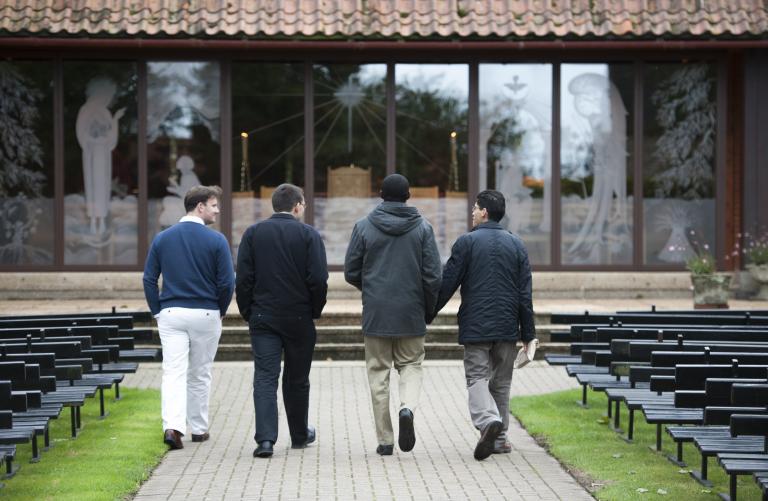
4 Seminarians walking (Catholic Church of England and Wales CC BY-NC-SA 2.0)
The purpose of discernment is action. The purpose of discerning if you are called to the priesthood is to either be set on the path of ordination or set on the path to marriage. Someone may ask whether all discernment should come before entering the Seminary. Recently, a story about those who had discerned out of the seminary lead some people I know to wonder if such discernment should be done before the seminary. I thought I should give a brief explainer about why discernment should not finish before the seminary.
I’ve not worked extensively in a seminary but base this on my own experience and experiences shared by those I’ve known. My goal is not to explain every point about seminary discernment but to point out why you should not wait to enter the seminary because you are still discerning if you are called to be a priest. I hope to answer with an analogy to marriage, the stages of discernment and a longer conclusion than I usually offer.
An Analogy to Marriage
Should people discern if they are called to marriage? Yes.
Should some of that discernment be while in a serious relationship with a woman, including engagement? Yes. And there will be different stages from asking someone out to making it serious and definitely exclusive to engagement to marriage.
Apply the same logic to the priesthood.
Just as it often takes a few years of dating to discern to marry a certain person, it often takes a few years to discern the priesthood. Living in the seminary should help a young man to see priestly life just like dating should help someone see a marriage relationship. If a couple came in asking to get married and they said they never had disagreements, I’d be suspicious. Even though most of us think of an ideal relationship as disagreement-free, we all know that basically no two people agree 100% on everything. Part of discerning marrying one person is that you realize that even after you strongly disagreed over something, you still love that person, want what’s best for them, and want to be with them. Likewise, discerning only outside the seminary likely gives too idealized a view, while in the seminary one will have struggles where they argue or have some ministry that flops – do they still feel called to be a priest then?
Obviously, priesthood is not marriage and discernment is different. Usually, a 6-month minimum is asked from engagement to marriage while religious need between 4 and 11 years, and diocesan seminarians usually take the first half of seminary. When I entered, I told my superiors that if after 2-3 years, I was not convinced to be a member for life, I was going to leave with no hard feelings as I didn’t want to go around for years wondering what I was supposed to do with my life. However, I had by no means finished discernment for the Legion when I entered. I had only met with a Legionary twice and visited the seminary for a weekend (it was far away and plane flights are expensive).
The Stages of Seminary Discernment
Obviously, for the priesthood, there are different moments of discernment like there would be in a dating relationship. You discern going to a vocational event, stating out in the seminary, continuing in the seminary, making a definitive commitment, and then diaconate and priesthood.
To be a priest, you need two degrees – generally an undergrad degree with a minor or major in philosophy and a Masters of Divinity, which is a theology degree. Many dioceses in North America do these two stages in completely different places and even those that do them in the same place have some separation between the two stages by formation activities, by rules, by organizing activities with that group, by dress code (tie vs. collar), etc. The first half doing undergrad is often referred to as “college seminary.” Those studying undergrad are still in discernment while once you get to theology, you are generally committed to ordination.
About halfway through seminary, for diocesan seminarians, there is the admission to candidacy, which marks a kind of end to the discernment phase and a focus on becoming a priest, no longer on discerning that vocation. For religious, final vows in the community marks the end of discernment in a similar manner.
Discernment is also the formators in the seminary and the bishop or provincial discerning if they think a young man is called to their diocese or community. Just because a young man has the qualities to start seminary does not mean he has the traits to be a priest. Often, certain things are expected to be smoothed over or fixed in the seminary and failure to do so means no ordination. It can be character issues or something as simple as my superiors telling me I needed to have legible handwriting. (Really, before the seminary my handwriting was horrible.)
Conclusion of Discernment
From my experience, sometimes the young men who came in seeming most done with discernment and set on being a priest are not priests today. While others who came thinking “maybe God is calling me this way and I’m going for the summer more to get the monkey off my back than because I think I’m called” are good priests.
Another danger of putting all discernment outside the seminary is a current trend to perpetual discernment. Discernment should move towards a decision. Being in the seminary helps a young man discern either way more clearly. Forcing all discernment pre-seminary would be like discerning who to marry without being in a serious relationship with them first.
In summary, discerning for the first few years in the seminary is a good thing, but this should come to an end at least a year or two before ordination.
Hopefully, this summary of how young men might discern a vocation is helpful. Religious vocations are likewise similar where one has a period of discernment while living as a novice or temporarily professed member.
Note 1: I based this on a discussion on a private Facebook group. Some of my own words have been copied and pasted but I chose to paraphrase and not name others to keep the group privacy.
Note 2: Please support me via Patreon so I can make more posts like this.
Previous Post
January 10, 2020
Sharing My Vocation as an Autistic Priest on the Radio
Next Post

January 22, 2020 Facial Recognition: How Much Privacy is Just?
Browse Our Archives
Select a Category Autism Bioethics Book Review Business and Economics Catholic Social Teaching Culture Diocesan Life Disability Discipleship Euthanasia Family Life Genetics Global Politics History Immigration Inspiration Interview Liturgy Moral Theology My Life News Analysis Original Articles Prayer Privacy Pro-Life Science Sexual orientation or identity Social Media Sports Technology Theology Uncategorized US Politics Vatican
Select a Month March 2022 February 2022 January 2022 December 2021 November 2021 October 2021 September 2021 August 2021 July 2021 June 2021 April 2021 March 2021 February 2021 January 2021 December 2020 November 2020 October 2020 September 2020 August 2020 July 2020 June 2020 May 2020 April 2020 March 2020 February 2020 January 2020 December 2019 November 2019 October 2019 September 2019 August 2019 July 2019 June 2019 May 2019 April 2019 March 2019 February 2019 January 2019 December 2018 November 2018 October 2018 September 2018 August 2018 July 2018 June 2018 May 2018
Follow Us!
TAKE THE
Religious Wisdom Quiz
According to Titus, what did God do when his kindness and love appeared?
Select your answer to see how you score.
He destroyed his enemies He established his church He sent his Son He saved us through the washing of rebirth and renewal by the Holy Spirit
Support this
Column


Related posts from Through Catholic Lenses

Why Such a Focus on Extraordinary Form in...

Sensory-Friendly Mass Directory Now Available

Greg Locke, Autism Is not Demonic
Catholic Media: Fides Quarens Rem Publicam
TRENDING AT PATHEOS Catholic

Rejecting Doom: Christian Hope And Human Action
Christianity is a religion of hope. We are to have hope and...

It’s What Comes From Within Which Matters
One of the most difficult things for us to understand is why...

Why I Choose the Eucharist Over the Sermon
Choose the Eucharist, Not the Sermon What are we supposed to get...

5 Design Elements Found in Spiritually Rooted Homes
Putting Spirituality Into Home Decor Our homes are more than our living...

Credo: A Story of God Told with the...
About 10 years ago, I began to imagine a personal "Credo" that...

The Anatomy of Divine Revelation in Catholic Thought
The claim that God has made Himself known to human beings is...
view all Catholic blogs
Ad-Free & Subscriber Log-In Subscription Support
- About Us
- 2026 Calendar
- Videos
- Podcasts
- Library of World Religions
- Faith In Media Tracker
- Advertise With Us
- Write for Us
- Privacy Policy
- Terms of Service
- Do Not Sell My Data
- Contact Us
- Radiant Digital
- Manage Newsletter Subscriptions
- Unsubscribe From Notifications
- Sitemap
Copyright 2008-2026, Patheos. All rights reserved.
Subscription Support Ad-Free & Subscriber Log-In
Follow Patheos