
BuddhistCatholicContemplativeEvangelicalGeneral ChristianHinduJewishLatter-day SaintMuslimNew VisionsProgressive Christian
Beliefs
- Buddhist
- Catholic
- Contemplative
- Evangelical
- General Christian
- Hindu
- Jewish
- Latter-day Saint
- More Voices
- Muslim
- New Visions
- Pagan
- Progressive Christian
Topics
- Religion News
- Food and Religion
- Sports and Religion
- Religious Art
- Religious Music and Entertainment
- Religious Events
- History and Religion
- Style and Religion
- Politics and Religion
- Women in Religion
- Recreation Outdoors and Religion
- Business Finance and Religion
- Careers Workplace and Religion
- Education and Religion
- Family Parenting and Religion
- Health Fitness and Religion
- Home and Religion
- Relationships and Religion
- Technology and Religion
- Travel and Religion
Columnists
- Buddhist Columnists
- Business Finance and Religion Columnists
- Careers Workplace and Religion Columnists
- Catholic Columnists
- Contemplative Columnists
- Education and Religion Columnists
- Evangelists Columnists
- Family Parenting and Religion Columnists
- General Christian Columnists
- Health Fitness and Religion Columnists
- Hindu Columnists
- History and Religion Columnists
- Home and Religion Columnists
- Jewish Columnists
- More Voices Columnists
- Latter Day Columnists
- Muslim Columnists
- New Visions Columnists
- Nonreligious Columnists
- Pagan Columnists
- Politics and Religion Columnists
- Progressive Columnists
- Recreation Outdoors and Religion Columnists
- Relationships and Religion Columnists
- Religion News Columnists
- Religious Art Columnists
- Religious Events Columnists
- Religious Music and Entertainment Columnists
- Sports and Religion Columnists
- Style and Religion Columnists
- Technology and Religion Columnists
- Travel and Religion Columnists
- Women in Religion Columnists
Resource Library
- 2026 Calendar
- Library of World Religions
- The 100 Most Holy Places on Earth
- Patheos Answers
- Podcasts
- Videos
- Faith Leaders Database
- Anglican Episcopalian
- Bahai
- Baptist
- Buddhism
- Christianity
- Confucianism
- Eastern Orthodoxy
- Hinduism
- Holiness and Pentecostal
- ISKCON
- Islam
- Judaism
- Lutheran
- Methodist
- The Church of Jesus Christ of Latter-day Saints
- New Age
- Paganism
- Presbytarian and Reformed
- Protestantism
- Religion Behind the Scenes
- Roman Catholic
- Scientology
- Shia Islam
- Sikhism
- Sufism
- Sunni Islam
- Taoism
- Zen
- See all religions
Research Tools
 Ad-Free & Subscriber Log-In Subscription Support
Ad-Free & Subscriber Log-In Subscription Support
Follow Patheos 

- Trending:
- Forgiveness
- |
- Marriage
- |
- Consciousness
- |
- Death Penalty
- |
- Election
- |
- Halloween
 Through Catholic Lenses
- Home
- Catholic
- Religion News
- Pope Francis: The Disabled Can Be Ministers, Not Just Ministered To
Pope Francis: The Disabled Can Be Ministers, Not Just Ministered To
Last updated on: December 4, 2019 at 10:14 am by Fr. Matthew P. Schneider, LC
Pope Francis: The Disabled Can Be Ministers, Not Just Ministered To 2019-12-04T10:14:57-05:00 Fr. Matthew P. Schneider, LC
Patheos Explore the world's faith through different perspectives on religion and spirituality! Patheos has the views of the prevalent religions and spiritualities of the world.
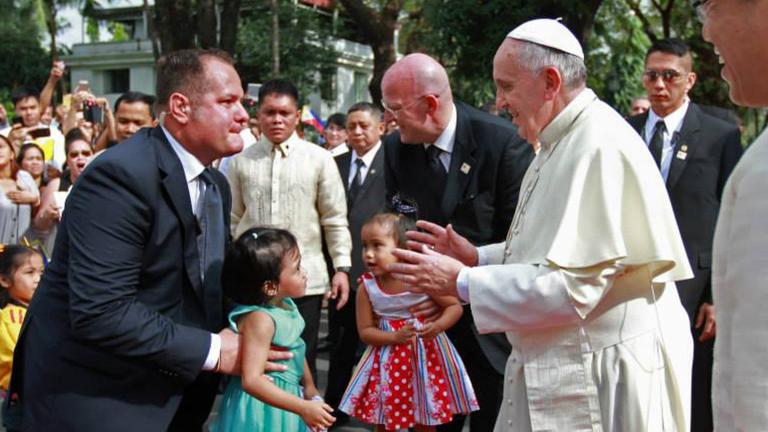
Pope Francis with children at the Malacañan Palace January 16, 2015 (public domain: Philippine Government)

Yesterday, Pope Francis gave a message for the International Day of Persons with Disabilities. He exhorted the Christian faithful to better accept those of us who struggle with such realities. He wants us to be recognized, to be accompanied, to not be discriminated against, and to be involved as ministers, not just those ministered too.
Here is part of Pope Francis’s text. I will comment briefly after each paragraph.
We renew our gaze of faith, which sees in each brother and sister the presence of Christ Himself, Who considers every gesture of love towards one of His least brothers to have been made to Himself. On this occasion, I would like to recall how today the promotion of the right to participation plays a central role in combating discrimination and promoting the culture of encounter and quality of life.
Jesus is present in each person. So often we can forget that every single human person is made in the image and likeness of God. For many today, unfortunately, they have more trouble seeing God in the disabled.
We also need to help everyone participate in society and the Church, whatever their medical condition. This is a reminder that churches should be accessible to wheelchairs and provide services for those with other disabilities like sensory-friendly Masses.
Great progress has been made towards people with disabilities in the medical and welfare fields, but still today we see the presence of the throwaway culture, and many of them feel that they exist without belonging and without participating. All this calls not only for the rights of people with disabilities and their families to be protected, but it also exhorts us to make the world more human by removing everything that prevents them from having full citizenship, the obstacles of prejudice, and by promoting the accessibility of places and quality of life, taking into account of all the dimensions of the human being.
I think it is valuable to link the throwaway culture with disability. One aspect of this culture is reducing each person to what they can do, instead of their intrinsic human dignity. Most with disabilities struggle to do one or more things most people take for granted. Hence, the danger of the throwaway culture is to marginalize the disabled which could eventually lead to euthanasia.
It is necessary to care for and accompany persons with disabilities in every condition of life… and to make way alongside them and to “anoint” them with dignity for an active participation in the civil and ecclesial community. It is a demanding, even tiring journey, which will increasingly contribute to forming consciences capable of recognizing that each one of us is a unique and unrepeatable person.
So often we think of those with disabilities only from the perspective of ministering to them. However, all with disabilities are able to contribute to the ministry of the Church. Some may only be able to pray but most can provide something more in ministry. We need to recognize the gifts each disabled person could contribute.
Making good laws and breaking down physical barriers is important, but it is not enough, if the mentality does not change, if we do not overcome a widespread culture that continues to produce inequalities, preventing people with disabilities from actively participating in ordinary life.
This is a good point that we need to change attitudes not just laws. If attitudes change, laws will follow, but if laws change without attitude changes, they will likely be short-lived.
Go read the complete text if you want more details.
Note: Please support my online writing on Patreon; my community relies on donations.
Previous Post
December 2, 2019
Christians Should Embrace Neurodiversity
Next Post

December 10, 2019 CBS Treats Eugenic Dating as Advancement
Browse Our Archives
Select a Category Autism Bioethics Book Review Business and Economics Catholic Social Teaching Culture Diocesan Life Disability Discipleship Euthanasia Family Life Genetics Global Politics History Immigration Inspiration Interview Liturgy Moral Theology My Life News Analysis Original Articles Prayer Privacy Pro-Life Science Sexual orientation or identity Social Media Sports Technology Theology Uncategorized US Politics Vatican
Select a Month March 2022 February 2022 January 2022 December 2021 November 2021 October 2021 September 2021 August 2021 July 2021 June 2021 April 2021 March 2021 February 2021 January 2021 December 2020 November 2020 October 2020 September 2020 August 2020 July 2020 June 2020 May 2020 April 2020 March 2020 February 2020 January 2020 December 2019 November 2019 October 2019 September 2019 August 2019 July 2019 June 2019 May 2019 April 2019 March 2019 February 2019 January 2019 December 2018 November 2018 October 2018 September 2018 August 2018 July 2018 June 2018 May 2018
Follow Us!
TAKE THE
Religious Wisdom Quiz
True or False: 3 John commends Diotrephes for his hospitality and love for the brethren.
Select your answer to see how you score.
FALSE TRUE
Support this
Column


Related posts from Through Catholic Lenses

Sensory-Friendly Mass Directory Now Available

Greg Locke, Autism Is not Demonic

The Church Cannot Change Teaching on Homosexuality (Hollerich...
TRENDING AT PATHEOS Catholic

Rejecting Doom: Christian Hope And Human Action
Christianity is a religion of hope. We are to have hope and...

It’s What Comes From Within Which Matters
One of the most difficult things for us to understand is why...

Why I Choose the Eucharist Over the Sermon
Choose the Eucharist, Not the Sermon What are we supposed to get...

5 Design Elements Found in Spiritually Rooted Homes
Putting Spirituality Into Home Decor Our homes are more than our living...

Credo: A Story of God Told with the...
About 10 years ago, I began to imagine a personal "Credo" that...

The Anatomy of Divine Revelation in Catholic Thought
The claim that God has made Himself known to human beings is...
view all Catholic blogs
Ad-Free & Subscriber Log-In Subscription Support
- About Us
- 2026 Calendar
- Videos
- Podcasts
- Library of World Religions
- Faith In Media Tracker
- Advertise With Us
- Write for Us
- Privacy Policy
- Terms of Service
- Do Not Sell My Data
- Contact Us
- Radiant Digital
- Manage Newsletter Subscriptions
- Unsubscribe From Notifications
- Sitemap
Copyright 2008-2026, Patheos. All rights reserved.
Subscription Support Ad-Free & Subscriber Log-In
Follow Patheos