
BuddhistCatholicContemplativeEvangelicalGeneral ChristianHinduJewishLatter-day SaintMuslimNew VisionsProgressive Christian
Beliefs
- Buddhist
- Catholic
- Contemplative
- Evangelical
- General Christian
- Hindu
- Jewish
- Latter-day Saint
- More Voices
- Muslim
- New Visions
- Pagan
- Progressive Christian
Topics
- Religion News
- Food and Religion
- Sports and Religion
- Religious Art
- Religious Music and Entertainment
- Religious Events
- History and Religion
- Style and Religion
- Politics and Religion
- Women in Religion
- Recreation Outdoors and Religion
- Business Finance and Religion
- Careers Workplace and Religion
- Education and Religion
- Family Parenting and Religion
- Health Fitness and Religion
- Home and Religion
- Relationships and Religion
- Technology and Religion
- Travel and Religion
Columnists
- Buddhist Columnists
- Business Finance and Religion Columnists
- Careers Workplace and Religion Columnists
- Catholic Columnists
- Contemplative Columnists
- Education and Religion Columnists
- Evangelists Columnists
- Family Parenting and Religion Columnists
- General Christian Columnists
- Health Fitness and Religion Columnists
- Hindu Columnists
- History and Religion Columnists
- Home and Religion Columnists
- Jewish Columnists
- More Voices Columnists
- Latter Day Columnists
- Muslim Columnists
- New Visions Columnists
- Nonreligious Columnists
- Pagan Columnists
- Politics and Religion Columnists
- Progressive Columnists
- Recreation Outdoors and Religion Columnists
- Relationships and Religion Columnists
- Religion News Columnists
- Religious Art Columnists
- Religious Events Columnists
- Religious Music and Entertainment Columnists
- Sports and Religion Columnists
- Style and Religion Columnists
- Technology and Religion Columnists
- Travel and Religion Columnists
- Women in Religion Columnists
Resource Library
- 2026 Calendar
- Library of World Religions
- The 100 Most Holy Places on Earth
- Patheos Answers
- Podcasts
- Videos
- Faith Leaders Database
- Anglican Episcopalian
- Bahai
- Baptist
- Buddhism
- Christianity
- Confucianism
- Eastern Orthodoxy
- Hinduism
- Holiness and Pentecostal
- ISKCON
- Islam
- Judaism
- Lutheran
- Methodist
- The Church of Jesus Christ of Latter-day Saints
- New Age
- Paganism
- Presbytarian and Reformed
- Protestantism
- Religion Behind the Scenes
- Roman Catholic
- Scientology
- Shia Islam
- Sikhism
- Sufism
- Sunni Islam
- Taoism
- Zen
- See all religions
Research Tools
 Ad-Free & Subscriber Log-In Subscription Support
Ad-Free & Subscriber Log-In Subscription Support
Follow Patheos 

- Trending:
- Forgiveness
- |
- Marriage
- |
- Consciousness
- |
- Death Penalty
- |
- Election
- |
- Halloween
 Through Catholic Lenses
- Home
- Catholic
- Religion News
- Rewriting Our Genes? Prime Editing Doesn’t Resolve Moral Issues
Rewriting Our Genes? Prime Editing Doesn’t Resolve Moral Issues
Last updated on: October 22, 2019 at 3:37 pm by Fr. Matthew P. Schneider, LC
Rewriting Our Genes? Prime Editing Doesn’t Resolve Moral Issues 2019-10-22T15:37:59-04:00 Fr. Matthew P. Schneider, LC
Patheos Explore the world's faith through different perspectives on religion and spirituality! Patheos has the views of the prevalent religions and spiritualities of the world.
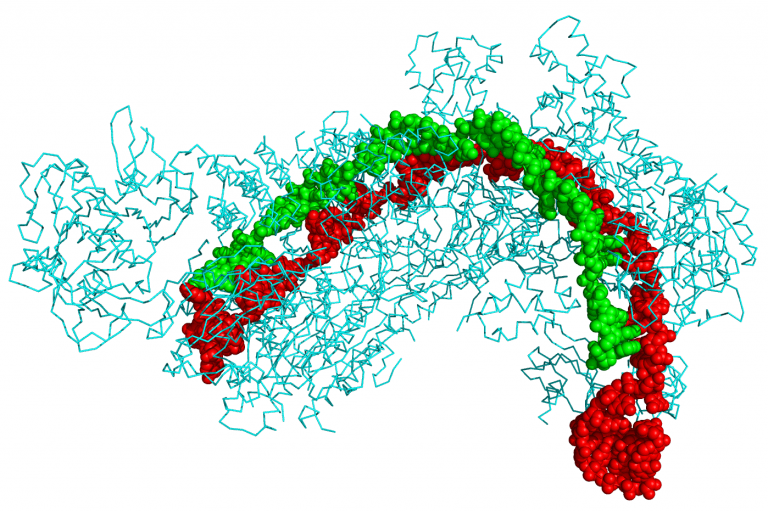
CRISPR proteins illustration (CC BY-SA 4.0 Boghog https://commons.wikimedia.org/wiki/File:4QYZ.png)

This week, a new variation of CRISPR called “Prime Editing” has come into the spotlight. The main method used before was CAS9 which cuts the DNA but prime editing does only “nicks” the genes.
News of Prime Editing
The Guardian reported on this. Here are a few selections:
The procedure, named “prime editing”, can mend about 89% of the 75,000 or so harmful mutations known to mangle the human genome and lead to conditions such as cystic fibrosis, sickle cell anaemia, and a nerve-destroying illness called Tay-Sachs disease. […]
“This first report of prime editing is the beginning rather than the end of a longstanding aspiration in the life sciences to be able to make any DNA change in any position of a living cell or organism, including potentially human patients with genetic diseases,” said David Liu at the Broad Institute of MIT and Harvard in Cambridge, Massachusetts. […]
Writing in the journal Nature, the scientists describe how they made 175 different DNA edits to human cells with impressive precision. In one demonstration, they corrected mutations that cause the inherited blood disorder, sickle cell anaemia. In another, they removed the four extra DNA letters in a particular gene that cause Tay-Sachs disease, a rare condition that destroys children’s nerves and usually proves fatal by five years old.
Before prime editing, it was impossible to make such a range of DNA changes in so many different cell types without leaving behind insertions, deletions and other genetic detritus that can interfere with the workings of the edited cell. […]
While the efficiency of the edits – about 50% in some cases – would be good enough for scientists conducting basic research, he questioned whether it would be useful for scientists working on live animals.
Morals about Prime Editing
There are two moral arguments about this, which apply to any kind of gene-editing: IVF, and germ-line editing. After exploring those two, I will offer a side argument and some good news.
If a couple wants to prevent themselves from having kids with these genes that they have, they can do IVF. However, making babies outside a loving marital act has many issues. Catholic Teaching is clear on this and I don’t think I need to explain more (but you can read some articles where I’ve explained it more).
Second, we have the issue of editing germline cells, sperm and egg, as these will be passed on to others. In general, most countries and the international community are moving towards banning these. I pointed out earlier that the arguments against a moratorium are inadequate.
A big argument here is that Prime Editing is so much more accurate and less likely for genetic side effects than CRISPR-CAS9. I would be a little hesitant to proclaim this so soon. When CRISPR-CAS9 came out, scientists thought it had few side effects but later on, they discovered it made insertions and deletions in places they didn’t look. Plus, as they themselves admit, I don’t know if 50% success is good enough for inserting gene-editing enzymes into my body. In some medicine, 50% is worth trying but the possible negative side effects of gene-editing make most of us a little more cautious.
The good news about this is that if it is done without touching the germline, we can evaluate it on par with other medical procedures. We could theoretically now, and probably in the coming decades, insert these enzymes into a gland that fails to make a hormone due to genetics or into a cancer cell to turn off its rapid replication. There is no particular moral issue with changing the genes in non-germline cells to correct a serious dysfunction.
Note: Please sponsor me on Patreon so I can write more on genetics and bioethics.
Previous Post

October 17, 2019
Christians, Please Call Us Autistic, Blind, and Deaf
Next Post

October 23, 2019 Autistic Confession: Tips for Both Sides of the Screen
Browse Our Archives
Select a Category Autism Bioethics Book Review Business and Economics Catholic Social Teaching Culture Diocesan Life Disability Discipleship Euthanasia Family Life Genetics Global Politics History Immigration Inspiration Interview Liturgy Moral Theology My Life News Analysis Original Articles Prayer Privacy Pro-Life Science Sexual orientation or identity Social Media Sports Technology Theology Uncategorized US Politics Vatican
Select a Month March 2022 February 2022 January 2022 December 2021 November 2021 October 2021 September 2021 August 2021 July 2021 June 2021 April 2021 March 2021 February 2021 January 2021 December 2020 November 2020 October 2020 September 2020 August 2020 July 2020 June 2020 May 2020 April 2020 March 2020 February 2020 January 2020 December 2019 November 2019 October 2019 September 2019 August 2019 July 2019 June 2019 May 2019 April 2019 March 2019 February 2019 January 2019 December 2018 November 2018 October 2018 September 2018 August 2018 July 2018 June 2018 May 2018
Follow Us!
TAKE THE
Religious Wisdom Quiz
Who was the high priest when Jesus was crucified?
Select your answer to see how you score.
Annas Nicodemus Gamaliel Caiaphas
Support this
Column


Related posts from Through Catholic Lenses

Greg Locke, Autism Is not Demonic

The Church Cannot Change Teaching on Homosexuality (Hollerich...
21 of the Most Dynamic Signs at March...

Distinguishing Between Religious and Conscience Exceptions.
TRENDING AT PATHEOS Catholic

Rejecting Doom: Christian Hope And Human Action
Christianity is a religion of hope. We are to have hope and...

It’s What Comes From Within Which Matters
One of the most difficult things for us to understand is why...

Why I Choose the Eucharist Over the Sermon
Choose the Eucharist, Not the Sermon What are we supposed to get...

5 Design Elements Found in Spiritually Rooted Homes
Putting Spirituality Into Home Decor Our homes are more than our living...

Credo: A Story of God Told with the...
About 10 years ago, I began to imagine a personal "Credo" that...

The Anatomy of Divine Revelation in Catholic Thought
The claim that God has made Himself known to human beings is...
view all Catholic blogs
Ad-Free & Subscriber Log-In Subscription Support
- About Us
- 2026 Calendar
- Videos
- Podcasts
- Library of World Religions
- Faith In Media Tracker
- Advertise With Us
- Write for Us
- Privacy Policy
- Terms of Service
- Do Not Sell My Data
- Contact Us
- Radiant Digital
- Manage Newsletter Subscriptions
- Unsubscribe From Notifications
- Sitemap
Copyright 2008-2026, Patheos. All rights reserved.
Subscription Support Ad-Free & Subscriber Log-In
Follow Patheos