
BuddhistCatholicContemplativeEvangelicalGeneral ChristianHinduJewishLatter-day SaintMuslimNew VisionsProgressive Christian
Beliefs
- Buddhist
- Catholic
- Contemplative
- Evangelical
- General Christian
- Hindu
- Jewish
- Latter-day Saint
- More Voices
- Muslim
- New Visions
- Pagan
- Progressive Christian
Topics
- Religion News
- Food and Religion
- Sports and Religion
- Religious Art
- Religious Music and Entertainment
- Religious Events
- History and Religion
- Style and Religion
- Politics and Religion
- Women in Religion
- Recreation Outdoors and Religion
- Business Finance and Religion
- Careers Workplace and Religion
- Education and Religion
- Family Parenting and Religion
- Health Fitness and Religion
- Home and Religion
- Relationships and Religion
- Technology and Religion
- Travel and Religion
Columnists
- Buddhist Columnists
- Business Finance and Religion Columnists
- Careers Workplace and Religion Columnists
- Catholic Columnists
- Contemplative Columnists
- Education and Religion Columnists
- Evangelists Columnists
- Family Parenting and Religion Columnists
- General Christian Columnists
- Health Fitness and Religion Columnists
- Hindu Columnists
- History and Religion Columnists
- Home and Religion Columnists
- Jewish Columnists
- More Voices Columnists
- Latter Day Columnists
- Muslim Columnists
- New Visions Columnists
- Nonreligious Columnists
- Pagan Columnists
- Politics and Religion Columnists
- Progressive Columnists
- Recreation Outdoors and Religion Columnists
- Relationships and Religion Columnists
- Religion News Columnists
- Religious Art Columnists
- Religious Events Columnists
- Religious Music and Entertainment Columnists
- Sports and Religion Columnists
- Style and Religion Columnists
- Technology and Religion Columnists
- Travel and Religion Columnists
- Women in Religion Columnists
Resource Library
- 2026 Calendar
- Library of World Religions
- The 100 Most Holy Places on Earth
- Patheos Answers
- Podcasts
- Videos
- Faith Leaders Database
- Anglican Episcopalian
- Bahai
- Baptist
- Buddhism
- Christianity
- Confucianism
- Eastern Orthodoxy
- Hinduism
- Holiness and Pentecostal
- ISKCON
- Islam
- Judaism
- Lutheran
- Methodist
- The Church of Jesus Christ of Latter-day Saints
- New Age
- Paganism
- Presbytarian and Reformed
- Protestantism
- Religion Behind the Scenes
- Roman Catholic
- Scientology
- Shia Islam
- Sikhism
- Sufism
- Sunni Islam
- Taoism
- Zen
- See all religions
Research Tools
 Ad-Free & Subscriber Log-In Subscription Support
Ad-Free & Subscriber Log-In Subscription Support
Follow Patheos 

- Trending:
- Forgiveness
- |
- Marriage
- |
- Consciousness
- |
- Death Penalty
- |
- Election
- |
- Halloween
 Through Catholic Lenses
- Home
- Catholic
- Religion News
- Key Quotes from Christus Vivit
Key Quotes from Christus Vivit
Last updated on: May 23, 2019 at 1:01 pm by Fr. Matthew P. Schneider, LC
Key Quotes from Christus Vivit 2019-05-23T13:01:15-04:00 Fr. Matthew P. Schneider, LC
Patheos Explore the world's faith through different perspectives on religion and spirituality! Patheos has the views of the prevalent religions and spiritualities of the world.
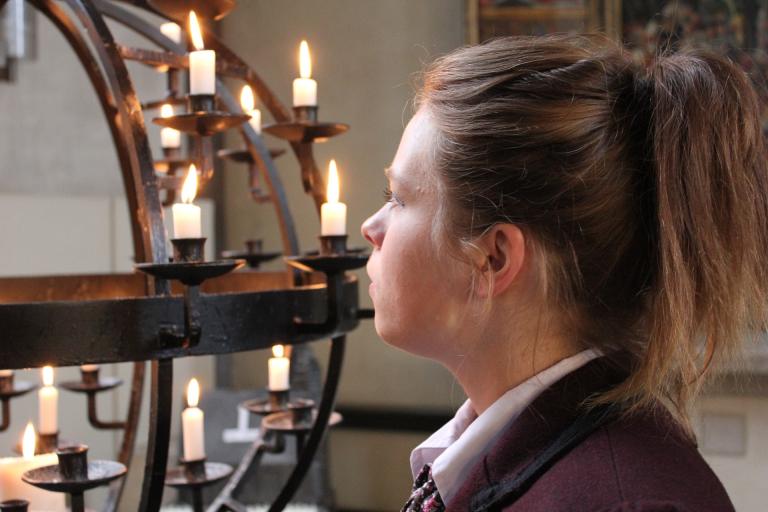
Young woman at prayer (pixabay CC0)
With Pope Francis issuing a letter to young people as after the synod on youth, we have an opportunity to reflect on what the Pope is saying to youth. As I read it, I pulled out some quotes and summarized other parts to hopefully give you a nice summary.
Introduction
Pope Francis begins “Christ is alive and he wants you to be alive!” (1) Right after, he continues, “He is in you, he is with you and he never abandons you. However far you may wander, he is always there, the Risen One. He calls you and he waits for you to return to him and start over again.” (2)
The rest of the introduction focuses on pointing out his intention to write this to and for young people.
Chapter 1: What Does the Word of God Have to Say about Young People?
Pope Francis begins with a number of Old Testament examples of youthfulness.
- “In Gideon, we see the frankness of young people, who are not used to sugar-coating reality.” (7)
- “Samuel was still a young boy, yet the Lord spoke to him. Thanks to the advice of an adult, he opened his heart to hear God’s call: ‘Speak, Lord, for your servant is listening’ (1 Sam 3:9-10).” (8)
- “Solomon, when he had to succeed his father, felt lost and told God: ‘I am a mere youth, not knowing at all how to act’ (1 Kg 3:7). Yet the audacity of youth moved him to ask God for wisdom and he devoted himself to his mission.” (10)
Then the Pope moves to the New Testament.
- “Young hearts are naturally ready to change, to turn back, get up and learn from life. How could anyone fail to support that son in this new resolution? Yet his older brother already had a heart grown old; he let himself be possessed by greed, selfishness and envy (Lk 15:28-30). Jesus praises the young sinner who returned to the right path over the brother who considered himself faithful, yet lacked the spirit of love and mercy.” (12)
- “True youth means having a heart capable of loving, whereas everything that separates us from others makes the soul grow old.” (13)
- “Jesus had no use for adults who looked down on the young or lorded it over them. On the contrary, he insisted that ‘the greatest among you must become like the youngest’ (Lk 22:26).”
- “Young people are also urged ‘to accept the authority of those who are older’ (1 Pet 5:5). The Bible never ceases to insist that profound respect be shown to the elderly, since they have a wealth of experience; they have known success and failure, life’s joys and afflictions, its dreams and disappointments.” (16)
- “In the Gospel of Matthew we find a young man (cf. Mt 19:20.22) who approaches Jesus and asks if there is more that he can do (v. 20); in this, he demonstrates that youthful openness of spirit which seeks new horizons and great challenges.” (18)
Chapter 2: Jesus, Ever Young
“Jesus is ‘young among the young in order to be an example for the young and to consecrate them to the Lord.’” (22, quoting St. Irenaeus)
“Jesus did not grow up in a narrow and stifling relationship with Mary and Joseph, but readily interacted with the wider family, the relatives of his parents and their friends.” (29, Quoting Amoris Laetitia 384)
“Jesus does not teach you, young people, from afar or from without, but from within your very youth, a youth he shares with you.” (31)
“Let us ask the Lord to free the Church from those who would make her grow old, encase her in the past, hold her back or keep her at a standstill.” (35)
“Christ’s Church can always yield to the temptation to lose enthusiasm because she no longer hears the Lord calling her to take the risk of faith, to give her all without counting the dangers; she can be tempted to revert to seeking a false, worldly form of security. Young people can help keep her young.” (37)
“To be credible to young people, there are times when she [the Church] needs to regain her humility and simply listen.” (41)
“In the heart of the Church, Mary shines forth. She is the supreme model for a youthful Church that seeks to follow Christ with enthusiasm and docility.” (43)
“Mary is the Mother who watches over us, her children, on our journey through life, often weary and in need, anxious that the light of hope not fail.” (48)
“Through the holiness of the young, the Church can renew her spiritual ardour and her apostolic vigour. The balm of holiness generated by the good lives of so many young people can heal the wounds of the Church and of the world, bringing us back to that fullness of love to which we have always been called.” (50, quoting final synod document)
Chapter 3: You Are the “Now” of God
“We cannot just say that young people are the future of our world. They are its present.” (64)
“Rather than listening to young people attentively, ‘all too often, there is a tendency to provide prepackaged answers and ready-made solutions, without allowing their real questions to emerge and facing the challenges they pose.’” (65, quoting final synod document)
“Youth is not something to be analyzed in the abstract. Indeed, “youth” does not exist: there exist only young people, each with the reality of his or her own life.” (71)
“Can I weep? Can I weep when I see a child who is starving, on drugs or on the street, homeless, abandoned, mistreated or exploited as a slave by society? Or is my weeping only the self-centred whining of those who cry because they want something else?” (76, quoting final synod document)
“At times, the hurt felt by some young people is heartrending, a pain too deep for words. They can only tell God how much they are suffering, and how hard it is for them to keep going, since they no longer believe in anyone.” (77)
“The web and social networks have created a new way to communicate and bond… Yet to understand this phenomenon as a whole, we need to realize that, like every human reality, it has its share of limitations and deficiencies.” (87 & 88)
“For many people, immersion in the virtual world has brought about a kind of ‘digital migration,’ involving withdrawal from their families and their cultural and religious values, and entrance into a world of loneliness and of self-invention, with the result that they feel rootless even while remaining physically in one place.” (90)
“[Venerable] Carlo [Acutis] said, ‘Everyone is born as an original, but many people end up dying as photocopies.’ Don’t let that happen to you!” (106)
Chapter 4: A Great Message for All Young People
“I now wish to speak to young people about what is essential, the one thing we should never keep quiet about. It is a message containing three great truths. […] The very first truth I would tell each of you is this: “God loves you”. It makes no difference whether you have already heard it or not. […] The second great truth is that Christ, out of love, sacrificed himself completely in order to save you. […] Finally, there is a third truth, inseparable from the second: Christ is alive!” (111, 112, 118, 124)
“What I can tell you, with absolute certainty, is that you can find security in the embrace of your heavenly Father, of the God who first gave you life and continues to give it to you at every moment. He will be your firm support, but you will also realize that he fully respects your freedom.” (113)
God’s love is “a love that does not overwhelm or oppress, cast aside or reduce to silence, humiliate or domineer. It is the love of the Lord, a daily, discreet and respectful love; a love that is free and freeing, a love that heals and raises up.” (116, quoting his address at WYD 2019)
“We are saved by Jesus because he loves us and cannot go against his nature. We can do any number of things against him, yet he loves us and he saves us. For only what is loved can be saved. Only what is embraced can be transformed. The Lord’s love is greater than all our problems, frailties and flaws. Yet it is precisely through our problems, frailties and flaws that he wants to write this love story.” (120, quoting his address at WYD 2019)
“See Jesus as happy, overflowing with joy. Rejoice with him as with a friend who has triumphed.” (126)
“Because he lives, there can be no doubt that goodness will have the upper hand in your life and that all our struggles will prove worthwhile.” (127)
“He [the Holy Spirit] takes nothing away from you, but instead helps you to find all that you need, and in the best possible way.” (131)

Young man lighting candle (pixabay CC0)
Chapter 5: Paths of Youth
“Youth, more than a source of pride, is a gift of God: ‘To be young is a grace, a blessing.’” (134, quoting Paul VI) “[Youth] is joy, a song of hope and a blessing.” (135)
“The love of God… elevates us, encourages us and inspires us to a better and more beautiful life.” (135)
“Keep following your hopes and dreams. But be careful about one temptation that can hold us back. It is anxiety. Anxiety can work against us by making us give up whenever we do not see instant results. Our best dreams are only attained through hope, patience and commitment, and not in haste.” (142 – note this is talking about normal anxiety; if you have clinical anxiety, get help.)
“Contrary to what many people think, the Lord does not want to stifle these desires for a fulfilling life.” (145)
“Far from obsessively seeking new pleasures, which would keep us from making the most of the present moment, we are asked to open our eyes and take a moment to experience fully and with gratitude every one of life’s little gifts.” (146)
“No matter how much you live the experience of these years of your youth, you will never know their deepest and fullest meaning unless you encounter each day your best friend, the friend who is Jesus.” (150)
“Friendship is one of life’s gifts and a grace from God. Through our friends, the Lord refines us and leads us to maturity. Faithful friends, who stand at our side in times of difficulty, are also a reflection of the Lord’s love, his gentle and consoling presence in our lives.” (151)
“The Holy Spirit wants to make us come out of ourselves, to embrace others with love and to seek their good. That is why it is always better to live the faith together and to show our love by living in community and sharing with other young people our affection, our time, our faith and our troubles.” (164)
“The lay vocation is directed above all to charity within the family and to social and political charity. It is a concrete and faith-based commitment to the building of a new society. It involves living in the midst of society and the world in order to bring the Gospel everywhere, to work for the growth of peace, harmony, justice, human rights and mercy, and thus for the extension of God’s kingdom in this world.” (168)
“Filled with the love of Christ, young people are called to be witnesses of the Gospel wherever they find themselves, by the way they live.” (175)
“Being an apostle does not mean wearing a lapel pin; it is not about speaking about the truth but living it, embodying it, being transformed in Christ. Being an apostle does not mean carrying a torch in hand, possessing the light, but being that light.” (175, quoting Saint Alberto Hurtado)
Chapter 6: Young People with Roots
“If someone tells young people to ignore their history, to reject the experiences of their elders, to look down on the past and to look forward to a future that he holds out, doesn’t it then become easy to draw them along so that they only do what he tells them? He needs the young to be shallow, uprooted and distrustful, so that they can trust only in his promises and act according to his plans.” (181)
“Do not let them [cultural elites] exploit your youth to promote a shallow life that confuses beauty with appearances.” (183)
“There is extraordinary beauty in the fellowship of a family at table, generously sharing what food it has. There is beauty in the wife, slightly dishevelled and no longer young, who continues to care for her sick husband despite her own failing health. Long after the springtime of their courtship has passed, there is beauty in the fidelity of those couples who still love one another in the autumn of life, those elderly people who still hold hands as they walk. There is also a beauty, unrelated to appearances or fashionable dress, in all those men and women who pursue their personal vocation with love, in selfless service.” (183)
“When young and old alike are open to the Holy Spirit, they make a wonderful combination.” (192)
“The very first dream of all is the creative dream of God our Father, which precedes and accompanies the lives of all his children.” (194)
“If we journey together, young and old, we can be firmly rooted in the present, and from here, revisit the past and look to the future.” (199)
Chapter 7: Youth Ministry
“Young people themselves are agents of youth ministry.” (203)
“By learning from one another, we can better reflect that wonderful multi-faceted reality that Christ’s Church is meant to be.” (207)
“We should never underestimate the ability of young people to be open to contemplative prayer.” (224)
“It doesn’t take much to make young people missionaries.” (239)
Chapter 8: Vocation
“The word ‘vocation’ can be understood in a broad sense as a calling from God, including the call to life, the call to friendship with him, the call to holiness, and so forth. This is helpful, since it situates our whole life in relation to the God who loves us. It makes us realize that nothing is the result of pure chance but that everything in our lives can become a way of responding to the Lord, who has a wonderful plan for us.” (248)
“Jesus wants to be a friend to every young person.” (250)
“The life that Jesus gives us is a love story, a life history that wants to blend with ours and sink roots in the soil of our own lives. That life is not a salvation up ‘in the cloud’ and waiting to be downloaded, a new ‘app’ to be discovered, or a technique of mental self-improvement.” (252, quoting the vigil at World Youth Day 2019)
“Two Christians who marry have recognized the call of the Lord in their own love story, the vocation to form one flesh and one life from two, male and female. The Sacrament of Holy Matrimony envelops this love in the grace of God; it roots it in God himself.” (260, quoting a homily to young people in 2013)
“Today, a culture of the ephemeral dominates, but it is an illusion.” (264)
“Work is an expression of human dignity, a path of development and of social inclusion. It is a constant stimulus to grow in responsibility and creativity.” (271)
“Do not dismiss the possibility of devoting yourself to God in the priesthood, the religious life or in other forms of consecration. Why not? You can be sure that, if you do recognize and follow a call from God, there you will find complete fulfilment.” (276)
Chapter 9: Discernment
“[Discernment] seeks a glimpse of that unique and mysterious plan that God has for each of us.” (280, quoting Gaudete et Exsultate)
“Only if we are prepared to listen, do we have the freedom to set aside our own partial or insufficient ideas.” (284, quoting Gaudete et Exsultate)
“To discern our personal vocation, we have to realize that it is a calling from a friend, who is Jesus. When we give something to our friends, we give them the best we have.” (287)
“My joyful hope is to see you keep running the race before you, outstripping all those who are slow or fearful.” (299)
Note: If you want more posts like this or my other posts, please support me on Patreon. You’ll get some extras like my weekly news summary.
Previous Post

May 9, 2019
What Is It Like Being an Autistic Priest?
Next Post

May 23, 2019 Bioethics Must Outpace Technology
Browse Our Archives
Select a Category Autism Bioethics Book Review Business and Economics Catholic Social Teaching Culture Diocesan Life Disability Discipleship Euthanasia Family Life Genetics Global Politics History Immigration Inspiration Interview Liturgy Moral Theology My Life News Analysis Original Articles Prayer Privacy Pro-Life Science Sexual orientation or identity Social Media Sports Technology Theology Uncategorized US Politics Vatican
Select a Month March 2022 February 2022 January 2022 December 2021 November 2021 October 2021 September 2021 August 2021 July 2021 June 2021 April 2021 March 2021 February 2021 January 2021 December 2020 November 2020 October 2020 September 2020 August 2020 July 2020 June 2020 May 2020 April 2020 March 2020 February 2020 January 2020 December 2019 November 2019 October 2019 September 2019 August 2019 July 2019 June 2019 May 2019 April 2019 March 2019 February 2019 January 2019 December 2018 November 2018 October 2018 September 2018 August 2018 July 2018 June 2018 May 2018
Follow Us!
TAKE THE
Religious Wisdom Quiz
What does the Bible say about using one's gifts or talents?
Select your answer to see how you score.
Hide them Waste them Brag about them Use them for God's glory
Support this
Column


Related posts from Through Catholic Lenses

Why Such a Focus on Extraordinary Form in...
Russia Was Consecrated in 1984 to the Immaculate...

Sensory-Friendly Mass Directory Now Available
Catholic Media: Fides Quarens Rem Publicam
TRENDING AT PATHEOS Catholic

Rejecting Doom: Christian Hope And Human Action
Christianity is a religion of hope. We are to have hope and...

It’s What Comes From Within Which Matters
One of the most difficult things for us to understand is why...

Why I Choose the Eucharist Over the Sermon
Choose the Eucharist, Not the Sermon What are we supposed to get...

5 Design Elements Found in Spiritually Rooted Homes
Putting Spirituality Into Home Decor Our homes are more than our living...

Credo: A Story of God Told with the...
About 10 years ago, I began to imagine a personal "Credo" that...

The Anatomy of Divine Revelation in Catholic Thought
The claim that God has made Himself known to human beings is...
view all Catholic blogs
Ad-Free & Subscriber Log-In Subscription Support
- About Us
- 2026 Calendar
- Videos
- Podcasts
- Library of World Religions
- Faith In Media Tracker
- Advertise With Us
- Write for Us
- Privacy Policy
- Terms of Service
- Do Not Sell My Data
- Contact Us
- Radiant Digital
- Manage Newsletter Subscriptions
- Unsubscribe From Notifications
- Sitemap
Copyright 2008-2026, Patheos. All rights reserved.
Subscription Support Ad-Free & Subscriber Log-In
Follow Patheos