
BuddhistCatholicContemplativeEvangelicalGeneral ChristianHinduJewishLatter-day SaintMuslimNew VisionsProgressive Christian
Beliefs
- Buddhist
- Catholic
- Contemplative
- Evangelical
- General Christian
- Hindu
- Jewish
- Latter-day Saint
- More Voices
- Muslim
- New Visions
- Pagan
- Progressive Christian
Topics
- Religion News
- Food and Religion
- Sports and Religion
- Religious Art
- Religious Music and Entertainment
- Religious Events
- History and Religion
- Style and Religion
- Politics and Religion
- Women in Religion
- Recreation Outdoors and Religion
- Business Finance and Religion
- Careers Workplace and Religion
- Education and Religion
- Family Parenting and Religion
- Health Fitness and Religion
- Home and Religion
- Relationships and Religion
- Technology and Religion
- Travel and Religion
Columnists
- Buddhist Columnists
- Business Finance and Religion Columnists
- Careers Workplace and Religion Columnists
- Catholic Columnists
- Contemplative Columnists
- Education and Religion Columnists
- Evangelists Columnists
- Family Parenting and Religion Columnists
- General Christian Columnists
- Health Fitness and Religion Columnists
- Hindu Columnists
- History and Religion Columnists
- Home and Religion Columnists
- Jewish Columnists
- More Voices Columnists
- Latter Day Columnists
- Muslim Columnists
- New Visions Columnists
- Nonreligious Columnists
- Pagan Columnists
- Politics and Religion Columnists
- Progressive Columnists
- Recreation Outdoors and Religion Columnists
- Relationships and Religion Columnists
- Religion News Columnists
- Religious Art Columnists
- Religious Events Columnists
- Religious Music and Entertainment Columnists
- Sports and Religion Columnists
- Style and Religion Columnists
- Technology and Religion Columnists
- Travel and Religion Columnists
- Women in Religion Columnists
Resource Library
- 2026 Calendar
- Library of World Religions
- The 100 Most Holy Places on Earth
- Patheos Answers
- Podcasts
- Videos
- Faith Leaders Database
- Anglican Episcopalian
- Bahai
- Baptist
- Buddhism
- Christianity
- Confucianism
- Eastern Orthodoxy
- Hinduism
- Holiness and Pentecostal
- ISKCON
- Islam
- Judaism
- Lutheran
- Methodist
- The Church of Jesus Christ of Latter-day Saints
- New Age
- Paganism
- Presbytarian and Reformed
- Protestantism
- Religion Behind the Scenes
- Roman Catholic
- Scientology
- Shia Islam
- Sikhism
- Sufism
- Sunni Islam
- Taoism
- Zen
- See all religions
Research Tools
 Ad-Free & Subscriber Log-In Subscription Support
Ad-Free & Subscriber Log-In Subscription Support
Follow Patheos 

- Trending:
- Forgiveness
- |
- Marriage
- |
- Consciousness
- |
- Death Penalty
- |
- Election
- |
- Halloween
 Through Catholic Lenses
- Home
- Catholic
- Religion News
- Let us Enter into the Passion (Palm Sunday Homily)
Let us Enter into the Passion (Palm Sunday Homily)
Last updated on: April 11, 2019 at 9:17 am by Fr. Matthew P. Schneider, LC
Let us Enter into the Passion (Palm Sunday Homily) 2019-04-11T09:17:52-04:00 Fr. Matthew P. Schneider, LC
Patheos Explore the world's faith through different perspectives on religion and spirituality! Patheos has the views of the prevalent religions and spiritualities of the world.
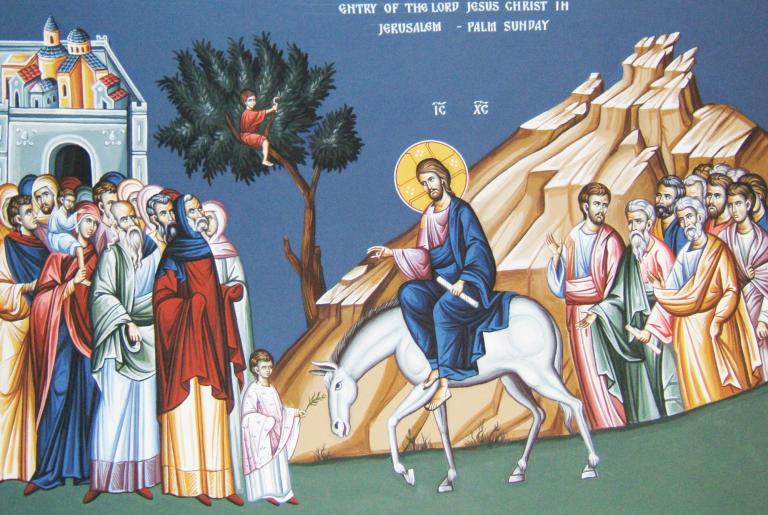
A Serbian Icon of Jesus’ Entry to Jerusalem (CC BY-SA 3.0 Deu commons.wikimedia.org/wiki/File:Entry_of_Jesus_Christ_into_Jerusalem.jpg)
Continuing my series of homilies I did for Homiletic and Pastoral Review, we have a double-homily for Palm or Passion Sunday. I hope this pair of homilies for the procession and Mass help you enter into the Passion. (Readings.)
Procession Homily
Today we enter into the Passion.
We begin now on the Mount of Olives. From there, we enter — with Jesus — into Jerusalem. We remember what he said a few chapters beforehand: “O Jerusalem, Jerusalem, killing the prophets and stoning those who are sent to you! How often would I have gathered your children together as a hen gathers her brood under her wings, and you would not!” (Lk 13:34).
We enter into Jesus’s sorrow; we enter in the foreshadowing of all that is about to happen.
We walk slowly with all the other pilgrims. We enter into their joy at the Passover feast while keeping this foreshadowed sorrow in mind.
[Entering Jesus’ Heart]
We enter into Jesus’s humility. He seeks not to come on a powerful animal like a horse or camel, but on a simple donkey often used for freight, not people. To the Jews, the donkey was a sign of the Messiah and of peace. We look at how we often choose to go in power and glory rather than remaining simple and humble. Looking at our own lives, we realize we probably would have preferred a war horse to a simple donkey.
The gates finally open and we physically enter the city. We enter into the last week of Jesus’s earthly life. We enter into the week which will save us.
People are calling out and praising Jesus. So much so that he notes the rocks would cry out. Do we enter into how profound a reality this is? We can think of Jesus’s salvation in merely legalistic terms but it really is a cosmic reality.
Finally, as we reach in, we enter into Jesus’s mind where he can see the Romans razing the whole city to the ground in 40 years. He weeps for these who will not accept him, those who will die in that battle and destruction. This allows us to enter the new Jerusalem, the Church, so let us now go forth, entering into it like the crowds entered Jerusalem with Jesus 2000 years ago.
Mass Homily
In today’s second reading, St. Paul suggests that we enter into the Incarnation. He notes the Second Person of the Trinity was purely God but chose to enter into our world; he chose to enter even into our death, so as to allow us to escape from eternal death.
The long Passion narrative has six parts we can briefly enter into: the Last Supper, the agony in the Garden, the trials, carrying the Cross, Jesus’s death, and the silence after his death.
[Last Supper]
We enter into the Last Supper to see the reality of a God who comes to us so simply in the Eucharist. We see here not only the rest of the Passion in miniature, but we see Jesus’s gift we can receive every day. In the Eucharist, we have the opportunity to enter into Jesus’s passion, death, and resurrection every day.
[Agony]
Then, as Jesus leaves the upper room, he walks out to a garden to pray. We enter in with him: not just to the garden, but to his heart so burdened with what is about to happen. He is suffering. He knows what will happen. His struggle is so real that he sweats blood. When we face difficulty, do we let Jesus enter in and help us? Even though he sweat blood in his difficult prayer, he had the strength to do the right thing. Each time we face some difficult choice — where we know the right thing to do but also know it isn’t the easiest — we can enter into this prayer in the garden with Jesus.
[Trails]
Jesus is tried multiple times by rulers and by the crowd. Each time, they seem to just put off the inevitable we all know will happen: Jesus will be crucified. Let’s enter in to see how Jesus lives these trials and how we can live life when society or cultural elites don’t think we’re doing the right thing. So often today, society encourages us to do the wrong thing. For example, we all know abortion is wrong and should never happen, but if you look to Hollywood or New York City media, we have to search for cultural leaders who agree with that. Technology has made our lives easy, and cultural leaders seem to want to promote such ease even to varied forms of immorality regarding human life and sexuality. When we feel judged by our culture, how do we react? When Jesus was judged unfairly, he did not lose his resolve. He did not cave and apologize for speaking the truth. We can enter into Jesus’s trials when our culture judges us and tells us we are wrong.
[Carrying the Cross]
Next, we enter into the carrying of the Cross. We all have our particular cross we are asked to carry with Jesus. Some are lazy and will tend to do nothing unless provoked; others need to avoid yelling curses at every second person. Even though such tendencies may seem opposite, these are both crosses those people need to carry. God allowed that, when each of us was created, we’d have some little cross where we tend to some sin more than others. Jesus grants us these so we can become more like him, so that we can enter into the Cross. We enter with our weaknesses and faults, carrying them up Calvary with Jesus.
[Jesus’ Death]
As he dies, we enter into what seems like utter blackness and lack of hope; we enter into moments where we feel lost and abandoned; we enter into seeming hopelessness. But even in that dark moment Jesus is there. If we acknowledge him then, he can help lift us out. You may have heard the saying that Jesus descended to Hell or to the domain of the dead. He did descend, to bring up the righteous who died before him. However, for us, we can see how at that moment we can feel this dead, or in Hell. Jesus wants to bring us up from that moment.
Finally, we enter into the eye of the storm. Jesus has died and is now buried. We enter into those few moments between the two most pivotal moments in history: Jesus’s death and his resurrection. We enter into the silence where things seem all upside down. At times things in our life don’t make sense, but Jesus wants to set them right if we let him.
Now, if we really entered into the Passion we can enter into the Resurrection. We don’t enter the Passion just to feel sad; we enter to be redeemed. Human life has ups and downs while we all search for the perfect life. If in those down moments we enter into the Passion, we allow ourselves to enter into Jesus’s redemption that leads us to the perfect life where we are all resurrected. We enter not into some abstract heaven of pillowy clouds or choirs of saints, but a perfect wonderful life for both our soul and our body.
You can read this homily and all for this week in Homiletic and Pastoral Review.
Previous Post

April 9, 2019
Autistic Children Should Receive First Communion!
Next Post
April 17, 2019 A Small Group Guidebook But More (Building the Benedict Option)
Browse Our Archives
Select a Category Autism Bioethics Book Review Business and Economics Catholic Social Teaching Culture Diocesan Life Disability Discipleship Euthanasia Family Life Genetics Global Politics History Immigration Inspiration Interview Liturgy Moral Theology My Life News Analysis Original Articles Prayer Privacy Pro-Life Science Sexual orientation or identity Social Media Sports Technology Theology Uncategorized US Politics Vatican
Select a Month March 2022 February 2022 January 2022 December 2021 November 2021 October 2021 September 2021 August 2021 July 2021 June 2021 April 2021 March 2021 February 2021 January 2021 December 2020 November 2020 October 2020 September 2020 August 2020 July 2020 June 2020 May 2020 April 2020 March 2020 February 2020 January 2020 December 2019 November 2019 October 2019 September 2019 August 2019 July 2019 June 2019 May 2019 April 2019 March 2019 February 2019 January 2019 December 2018 November 2018 October 2018 September 2018 August 2018 July 2018 June 2018 May 2018
Follow Us!
TAKE THE
Religious Wisdom Quiz
Which city did David conquer and make his capital?
Select your answer to see how you score.
Bethel Hebron Gibeon Jerusalem
Support this
Column


Related posts from Through Catholic Lenses
Russia Was Consecrated in 1984 to the Immaculate...
Catholic Media: Fides Quarens Rem Publicam

21 of the Most Dynamic Signs at March...
TRENDING AT PATHEOS Catholic

Rejecting Doom: Christian Hope And Human Action
Christianity is a religion of hope. We are to have hope and...

It’s What Comes From Within Which Matters
One of the most difficult things for us to understand is why...

Why I Choose the Eucharist Over the Sermon
Choose the Eucharist, Not the Sermon What are we supposed to get...

5 Design Elements Found in Spiritually Rooted Homes
Putting Spirituality Into Home Decor Our homes are more than our living...

Credo: A Story of God Told with the...
About 10 years ago, I began to imagine a personal "Credo" that...

The Anatomy of Divine Revelation in Catholic Thought
The claim that God has made Himself known to human beings is...
view all Catholic blogs
Ad-Free & Subscriber Log-In Subscription Support
- About Us
- 2026 Calendar
- Videos
- Podcasts
- Library of World Religions
- Faith In Media Tracker
- Advertise With Us
- Write for Us
- Privacy Policy
- Terms of Service
- Do Not Sell My Data
- Contact Us
- Radiant Digital
- Manage Newsletter Subscriptions
- Unsubscribe From Notifications
- Sitemap
Copyright 2008-2026, Patheos. All rights reserved.
Subscription Support Ad-Free & Subscriber Log-In
Follow Patheos