
BuddhistCatholicContemplativeEvangelicalGeneral ChristianHinduJewishLatter-day SaintMuslimNew VisionsProgressive Christian
Beliefs
- Buddhist
- Catholic
- Contemplative
- Evangelical
- General Christian
- Hindu
- Jewish
- Latter-day Saint
- More Voices
- Muslim
- New Visions
- Pagan
- Progressive Christian
Topics
- Religion News
- Food and Religion
- Sports and Religion
- Religious Art
- Religious Music and Entertainment
- Religious Events
- History and Religion
- Style and Religion
- Politics and Religion
- Women in Religion
- Recreation Outdoors and Religion
- Business Finance and Religion
- Careers Workplace and Religion
- Education and Religion
- Family Parenting and Religion
- Health Fitness and Religion
- Home and Religion
- Relationships and Religion
- Technology and Religion
- Travel and Religion
Columnists
- Buddhist Columnists
- Business Finance and Religion Columnists
- Careers Workplace and Religion Columnists
- Catholic Columnists
- Contemplative Columnists
- Education and Religion Columnists
- Evangelists Columnists
- Family Parenting and Religion Columnists
- General Christian Columnists
- Health Fitness and Religion Columnists
- Hindu Columnists
- History and Religion Columnists
- Home and Religion Columnists
- Jewish Columnists
- More Voices Columnists
- Latter Day Columnists
- Muslim Columnists
- New Visions Columnists
- Nonreligious Columnists
- Pagan Columnists
- Politics and Religion Columnists
- Progressive Columnists
- Recreation Outdoors and Religion Columnists
- Relationships and Religion Columnists
- Religion News Columnists
- Religious Art Columnists
- Religious Events Columnists
- Religious Music and Entertainment Columnists
- Sports and Religion Columnists
- Style and Religion Columnists
- Technology and Religion Columnists
- Travel and Religion Columnists
- Women in Religion Columnists
Resource Library
- 2026 Calendar
- Library of World Religions
- The 100 Most Holy Places on Earth
- Patheos Answers
- Podcasts
- Videos
- Faith Leaders Database
- Anglican Episcopalian
- Bahai
- Baptist
- Buddhism
- Christianity
- Confucianism
- Eastern Orthodoxy
- Hinduism
- Holiness and Pentecostal
- ISKCON
- Islam
- Judaism
- Lutheran
- Methodist
- The Church of Jesus Christ of Latter-day Saints
- New Age
- Paganism
- Presbytarian and Reformed
- Protestantism
- Religion Behind the Scenes
- Roman Catholic
- Scientology
- Shia Islam
- Sikhism
- Sufism
- Sunni Islam
- Taoism
- Zen
- See all religions
Research Tools
 Ad-Free & Subscriber Log-In Subscription Support
Ad-Free & Subscriber Log-In Subscription Support
Follow Patheos 

- Trending:
- Forgiveness
- |
- Marriage
- |
- Consciousness
- |
- Death Penalty
- |
- Election
- |
- Halloween
 Through Catholic Lenses
- Home
- Catholic
- Religion News
- One Page Doesn’t Ruin “The Kingdom” or Other Literature.
One Page Doesn’t Ruin “The Kingdom” or Other Literature.
Last updated on: February 22, 2019 at 3:23 pm by Fr. Matthew P. Schneider, LC
One Page Doesn’t Ruin “The Kingdom” or Other Literature. 2019-02-22T15:23:00-05:00 Fr. Matthew P. Schneider, LC
Patheos Explore the world's faith through different perspectives on religion and spirituality! Patheos has the views of the prevalent religions and spiritualities of the world.
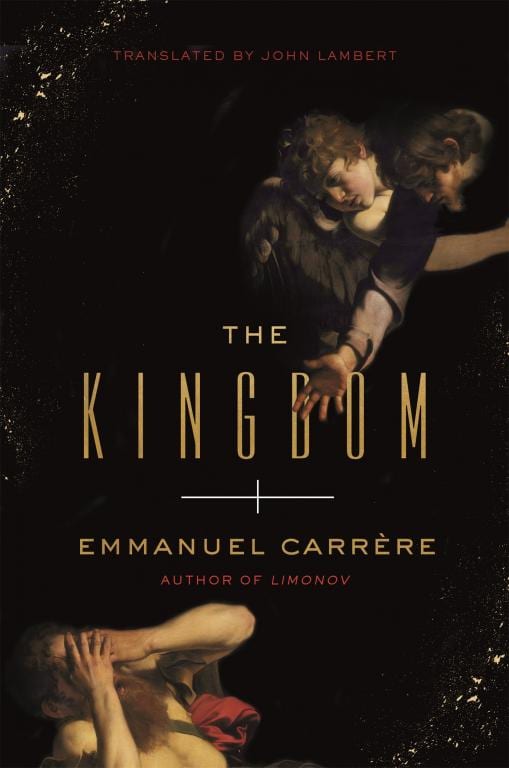
Cover of The Kingdom (fair use)
Earlier this year, Church Militant got up in arms about Franciscan University of Steubenville including The Kingdom by Emmanuel Carrère on its reading list. Stephen Lewis, the professor in question was demoted. Two arguments support the use of books like this: they are decent literature and reading some books you disagree with helps you grow intellectually. To show those two points let me quote extensively from two sources: a Catholic review of the Book and Lewis’s defense in First Things.
A Review of The Kingdom
I don’t consider reviewing literature my greatest strength. Thus, I want to take a public facebook review from Mark Spencer, a former student of Prof. Stephen Lewis at Steubenville.
I have finished reading The Kingdom. […] I can report that not only do I think it’s acceptable for Catholic students to read, but I most strongly recommend this book to you all! It’s really quite excellent.
First, Carrère writes with a style that, if you like good writing, you should not miss. It’s a unique mix of autobiography or memoir, narrating the process of writing the book itself, philosophical and theological research, narrative about New Testament figures and others from various pieces of history, all beautifully woven together. I’ve never read a book with this style. One of the reasons I read literature is for those unique styles, to encounter that intrinsic beauty that belongs to great and distinctive literature and that intrinsically valuable mark of another unique person. […]
Second, more than any author I’ve read since I read Kierkegaard, he shows what is unsettling, odd, and beautiful about Christianity. Carrère once fervently believed in Christianity; he no longer does, but he still is deeply unsettled and fascinated by, maybe even attracted by, Christianity. He describes himself like the rich young man who went away from Jesus sad. That story is the main focus on this book. His retelling and analysis of the New Testament allows the Christian to see just how strange our faith is (e.g. the violence of Jesus in Mark’s Gospel, the unsettling revaluation of values in the beatitudes) and how beautiful it is (showing us how life can be lived such that the last are first, the hated and outcast are most blessed.) I think it’s really worthwhile for Christians to spend time seeing what our religion looks like from outside perspectives. In The Kingdom we have a deeply reflective, wide-ranging, personal perspective on this. Carrère doesn’t believe in the resurrection or the supernatural origin of the Church (though he doesn’t straight-forwardly reject them either), and he draws a lot on historical critical studies of the New Testament, but he’s surprisingly open to traditional views of the New Testament as well. It’s a picture of Christianity that’s well worth your time—I found it not only literarily but spiritually beneficial.
Third, Carrère belongs to that wonderful tradition of French literature (Flaubert, Balzac, Mauriac, Bernanos, etc.) whose greatest gift is taking the most quotidian, normal, everyday, boring, sordid, or humdrum aspects of life and rendering them art, transfiguring them with beauty. There are, admittedly, some actually boring parts—particularly the second part on Paul, because Carrère really doesn’t like Paul—which I mentioned in an earlier Facebook post. But most of the book is beautiful: bourgeois lives (both Carrère’s and St. Luke’s) transfigured.
And yes, he does describe a pornographic film at one point (it lasts about two-thirds of a page), and he expresses some hopes about Our Lady’s sexual life (that lasts maybe three sentences). The passages fit, though, in context. (For evaluating sex scenes in art, I personally ask whether the work would have the same or greater aesthetic value were the scene removed, and I ask whether the scene is there purely to titillate. The passages in question pass this test–and remember that a description of a thing is not the same as that thing.) The passages about Our Lady are objectively disrespectful and maybe sacrilegious. But look: as both Our Lord and Friedrich Nietzsche tell us, we Christians don’t worry about our honor; we turn the other cheek. In the context of his attempt to make sense of Christianity, to take his earlier Christian self seriously rather than taking his current point of view for granted, while still occupying his current point of view, what he says makes some sense. We should not, for the sake of Christian honor, be quick to condemn someone who, in the most authentic sense of that phrase, is a seeker after the truth.
Stephen Lewis Defends Reading The Kingdom
When the controversy erupted, Stephen Lewis wrote an article pointing out that we shouldn’t just read literature we agree with.
The book provided my students with both insights into and questions about the meaning of the collapse of faith for contemporary men and women, from the standpoint of both believers and unbelievers. Carrère possesses more knowledge of the facts of Catholic practice and doctrine, the New Testament, and the history of the apostolic age than most believers do, yet he doesn’t believe. Discussion of the book, particularly of the ramifications of the position that “love is possible without faith,” helped the students to understand more deeply what it means when we Catholics affirm that Jesus Christ cannot be known outside the Church. […]
As critical readers of this essay are sure to realize, we rarely endorse everything we read. Sometimes we read works with which we strenuously disagree. Indeed, humanities professors, who are professional readers, design their courses with this fact in mind, setting up for their students critical encounters of various sorts among the items on their syllabi. We do this because we know that learning takes place through engagement with reasoned argument.
Certain websites have taken a handful of obscene passages from the book and presented them to the public in a manner intended to shock and scandalize. While affecting piety, they spread blasphemies against Our Lady far and wide. In the name of modesty, they printed lewd words stripped of context. […]
Such irresponsible and un-Christian methods are totally counter to my own approach. I assigned the book in an upper-level course to students whose maturity and intellectual preparation I knew well. Our class read the entire text, focusing not on a few lurid passages but on its appropriation of Renan’s method and its related atheistic concept of witness, so as to understand the superiority of Christian methods and concepts.
Conclusions
As a first point, this controversy was clearly overblown. The Kingdom has a few scandalous passages, but from as far as I can read two of the novels I had to read in a Catholic high school were more scandalous. Beyond that, especially once someone has gotten to that level of maturity, one should be ready to read some works that contradict the Catholic worldview, so you can understand others and respond. In the seminary, we read Nietzsche and Marx. It is helpful to get varied perspectives so we can understand the world around us not just get caught in our own reality.
Note: If you want more like this, please support me on Patreon.
Franciscan University of Steubenville
Previous Post

February 21, 2019
California Prepares to Make Martyrs of the Confessional
Next Post
February 23, 2019 "Hypocrites at Times? Yes!" Nigerian Sister to Abuse Summit
Browse Our Archives
Select a Category Autism Bioethics Book Review Business and Economics Catholic Social Teaching Culture Diocesan Life Disability Discipleship Euthanasia Family Life Genetics Global Politics History Immigration Inspiration Interview Liturgy Moral Theology My Life News Analysis Original Articles Prayer Privacy Pro-Life Science Sexual orientation or identity Social Media Sports Technology Theology Uncategorized US Politics Vatican
Select a Month March 2022 February 2022 January 2022 December 2021 November 2021 October 2021 September 2021 August 2021 July 2021 June 2021 April 2021 March 2021 February 2021 January 2021 December 2020 November 2020 October 2020 September 2020 August 2020 July 2020 June 2020 May 2020 April 2020 March 2020 February 2020 January 2020 December 2019 November 2019 October 2019 September 2019 August 2019 July 2019 June 2019 May 2019 April 2019 March 2019 February 2019 January 2019 December 2018 November 2018 October 2018 September 2018 August 2018 July 2018 June 2018 May 2018
Follow Us!
TAKE THE
Religious Wisdom Quiz
Which Psalm ends the Book of Psalms with "Let everything that has breath praise the Lord"?
Select your answer to see how you score.
Psalm 100 Psalm 150 Psalm 23 Psalm 50
Support this
Column


Related posts from Through Catholic Lenses

Greg Locke, Autism Is not Demonic

The Church Cannot Change Teaching on Homosexuality (Hollerich...
Aquinas: Some Sins Worse Than Sexual Sins
Ohio Dioceses Dealing with Closing Parishes
TRENDING AT PATHEOS Catholic

Rejecting Doom: Christian Hope And Human Action
Christianity is a religion of hope. We are to have hope and...

It’s What Comes From Within Which Matters
One of the most difficult things for us to understand is why...

Why I Choose the Eucharist Over the Sermon
Choose the Eucharist, Not the Sermon What are we supposed to get...

5 Design Elements Found in Spiritually Rooted Homes
Putting Spirituality Into Home Decor Our homes are more than our living...

Credo: A Story of God Told with the...
About 10 years ago, I began to imagine a personal "Credo" that...

The Anatomy of Divine Revelation in Catholic Thought
The claim that God has made Himself known to human beings is...
view all Catholic blogs
Ad-Free & Subscriber Log-In Subscription Support
- About Us
- 2026 Calendar
- Videos
- Podcasts
- Library of World Religions
- Faith In Media Tracker
- Advertise With Us
- Write for Us
- Privacy Policy
- Terms of Service
- Do Not Sell My Data
- Contact Us
- Radiant Digital
- Manage Newsletter Subscriptions
- Unsubscribe From Notifications
- Sitemap
Copyright 2008-2026, Patheos. All rights reserved.
Subscription Support Ad-Free & Subscriber Log-In
Follow Patheos