
BuddhistCatholicContemplativeEvangelicalGeneral ChristianHinduJewishLatter-day SaintMuslimNew VisionsProgressive Christian
Beliefs
- Buddhist
- Catholic
- Contemplative
- Evangelical
- General Christian
- Hindu
- Jewish
- Latter-day Saint
- More Voices
- Muslim
- New Visions
- Pagan
- Progressive Christian
Topics
- Religion News
- Food and Religion
- Sports and Religion
- Religious Art
- Religious Music and Entertainment
- Religious Events
- History and Religion
- Style and Religion
- Politics and Religion
- Women in Religion
- Recreation Outdoors and Religion
- Business Finance and Religion
- Careers Workplace and Religion
- Education and Religion
- Family Parenting and Religion
- Health Fitness and Religion
- Home and Religion
- Relationships and Religion
- Technology and Religion
- Travel and Religion
Columnists
- Buddhist Columnists
- Business Finance and Religion Columnists
- Careers Workplace and Religion Columnists
- Catholic Columnists
- Contemplative Columnists
- Education and Religion Columnists
- Evangelists Columnists
- Family Parenting and Religion Columnists
- General Christian Columnists
- Health Fitness and Religion Columnists
- Hindu Columnists
- History and Religion Columnists
- Home and Religion Columnists
- Jewish Columnists
- More Voices Columnists
- Latter Day Columnists
- Muslim Columnists
- New Visions Columnists
- Nonreligious Columnists
- Pagan Columnists
- Politics and Religion Columnists
- Progressive Columnists
- Recreation Outdoors and Religion Columnists
- Relationships and Religion Columnists
- Religion News Columnists
- Religious Art Columnists
- Religious Events Columnists
- Religious Music and Entertainment Columnists
- Sports and Religion Columnists
- Style and Religion Columnists
- Technology and Religion Columnists
- Travel and Religion Columnists
- Women in Religion Columnists
Resource Library
- 2026 Calendar
- Library of World Religions
- The 100 Most Holy Places on Earth
- Patheos Answers
- Podcasts
- Videos
- Faith Leaders Database
- Anglican Episcopalian
- Bahai
- Baptist
- Buddhism
- Christianity
- Confucianism
- Eastern Orthodoxy
- Hinduism
- Holiness and Pentecostal
- ISKCON
- Islam
- Judaism
- Lutheran
- Methodist
- The Church of Jesus Christ of Latter-day Saints
- New Age
- Paganism
- Presbytarian and Reformed
- Protestantism
- Religion Behind the Scenes
- Roman Catholic
- Scientology
- Shia Islam
- Sikhism
- Sufism
- Sunni Islam
- Taoism
- Zen
- See all religions
Research Tools
 Ad-Free & Subscriber Log-In Subscription Support
Ad-Free & Subscriber Log-In Subscription Support
Follow Patheos 

- Trending:
- Forgiveness
- |
- Marriage
- |
- Consciousness
- |
- Death Penalty
- |
- Election
- |
- Halloween
 Through Catholic Lenses
- Home
- Catholic
- Religion News
- The Pope Didn’t Deny the Immaculate Conception
The Pope Didn’t Deny the Immaculate Conception
Last updated on: January 1, 2019 at 12:52 pm by Fr. Matthew P. Schneider, LC
The Pope Didn’t Deny the Immaculate Conception 2019-01-01T12:52:57-05:00 Fr. Matthew P. Schneider, LC
Patheos Explore the world's faith through different perspectives on religion and spirituality! Patheos has the views of the prevalent religions and spiritualities of the world.
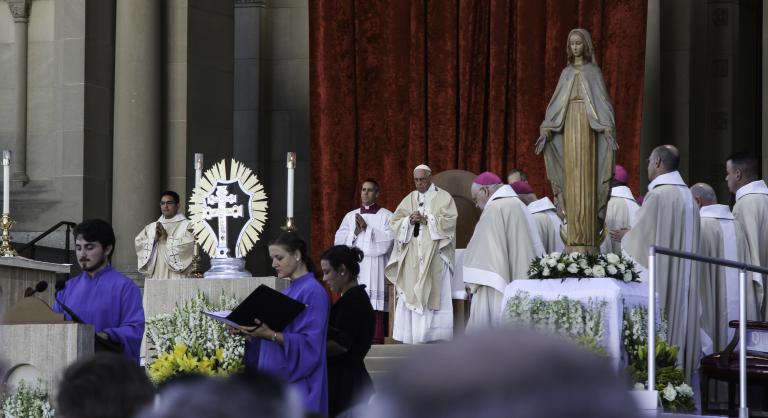
Pope Francis during the Canonization of Junipero Serra (Fr. Lawrence Lew, OP CC BY-NC-ND 2.0 https://www.flickr.com/photos/paullew/21651761466/)
It’s crazy what gets spread online today. One website was posting that Pope Francis denied the Immaculate Conception in his Christmas greetings to Vatican employees. Really? I will include their claim, explain why it’s wrong, point to the times Francis affirmed the Immaculate Conception, and conclude with a note on interpretation.
The Claim of Denial
Gloria.tv wrote a piece titled, “Francis Denying Immaculate Conception: ‘Mary Not Born A Saint.'” This attributes heresy to the following lines:
In his Christmas greetings to the employees of the Holy See on December 21, Pope Francis spoke about Our Lady and Saint Joseph in the Nativity scene being full of holiness and joy.
He continued: “And you will tell me: of course! They are Our Lady and Saint Joseph! Yes, but let us not think it was easy for them: saints are not born, they become thus, and this is true for them too.”
According to Catholic doctrine Our Lady was conceived without original sin and therefore born a saint.
It is odd when an article has a quote attributed to a person in the title but that quote is not in the article.
The Actual Address
The Vatican website includes the full text of the address. The key section is:
Let us look at the Nativity scene. Who is happy, in the Nativity? I would like to ask you children, who love to look at the little figures … and maybe even move them a bit, putting them in different places, angering their dad, who arranged them with such care!
So who is happy in the Nativity scene? Our Lady and Saint Joseph are full of joy: they look at the Child Jesus and they are happy because, after a thousand worries, they have accepted this gift of God, with so much faith and so much love. They are “overflowing” with holiness and therefore with joy. And you will tell me: of course! They are Our Lady and Saint Joseph! Yes, but let us not think it was easy for them: saints are not born, they become thus, and this is true for them too.
Now, what is Pope Franics’s point? It seems to be that each person – even Mary and Joseph – needs to grow in holiness. We become saints by our actions. Of course, Mary was born Immaculately Conceived but she still had free will and if she chose sin she would not have been a saint. She still had to strive for holiness.
Francis on the Immaculate Conception
Pope Francis has even clearly affirmed the Immaculate Conception on multiple occasions. Here are a few.
December 8, 2013:
In view of this motherhood, Mary was preserved from original sin, from that fracture in communion with God, with others and with creation, which deeply wounds every human being. But this fracture was healed in advance in the Mother of the One who came to free us from the slavery of sin. The Immaculata was written in God’s design; she is the fruit of God’s love that saves the world.
Also, December 8, 2013:
You are all-beautiful, O Mary!
In you there is no sin.
December 8, 2014:
The Angel Gabriel calls Mary “full of grace” (Lk 1:28): in her there is no room for sin, because God chose her from eternity to be the mother of Jesus and preserved her from original sin.
Also, December 8, 2014:
Today the People of God celebrate, they venerate you, the Immaculate, ever preserved from the stain of sin. […]
Though we are sinners, we are still your children, the children of the Immaculate, called to that holiness that has shown resplendent in you by the grace of God from the beginning.
December 8, 2016:
He [Jesus] was made equal to us in every way, except one thing, that ‘no’. Except sin. For this reason, he chose Mary, the only creature without sin, immaculate. In the Gospel, with one word only, she is called “full of grace” (Lk 1:28), that is, filled with grace. It means that, in her, full of grace from the start, there is no space for sin. And when we turn to her, we too recognize this beauty: we invoke her, “full of grace”, without a shadow of evil.
December 8, 2017:
Even the greatest saints were sinners and everything in reality, even the most beautiful things, are corroded by evil: everything, except Mary. She is the one “evergreen oasis” of humanity, the only one uncontaminated, created immaculate so as to fully welcome, with her ‘yes’, God who came into the world and thus to begin a new history.
Please Read Francis Fairly
Pope Francis often speaks casually and informally, versus using strict theological language. Whatever you think of this stylistic choice, it is only fair to interpret informal addresses knowing this. When Pope Francis wants to say that even Mary and Joseph faced challenges being holy, I think we all agree. In saying they became saints through their life, he isn’t denying the Immaculate Conception but focusing on Mary’s actions. Let’s read Francis fairly.
Become a Patron! (The best Christmas gift you can give me).
Addendum (added later)
Several people made good arguments in comments to me. If I were to baptize an infant then say right after, “I hope he grows up to be a saint,” I am not denying the efficacy of baptism at removing all sin. Even if someone is free of sin, they can still grow more in virtue. This is the analogy of the different buckets which St Therese of Lisieux is so famous for. Or it’s like a kid might get 100% on math in grade 4 and grade 12 – both are perfect but I think we’d all agree the high school student knows more math.
Furthermore, the word “saint” has two meanings. The first is “one who is in heaven.” The second is “a holy person in heaven or on earth.” Obviously, Mary was not a saint by the first definition till the Assumption.
As well, Dave Armstrong quoted this in an extended version if you want it.
Previous Post
December 28, 2018
Burning Questions about Catholicism: Theology Q&A on CuriousCat
Browse Our Archives
Select a Category Autism Bioethics Book Review Business and Economics Catholic Social Teaching Culture Diocesan Life Disability Discipleship Euthanasia Family Life Genetics Global Politics History Immigration Inspiration Interview Liturgy Moral Theology My Life News Analysis Original Articles Prayer Privacy Pro-Life Science Sexual orientation or identity Social Media Sports Technology Theology Uncategorized US Politics Vatican
Select a Month March 2022 February 2022 January 2022 December 2021 November 2021 October 2021 September 2021 August 2021 July 2021 June 2021 April 2021 March 2021 February 2021 January 2021 December 2020 November 2020 October 2020 September 2020 August 2020 July 2020 June 2020 May 2020 April 2020 March 2020 February 2020 January 2020 December 2019 November 2019 October 2019 September 2019 August 2019 July 2019 June 2019 May 2019 April 2019 March 2019 February 2019 January 2019 December 2018 November 2018 October 2018 September 2018 August 2018 July 2018 June 2018 May 2018
Follow Us!
TAKE THE
Religious Wisdom Quiz
What disciple walked on water toward Jesus?
Select your answer to see how you score.
Peter Matthew James John
Support this
Column


Related posts from Through Catholic Lenses
Russia Was Consecrated in 1984 to the Immaculate...

Greg Locke, Autism Is not Demonic

The Church Cannot Change Teaching on Homosexuality (Hollerich...
Catholic Media: Fides Quarens Rem Publicam
TRENDING AT PATHEOS Catholic

Rejecting Doom: Christian Hope And Human Action
Christianity is a religion of hope. We are to have hope and...

It’s What Comes From Within Which Matters
One of the most difficult things for us to understand is why...

Why I Choose the Eucharist Over the Sermon
Choose the Eucharist, Not the Sermon What are we supposed to get...

5 Design Elements Found in Spiritually Rooted Homes
Putting Spirituality Into Home Decor Our homes are more than our living...

Credo: A Story of God Told with the...
About 10 years ago, I began to imagine a personal "Credo" that...

The Anatomy of Divine Revelation in Catholic Thought
The claim that God has made Himself known to human beings is...
view all Catholic blogs
Ad-Free & Subscriber Log-In Subscription Support
- About Us
- 2026 Calendar
- Videos
- Podcasts
- Library of World Religions
- Faith In Media Tracker
- Advertise With Us
- Write for Us
- Privacy Policy
- Terms of Service
- Do Not Sell My Data
- Contact Us
- Radiant Digital
- Manage Newsletter Subscriptions
- Unsubscribe From Notifications
- Sitemap
Copyright 2008-2026, Patheos. All rights reserved.
Subscription Support Ad-Free & Subscriber Log-In
Follow Patheos