
BuddhistCatholicContemplativeEvangelicalGeneral ChristianHinduJewishLatter-day SaintMuslimNew VisionsProgressive Christian
Beliefs
- Buddhist
- Catholic
- Contemplative
- Evangelical
- General Christian
- Hindu
- Jewish
- Latter-day Saint
- More Voices
- Muslim
- New Visions
- Pagan
- Progressive Christian
Topics
- Religion News
- Food and Religion
- Sports and Religion
- Religious Art
- Religious Music and Entertainment
- Religious Events
- History and Religion
- Style and Religion
- Politics and Religion
- Women in Religion
- Recreation Outdoors and Religion
- Business Finance and Religion
- Careers Workplace and Religion
- Education and Religion
- Family Parenting and Religion
- Health Fitness and Religion
- Home and Religion
- Relationships and Religion
- Technology and Religion
- Travel and Religion
Columnists
- Buddhist Columnists
- Business Finance and Religion Columnists
- Careers Workplace and Religion Columnists
- Catholic Columnists
- Contemplative Columnists
- Education and Religion Columnists
- Evangelists Columnists
- Family Parenting and Religion Columnists
- General Christian Columnists
- Health Fitness and Religion Columnists
- Hindu Columnists
- History and Religion Columnists
- Home and Religion Columnists
- Jewish Columnists
- More Voices Columnists
- Latter Day Columnists
- Muslim Columnists
- New Visions Columnists
- Nonreligious Columnists
- Pagan Columnists
- Politics and Religion Columnists
- Progressive Columnists
- Recreation Outdoors and Religion Columnists
- Relationships and Religion Columnists
- Religion News Columnists
- Religious Art Columnists
- Religious Events Columnists
- Religious Music and Entertainment Columnists
- Sports and Religion Columnists
- Style and Religion Columnists
- Technology and Religion Columnists
- Travel and Religion Columnists
- Women in Religion Columnists
Resource Library
- 2026 Calendar
- Library of World Religions
- The 100 Most Holy Places on Earth
- Patheos Answers
- Podcasts
- Videos
- Faith Leaders Database
- Anglican Episcopalian
- Bahai
- Baptist
- Buddhism
- Christianity
- Confucianism
- Eastern Orthodoxy
- Hinduism
- Holiness and Pentecostal
- ISKCON
- Islam
- Judaism
- Lutheran
- Methodist
- The Church of Jesus Christ of Latter-day Saints
- New Age
- Paganism
- Presbytarian and Reformed
- Protestantism
- Religion Behind the Scenes
- Roman Catholic
- Scientology
- Shia Islam
- Sikhism
- Sufism
- Sunni Islam
- Taoism
- Zen
- See all religions
Research Tools
 Ad-Free & Subscriber Log-In Subscription Support
Ad-Free & Subscriber Log-In Subscription Support
Follow Patheos 

- Trending:
- Forgiveness
- |
- Marriage
- |
- Consciousness
- |
- Death Penalty
- |
- Election
- |
- Halloween
 Through Catholic Lenses
- Home
- Catholic
- Religion News
- UPDATED x2: Moral & Practical Problems with the 1st Gene-Edited Babies
UPDATED x2: Moral & Practical Problems with the 1st Gene-Edited Babies
Last updated on: November 29, 2018 at 10:29 am by Fr. Matthew P. Schneider, LC
UPDATED x2: Moral & Practical Problems with the 1st Gene-Edited Babies 2018-11-29T10:29:15-05:00 Fr. Matthew P. Schneider, LC
Patheos Explore the world's faith through different perspectives on religion and spirituality! Patheos has the views of the prevalent religions and spiritualities of the world.
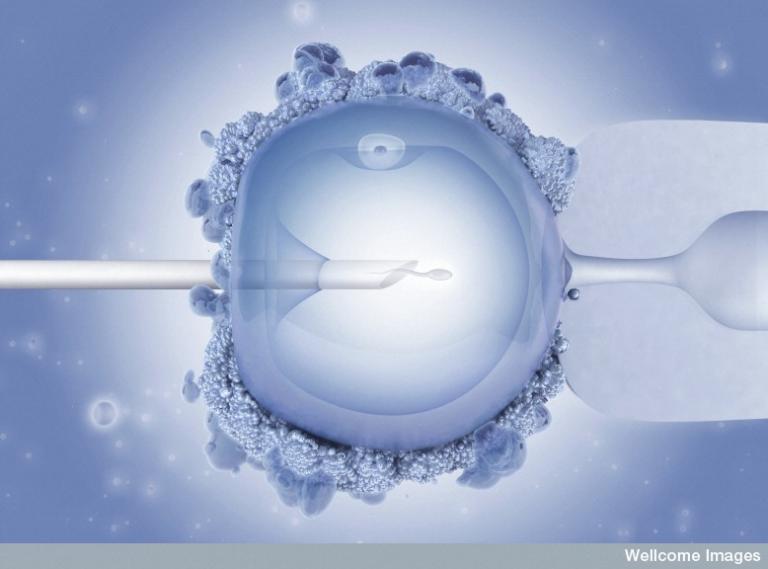
Intracytoplasmic sperm injection (ICSI)
Credit: Maurizio De Angelis. Wellcome Images
[email protected]
http://images.wellcome.ac.uk
Early this morning, there was a shocking announcement out of China. They performed gene editing on humans, and a woman had gotten pregnant with genetically edited babies. I want to note this, then discuss the moral and practical problems.
AP carried the story as an exclusive:
A Chinese researcher claims that he helped make the world’s first genetically edited babies — twin girls born this month whose DNA he said he altered with a powerful new tool capable of rewriting the very blueprint of life. […]
The researcher, He Jiankui of Shenzhen, said he altered embryos for seven couples during fertility treatments, with one pregnancy resulting thus far. He said his goal was not to cure or prevent an inherited disease, but to try to bestow a trait that few people naturally have — an ability to resist possible future infection with HIV, the AIDS virus.
Moral Issues with Gene Editing
Even the AP story includes some ethical concerns over this.
Some scientists were astounded to hear of the claim and strongly condemned it.
It’s “unconscionable … an experiment on human beings that is not morally or ethically defensible,” said Dr. Kiran Musunuru, a University of Pennsylvania gene editing expert and editor of a genetics journal.
“This is far too premature,” said Dr. Eric Topol, who heads the Scripps Research Translational Institute in California. “We’re dealing with the operating instructions of a human being. It’s a big deal.”
However, one famed geneticist, Harvard University’s George Church, defended attempting gene editing for HIV, which he called “a major and growing public health threat.”
“I think this is justifiable,” Church said of that goal.
I am more of the school of Musunuru and Topol, not Church.
Catholic Teaching on Gene Editing
The Catholic Church has not forbidden gene editing completely but we condemn any editing that would be added passed on to further generations. Even US law note this distinction. AP explains, “It’s only recently been tried in adults to treat deadly diseases, and the changes are confined to that person. Editing sperm, eggs or embryos is different — the changes can be inherited. In the U.S., it’s not allowed except for lab research.”
The reasons for Church teaching are explained in Dignitas Personae 26:
For a moral evaluation the following distinctions need to be kept in mind. Procedures used on somatic cells for strictly therapeutic purposes are in principle morally licit. Such actions seek to restore the normal genetic configuration of the patient or to counter damage caused by genetic anomalies or those related to other pathologies. Given that gene therapy can involve significant risks for the patient, the ethical principle must be observed according to which, in order to proceed to a therapeutic intervention, it is necessary to establish beforehand that the person being treated will not be exposed to risks to his health or physical integrity which are excessive or disproportionate to the gravity of the pathology for which a cure is sought. […]
The moral evaluation of germ line cell therapy is different. Whatever genetic modifications are effected on the germ cells of a person will be transmitted to any potential offspring. Because the risks connected to any genetic manipulation are considerable and as yet not fully controllable, in the present state of research, it is not morally permissible to act in a way that may cause possible harm to the resulting progeny. In the hypothesis of gene therapy on the embryo, it needs to be added that this only takes place in the context of in vitro fertilization and thus runs up against all the ethical objections to such procedures. For these reasons, therefore, it must be stated that, in its current state, germ line cell therapy in all its forms is morally illicit.
Thus in 2008 (when this was published), the Vatican said wait till further notice on safety before anything that could affect more than an individual patient. ANd we Catholics are whole-heartedly against IVF which is the main way this is done early in life.
Gene Editing Isn’t Easy
AP reported this research used CRISPR-cas9:
In recent years scientists have discovered a relatively easy way to edit genes, the strands of DNA that govern the body. The tool, called CRISPR-cas9, makes it possible to operate on DNA to supply a needed gene or disable one that’s causing problems.
Originally scientists thought CRISPR was a precision tool but this summer a report came out showing it had many unexpected side effects. The issue was that at first they only looked right near the gene they were modifying but it would edit parts of the genome far away. So far we can’t control this.
CRISPR Causes Random Additions and Deletions
New Scientist reported in July:
A study of CRIPSR suggests we shouldn’t rush into trying out CRISPR genome editing inside people’s bodies just yet. The technique can cause big deletions or rearrangements of DNA, says Allan Bradley of the Wellcome Sanger Institute in the UK, meaning some therapies based on CRISPR may not be quite as safe as we thought. […]
In studies of mice and human cells, Bradley’s team has found that in around a fifth of cells, CRISPR causes deletions or rearrangements more than 100 DNA letters long. These surprising changes are sometimes thousands of letters long. […]
“There’s a risk of causing cancer sometime in a patient’s lifetime,” says Bradley. “We need to understand more before rushing into human clinical trials.”
“I do believe the findings are robust,” says Gaetan Burgio of the Australian National University, an expert on CRISPR who has debunked previous studies questioning the method’s safety. “This is a well-performed study and fairly significant.”
Hence, despite a bit of fanfare for CRISPR it is not safe enough for human use that might be inherited. This goes back to the Vatican’s statement about “in the present state of research” we can’t use this.
Not Now and Probably Not Ever
Given that gene editing is such a difficult and precise operation, I’m thinking it will always be difficult and prone to random errors when done on the large scale of a whole developed human body. It could be done on an early zygote but that implies IVF which is immoral. If done in an IVF setting, it is likely to produce extra babies they throw away because the procedure didn’t work perfectly on them. This is a form of ableism.
I think the Vatican is right to currently have a moratorium on such treatments on embryos or germ cells of developed humans. I suspect that at least in my lifetime we will not know enough to end that moratorium. We need to see the value in humans that are seen as otherwise imperfect and not try to play with our genes.
Updates
November 27
MIT Technology Review reported that even in China, this raised some concerns and He Jiankui is under investigation.
A Chinese researcher who claims to have created the first gene-edited babies, He Jiankui of the Southern University of Science and Technology (SUST), in Shenzhen, is now facing investigation over whether the experiment broke Chinese laws or regulations. […]
On Sunday, the Shenzhen City Medical Ethics Expert Board said it would begin an investigation of He’s research and released a statement saying that HarMoniCare “according to our findings … never conducted the appropriate reporting according to requirements.” The former medical director of the private hospital, Jiang Su-Qi, told Southern Capital News he had no recollection of approving He’s research while he was on its ethics committee.
“These two children are the guinea pigs. They will go through their whole maturing process having not understood the risks ahead of time,” said Liu Ying of Peking University’s Institute of Molecular Medicine.
November 28
The NIH condemned this action in no uncertain terms:
This work represents a deeply disturbing willingness by Dr. He and his team to flout international ethical norms. The project was largely carried out in secret, the medical necessity for inactivation of CCR5 in these infants is utterly unconvincing, the informed consent process appears highly questionable, and the possibility of damaging off-target effects has not been satisfactorily explored. It is profoundly unfortunate that the first apparent application of this powerful technique to the human germline has been carried out so irresponsibly.
If you like what you see, please sponsor me on Patreon. I get very little from my online writing and want to do my fair share to help my religious community. Even $2 a month helps.
Previous Post

November 26, 2018
Elizabeth Bruenig: Tell the Whole Truth to End the Crisis
Next Post

November 27, 2018 #GivingTuesday: Help My Community Replace Our Roof
Browse Our Archives
Select a Category Autism Bioethics Book Review Business and Economics Catholic Social Teaching Culture Diocesan Life Disability Discipleship Euthanasia Family Life Genetics Global Politics History Immigration Inspiration Interview Liturgy Moral Theology My Life News Analysis Original Articles Prayer Privacy Pro-Life Science Sexual orientation or identity Social Media Sports Technology Theology Uncategorized US Politics Vatican
Select a Month March 2022 February 2022 January 2022 December 2021 November 2021 October 2021 September 2021 August 2021 July 2021 June 2021 April 2021 March 2021 February 2021 January 2021 December 2020 November 2020 October 2020 September 2020 August 2020 July 2020 June 2020 May 2020 April 2020 March 2020 February 2020 January 2020 December 2019 November 2019 October 2019 September 2019 August 2019 July 2019 June 2019 May 2019 April 2019 March 2019 February 2019 January 2019 December 2018 November 2018 October 2018 September 2018 August 2018 July 2018 June 2018 May 2018
Follow Us!
TAKE THE
Religious Wisdom Quiz
Which parable tells of a traveler who fell among thieves?
Select your answer to see how you score.
The Rich Fool The Good Samaritan The Lost Coin The Pearl of Great Price
Support this
Column


Related posts from Through Catholic Lenses

Sensory-Friendly Mass Directory Now Available

Greg Locke, Autism Is not Demonic

The Church Cannot Change Teaching on Homosexuality (Hollerich...
21 of the Most Dynamic Signs at March...
TRENDING AT PATHEOS Catholic

Rejecting Doom: Christian Hope And Human Action
Christianity is a religion of hope. We are to have hope and...

It’s What Comes From Within Which Matters
One of the most difficult things for us to understand is why...

Why I Choose the Eucharist Over the Sermon
Choose the Eucharist, Not the Sermon What are we supposed to get...

5 Design Elements Found in Spiritually Rooted Homes
Putting Spirituality Into Home Decor Our homes are more than our living...

Credo: A Story of God Told with the...
About 10 years ago, I began to imagine a personal "Credo" that...

The Anatomy of Divine Revelation in Catholic Thought
The claim that God has made Himself known to human beings is...
view all Catholic blogs
Ad-Free & Subscriber Log-In Subscription Support
- About Us
- 2026 Calendar
- Videos
- Podcasts
- Library of World Religions
- Faith In Media Tracker
- Advertise With Us
- Write for Us
- Privacy Policy
- Terms of Service
- Do Not Sell My Data
- Contact Us
- Radiant Digital
- Manage Newsletter Subscriptions
- Unsubscribe From Notifications
- Sitemap
Copyright 2008-2026, Patheos. All rights reserved.
Subscription Support Ad-Free & Subscriber Log-In
Follow Patheos