
BuddhistCatholicContemplativeEvangelicalGeneral ChristianHinduJewishLatter-day SaintMuslimNew VisionsProgressive Christian
Beliefs
- Buddhist
- Catholic
- Contemplative
- Evangelical
- General Christian
- Hindu
- Jewish
- Latter-day Saint
- More Voices
- Muslim
- New Visions
- Pagan
- Progressive Christian
Topics
- Religion News
- Food and Religion
- Sports and Religion
- Religious Art
- Religious Music and Entertainment
- Religious Events
- History and Religion
- Style and Religion
- Politics and Religion
- Women in Religion
- Recreation Outdoors and Religion
- Business Finance and Religion
- Careers Workplace and Religion
- Education and Religion
- Family Parenting and Religion
- Health Fitness and Religion
- Home and Religion
- Relationships and Religion
- Technology and Religion
- Travel and Religion
Columnists
- Buddhist Columnists
- Business Finance and Religion Columnists
- Careers Workplace and Religion Columnists
- Catholic Columnists
- Contemplative Columnists
- Education and Religion Columnists
- Evangelists Columnists
- Family Parenting and Religion Columnists
- General Christian Columnists
- Health Fitness and Religion Columnists
- Hindu Columnists
- History and Religion Columnists
- Home and Religion Columnists
- Jewish Columnists
- More Voices Columnists
- Latter Day Columnists
- Muslim Columnists
- New Visions Columnists
- Nonreligious Columnists
- Pagan Columnists
- Politics and Religion Columnists
- Progressive Columnists
- Recreation Outdoors and Religion Columnists
- Relationships and Religion Columnists
- Religion News Columnists
- Religious Art Columnists
- Religious Events Columnists
- Religious Music and Entertainment Columnists
- Sports and Religion Columnists
- Style and Religion Columnists
- Technology and Religion Columnists
- Travel and Religion Columnists
- Women in Religion Columnists
Resource Library
- 2026 Calendar
- Library of World Religions
- The 100 Most Holy Places on Earth
- Patheos Answers
- Podcasts
- Videos
- Faith Leaders Database
- Anglican Episcopalian
- Bahai
- Baptist
- Buddhism
- Christianity
- Confucianism
- Eastern Orthodoxy
- Hinduism
- Holiness and Pentecostal
- ISKCON
- Islam
- Judaism
- Lutheran
- Methodist
- The Church of Jesus Christ of Latter-day Saints
- New Age
- Paganism
- Presbytarian and Reformed
- Protestantism
- Religion Behind the Scenes
- Roman Catholic
- Scientology
- Shia Islam
- Sikhism
- Sufism
- Sunni Islam
- Taoism
- Zen
- See all religions
Research Tools
 Ad-Free & Subscriber Log-In Subscription Support
Ad-Free & Subscriber Log-In Subscription Support
Follow Patheos 

- Trending:
- Forgiveness
- |
- Marriage
- |
- Consciousness
- |
- Death Penalty
- |
- Election
- |
- Halloween
 Through Catholic Lenses
- Home
- Catholic
- Religion News
- Should We Use Technology in Homilies?
Should We Use Technology in Homilies?
Last updated on: July 30, 2018 at 9:05 am by Fr. Matthew P. Schneider, LC
Should We Use Technology in Homilies? 2018-07-30T09:05:41-04:00 Fr. Matthew P. Schneider, LC
Patheos Explore the world's faith through different perspectives on religion and spirituality! Patheos has the views of the prevalent religions and spiritualities of the world.
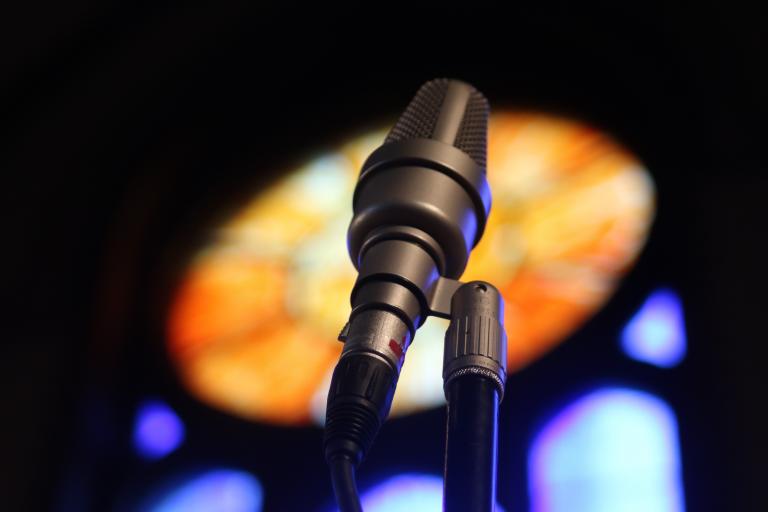 There has been some debate about the role of technology in homilies. Dioceses might run a video of the bishop in place of the homily or others may be averse to almost any technology in church. I take a slightly more moderated view which Homiletic and Pastoral Review recently published. Here are a few highlights.
I want to go a little deeper than matters such as the “effectiveness” or “process” of preaching to focus on the arguments around the homily as a liturgical act. Preaching can be anything from street preaching, to homilies, to a bioethics course for clergy. The situation in such cases is so different that we can’t really come to a universal rule regarding technology. Maybe on the street corner, showing a 3-D holographic version of Jesus’ life is the most effective; and in the case of bioethics, you probably want slides showing stats or details of procedures. What concerns us is the homily, and what is unique about the homily compared to all other forms of preaching, which is that it is liturgical. It is not an additional flair, like a musical setting of Beethoven. Vatican II goes so far as to declare that the homily, “Is to be highly esteemed as part of the liturgy itself.” Thus, we will focus on technology in the homily as part of the liturgy, not preaching in general.
I will argue that technology can be used around the homily, but not in it.
[…]
Media as Liturgical Message
Liturgy has a message that is inappropriate for technology to mediate. Marshall McLuhan’s quote, “The media is the message,” makes us ask if the technological medium is appropriate for the liturgical message. Non-liturgical preaching says God can save us and God can dwell among us. The liturgy, on the other hand, proclaims that through these acts, God saves us and dwells among us. Actualization cannot be transmitted or mediated by technology.
Romano Guardini makes three points about this: “The liturgy has no purpose, or, at least, it cannot be considered from the standpoint of purpose. It is not a means which is adapted to attain a certain end— it is an end in itself […] it does not exist for the sake of humanity, but for the sake of God.”
[…]
The Liturgy vs. the Everyday
An excessive use of technology tends to lower the liturgy to the everyday. To explain this, we must first separate the liturgy from the everyday, as part of “leisure,” then examine how technology yanks it back down into the everyday.
Josef Pieper develops the idea of leisure in his book Leisure: The Basis of Culture. He distinguishes leisure from the everyday, “Leisure is not the attitude of mind of those who actively intervene, but of those who are open to everything; not of those who grab and hold, but those who leave the reigns loose.” Leisure is not just a non-activity or relaxation, but something where we can let go, and be caught up in the crowd, the emotion, the sacred, God, etc. Such letting go is not without a goal but, “In leisure… the truly human values are saved from and preserved because leisure is the means whereby the sphere of the ‘specifically human’ can […] be left behind […] as in an ecstasy.” Thus, leisure is the height of human activity where man reaches his highest level, and what is most human comes from what is above the merely human. Leisure does not exist on its own, but: “Culture depends for its very existence of leisure, and leisure, in its turn, is not possible unless it has a durable and consequently living link with cultus, with divine worship.”
[…]
Conclusion
In conclusion, we see that technology can be used around the homily, and in non-liturgical preaching. However, the nature of the liturgy prevents it from being part of the homily because it transforms the message of the liturgy, and it brings the liturgy down from its proper role as worship. Rules for preaching reinforce these two reasons, and add a few minor ones that reinforce the idea that the liturgical acts should not be done technologically.
If this interests you at all, I highly recommend you read the whole article on the HPR website.

Browse Our Archives
Select a Category Autism Bioethics Book Review Business and Economics Catholic Social Teaching Culture Diocesan Life Disability Discipleship Euthanasia Family Life Genetics Global Politics History Immigration Inspiration Interview Liturgy Moral Theology My Life News Analysis Original Articles Prayer Privacy Pro-Life Science Sexual orientation or identity Social Media Sports Technology Theology Uncategorized US Politics Vatican
Select a Month March 2022 February 2022 January 2022 December 2021 November 2021 October 2021 September 2021 August 2021 July 2021 June 2021 April 2021 March 2021 February 2021 January 2021 December 2020 November 2020 October 2020 September 2020 August 2020 July 2020 June 2020 May 2020 April 2020 March 2020 February 2020 January 2020 December 2019 November 2019 October 2019 September 2019 August 2019 July 2019 June 2019 May 2019 April 2019 March 2019 February 2019 January 2019 December 2018 November 2018 October 2018 September 2018 August 2018 July 2018 June 2018 May 2018
Follow Us!
TAKE THE
Religious Wisdom Quiz
Which prophet spoke of a 'new covenant' in the Old Testament?
Select your answer to see how you score.
Jeremiah Malachi Isaiah Ezekiel
Support this
Column


Related posts from Through Catholic Lenses

Why Such a Focus on Extraordinary Form in...

Sensory-Friendly Mass Directory Now Available
Catholic Media: Fides Quarens Rem Publicam

21 of the Most Dynamic Signs at March...
TRENDING AT PATHEOS Catholic

Rejecting Doom: Christian Hope And Human Action
Christianity is a religion of hope. We are to have hope and...

It’s What Comes From Within Which Matters
One of the most difficult things for us to understand is why...

Why I Choose the Eucharist Over the Sermon
Choose the Eucharist, Not the Sermon What are we supposed to get...

5 Design Elements Found in Spiritually Rooted Homes
Putting Spirituality Into Home Decor Our homes are more than our living...

Credo: A Story of God Told with the...
About 10 years ago, I began to imagine a personal "Credo" that...

The Anatomy of Divine Revelation in Catholic Thought
The claim that God has made Himself known to human beings is...
view all Catholic blogs
Ad-Free & Subscriber Log-In Subscription Support
- About Us
- 2026 Calendar
- Videos
- Podcasts
- Library of World Religions
- Faith In Media Tracker
- Advertise With Us
- Write for Us
- Privacy Policy
- Terms of Service
- Do Not Sell My Data
- Contact Us
- Radiant Digital
- Manage Newsletter Subscriptions
- Unsubscribe From Notifications
- Sitemap
Copyright 2008-2026, Patheos. All rights reserved.
Subscription Support Ad-Free & Subscriber Log-In
Follow Patheos