
BuddhistCatholicContemplativeEvangelicalGeneral ChristianHinduJewishLatter-day SaintMuslimNew VisionsProgressive Christian
Beliefs
- Buddhist
- Catholic
- Contemplative
- Evangelical
- General Christian
- Hindu
- Jewish
- Latter-day Saint
- More Voices
- Muslim
- New Visions
- Pagan
- Progressive Christian
Topics
- Religion News
- Food and Religion
- Sports and Religion
- Religious Art
- Religious Music and Entertainment
- Religious Events
- History and Religion
- Style and Religion
- Politics and Religion
- Women in Religion
- Recreation Outdoors and Religion
- Business Finance and Religion
- Careers Workplace and Religion
- Education and Religion
- Family Parenting and Religion
- Health Fitness and Religion
- Home and Religion
- Relationships and Religion
- Technology and Religion
- Travel and Religion
Columnists
- Buddhist Columnists
- Business Finance and Religion Columnists
- Careers Workplace and Religion Columnists
- Catholic Columnists
- Contemplative Columnists
- Education and Religion Columnists
- Evangelists Columnists
- Family Parenting and Religion Columnists
- General Christian Columnists
- Health Fitness and Religion Columnists
- Hindu Columnists
- History and Religion Columnists
- Home and Religion Columnists
- Jewish Columnists
- More Voices Columnists
- Latter Day Columnists
- Muslim Columnists
- New Visions Columnists
- Nonreligious Columnists
- Pagan Columnists
- Politics and Religion Columnists
- Progressive Columnists
- Recreation Outdoors and Religion Columnists
- Relationships and Religion Columnists
- Religion News Columnists
- Religious Art Columnists
- Religious Events Columnists
- Religious Music and Entertainment Columnists
- Sports and Religion Columnists
- Style and Religion Columnists
- Technology and Religion Columnists
- Travel and Religion Columnists
- Women in Religion Columnists
Resource Library
- 2026 Calendar
- Library of World Religions
- The 100 Most Holy Places on Earth
- Patheos Answers
- Podcasts
- Videos
- Faith Leaders Database
- Anglican Episcopalian
- Bahai
- Baptist
- Buddhism
- Christianity
- Confucianism
- Eastern Orthodoxy
- Hinduism
- Holiness and Pentecostal
- ISKCON
- Islam
- Judaism
- Lutheran
- Methodist
- The Church of Jesus Christ of Latter-day Saints
- New Age
- Paganism
- Presbytarian and Reformed
- Protestantism
- Religion Behind the Scenes
- Roman Catholic
- Scientology
- Shia Islam
- Sikhism
- Sufism
- Sunni Islam
- Taoism
- Zen
- See all religions
Research Tools
 Ad-Free & Subscriber Log-In Subscription Support
Ad-Free & Subscriber Log-In Subscription Support
Follow Patheos 

- Trending:
- Forgiveness
- |
- Marriage
- |
- Consciousness
- |
- Death Penalty
- |
- Election
- |
- Halloween
 Through Catholic Lenses
- Home
- Catholic
- Religion News
- Francis’s Ideas for Overcoming a False Dichotomy in Catholic Moral Discussion
Francis’s Ideas for Overcoming a False Dichotomy in Catholic Moral Discussion
Last updated on: May 16, 2018 at 1:28 pm by Fr. Matthew P. Schneider, LC
Francis’s Ideas for Overcoming a False Dichotomy in Catholic Moral Discussion 2018-05-16T13:28:17-04:00 Fr. Matthew P. Schneider, LC
Patheos Explore the world's faith through different perspectives on religion and spirituality! Patheos has the views of the prevalent religions and spiritualities of the world.
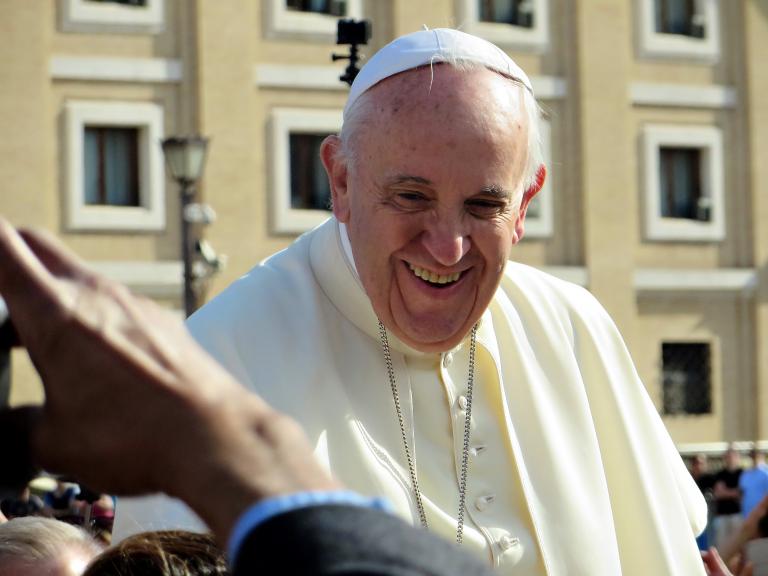
Pope Francis Stock Photo (CC0)
In the debate over Amoris Laetitia, many people assume Pope Francis is allowing Communion for the divorced and remarried in many cases. The debate then switches to if this is good or not. And in this debate, there is a great dichotomy in Catholic discussion. Even in other moral topics, we see a dichotomy where each side takes part of the Catholic view, but not the whole. Pope Francis presents something else that actually includes what is right in both views and supersedes both views.
Division Regarding Amoris Laetitia
From the publication of Amoris Laetitia, Catholic circles have debated whether it is good or bad to allow Communion for the divorced and remarried continuing in relations. However, incorrect assumptions about what Amoris actually says are often behind this. Numerous theologians like Card. Müller, Fastiggi, Eden-Goldstein, Granados, Kampowski, Pérez-Soba, and even I have repeatedly tried to correct these misunderstandings. We have noted that the document does not allow widespread Communion for the divorce remarried. (A selection of articles from the theologians mentioned above pointing out AL does not allow Communion for the divorced and remarried intending to continue relations: 1, 2, 3, 4, 5, 6, 7, and 8.)
Most interpreting chapter 8 as allowing widespread Communion for the divorced and remarried continuing relations have a small oversight. They forget to take into account one key line Francis has about discernment early in that chapter (300): “Discernment can never prescind from the Gospel demands as proposed by the Church.” Discernment is within Church teaching, not apart from it or redefining it. He follows this statement up with perquisites for discernment that paraphrase St. Ignatius of Loyola.
If you missed that distinction, you might think that almost anything is fair game in discernment. However, I think part of Francis’s wisdom is that he wants to open as much as possible to discernment while maintaining the absolute moral teachings of the Church.
Other Moral Questions
Similar discussions often come up in other moral issues the Church. For example, a recent blog presented a tough case regarding NFP where a woman was very scared of a pregnancy. Her fear of PTSD from miscarriages and being overwhelmed by current kids made her seriously consider abortion. A friend, the author, suggests contraception in such a case. The story includes two priests. The first seems to give a kind of situational ethics saying that although Church teaching is true, you can disobey it sometimes. The second priest suggests, “All I could do, he said, was make sure that she committed suicide in a state of grace, without the sin of contraception on her soul.”(!)
Since this is an anonymous story, I don’t want to misjudge either priest as the author may have misunderstood them. However, the story doesn’t mention other avenues to pursue in discerning other possibilities within Church teaching. I and several others in the comments mentioned a rather odd line needing much further investigation: “Her husband had minimal tolerance for the periodic abstinence required by NFP.” How could anyone do discernment about what is right for this couple without considering the husband’s perspective? Especially, when it seems likely to be the cause of her problems. He has chosen, at least on some level, to put his own sexual gratification above his wife’s psychological well-being.
Church teaching gives us a very clear definition that abortion and contraception are always morally wrong. But, it never says anything about a couple needing to practice NFP, or needing to use a particular type of NFP, or how long a month they should abstain, or how many kids they should have, or exactly what timing they should strive for with those kids, or anything of the sort. Within the matrix of options, I don’t think there is a single right choice for every Catholic couple. Church teaching limits unacceptable areas but does not define which of the acceptable options a particular couple should take. That is where discernment comes in.
Chesterton’s Analogy Leads to Pope Francis’s Solution to the Dichotomy
G. K. Chesterton gives an analogy that is very applicable in this case, which I’ll develop. He notes that church teaching is like walls – but walls protecting us from falling off a cliff. If we were on an island with 100-foot cliffs around and a raging sea below, most of us would huddle in the center. We’d be scared and want to protect ourselves from the danger. However, if there are solid walls just before those cliffs that we knew we could rely on, instead of cowering in the center we could run around, play soccer, enjoy a good beer, or all kinds of wonderful possibilities. Chesterton argues that the Church’s moral teaching allows us to enjoy life fully within those walls.
Pope Francis often points out the limits of where we can go in the Church. For example, in Gaudete et Exsultate 161, he noted, “We should not think of the devil as a myth, a representation, a symbol, a figure of speech or an idea. This mistake would lead us to let down our guard, to grow careless and end up more vulnerable.” But he doesn’t stop there.
At the same time, Pope Francis emphasizes discernment. For him, it allows this particular person to determine where within the walls to set up their abode. It is not as a way to climb the walls and fall into the sea. A Catholic can never set up shop away from Church teaching, but within it, many options exist. One can discern: religious or layperson, Franciscan or Jesuit, Susan can marry Joe or Steve, praying the rosary or the divine mercy chaplet daily, etc. None of these choices have a wrong or sinful option.
Pope Francis Builds on John Paul II Regarding Discernment
The concept of discernment is in previous Popes, but Francis seems to focus on it more. St. John Paul II said, “Pastors must know that, for the sake of truth, they are obliged to exercise careful discernment of situations.” (Familiaris Consortio, 84) John Paul II looked at discernment as picking between the possible options form those options within Church teaching. He is noting the difference between the one being abandoned and the one abandoning, or similar distinctions. For example, a pastor would probably discern a more conciliatory path for an abandoned spouse than the one abandoning.
Francis develops the idea of discernment in various ways based off John Paul II. Francis wants young people to discern who they marry: “The decision to marry and to have a family ought to be the fruit of a process of vocational discernment.” (Amoris Laetitia 72, cf. 209) He also applies this to people with marital complexities: “In such cases, bishops are called to exercise a pastoral discernment which is commensurate with their spiritual good.” (AL 249) It would never be in the spiritual good of a person to lead them outside the walls of Church teaching.
Francis says that discernment should foster growth, both in the spiritual life and in virtue (AL 293). He speaks of, “A process of accompaniment and discernment which guides the faithful to an awareness of their situation before God.” (AL 300) If you are making someone aware of their situation before God, you can’t be ignoring or sidestepping their moral responsibilities.
Francis seems to want to try to find the best option for each individual or couple within Church teaching. And he sees discernment as the way there.
Conclusion
This understanding of Francis resolves the dichotomy between the two sides. The one side wants to be certain we maintain the rules. This methodology completely maintains the absolute certainty of rules as the limit to discernment. The other side wants to find a solution for people in tough situations, even if outside the ordinary. This view does that by putting an emphasis on discernment within the Church’s moral teaching.
Previous Post

May 11, 2018
69% of Russian Orthodox Accept "And the Son" - A Step Towards Unity?
Next Post
May 15, 2018 Pope Francis's Choice for the JP2 Institute Defends Humanae Vitae
Browse Our Archives
Select a Category Autism Bioethics Book Review Business and Economics Catholic Social Teaching Culture Diocesan Life Disability Discipleship Euthanasia Family Life Genetics Global Politics History Immigration Inspiration Interview Liturgy Moral Theology My Life News Analysis Original Articles Prayer Privacy Pro-Life Science Sexual orientation or identity Social Media Sports Technology Theology Uncategorized US Politics Vatican
Select a Month March 2022 February 2022 January 2022 December 2021 November 2021 October 2021 September 2021 August 2021 July 2021 June 2021 April 2021 March 2021 February 2021 January 2021 December 2020 November 2020 October 2020 September 2020 August 2020 July 2020 June 2020 May 2020 April 2020 March 2020 February 2020 January 2020 December 2019 November 2019 October 2019 September 2019 August 2019 July 2019 June 2019 May 2019 April 2019 March 2019 February 2019 January 2019 December 2018 November 2018 October 2018 September 2018 August 2018 July 2018 June 2018 May 2018
Follow Us!
TAKE THE
Religious Wisdom Quiz
Who said: "Count it all joy when you fall into various trials"?
Select your answer to see how you score.
James Jesus Peter Paul
Support this
Column


Related posts from Through Catholic Lenses

Why Such a Focus on Extraordinary Form in...
Russia Was Consecrated in 1984 to the Immaculate...

The Church Cannot Change Teaching on Homosexuality (Hollerich...
Catholic Media: Fides Quarens Rem Publicam
TRENDING AT PATHEOS Catholic

Rejecting Doom: Christian Hope And Human Action
Christianity is a religion of hope. We are to have hope and...

It’s What Comes From Within Which Matters
One of the most difficult things for us to understand is why...

Why I Choose the Eucharist Over the Sermon
Choose the Eucharist, Not the Sermon What are we supposed to get...

5 Design Elements Found in Spiritually Rooted Homes
Putting Spirituality Into Home Decor Our homes are more than our living...

Credo: A Story of God Told with the...
About 10 years ago, I began to imagine a personal "Credo" that...

The Anatomy of Divine Revelation in Catholic Thought
The claim that God has made Himself known to human beings is...
view all Catholic blogs
Ad-Free & Subscriber Log-In Subscription Support
- About Us
- 2026 Calendar
- Videos
- Podcasts
- Library of World Religions
- Faith In Media Tracker
- Advertise With Us
- Write for Us
- Privacy Policy
- Terms of Service
- Do Not Sell My Data
- Contact Us
- Radiant Digital
- Manage Newsletter Subscriptions
- Unsubscribe From Notifications
- Sitemap
Copyright 2008-2026, Patheos. All rights reserved.
Subscription Support Ad-Free & Subscriber Log-In
Follow Patheos