
BuddhistCatholicContemplativeEvangelicalGeneral ChristianHinduJewishLatter-day SaintMuslimNew VisionsProgressive Christian
Beliefs
- Buddhist
- Catholic
- Contemplative
- Evangelical
- General Christian
- Hindu
- Jewish
- Latter-day Saint
- More Voices
- Muslim
- New Visions
- Pagan
- Progressive Christian
Topics
- Religion News
- Food and Religion
- Sports and Religion
- Religious Art
- Religious Music and Entertainment
- Religious Events
- History and Religion
- Style and Religion
- Politics and Religion
- Women in Religion
- Recreation Outdoors and Religion
- Business Finance and Religion
- Careers Workplace and Religion
- Education and Religion
- Family Parenting and Religion
- Health Fitness and Religion
- Home and Religion
- Relationships and Religion
- Technology and Religion
- Travel and Religion
Columnists
- Buddhist Columnists
- Business Finance and Religion Columnists
- Careers Workplace and Religion Columnists
- Catholic Columnists
- Contemplative Columnists
- Education and Religion Columnists
- Evangelists Columnists
- Family Parenting and Religion Columnists
- General Christian Columnists
- Health Fitness and Religion Columnists
- Hindu Columnists
- History and Religion Columnists
- Home and Religion Columnists
- Jewish Columnists
- More Voices Columnists
- Latter Day Columnists
- Muslim Columnists
- New Visions Columnists
- Nonreligious Columnists
- Pagan Columnists
- Politics and Religion Columnists
- Progressive Columnists
- Recreation Outdoors and Religion Columnists
- Relationships and Religion Columnists
- Religion News Columnists
- Religious Art Columnists
- Religious Events Columnists
- Religious Music and Entertainment Columnists
- Sports and Religion Columnists
- Style and Religion Columnists
- Technology and Religion Columnists
- Travel and Religion Columnists
- Women in Religion Columnists
Resource Library
- 2026 Calendar
- Library of World Religions
- The 100 Most Holy Places on Earth
- Patheos Answers
- Podcasts
- Videos
- Faith Leaders Database
- Anglican Episcopalian
- Bahai
- Baptist
- Buddhism
- Christianity
- Confucianism
- Eastern Orthodoxy
- Hinduism
- Holiness and Pentecostal
- ISKCON
- Islam
- Judaism
- Lutheran
- Methodist
- The Church of Jesus Christ of Latter-day Saints
- New Age
- Paganism
- Presbytarian and Reformed
- Protestantism
- Religion Behind the Scenes
- Roman Catholic
- Scientology
- Shia Islam
- Sikhism
- Sufism
- Sunni Islam
- Taoism
- Zen
- See all religions
Research Tools
 Ad-Free & Subscriber Log-In Subscription Support
Ad-Free & Subscriber Log-In Subscription Support
Follow Patheos 

- Trending:
- Forgiveness
- |
- Marriage
- |
- Consciousness
- |
- Death Penalty
- |
- Election
- |
- Halloween

- Home
- About The Thoughtful Pastor
- Archives
- Read my Book
- Ask the Pastor
- Mystery Worship Series
- FREE NEWSLETTER
- Home
- Progressive Christian
- Walking, weight loss and wishful thinking
Walking, weight loss and wishful thinking
Last updated on: January 10, 2017 at 3:46 pm by Christy Thomas
Walking, weight loss and wishful thinking 2017-01-10T15:46:09-05:00 Christy Thomas
Patheos Explore the world's faith through different perspectives on religion and spirituality! Patheos has the views of the prevalent religions and spiritualities of the world.
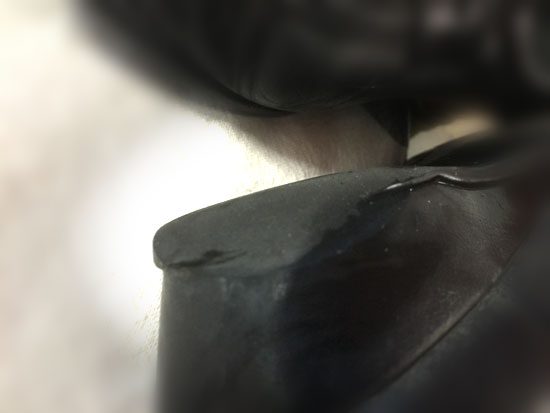
The worn-out heels of my walking shoes with at least 800,000 steps on them.
These shoes have seen at least 800,000 steps since September of this year, probably more than a million steps in the two years I have owned them. I recently took them in to get new soles after I realized that I was tilting while walking on them.
In September, I had my “aha” moment. It had been a summer of relative inactivity, compounded by my husband’s foot surgery and my own suddenly worsening cardiac problem. I found myself shocked by how plump I had become.
I also was feeling better than I had in years, thanks to a procedure which corrected that long-standing arrhythmia issue. Probably more than long-standing–according to the cardiologist, I’d probably been dealing with this for 60 years. I lived unaware of its systematic draining of my energy because I didn’t know that this was not abnormal.
And so I began to walk, starting slowly. I remember my first walk, just under a week after the surgery. Relieved, I saw that I could manage a very slow 1 ½ miles, about 75 exercise calories burned.
We had some months before booked a cruise starting early October to parts of Greece and Italy. Our plans included daily walking tours. I needed to get ready for that kind of exertion. I also wanted to switch to these shoes, a comfortable loafer, for walking. They take less packing space and would work for occasions when a regular athletic shoe might look out of place.
I decided to see if I could work up to a 225 calorie walk before leaving for our trip, 30 days away. What I didn’t expect was that I would feel so good that I hit the 225 calorie mark in less than two weeks. By the time I went back for a follow-up with the cardiologist, my morning routine had become a brisk 5 mile, 380 calorie walk.
Now, six miles seems almost too short, so periodically I take seven and eight-mile walks to start my day.
As I said, 800,000 steps in three months on those shoes.
What happened with all that walking?
So, what has happened to me with all that walking? Just for the heck of it, I decided to interview myself about this intriguing time in my life.
Q: Why do you walk?
A: Walking is the one exercise I have ever been able to do. I have so little hand-eye coordination (it is my contention that the words “hand” and “eye” do not ever belong in the same sentence) that sports like tennis are impossible. When I’ve tried jogging, I invariably end up with a nasty stress fracture in my foot. Cycling causes a horrible accumulation of lactic acid in my thighs leaving me uncomfortable to the point of misery. I had engaged a personal trainer at a gym last spring and, while I appreciated her expertise and help, I realized I need to be outside. So I walk. It is also my best prayer time.
Q: Do you listen to music when you walk?
A: Nope. Again, it is my prayer time. I want to focus my mental energy there. Plus, I think it is dangerous to walk outside unable to hear sounds, especially of cars approaching.
Q: How has all that walking affected your weight? You said you had hit a high just before your surgery.
A: Actually, that weight wasn’t my all-time high, but it was higher than I’d been in a couple of years and depressing to boot. Some weight came off–but not as much as one would think with all that walking. I would guess that I’ve lost about one pound for every 100,000 to 120,000 steps, but that is coupling the walking with careful eating.
Q: Describe what you mean by “careful eating.”
A: In the last few years, I slogged through several books on body chemistry and what the scientific community knows about the biology of weight loss. I’ve especially been reading about “metabolic syndrome,” something that appears to be a precursor to diabetes.
Here’s what I’ve gleaned–and keep in mind that I did not fully understand a lot of what I read.
First, our bodies are lazy–we want to use as few calories as possible to do what is necessary for life. That laziness has kept us alive during the times of famine.
In that biochemical laziness, the body prefers that we ingest carbs and sugars. They easily break down into glucose, the energy source of the body.
However, too much glucose in the system is a killer. As soon as circulating glucose spikes, the pancreas releases insulin. Insulin takes up the excess glucose from the blood and stores it in fat cells. It is released as necessary when the blood glucose levels fall too low.
Second, because of the high sugar/carb content of most US diets (so different from the diet of our ancestors), the pancreas gets overworked trying to keep the proper amount of glucose circulating. The result is big spikes and drops.
When the level drops, we crave a quick fix. When we give into that craving and eat a sugar-laden item, the massive insulin push then sticks as much as possible of the circulating glucose into fat cells. At that point, we crave another sugar fix.
From what I can understand, artificial sweeteners bring out the same insulin reaction. Even though they don’t have the calories, they end up making us fatter. The insulin released takes what glucose is available out of the blood stream and into fat cells, leading to actual fat/weight gain.
Sigh.
So, I decided that what I needed to do was eat in a way that avoided the sugar/glucose spikes in my bloodstream. Like it or not, that means a minimal sugar/low carb diet. The only way to lose actual weight was to figure out how to burn that fat.
Exercise/Weight-loss Realities
Q: What’s it like in practice for you?
It came down to two principles for me: get myself into fat-burning mode as soon as possible each day and stay there as long as possible.
I permitted myself a cup of sweetened tea before the morning walks to kickstart the day. After a while, I became so sensitive to my body that I could tell when it switched from burning the glucose to needing to access the fat from my cells. Generally, it was about 1 ½ to two miles into the walk.
Once my metabolism had made the switch to fat burning, I realized that I could walk for long periods without fatigue simply because there was a stable amount of glucose coming into my system. Often, the only reason I needed to end the walks was time pressure or because my feet starting hurting (OK: I’m old and I have bad feet). But my muscles themselves were fine.
The hardest part then was avoiding anything that would put me back in an insulin response. So, no chai lattes, no bread, no potatoes, no fruit or fruit juices, essentially nothing with carbs was an option after walking.
What I discovered was that sparkling water with a twist of fresh lime would work wonders for me. Breakfasts, which I ate about 30 minutes after the walk, were eggs and bacon, eggs and ham, eggs and sausage, eggs and egg.
I rarely ate lunch, but if I did, it was something like tomatoes and cottage cheese. Dinners were a protein source and an exuberant serving of vegetables of some sort. I did indulge in wine in the evenings, however. Perhaps a dessert once a month. Maybe once a week, some rice or a baked potato.
Q: Again, how much weight did you lose?
A: Not very much. That’s what shocked me.
Q: What did you learn from this?
A: Losing weight and keeping it off is the privilege of the well-to-do.
Q: What do you mean?
A: OK, look at it this way. Because I have adequate funds, the following privileges are part of my life:
- Time for long walks.
- Funds for expensive and highly nutritious foods.
- Access to machines to keep my walking clothes clean (only on the coldest of mornings do I come in without sweat-soaked clothes).
- A neighborhood with good sidewalks, dogs always on leashes, and safe for pre-dawn walks.
- Shoes that fit and properly support my feet, re-soled as necessary.
The more I walked, the more aware I became of the privilege of being able to care for myself this way. I kept thinking of and praying for those who work two jobs, parents who barely have 10 minutes a day to themselves, people who live in unsafe/non-sidewalked neighborhoods, and those who are lucky to get any food daily.
Essential Takeways and Wishful Thinking
Q: What’s your takeaway?
A: The idea that those who are overweight can “fix themselves” by diet and exercise is truly tragic for most of us. It just doesn’t work that way for most people. Furthermore, those who have experienced prior chemotherapies or necessary extensive use of steroids generally discover that such therapies permanently disrupt body-weight setpoints.
My personal goal was to burn about 400 exercise calories per day. That would translate into 2800 exercise calories/week. At best, that might mean into a pound off about every nine or ten days. It also requires absolute consistency with eating a very low carb/sugar diet.
That kind of consistency is nearly impossible. PLUS, I became aware that my muscles were getting more efficient, meaning I was burning fewer calories despite the longer walking routines.
Here’s the truth: our bodies have evolved, for good reason, to make weight gain incredibly easy and weight loss tough. That is how humankind has lived through the inevitable famines.
I also think there is another factor involved, although I’ve not seen research to back this up. Both sides of my family come from northern European stock. My ancestors survived by putting on weight in the summer/fall to get through the long, lean, dark, non-food producing winters. Because I started this program in September, I was working against eons of cellular history which said, “GAIN WEIGHT NOW OR YOU WILL DIE!!!”
I am guessing this would be a very different dynamic from those with genetic history from the Southern Hemisphere (longest days in December) or from tropical regions where food is readily available year round.
The main thing: We must stop fat-shaming people for being alive and normal.
Q: Any other observations?
A: Painfully, yes. I just came through a three week period with little exercise and way too much food, especially of the high sugar/high carb kind. I quickly gained several pounds. Clearly, I must choose to live in a highly disciplined, extremely active, food-restricted way to stay healthy. No back-sliding here.
Furthermore, “wishful thinking” as in “this one slip-up won’t hurt me” is a real killer. The body loves carbs. Staying away from them is just tough. Once we start eating them in abundance, the cravings for more grow exponentially. The mind-set of “eating to live” rather than “living to eat” has to take over.
Finally, there is much to be said for simply accepting the bodies we have, even as we seek to care for them. Our media-saturated/manipulated world gives us a skewed view as to what we should and should not look like. Aiming for greater health and energy helps. Aiming to look “perfect” or fit into some predetermined size does not.
Previous Post

December 30, 2016
What religion does to women
Next Post
January 4, 2017 Church: take notice--people are leaving and not coming back
Browse Our Archives
Select a Category " obedience abortion accommodation accountability administration adolescence Advent advice an ordinary death anxiety apology apportionments Ash Wednesday ask thoughtfulpastor baptism betrayal Bible bondage calling certainty change character charity children Christianity Christmas church church as garden clergy clergy credentials closure comfort compassion competition compromise Confirmation conservation conservative conspiracy theories consumer conversion coronavirua corruption courage covenant cultural context death Deconstruction discipleship discord divorce doctrine doing good drugs dysfunctional Easter Easter; Resurrection education election entertainment envy escape evaluation evil exclusive church exercise faith faithfulness family fasting fear feast featured film review finances first world problem food forgiveness fundamentalist garden gay marriage General Conference generosity giving thanks GLBT glory good government grace guilt habit happy harmony hateful acts healing health health care heaven hell hello/goodbye heresy hidden agenda holiness homelessness homosexuality humility hymn hypocrisy Imago Dei In training inclusive church indulgence injustice innocents insurance intolerance itinerancy joy Justice kindness Kingdom of Heave kingdom of heaven language laughter laundry lawsuit leadership Lent LGBTQ liberal life Little Things Matter longform meandering thoughts memories mercy metaphor metrics miracle misfortunes morality Mormon Muslim mystery worship natural disasters New Category Name nutrients older adults oppression pain Paleo paperwork partnered pastor peace pension pharmaceutical placebo politics poverty prayer privilege public schools questions quiet racism rain reason reconciliation religion repentance requirements rescue respect rest resurrection retirement Sabbath sacrament sacred salvation same-sex marriage sanctuary schism schooling science SCOTUS secrecy separation of church and state sexism sexuality short cuts silence sin sleep soil spiritual journey stillness suffering surgery sustainable church teacher technology thank you theology therapy thinking tolerance TOS trust truth Uncategorized welcome Why Easter? wisdom women worship
Select a Month October 2026 September 2026 August 2026 July 2026 June 2026 May 2026 April 2026 March 2026 February 2026 December 2025 October 2025 September 2025 July 2025 June 2025 March 2025 February 2025 December 2024 November 2024 August 2024 July 2024 June 2024 April 2024 March 2024 January 2024 December 2023 August 2023 July 2023 June 2023 May 2023 March 2023 February 2023 January 2023 December 2022 October 2022 September 2022 July 2022 March 2022 February 2022 January 2022 October 2021 July 2021 June 2021 April 2021 March 2021 February 2021 January 2021 December 2020 November 2020 October 2020 September 2020 August 2020 July 2020 June 2020 May 2020 April 2020 March 2020 January 2020 November 2019 October 2019 September 2019 August 2019 May 2019 April 2019 March 2019 February 2019 January 2019 December 2018 November 2018 October 2018 September 2018 August 2018 July 2018 June 2018 May 2018 April 2018 March 2018 February 2018 January 2018 December 2017 November 2017 October 2017 September 2017 August 2017 July 2017 June 2017 May 2017 April 2017 March 2017 February 2017 January 2017 December 2016 November 2016 October 2016 September 2016 August 2016 July 2016 June 2016 May 2016 April 2016 March 2016 February 2016 January 2016 December 2015 November 2015 October 2015 September 2015 August 2015 July 2015 June 2015 May 2015 April 2015 March 2015 February 2015 January 2015 December 2014 November 2014 October 2014 September 2014 August 2014 July 2014 June 2014 May 2014 April 2014 March 2014 February 2014 January 2014 December 2013 November 2013 October 2013 September 2013 August 2013 July 2013 June 2013 May 2013 April 2013 March 2013 February 2013 January 2013 December 2012 November 2012 October 2012 September 2012 August 2012 July 2012 June 2012 May 2012 April 2012 March 2012 February 2012 January 2012 December 2011 November 2011 October 2011 September 2011 August 2011 July 2011 June 2011 May 2011 April 2011 March 2011 February 2011 January 2011 December 2010 November 2010 October 2010 September 2010 August 2010 July 2010 June 2010 May 2010 April 2010 March 2010 February 2010 January 2010 December 2009 November 2009 October 2009 September 2009 August 2009 July 2009 June 2009 May 2009 April 2009 March 2009 February 2009 January 2009 December 2008 November 2008 October 2008 August 2008 July 2008 June 2008 May 2008 April 2008 March 2008 February 2008 January 2008 December 2007 November 2007 October 2007 September 2007 July 2007 March 2007
Follow Us!
TAKE THE
Religious Wisdom Quiz
Which river did Naaman wash in to be healed of leprosy?
Select your answer to see how you score.
Arnon River Jordan River Euphrates River Nile River
Related posts from The Thoughtful Pastor

Twenty Days Post Retirement: The Walking Life
The Lies and Hypocrisy Are Degrading All Of...

I Ache For The People Of First Baptist,...

The Fall Equinox And The Church's Blindness
TRENDING AT PATHEOS Progressive Christian

Janie Learns the Way of the Cross: A...
Teaching children about Jesus' Passion can be challenging. Many parents and educators...

Looking For Good Catholic Writing - October 2026
He alone extends the heavens, and he walks upon the waves of...

In "Irreplaceable," our book on vocation and technology, Trevor Sutton and I...

I was strolling through the top floor of the brand new Parthenon...

What Does Gêvâh Mean For Kimberley Guifoyle &...
This week, a lot of the news is focused on Kimberly Guilfoyle....

INNER CIRCLE: Profound Mystery (Of Christ In All...
Ephesians 5:31-32 “For this reason, a man will leave his father and...
view all Progressive Christian blogs
Ad-Free & Subscriber Log-In Subscription Support
- About Us
- 2026 Calendar
- Videos
- Podcasts
- Library of World Religions
- Faith In Media Tracker
- Advertise With Us
- Write for Us
- Privacy Policy
- Terms of Service
- Do Not Sell My Data
- Contact Us
- Radiant Digital
- Manage Newsletter Subscriptions
- Unsubscribe From Notifications
- Sitemap
Copyright 2008-2026, Patheos. All rights reserved.
Subscription Support Ad-Free & Subscriber Log-In
Follow Patheos