
BuddhistCatholicContemplativeEvangelicalGeneral ChristianHinduJewishLatter-day SaintMuslimNew VisionsProgressive Christian
Beliefs
- Buddhist
- Catholic
- Contemplative
- Evangelical
- General Christian
- Hindu
- Jewish
- Latter-day Saint
- More Voices
- Muslim
- New Visions
- Pagan
- Progressive Christian
Topics
- Religion News
- Food and Religion
- Sports and Religion
- Religious Art
- Religious Music and Entertainment
- Religious Events
- History and Religion
- Style and Religion
- Politics and Religion
- Women in Religion
- Recreation Outdoors and Religion
- Business Finance and Religion
- Careers Workplace and Religion
- Education and Religion
- Family Parenting and Religion
- Health Fitness and Religion
- Home and Religion
- Relationships and Religion
- Technology and Religion
- Travel and Religion
Columnists
- Buddhist Columnists
- Business Finance and Religion Columnists
- Careers Workplace and Religion Columnists
- Catholic Columnists
- Contemplative Columnists
- Education and Religion Columnists
- Evangelists Columnists
- Family Parenting and Religion Columnists
- General Christian Columnists
- Health Fitness and Religion Columnists
- Hindu Columnists
- History and Religion Columnists
- Home and Religion Columnists
- Jewish Columnists
- More Voices Columnists
- Latter Day Columnists
- Muslim Columnists
- New Visions Columnists
- Nonreligious Columnists
- Pagan Columnists
- Politics and Religion Columnists
- Progressive Columnists
- Recreation Outdoors and Religion Columnists
- Relationships and Religion Columnists
- Religion News Columnists
- Religious Art Columnists
- Religious Events Columnists
- Religious Music and Entertainment Columnists
- Sports and Religion Columnists
- Style and Religion Columnists
- Technology and Religion Columnists
- Travel and Religion Columnists
- Women in Religion Columnists
Resource Library
- 2026 Calendar
- Library of World Religions
- The 100 Most Holy Places on Earth
- Patheos Answers
- Podcasts
- Videos
- Faith Leaders Database
- Anglican Episcopalian
- Bahai
- Baptist
- Buddhism
- Christianity
- Confucianism
- Eastern Orthodoxy
- Hinduism
- Holiness and Pentecostal
- ISKCON
- Islam
- Judaism
- Lutheran
- Methodist
- The Church of Jesus Christ of Latter-day Saints
- New Age
- Paganism
- Presbytarian and Reformed
- Protestantism
- Religion Behind the Scenes
- Roman Catholic
- Scientology
- Shia Islam
- Sikhism
- Sufism
- Sunni Islam
- Taoism
- Zen
- See all religions
Research Tools
 Ad-Free & Subscriber Log-In Subscription Support
Ad-Free & Subscriber Log-In Subscription Support
Follow Patheos 

- Trending:
- Forgiveness
- |
- Marriage
- |
- Consciousness
- |
- Death Penalty
- |
- Election
- |
- Halloween

- Home
- About The Thoughtful Pastor
- Archives
- Read my Book
- Ask the Pastor
- Mystery Worship Series
- FREE NEWSLETTER
- Home
- Progressive Christian
- Education and Religion
- Ask the Thoughtful Pastor: Inerrancy; My Journey Out
Ask the Thoughtful Pastor: Inerrancy; My Journey Out
Last updated on: August 19, 2024 at 7:10 pm by Christy Thomas
Ask the Thoughtful Pastor: Inerrancy; My Journey Out 2024-08-19T19:10:22-05:00 Christy Thomas
Patheos Explore the world's faith through different perspectives on religion and spirituality! Patheos has the views of the prevalent religions and spiritualities of the world.
How important is biblical inerrancy to matters of the Christian faith and the life of Christian discipleship? If we don’t take the Bible literally, are we destined for relativism—any opinion goes?

Image generated by OpenAI Chat GPT
 Dear Thoughtful Pastor,
In 1978, around 300 evangelical leaders assembled to write and adopt the Chicago Statement on Biblical Inerrancy. I believe this gathering in defense of biblical inerrancy represented one of the most significant theological councils in modern times. But unlike the Council of Nicea (325 AD), only the like-minded gathered, so the outcome was a rather predictable defense against the trend toward liberalism and higher biblical criticism.
As I understand the defense of biblical inerrancy, it goes like this: God is Truth. The Bible was written by men who were inspired by God. Thus the Bible is God’s written Truth. And like God, the Bible is infallible and authoritative. They included the caveat that this only applies to the original manuscripts, which, by the way, no longer exist. But, there are thoughtful scholars on the other side of the debate who use historical critical methodology of interpretation and who find unsubstantiated claims and outright errors.
Apparently, it is really important to evangelicals that biblical authority be safeguarded with precious little nuance. Justification for slavery, oppression of women and basis for racism aside, it seems that taking a view of infallibility of the Bible, particularly by the least gracious examples of the far right fringe, is really dangerous. Frankly, some in that camp who are concerned about the possibility of Sharia Law [rigidly applied Islamic religious control] would gladly impose Evangelical Law.
So here is my question:
How important is biblical inerrancy to matters of the Christian faith and the life of Christian discipleship? If we don’t take the Bible literally, are we destined for relativism—any opinion goes? If we do, do we become frozen in the Second Century?
Thank you for your thoughtful consideration of my question.
The safety of inerrancy
When holding to the named “inerrancy,” it does indeed become the centerpiece of faith. Any possibility that the Bible contains error and is not totally trustworthy in all it says threatens the foundations upon which the faith structure builds. It’s a powerful and important glue.
Also, the inerrantist is not necessary a literalist in the sense that he/she does not recognize that some of the Bible uses various language conventions to convey larger truths.
The inerrant world offers good boundaries with clear answers offered by biblical authorities. For those who hold t inerrancy, there exists only one proper interpretation for any given section or verse of Scripture. As a rule, that single interpretation is decided upon by a group of older, white males, although there are exceptions.
Much safety can be found there.
However, many inerrantists, although not all, hold to a new earth creation theory, i.e., the earth–and the universe–is only a few thousand years old, and was created in seven 24 hour days.
That group does seem to be stuck in a pre-scientific world.
An important question: “What is meant when declaring the Scriptures as without error?”
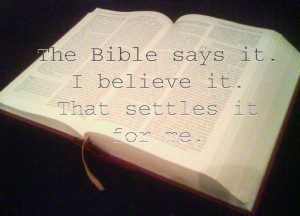 For example, Matthew 4 shows a different order of the temptations of Jesus than recorded in Luke 4. In Acts, there are two stories of Paul’s conversion. In Acts 9,the people around him heard a voice but saw no one. In Acts 22, when Paul retells the story, the people saw the light but heard nothing. So which of these two stories, Jesus’s temptation and Paul’s conversion, are the inerrant ones?
Perhaps “inspired” is a better word than “inerrancy.”
These questions lead many Christians to prefer “inspired” as a better description of the Bible. It is helpful to keep in mind that the term “inerrant” would not have been recognized by the early writers of Scripture. It emerged in the 17th century by some Protestant groups, but is not part of the longer heritage of understanding the Bible as God-breathed, which is the basic meaning of “inspired.”.
This viewpoint gives room for more nuanced views of biblical texts. Those texts were written by people living in cultures radically different from ours and in ancient languages not always perfectly understood or easily translated.
Scholars use various interpretative lenses in their studies. They do not assume the Bible was written with the 21st century modern or postmodern cultures in mind. People from different ethnicities and women are more welcome to the table of interpretation. There is more tolerance for varied answers.
But this does not mean “anything goes.” So the word relativist may not be the best description of the alternative to the inerrantist. Instead there is a belief that God speaks through the gathered community in the reading and studying of the ancient texts.
Basing life on the principles of loving God, loving others and treating others the way we ourselves want to be treated lead to a sound ethical and moral base as a foundation to life. People may differ in the details, but the overall structure has good solidity.
Both systems can and do offer solid paths to discipleship and Christian living. Sadly, those from one system often don’t want to recognize the legitimacy of the other.
[Note: the above question and answer ran in the April 22, 2016, edition of the Denton Record Chronicle. Because of space limitations, it is intentionally condensed. Below is a more personal answer, although this is the type of question that could take books to answer thoroughly. By the way, the Thoughtful Pastor, AKA Christy Thomas, welcomes all questions for the column. Although the questioner will not be identified, I do need a name and verifiable contact information in case the newspaper editor has need of it. Please email questions to: [email protected].]

 My Own Story
I spent my first years of theological study in the inerrantist world and know it well. As I went deeper into language study, becoming somewhat proficient in biblical Hebrew and Greek, I found myself more and more uncomfortable with the idea of an inerrant text.
Writers have styles: and give the lie to inerrancy
I think what snapped it for me was an in-depth study of 1 Timothy in Greek. I had read enough in Greek of Paul’s epistles by then to know within a few moments of starting my reading that the Apostle Paul did not write I Timothy.
Writers have styles. They are, I think, as individual as fingerprints. Anyone who reads my raw writing, for example, knows I put sentences inside sentences, with (tons of parentheses), and way too many, comma splices. Thank goodness for good editors and the discipline of writing instructors who taught me to edit my own work. BUT . . . (as one who uses ellipses often), the style is still mine. All mine. Because I often also use two or three word “sentences” that are not actually “sentences” in the grammatically proper way.
But, to get back to I Timothy, it does begin with “Paul, an apostle of Christ Jesus by the command of God our Savior and of Christ Jesus our hope, to Timothy my true son in the faith” (NIV).
But Paul didn’t write it. Period. Not only is the style wrong, but the allusions to church structure already set indicate a much later date.
BUT . . . to the inerrantist, Paul HAD to have written it, otherwise the Bible is lying. So, in order to keep the inerrantist stance alive, the student or scholar in the inerrant world has to lie about everything else.
I remember one fellow student talking with me in despair about the problem. If we, as students, even suggested that we did not hold fully to inerrancy, we would be in a world of trouble. I said to the student, “the only thing I can say is that sometimes the Bible is inerrantly wrong.”
How much mental gymnastics become necessary to stay an inerrantist!
Internal lying and inerrancy
That much internal lying and cognitive dissonance suck the energy out of a person. For me, it eventually became untenable. I plunged into a deep, deep depression. The destructive work of rigid marital rules and roles found primarily in the inerrantist world and upon which my marriage was founded surfaced with devastating force.
I was lucky to emerge alive. During that period of darkness, I read The Making and Unmaking of an Evangelical Mind: The Case of Edward Carnell. I don’t remember a lot of the details now, although I hope to receive soon a used copy of the book, long out of print.
Carnell was an influential theologian and President of Fuller Seminary. I remember that the author (and this is an unauthorized biography, I think) contented that Carnell’s eventual mental breakdown sprang at least to some degree from his eventual inability to hold to a deeply conservative view of the Bible AND remain intellectually honest.
The other thing I remember is weeping my way through the end of the book. That was about the time I started writing, “The Making and Unmaking of an Evangelical Woman,” which was to be my story. I never finished it, but it may be time to bring it back out again.
I want to be generous to those who hold to inerrancy. Most are genuinely good people, people who are totally convinced that their theology and understanding of the Scriptures are the only right way to deal with them. Outside their world, there is no truth and probably no salvation.
I hope they are wrong. I remember being terrified as I finally took my first steps away. I also remember thinking, “If they are right, if I will be unable to use the mind that God gave me to think, then heaven will be hell for me anyway. I lose nothing in the end.”
I lost everything. And I gained everything. Thanks be to God.
Education and Religion

About Christy Thomas
I am an opinionated Jesus-follower, a retired elder in the United Methodist church, a questioner of everything, and a lover of grace. I am married to a wonderful man and together we claim 11 children and 12 grandchildren. I love to travel, garden, walk and connect ideas together. You can read more about the author here.
Previous Post
April 18, 2016
Toxic Christianity: Can Jesus Save Us From It?
Next Post

April 22, 2016 Sex, Punishment and Power--is That Really Good News?
Recent Comments
"Stepping away from his campaign for 13 days handed his opponents a gift which they ..."
The Lies and Hypocrisy Are Degrading ..."
"Thank you. We really do need to practice what we preach. And hardly any of ..."
The Lies and Hypocrisy Are Degrading ..."
"Mrs. Thomas, Reverend Jefferies became the pastor of First Baptist Dallas in August 2007 – ..."
"I sent you a reply which for some reason was not deemed appropriate for posting. ..."
Browse Our Archives
Select a Category " obedience abortion accommodation accountability administration adolescence Advent advice an ordinary death anxiety apology apportionments Ash Wednesday ask thoughtfulpastor baptism betrayal Bible bondage calling certainty change character charity children Christianity Christmas church church as garden clergy clergy credentials closure comfort compassion competition compromise Confirmation conservation conservative conspiracy theories consumer conversion coronavirua corruption courage covenant cultural context death Deconstruction discipleship discord divorce doctrine doing good drugs dysfunctional Easter Easter; Resurrection education election entertainment envy escape evaluation evil exclusive church exercise faith faithfulness family fasting fear feast featured film review finances first world problem food forgiveness fundamentalist garden gay marriage General Conference generosity giving thanks GLBT glory good government grace guilt habit happy harmony hateful acts healing health health care heaven hell hello/goodbye heresy hidden agenda holiness homelessness homosexuality humility hymn hypocrisy Imago Dei In training inclusive church indulgence injustice innocents insurance intolerance itinerancy joy Justice kindness Kingdom of Heave kingdom of heaven language laughter laundry lawsuit leadership Lent LGBTQ liberal life Little Things Matter longform meandering thoughts memories mercy metaphor metrics miracle misfortunes morality Mormon Muslim mystery worship natural disasters New Category Name nutrients older adults oppression pain Paleo paperwork partnered pastor peace pension pharmaceutical placebo politics poverty prayer privilege public schools questions quiet racism rain reason reconciliation religion repentance requirements rescue respect rest resurrection retirement Sabbath sacrament sacred salvation same-sex marriage sanctuary schism schooling science SCOTUS secrecy separation of church and state sexism sexuality short cuts silence sin sleep soil spiritual journey stillness suffering surgery sustainable church teacher technology thank you theology therapy thinking tolerance TOS trust truth Uncategorized welcome Why Easter? wisdom women worship
Select a Month October 2026 September 2026 August 2026 July 2026 June 2026 May 2026 April 2026 March 2026 February 2026 December 2025 October 2025 September 2025 July 2025 June 2025 March 2025 February 2025 December 2024 November 2024 August 2024 July 2024 June 2024 April 2024 March 2024 January 2024 December 2023 August 2023 July 2023 June 2023 May 2023 March 2023 February 2023 January 2023 December 2022 October 2022 September 2022 July 2022 March 2022 February 2022 January 2022 October 2021 July 2021 June 2021 April 2021 March 2021 February 2021 January 2021 December 2020 November 2020 October 2020 September 2020 August 2020 July 2020 June 2020 May 2020 April 2020 March 2020 January 2020 November 2019 October 2019 September 2019 August 2019 May 2019 April 2019 March 2019 February 2019 January 2019 December 2018 November 2018 October 2018 September 2018 August 2018 July 2018 June 2018 May 2018 April 2018 March 2018 February 2018 January 2018 December 2017 November 2017 October 2017 September 2017 August 2017 July 2017 June 2017 May 2017 April 2017 March 2017 February 2017 January 2017 December 2016 November 2016 October 2016 September 2016 August 2016 July 2016 June 2016 May 2016 April 2016 March 2016 February 2016 January 2016 December 2015 November 2015 October 2015 September 2015 August 2015 July 2015 June 2015 May 2015 April 2015 March 2015 February 2015 January 2015 December 2014 November 2014 October 2014 September 2014 August 2014 July 2014 June 2014 May 2014 April 2014 March 2014 February 2014 January 2014 December 2013 November 2013 October 2013 September 2013 August 2013 July 2013 June 2013 May 2013 April 2013 March 2013 February 2013 January 2013 December 2012 November 2012 October 2012 September 2012 August 2012 July 2012 June 2012 May 2012 April 2012 March 2012 February 2012 January 2012 December 2011 November 2011 October 2011 September 2011 August 2011 July 2011 June 2011 May 2011 April 2011 March 2011 February 2011 January 2011 December 2010 November 2010 October 2010 September 2010 August 2010 July 2010 June 2010 May 2010 April 2010 March 2010 February 2010 January 2010 December 2009 November 2009 October 2009 September 2009 August 2009 July 2009 June 2009 May 2009 April 2009 March 2009 February 2009 January 2009 December 2008 November 2008 October 2008 August 2008 July 2008 June 2008 May 2008 April 2008 March 2008 February 2008 January 2008 December 2007 November 2007 October 2007 September 2007 July 2007 March 2007
Follow Us!
TAKE THE
Religious Wisdom Quiz
Who first witnessed the empty tomb after Jesus' resurrection?
Select your answer to see how you score.
John Andrew Nicodemus Mary Magdalene
Related posts from The Thoughtful Pastor

Five Thoughts About New Mercies And New Year's...


Just Imagine: Their Heaven Becomes Your Hell

Joe Biden and Religion: Exploring His Faith
TRENDING AT PATHEOS Progressive Christian

How to Make a Decision When You Can't...
Main point: It’s much more valuable to stay close to God so...

Archdiocese Hosts Military Marriage Retreat in Germany
RASTATT, Germany — The transient military lifestyle, with its frequent deployments and...

Nearly every morning, I make the drive to Detroit with my high-school-age...

The Real AI Story Is Adoption Without Trust
Artificial intelligence has crossed a political threshold. It is no longer a...

A new article, written by Jeff Lindsay and Gale L. Pooley,...

Swimfan: Forgotten Aughts Pleasures
This is a recovery effort. In 2002, My Big Fat Greek Wedding...
view all Progressive Christian blogs
What Are Your Thoughts?leave a comment
Ad-Free & Subscriber Log-In Subscription Support
- About Us
- 2026 Calendar
- Videos
- Podcasts
- Library of World Religions
- Faith In Media Tracker
- Advertise With Us
- Write for Us
- Privacy Policy
- Terms of Service
- Do Not Sell My Data
- Contact Us
- Radiant Digital
- Manage Newsletter Subscriptions
- Unsubscribe From Notifications
- Sitemap
Copyright 2008-2026, Patheos. All rights reserved.
Subscription Support Ad-Free & Subscriber Log-In
Follow Patheos