
BuddhistCatholicContemplativeEvangelicalGeneral ChristianHinduJewishLatter-day SaintMuslimNew VisionsProgressive Christian
Beliefs
- Buddhist
- Catholic
- Contemplative
- Evangelical
- General Christian
- Hindu
- Jewish
- Latter-day Saint
- More Voices
- Muslim
- New Visions
- Pagan
- Progressive Christian
Topics
- Religion News
- Food and Religion
- Sports and Religion
- Religious Art
- Religious Music and Entertainment
- Religious Events
- History and Religion
- Style and Religion
- Politics and Religion
- Women in Religion
- Recreation Outdoors and Religion
- Business Finance and Religion
- Careers Workplace and Religion
- Education and Religion
- Family Parenting and Religion
- Health Fitness and Religion
- Home and Religion
- Relationships and Religion
- Technology and Religion
- Travel and Religion
Columnists
- Buddhist Columnists
- Business Finance and Religion Columnists
- Careers Workplace and Religion Columnists
- Catholic Columnists
- Contemplative Columnists
- Education and Religion Columnists
- Evangelists Columnists
- Family Parenting and Religion Columnists
- General Christian Columnists
- Health Fitness and Religion Columnists
- Hindu Columnists
- History and Religion Columnists
- Home and Religion Columnists
- Jewish Columnists
- More Voices Columnists
- Latter Day Columnists
- Muslim Columnists
- New Visions Columnists
- Nonreligious Columnists
- Pagan Columnists
- Politics and Religion Columnists
- Progressive Columnists
- Recreation Outdoors and Religion Columnists
- Relationships and Religion Columnists
- Religion News Columnists
- Religious Art Columnists
- Religious Events Columnists
- Religious Music and Entertainment Columnists
- Sports and Religion Columnists
- Style and Religion Columnists
- Technology and Religion Columnists
- Travel and Religion Columnists
- Women in Religion Columnists
Resource Library
- 2026 Calendar
- Library of World Religions
- The 100 Most Holy Places on Earth
- Patheos Answers
- Podcasts
- Videos
- Faith Leaders Database
- Anglican Episcopalian
- Bahai
- Baptist
- Buddhism
- Christianity
- Confucianism
- Eastern Orthodoxy
- Hinduism
- Holiness and Pentecostal
- ISKCON
- Islam
- Judaism
- Lutheran
- Methodist
- The Church of Jesus Christ of Latter-day Saints
- New Age
- Paganism
- Presbytarian and Reformed
- Protestantism
- Religion Behind the Scenes
- Roman Catholic
- Scientology
- Shia Islam
- Sikhism
- Sufism
- Sunni Islam
- Taoism
- Zen
- See all religions
Research Tools
 Ad-Free & Subscriber Log-In Subscription Support
Ad-Free & Subscriber Log-In Subscription Support
Follow Patheos 

- Trending:
- Forgiveness
- |
- Marriage
- |
- Consciousness
- |
- Death Penalty
- |
- Election
- |
- Halloween

- Home
- About The Thoughtful Pastor
- Archives
- Read my Book
- Ask the Pastor
- Mystery Worship Series
- FREE NEWSLETTER
- Home
- Progressive Christian
- Why FaceBook And Robert’s Rules of Order Make Holy Conferencing Impossible: An Alternative Approach
Why FaceBook And Robert’s Rules of Order Make Holy Conferencing Impossible: An Alternative Approach
Last updated on: February 26, 2019 at 11:19 am by Christy Thomas
Why FaceBook And Robert’s Rules of Order Make Holy Conferencing Impossible: An Alternative Approach 2019-02-26T11:19:08-05:00 Christy Thomas
Patheos Explore the world's faith through different perspectives on religion and spirituality! Patheos has the views of the prevalent religions and spiritualities of the world.
 Yet One More FB Explosion
For what seemed like the trillionth time, I watched another clergy Facebook conversation degenerate into frustration, name-calling, shut-off, and despair.
The few political conversations I have participated while using the same medium have seen similar fates.
Why? First, let’s look at Twitter. With a tiny character limit, it became a place to is to make a hard hit with few words and watch the fallout. One-liners rule the day. And one-liners have no space for nuance, for shades of gray, for real dialogue that might lead to mutual understanding.
With FB conversations, those brief one-liners can be expanded, but not by much before FB itself inserts the “read more” link, leading to a psychological break with the conversation stream. Furthermore, vital non-verbal elements to the conversation are lost.
No one really knows for sure how much the non-verbal portions (tone, eye-contact, micro-expressions, bodily expressions, physical distance, etc) affect understanding, but it probably ranges from 60-90%. No matter what percentage we take, the majority of the communication process is lost here.
Because of those factors, these kinds of electronic encounters lend themselves to polarized positions with win/lose positions taking precedence over mutual understanding. The mode is attack, not understanding. Each side digs deeper trenches with every grenade launch.
The goal? Disable, kill, and devastate. This is war.
Why Robert’s Rules of Order fail us and make holy conferencing impossible
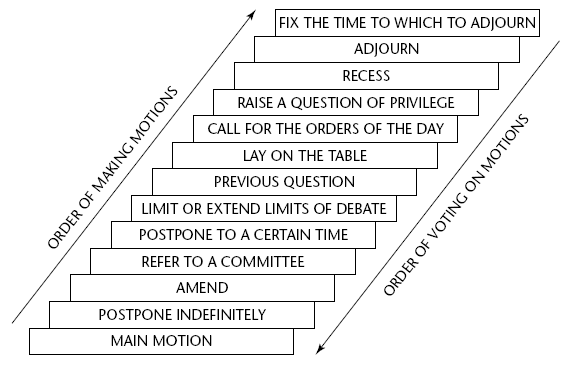
We have the same problem at our Annual and General Conferences where we follow Robert’s Rules of Order to perfect the motions. So, when a challenging issue hits the floor, responses are generally limited to three for the proposal and three against, and each response also has a time limit. And then there are all the amendments, sub-amendments, calls to table, etc.
We may pass motions that way (but they will frequently be disallowed by the Judicial Council) but we don’t engage in Holy Conferencing. We end up being more polarized, more able to say, “That person is from the devil” because we need to move onto the next motion. We’ve shot, we’ve killed, we’ve shoved away and now its time to re-arm for the battles to come.
This is not the way to bring renewal to the church or bring the good news of Jesus, the one who sets us free and brings us redemption, to the world.
The Learning Organization: systems and dialogue
A number of years ago, I read Peter Senge’s powerful work, The Fifth Discipline: the Art Practice of the Learning Organization. It’s a book I wish all who love The United Methodist Church and want to see it go forward with grace and impact would read before the next time we gather.
The “fifth discipline” refers to an understanding of systems. It builds on four other vital disciplines necessary for organizational health: personal mastery, mental models, building shared vision, and team learning.
A good summary of this powerful work can be found here. What I want to particularly mention is Senge’s insistence that we must learn to dialogue, and that dialogue is very, very different from discussion.
He puts it this way:
The discipline of team learning starts with ‘dialogue’, the capacity of members of a team to suspend assumptions and enter into a genuine ‘thinking together’. To the Greeks dia-logos meant a free-flowing of meaning through a group, allowing the group to discover insights not attainable individually…. [It] also involves learning how to recognize the patterns of interaction in teams that undermine learning. (Senge 1990: 10)
The illustration below helps us to see how each of us create mental models of our worlds that can be adjusted through the power of dialogue. An important skill consists of learning to temporarily suspend assumptions that may otherwise blind us to new and more powerful ways of thinking, seeing, and believing. That suspension simply says, “I may be wrong.” Everyone needs to start here. No one owns a complete picture of God and the nature of the Holy One.
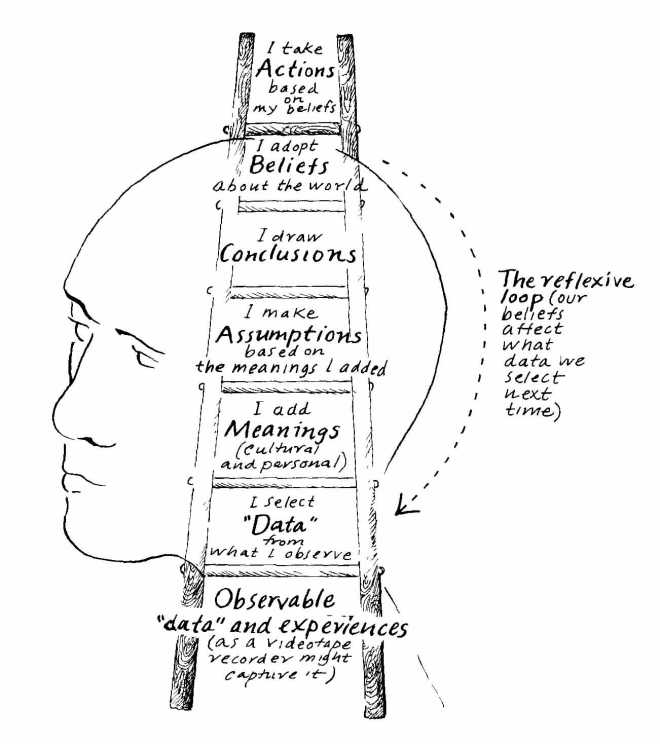
Dialogue that leads to deeper understanding cannot happen quickly. It won’t happen when either side chooses attack language and non-negotiable self-righteous positions (“That position is heretical.” “I am taking the proper biblical view.” “Clearly this is sin and sin must be judged.”)
Again, that’s the language of war, of division, of winner-takes-all.
Essentially what we are doing by using the standard way of conferencing is expecting a structure opposed to the very concept of dialogue and mutual learning to have results that come from dialogue and mutual learning.
We have set ourselves up to fail and then we wonder, “What on earth just happened?”
The future of the UMC
I find myself with growing anxiety for the future of the UMC as we start to face the reality of another outrageously expensive General Conference (Portland, 2016) with an increasingly polarized church and the with Robert making holy conferencing impossible.
The polarization grows because we choose debate and ideology over dialogue. We are left unable to discover new models that are both biblically coherent AND incorporate scientific and sociological insights that affect our culture and the way we understand God and the world around us.
Our structures dictate that we converse around debate and ideology, but my readings of Wesley’s history suggest that it was dialogue–NOT debate–that brought him to the profound understanding of grace that is now ours. Ours to either destroy or to interpret to a very different world from Wesley’s–and from the biblical world where we first learn about it.
Acknowledge the Difficulties
Is anyone willing to wade into this complicated but seminal book on the learning organization? Could we set up times and places where we are willing to do this–to listen in community, to examine our own assumptions and what brought us to them, to see if a larger shared understanding can come from this?
I was thinking today about my long and complex journey from a place where I genuinely believed and vehemently defended the belief that women had no place in ecclesiastical leadership to eventually becoming the lead pastor in a thriving church. That journey almost destroyed me, because to make that move meant I had to leave not just one cherished belief behind but I had to rethink a whole theological system that supported that belief. The dam broke and I nearly drowned in the flood that resulted.
Argument and debate did nothing to help the journey. The process that Senge advocates, particularly the part of carefully examining my assumptions, along with a supportive community that did engage in real, gut-wrenching dialogue with me eventually helped me find the courage to move forward and rebuild my theology with a more adequate hermeneutic.
I lost a great, great deal when I did this. Among other things, I lost my marriage, my career, and my church–and a faith understanding that had served me well until then and which many others, whom I love and respect, still affirm.
I had to rebuild my entire life. In no sense do I regret having made that move. However, I write this to remind everyone that when anyone takes a major stand on a controversial issue that there is much behind that stand.
While I am very much in favor of full inclusion of the GLBTQ community, I understand very well how complicated, and very nearly impossible, a move like that can be to those whose worldview cannot make space for this without disrupting their entire theological base. It is wrong to take this lightly or to mistreat those who have solid and defensible reasons for their decisions, no matter how much we may be in disagreement with them.
I am willing, as a retired clergy in the UMC, to do whatever I can to help here. I chose The UMC because I believed then and still do believe that the core of our theology is the best hope for the healing of the world.
But if we cannot or will not heal ourselves, we dare not pretend to take healing to others. This Dilbert comic strip below captures us very well. We import ideas without considering whether they will work or not (the “Jeff Bezos Rule”); our self-interests far transcend the larger interests of the group as a whole; each amendment must be amended in order to make no-one happy; and we have to stop being what we are called to be in order to serve the organization.
It’s time to dialogue. Or die. And if death is chosen, then so be it. Let’s at least choose it openly and not pretend that we can fix this with yet another amendment or patch or Facebook conflagration.
Can’t be done.
Photo Credits: Roberts ladder? I genuinely have no idea where I got that image and would love to give proper credit if anyone knows.
Ladder of assumptions: Source: Peter Senge et al (1994) The Fifth Discipline Fieldbook
Previous Post

February 2, 2014
Girl Scouts, Cookies, The Far Right and Christians
Next Post
February 5, 2014 Why Bill Nye Was the Wrong Guy
Browse Our Archives
Select a Category " obedience abortion accommodation accountability administration adolescence Advent advice an ordinary death anxiety apology apportionments Ash Wednesday ask thoughtfulpastor baptism betrayal Bible bondage calling certainty change character charity children Christianity Christmas church church as garden clergy clergy credentials closure comfort compassion competition compromise Confirmation conservation conservative conspiracy theories consumer conversion coronavirua corruption courage covenant cultural context death Deconstruction discipleship discord divorce doctrine doing good drugs dysfunctional Easter Easter; Resurrection education election entertainment envy escape evaluation evil exclusive church exercise faith faithfulness family fasting fear feast featured film review finances first world problem food forgiveness fundamentalist garden gay marriage General Conference generosity giving thanks GLBT glory good government grace guilt habit happy harmony hateful acts healing health health care heaven hell hello/goodbye heresy hidden agenda holiness homelessness homosexuality humility hymn hypocrisy Imago Dei In training inclusive church indulgence injustice innocents insurance intolerance itinerancy joy Justice kindness Kingdom of Heave kingdom of heaven language laughter laundry lawsuit leadership Lent LGBTQ liberal life Little Things Matter longform meandering thoughts memories mercy metaphor metrics miracle misfortunes morality Mormon Muslim mystery worship natural disasters New Category Name nutrients older adults oppression pain Paleo paperwork partnered pastor peace pension pharmaceutical placebo politics poverty prayer privilege public schools questions quiet racism rain reason reconciliation religion repentance requirements rescue respect rest resurrection retirement Sabbath sacrament sacred salvation same-sex marriage sanctuary schism schooling science SCOTUS secrecy separation of church and state sexism sexuality short cuts silence sin sleep soil spiritual journey stillness suffering surgery sustainable church teacher technology thank you theology therapy thinking tolerance TOS trust truth Uncategorized welcome Why Easter? wisdom women worship
Select a Month October 2026 September 2026 August 2026 July 2026 June 2026 May 2026 April 2026 March 2026 February 2026 December 2025 October 2025 September 2025 July 2025 June 2025 March 2025 February 2025 December 2024 November 2024 August 2024 July 2024 June 2024 April 2024 March 2024 January 2024 December 2023 August 2023 July 2023 June 2023 May 2023 March 2023 February 2023 January 2023 December 2022 October 2022 September 2022 July 2022 March 2022 February 2022 January 2022 October 2021 July 2021 June 2021 April 2021 March 2021 February 2021 January 2021 December 2020 November 2020 October 2020 September 2020 August 2020 July 2020 June 2020 May 2020 April 2020 March 2020 January 2020 November 2019 October 2019 September 2019 August 2019 May 2019 April 2019 March 2019 February 2019 January 2019 December 2018 November 2018 October 2018 September 2018 August 2018 July 2018 June 2018 May 2018 April 2018 March 2018 February 2018 January 2018 December 2017 November 2017 October 2017 September 2017 August 2017 July 2017 June 2017 May 2017 April 2017 March 2017 February 2017 January 2017 December 2016 November 2016 October 2016 September 2016 August 2016 July 2016 June 2016 May 2016 April 2016 March 2016 February 2016 January 2016 December 2015 November 2015 October 2015 September 2015 August 2015 July 2015 June 2015 May 2015 April 2015 March 2015 February 2015 January 2015 December 2014 November 2014 October 2014 September 2014 August 2014 July 2014 June 2014 May 2014 April 2014 March 2014 February 2014 January 2014 December 2013 November 2013 October 2013 September 2013 August 2013 July 2013 June 2013 May 2013 April 2013 March 2013 February 2013 January 2013 December 2012 November 2012 October 2012 September 2012 August 2012 July 2012 June 2012 May 2012 April 2012 March 2012 February 2012 January 2012 December 2011 November 2011 October 2011 September 2011 August 2011 July 2011 June 2011 May 2011 April 2011 March 2011 February 2011 January 2011 December 2010 November 2010 October 2010 September 2010 August 2010 July 2010 June 2010 May 2010 April 2010 March 2010 February 2010 January 2010 December 2009 November 2009 October 2009 September 2009 August 2009 July 2009 June 2009 May 2009 April 2009 March 2009 February 2009 January 2009 December 2008 November 2008 October 2008 August 2008 July 2008 June 2008 May 2008 April 2008 March 2008 February 2008 January 2008 December 2007 November 2007 October 2007 September 2007 July 2007 March 2007
Follow Us!
TAKE THE
Religious Wisdom Quiz
Which Christian group is known for its emphasis on health and diet?
Select your answer to see how you score.
Jehovah’s Witnesses Methodists Presbyterians Seventh-day Adventists
Related posts from The Thoughtful Pastor

Yes, Church, The Stock Market DOES Matter To...
"Will Your Church Survive?" Coronavirus Diary, March 18,...

Definition of A Dysfunctional Organization: The United Methodist...

Starbucks, Inclusivity, And The United Methodist Church
TRENDING AT PATHEOS Progressive Christian

The Sermon on the Mount, Part I: Matthew...
The Sermon on the Mount, Part I (Matthew 4:12-5:12) St. Matthew moves...

What's up from Crossway: Reviewing some of their latest A few weeks...

Janie Learns the Way of the Cross: A...
Teaching children about Jesus' Passion can be challenging. Many parents and educators...

Looking For Good Catholic Writing - October 2026
He alone extends the heavens, and he walks upon the waves of...

In "Irreplaceable," our book on vocation and technology, Trevor Sutton and I...

I was strolling through the top floor of the brand new Parthenon...
view all Progressive Christian blogs
Ad-Free & Subscriber Log-In Subscription Support
- About Us
- 2026 Calendar
- Videos
- Podcasts
- Library of World Religions
- Faith In Media Tracker
- Advertise With Us
- Write for Us
- Privacy Policy
- Terms of Service
- Do Not Sell My Data
- Contact Us
- Radiant Digital
- Manage Newsletter Subscriptions
- Unsubscribe From Notifications
- Sitemap
Copyright 2008-2026, Patheos. All rights reserved.
Subscription Support Ad-Free & Subscriber Log-In
Follow Patheos